Nobody
-
Posts
4,156 -
Joined
-
Last visited
-
Days Won
70
Content Type
Profiles
Forums
Events
Store
Downloads
Gallery
Everything posted by Nobody
-
The description on the page says that the Sadakatsu tachi is located in Japan. The same Sadakatsu tachi appears on bidders auction in Japan. They say that the tachi is located outside of Japan and import process is necessary. That is strange. http://www.bidders.co.jp/dap/sv/nor1?id ... _item_open
-
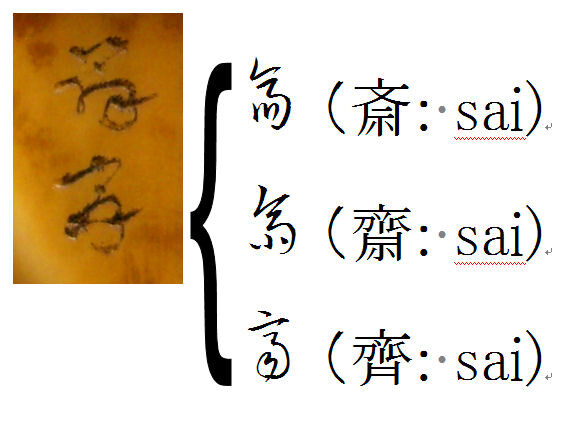
Guido, your work is excellent. Actually, I was thinking after my previous post that the second kanji may be sai (齋).
-
Although I am 99 % UNSURE, I dare to guess that. 晶家 (Akiie or Masaie?)
-
Gimei "Rai Kunitoshi" on eBay
Nobody replied to Marius's topic in Auctions and Online Sales or Sellers
I cannot judge the blade itself. However, I do not like the sayagaki. The clumsy handwriting does not look like written by Dr. Kanzan to me, though I could be wrong. -
Gimei "Rai Kunitoshi" on eBay
Nobody replied to Marius's topic in Auctions and Online Sales or Sellers
Hi Piers, "大磨上無銘" reads O-suriage Mumei. For more information, please refer to the last part of the following thread. http://militaria.co.za/nihontomessagebo ... ght=#16597 -
The translation for the sayagaki was already done by Wim, and that was almost perfect. Here is my reading with a few corrections. 濃劦関住兼房 (Noshu Seki ju Kanefusa) 但薙刀直無銘也 (Tadashi naginata-naoshi mumei nari) – However, it is a naginata-naoshi and unsigned. 時代永禄頃歟 (Jidai Eiroku goro ka) – Era may be around Eiroku (1558-1570). 刃長貳尺六分半有之 (Hacho ni shaku roku bu han ari kore) - Blade length is 2 shaku and 6.5 bu. 平成壬午歳睦月下浣探山識 (Heisei Mizunoe-Uma no toshi mutsuki gekan Tanzan shirusu) – At the latter part of January in 2002, Tanzan wrote.
-
A Very simple gift to a Very Special Person
Nobody replied to Rich T's topic in General Nihonto Related Discussion
Thank you for your kind words. I am also learning a lot of things from this board. But please do not overestimate my posts, as I am only a begginer who happens to speak Japanese. -
I read that as follows; 備刕長船賀光 – Bishû Osafune Yoshimitsu 長禄四年紀有之 同工佳品而此出来ハ (Chôroku yo nen-ki ari kore, dôkô kahin shikoushite kore deki wa) 室町中葉ノ典型的作域也 (Muromachi chûyô no tenkeiteki sakuiki nari) - Its date is the 4th year of Chôroku (1460). It is a good work of the smith, and the workmanship shows a typical style of the middle of Muromachi period. 刃長 壹尺九寸九分弱有之 (Hachô: ichi shaku kyû sun kyû bu jaku ari kore) – Blade length is a little less than 1 shaku 9 sun 9 bu (60.3 cm). 丁丑歳霜月中浣 田野邉道宏識 (Hinoto-Ushi no toshi, Shimotsuki chûkan, Tanobe Michihiro shirusu) – The middle of November in 1997, Tanobe Michihiro wrote.
-
Thanks for the information. There is one point that is not clear for me. Which is correct for the quoted GO? 杏堂 (Kôdô or Kyôdô) - 杏 means apricot. 香堂 (Kôdô) - 香 means incense/fragrance.
-
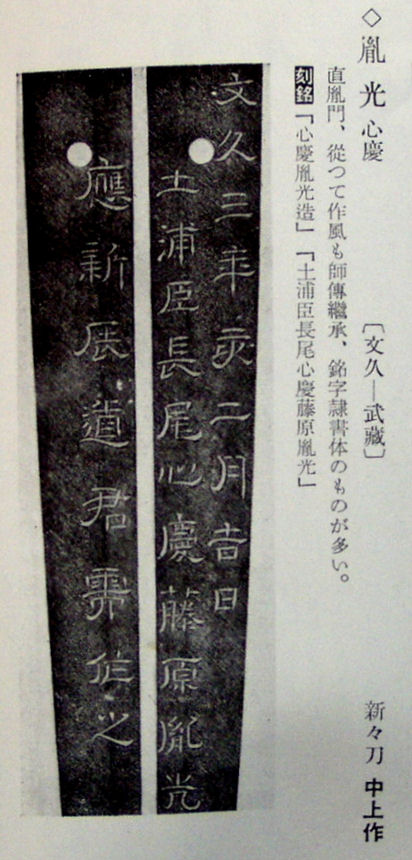
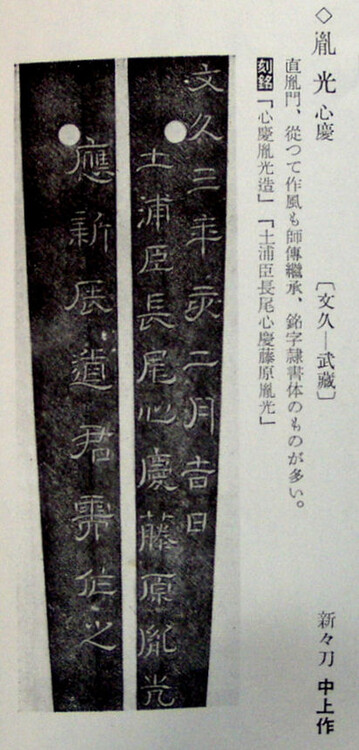
reinhard, There is at least one example. Shinkei Tanemitsu (心慶胤光): http://sinogi.dee.cc/katarogu/1501/tane ... itu-k.html However, I do not insist that the mei (Sadatoshi?) in question is genuine.
-
I cannot judge the authenticity of the mei, as I am not an expert. However, one point I realize is that the chiselling is not so bad. The style looks like typical Reisho-tai (隷書体).

-
These photos show some examples of nanako-tagane (魚々子鏨). However, they are not exactly nanako-tagane for tosogu.

-
FYI; The following links show some photos of Sadahide wakizashi (Sadatoshi's father). http://www.finesword.co.jp/sale/touken/ ... dahide.htm http://www.e-sword.jp/sale/0610_2028syousai.htm
-
Sorry, that typo was my careless mistake. Of course, Matsui (松井) is correct.
-
Ah, kanji for ASON are usually 朝臣.
-
Generally, that is correct. But in this case, I think that the appropriate reading for 臣 may be "shin". 越高田臣 means "a feudatory (臣) of Takada clan (高田[藩]) in Echigo (越[後])". Matsui (柗井) may be his family name. The smith might be one in the line of Matsui Sadahide (松井貞英) or his son Matsui Sadatoshi (松井貞壽) in Etsu Takada (越高田). notes) typos were corrected (Matsuda ---> Matsui), Dec. 10
-
sketches of Japanese manners and customs
Nobody replied to Nobody's topic in General Nihonto Related Discussion
Sakai Hoitsu (酒井抱一) is a BIG name. But sorry, he is not the artist in question. One of his art names Oson was wrtten as 鶯村. And I think that the style of Curran's painting is not of Rimpa. I found an artist's name Okada Oson (岡田櫻邨) on the net. He could be the artist, though I could not find more info. -
sketches of Japanese manners and customs
Nobody replied to Nobody's topic in General Nihonto Related Discussion
Hi Curran, I am sure about the first kanji, which is an old style of 桜 (sakura = cherry). Although I am totally unsure about the second kanji, the name could be 櫻都. 櫻都 (Ôto) BTW, 櫻都 is also an old expression of Sacramento. -
sketches of Japanese manners and customs
Nobody posted a topic in General Nihonto Related Discussion
Drawings for "sketches of Japanese manners and customs" / J.M.W. Silver Notes: "Sketches of Japanese manners and customs" published: London : Day and Son, 1867 [vol. 1]: 27 leaves of color plates, [vol. 2]: 7 leaves of color plates, [vol. 3]: 6 leaves of color plates, [vol. 4]: 12 leaves of color plat vol. 1: http://elib.doshisha.ac.jp/denshika/dra ... dx206.html vol. 2: http://elib.doshisha.ac.jp/denshika/dra ... dx207.html vol. 3: http://elib.doshisha.ac.jp/denshika/dra ... dx208.html vol. 4: http://elib.doshisha.ac.jp/denshika/dra ... dx209.html vol. 5: http://elib.doshisha.ac.jp/denshika/dra ... dx263.html Ref. Doshisha University Academic Repository http://elib.doshisha.ac.jp/english/digital/yosyo.html -
Kubota is a common family name.
-
sencho san, The last kanji may be kane (兼).
-
Are the kanji for "Kodo" 杏堂 ? They can be read as Kodo or Kyodo.
-
This is my reading. 鉄地 無銘 (tetsu-ji, mumei) – iron ground, unsigned 隅入角形 角耳小肉 (sumiiri-kakugata, kakumimi-koniku) 卍字洲浜小透 (manji suhama ko-sukashi) 軍配彫上 (gumbai horiage) – war fan in relief 竪 弐寸五分五厘 (tate: 2 sun 5 bu 5 rin) – longitude: 7.73 cm 右鎌倉鐔ト鑑 (migi Kamakura-tsuba to miru) – the right item is appraised as a Kamakura-tsuba. 昭和四十年十月吉日 (Showa yon-ju nen ju gatsu kichijitsu) – a lucky day in October of 1965 碧堂 (Hekido - I could be wrong in identifying this art name)
-
I do not know if this is your Masanao or not, but there is one Masanao on the list below. His real name is Nakata Katsuro (中田勝郎) living in Seki. http://www.tousyoukai.jp/english/member_e.shtml http://www.n-p-s.net/tohsho.htm
-
I will present those kanji for now. 鉄地 無銘 隅入角形 角耳小肉 卍字洲浜小透 軍配彫上 竪 弐寸五分五厘 右鎌倉鐔ト鑑 昭和四十年十月吉日 碧堂 (I could be wrong in reading this art name)