

Drago
-
Posts
464 -
Joined
-
Last visited
Content Type
Profiles
Forums
Events
Store
Downloads
Gallery
Everything posted by Drago
-
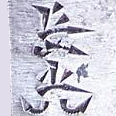
Thanks. Guess I'm a bit slow today. How do you read that? Sukeshige? Toshishige? Sakashige? A google search with these kanji only brought Chinese websites...
-
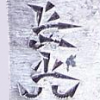
Ah, not 鬼 but 忠 - They look so similar when the photo quality isn't the best. THANKS! But the kanji between 忠 and 重 is what gives me the most problems, I just can't figure it out. yama-radical, but the rest...
-
Hi, I was using this tsuba as a translation exercise, but I'm stuck. What I have so far is: 山城國住埋鬼x重, and I can read right line "Yamashiro no Kuni ju" but, the name completely eludes me. Would be great if you could help.

-
Sorry, can't help with the signature. BUT I think it is upside down. But I have been wondering: I've seen dried fish as menuki as well... Why do they use this theme?
-
Jinzaemon is the maker, the gunsmith. What he means is similar to this: "Your Picasso (painting) could be older than others." -> "Your Jinzaemon (matchlock) could be older..." Teppo and Tanegashima are the terms for these kinds of weapons.
-
 Ah, shame. And for the reason you give it probably won't be translated outside of Japan either. Not without the obligatory 200 pages of political and historical analysis/commentary... Though I'm wondering if Markus Sesko might be interested in doing a translation.
 -
Photo 1: A beauty! Photo 2: sagari-fuji mon - usually used by the Fujiwara clan Photo 3: This is a flaming pearl. If I remember correctly, this represents wisdom/wealth/luck and the eternal pursuit of it. Asian dragons are often depicted together with it. Photo 7: Looks like something was removed. But perhaps we're reading too much into some signs of usage...
-
Hi. Inspired by the interesting discussion here viewtopic.php?f=1&t=17365 I would like to know if there is a translation of Naruse's "Tatakau Nihonto". In it, he describes his experiences with swords and repairing them during WW2. If there is, please point me to it.
-
Adam: You can swing your sword harder and faster if you use the left hand to pull the rear end towards you while striking or to apply more pressure while crossing blades. But the force necessary is not that big. I think most of the force happens when you have to take the full force of the opponent's attack when blocking. But even then... If the tsuka is made to fit and sits well, it shouldn't be that great a danger. Someone mentioned same and ito holding the tsuka together - that is true, but their "contribution" to stability is minimal compared to the wood and glue. No matter how long the tsuka is, the end will never stick out behind the back hand. It's a common mistake beginner swordfighters make and you often see in movies. You never hold the blade with both hands right next to each other - that is completely useless and you waste a lot of strength when striking. One is at the tsuba/crossguard, the other at the kashira/pommel.
-
Thanks Brian.
-
Hi Rodriguez. I'm afraid this is not Muromachi. It's a Gendaito. See those red marks on the tang? That's where numbers used to be. Those were used to keep track of the blade during production. And did you notice there is a hagire near the tip? Sorry, those aren't really happy news for you... And btw: Why did you open a new post for the continuation? You simply could have posted a reply...
-
My Nagamitsu has no star stamp (there was a discussion about N vs. Stamp recently). It has a number on the nakago mune but no arsenal stamp.
-
Thanks. But it makes me think: If the use of two holes was part of the specifications, why are there so many high quality Type 3s out there that only have one? (Like mine...)
-
Thank you very much. As for stress on the end: I can't speak for kendo/kenjustu, but I did European Swordfighting for a while. We used bastard swords (one and a half hand swords) that are held in a similar fashion as two-handed katana. Many atacks utilize most of the right arm/hand. In those cases the left hand at the pommel is mostly for stabilization/precision. But there are a few attacks and especially blocks where you use the left hand to firmly control the blade. During attacks you can use it to speed up the blade or rotate it quickly - during blocks to hold against the pressure of the opponent's blade. So in those cases I suppose there is some pressure on the blade, but I still have difficulties to believe a new wooden tsuka would break that easily if it sits firmly. @George: Even if Ohmura's page is unavailable atm, could you please give me a link? And if you have it, a picture of the tsuka with metal under it. I'm a bit of a fan of Ichihara Nagamitsu and have seen (even if mostly in pcitures) many blades made by him. Sometimes he has 1, sometimes 2. My Type 3 ("Ichihara Ichiryushi Nagamitsu saku") has only 1.
-
Hi, i've seen this mentioned here a few times before. It is said that gunto usually have two mekugi ana. The reason supposedly is to give stability and to reduce the risk of the tsuka breaking from stress during combat if it only has one ana. Is that really true? The reason I ask is this: I have never seen a dual ana configuration on old blades. If old blades have more than one ana it only is because the blade was shortened or the nakago area lenghtened. If a tsuka breaking from stress really were such big a problem wouldn't you find the dual ana more often?
-
1890 naval kyu gunto sword for admirals price guide
Drago replied to lonely panet's topic in Military Swords of Japan
I see, but why did the Japanese government during Meiji and even today use the same mon Toyotomi used? Is there a connection? -
I've seen a few of them on eBay lately. Though this seems to be the smallest yet. What I always wanted to know about these: DO they actually work? Or are they purely for decoration?
-
What he means is that this is (almost) fraud - it's a gray area actually. This seller (and a few others) take stuff that someones ellse offers on Yahoo Auctions in Japan and put it on eBay. Usually for 5 times or more the price on Yahoo. I've seen things that were on YA von 300 Euro offered for 2500 Euro on eBay or more. (There was this one crappy Gunto, falling apart just from looking at it and rusted beyond saving on YA for 100 Euro and the seller offered it as "museum quality" for 2100!!!) The seller doesn't own the item! If you buy it from them, they bid on it on Yahoo cheap and make a huge profit re-selling it to you. If they don't win or your bids are too low for their tastes, they'll say something like "The item is not available anymore" or "it was damaged" Stay away from these offers!!! If you really want the item, find someone who can act as a trustworthy go-between for you and YA, just ask around on this board. It's a lot cheaper and faster.
-
Well, I AM happy. But I suppose Peter will be happier. :lol: I knew about the double two, but this 3' is new to me. Thanks Kunitaro.
-
Aah. That makes sense. Thanks.
-
I see. But in this context, what does 重代 mean?
-
What I see is: 皇紀二千六百四十八年秋吉日 Imperial year 2648 (1988), a lucky day in autumn 為 means something like deed, action or execution (of a task) 二十三代藤原兼房作 23rd generation Fujiwara Kanefusa saku 山本昌敬重代 Yamamoto Masanori successive generation
-
I see. Thanks. @Malcolm, I think so.
-
Yeah, I thought so too. But I'm still curious as to the exact contents.
-
Hi, there is this wooden sign on eBay at the moment: http://www.ebay.com/itm/161131253293 Since it looked interesting I thought I'd use this as a translation exercise. I got all the kanji, but the translation isn't really showing any results. And since there are older kanji in there Google translator and other online dictionaries don't work... 財團法人大日本國防衞生協會通常會員 What I got so far is that this is some sort of health foundation for the defense of Great Japan... If you can figure out anything, I'm looking forward to hearing your ideas.´
