Drago
-
Posts
464 -
Joined
-
Last visited
Content Type
Profiles
Forums
Events
Store
Downloads
Gallery
Everything posted by Drago
-
Hi, can someone please tell me what this Tsukamaki stlye is called and how it is made? http://www.ebay.com/itm/230918857367 That example might not be the best example though... It looks kind of like rubber, but of course it isn't. And do you know how sturdy it is compared to the usual silk/cotton ito? Thanks.
-
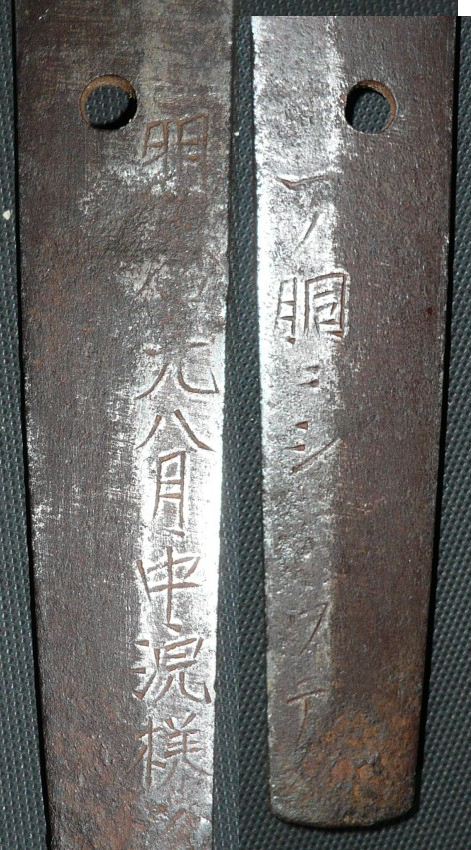
Please help to translate this cutting test inscription
Drago replied to Drago's topic in Translation Assistance
Ah! I just couldn't find that last one. Thanks. 中浣様 second third of a month... I never heard of that expression before. So what is you opinion? Is that mei real? -
Please help to translate this cutting test inscription
Drago replied to Drago's topic in Translation Assistance
Yeah, that was good. But I still haven't figured out that name or whatever it is after the month. Can you tell me what it says? -
Please help to translate this cutting test inscription
Drago replied to Drago's topic in Translation Assistance
Thanks Thomas. You're right, there probably is no symbol between the tsu and u. About thet date: I'll get back to you. EDIT: 1. There are only two periods I found that start with 明: 明暦 (Meireki 1655-1658) and 明治 (Meiji) I'd tend to say it's the first one, because test cutting on bodies during the Meiji period sounds odd (though no unimaginable). 2. The next kanji could be 元 (gen), which would mean the first year of that period. So that would translate to: February 1656 or April 1869. 3. And the rest is a name? 浣 and I can't find the last one. -
Anyone know anything about these guys?
Drago replied to md02geist's topic in Auctions and Online Sales or Sellers
There was talk about them not that long ago. Their items are way too overpriced. And they offer the items in Japan at much lower prices. They hope to find some suptid Westerners who are willing to pay a lot of money for stuff they could get cheeper. -
Silver Torii miniature, please help me understand it
Drago replied to Drago's topic in General Nihonto Related Discussion
Hmm, interesting. Thanks. I'll look into that. -
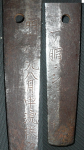
Hi, this blade is currently being offered for sale. Since the quality isn't that great and it seems tired I'm not really interested in buying. But ever since I saw the offer I've been thinking about what that might mean. Unfortunately one or two symbols aren't legible. So far, I only figured out: 一ノ胴 ? シ ? ウテ (one body, but can't figure out the rest) 明 ? 光八月中 ?? (no idea at all) Looking forward to your answers.
-
Silver Torii miniature, please help me understand it
Drago replied to Drago's topic in General Nihonto Related Discussion
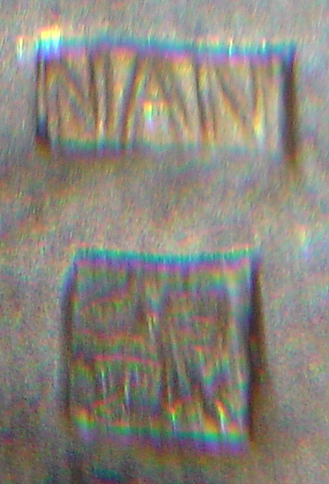
Good morning Piers, thank you for your answer. The NAN stamp is written in capital English letters. The 銀stamp is kanji, they are separate stamps. And both feet have both stamps. The Torii is exactly 7cm high and 6,8cm wide. I tried to take a photo of the stamps (torii2). It's a bit blurry, but with one hand on the magifying glasses and the other on the camera I couldn't get a better one. I also attached a photo of the rear of the sign. To the left is the roof of the torii, to the right the feet. I don't see any major scratches on the torii that would indicate a later modification. The sign has a circular scratch on the back but I couldn't match that to any part of the torii itself, so I don't know where that came from. As you can see, the rims of the sign are slightly bent, but the one side on the right on the photo (where the tip of the 奉 is) is flat. I think that wasn't intentional. Tobias

-
Hi, I bought this many years ago. Now it sits on front of my kamidana. Story is that it belonged to a German envoy to Asia in the first half of the 20th century The Kanji on the sign reads 奉納 which means something like dedication or offering. The sign is upside down however, but it doesn't look like it was ever upright. The kamebara (feet) are both stamped 銀 and NAN, so it is made from silver. I would like know: 1. What kind of offering is that? Who from? To Whom? Why? 2. What does the NAN stamp mean? 3. Why might the sign be upside down? Thanks.

-
I never would have guessed. At first I thought 世 but that made no sense. Morita-dono, do you have a computer version of this itai-ji? I'd like to look it up. The database I use for Kanji (Bibiko's online kanji dictionary) doesn't list any alternative writings for 作 Anyway, so, I suppose the smith is MIT204?
-
Odd how thinks always look different when you compare upright and upside down... Anyway, I'd stick with クハツラウ (kuhatsurau) or perhaps クハツテク (kuhatsuteku). The tsu seems to be the same size as the other symbols, so not kuharrau or kuhatteku. Really, this makes no sense to me. But then again, this might be some other language written with katakana. The blade looks real enough, but it probably is nothing traditionally made.
-
That's Katakana and upside down. It's a bit difficult to read, but I think is says クハツラウ (kuhatsurau) which makes no sense to me at all. If you have some chalk try dusting it into the "signature". It should become more legibly that way and take a photo again. Btw. That's a lot of red rust, that's not good.
-
FLINTLOCK TINDER LIGHTER NETSUKE ( SNAPHANCE )
Drago replied to watsonmil's topic in Tanegashima / Teppo / Hinawajū
Very beautiful. I would like to have one, and the 400 Pound given in that one picture look pretty good. It's interesting, I've never seen a similar concept like this in the western world, except perhaps for a tinder lighter that looks like a gun. -
@Chris: I see. Thanks. @Mariusz: Your question made me wonder so I checked about "to uchiko or not". So far I have always used it, but not that much I think. Then again, I only cleaned my blade three times since I got it (once every half year). Guess I'll use it less.
-
Hi, well, I'm still a noob, so I usually follow a sword care guide to the letter (NBTHK or Nakahara-san's from "Facts and Fundamentals of Japanese Swords") . But there is one thing I don't really get. So I clean the blade and then apply the oil. But then they ask me to wipe the blade down again to remove excess oil with a new piece of cloth. But doesn't that mean effectively removing the oil? Why oil it in the first place? Or how do I wipe it down without removing everything? (I know there is a discussion "to oil or not to", but since this place can get humid sometimes I think oiling would be better.)
-
Well, we talked about two-piece fuchi recently. But this one is new to me. After looking at it for a moment, my first idea was that this might be an adaption to use the fittings in an aikuchi koshirae when you don't really have fitting (style) fuchi and koiguchi pieces. But I'm by far not an expert so this is just my guess. But whatever the reason, it's beautiful and the craftsmanship seems to be very high too.
-
Hi, I bought a kiri box for a set of fittings I have (fuchi-kashira + menuki). Now, I'd really like some hakogaki on it (the F-K set is signed, F-K and menuki do no belong together originally). I do know some Japanese people I could ask to write that for me. What information belongs in the hakogaki? (I have a vase in a kiri box that says "vase, Tanba ware, name of the potter + stamp". But since this is a mixed set instead of a sinple piece I'm not sure.) Thanks.
-
Hi, nice tsuba, I like it. I'm not that well versed in Japanese symbolism, but check out the zodiac text in the "articles" section. The rat is one of the major signs. That might help.
-
Hi, I have been following some discussions here lately and realized I don't really know how to recognize a tired blade. My only clue so far as the size of hamachi and mune-machi, but that isn't that realiable. I also know that on very tired blades the shintetsu might "shine through" or show, but I'm not entirely sure I might be able to recognize that. So can you give this beginner some tips? Or is there some sort of visual guide? If this has been covered already, please link me to it. I used the search but failed to find anything clear. Thanks.
-
Thank you. Is there only the print version, or is there a pdf version as well?
-
Thanks, but that doesn't help that much. There's interesting info about the Nara school, but not about the guy in question.
-
Hi, there is this book "The Yasukuni Swords: Rare Weapons of Japan, 1933-1945" by Tom Kishida about the swords made at the Yasukuni shrine. Is there a similar book about the Minatogawa blades? Not just text but including oshigata and photos like the above book... Thanks.
-
Hello, I have this beautiful fuchi-kashira set I bought about a year ago from owazamono. A village scene set, perfect condition, signed Nara Toshishige + kao. 奈良利重 From what I understand he was the son of Nara Toshinaga and worked in Kanda (Musashi province) during the middle of the 18th century. But that's all I know. If you have any more information on him, I'd be happy to read it.
-
Very interesting! I just wish there had been better/more photos.
-
viewtopic.php?f=2&t=13066