

Drago
-
Posts
464 -
Joined
-
Last visited
Content Type
Profiles
Forums
Events
Store
Downloads
Gallery
Everything posted by Drago
-
Bizen-Osafune Sword Village trip
Drago replied to Ken-Hawaii's topic in General Nihonto Related Discussion
Wow. Thank you very much. -
Hello, I would be happy if somecould point me to: 1. a list of smiths that worked/work on Hokkaido (if you know currently active smiths, please point out) 2. links to good quality images of representative swords 3. texts about details of Hokkaido sword making traditions/schools (I'd prefer online texts, since I don't really have printed books, I usually use online references.)
-
Well, I've been wondering: If you take away everything from the sword - tsuka, saya, habaki, everything - so that only the bare blade remains. What do you call that? Is there a specific term for that? Yaiba means blade, Ha means blade (but more in terms of "cutting edge")... Thanks. PS: One more questions: If a Japanese wanted to write "from 1744 to 1764" in a short way, he'd probably wirte "1744-1764" like we do, but if he wanted to say "from era Enkyo to Horeki", would he write "延享-宝暦" or what?
-
Looks good. I wanted to check their website http://9dragonmetalworks.com/ but it expired. Do you know if they still have a website somewhere?
-
Uh, very nice one. I'd like to have that... :D Too bad there is no photo of the reverse side.
-
Hi, looking for something else, I ran across this at the UsagiYa: http://www.ksky.ne.jp./~sumie99/fittings1.html Can you explain to me why the fuchi and kashira are made from two parts each? What is the purpose? This is not the first time I've seen seen something like this, but this time I really want to know...
-
From taking a closer looks at my habaki I'd say it's electroliytically coated. (it's silver on the inside as well and the rubbing doesn't look like it's just plated) Anyway, thanks for your help. Turns out it wasn't necessary in the end. I found a nice piece of hard rubber in my toolbox that had a perfect notch for the habaki and hammer (so I won't accidentally hit the blade) and it worked like a charm. I took my time properly cleaning the inside of the habaki as well, to avoid it sticking or rusting on later. But I will keep what you said in mind should it become necessary later. Thank you again.
-
Thanks Martin, And what about the three signs above that? (right below the mekugi-ana)
-
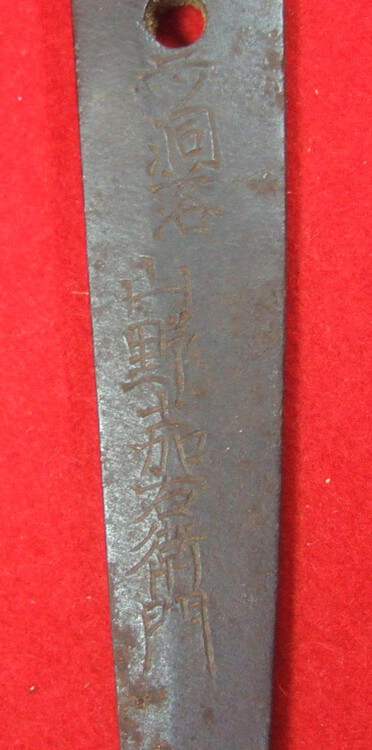
Hi, I found this. I tried to figure it out, but my kanji book didn't really help... Just being curious. I know it's not the maker signature. Thanks.
-
It is time to take proper care of my sword again. I only bought it not so long ago, and this will be the second time I do it. When I cleaned and oiled my blade the first time (my first time doing sword maintenance as well) I didn't try to remove the habaki. It is stuck really good. What can I do to remove it without damaging the blade and habaki? (Nagamitsu blade with silver-coated copper habaki) I found one topic here where the person used extreme measures (http://www.nihontomessageboard.com/nmb/ ... f=1&t=6651) and on other website it says to take a piece of soft wood and slightly hammer on both sides. But I'm really afraid of damaging the habaki and blade, so I'd like to hear your opinions first. Thanks.
-
Hi there! (First off, I really didn't know where to put this: here, Nihonto, Kodogu, Gunto... So if this is the wrong place, please move it.) I have here a saya that is just like this one http://www.japanesesword.com/Images/Swo ... 6ktx1.html I'd like to know what kind of lacquer this is and if anyone has more info on the production/application of this laquer. What I can say is: It's not ishime. (Un)fortunately, my saya's lacquer is chipped in one place and the lacquer layer is almost a milimeter thick! And although the roughest areas are rubbed off slightly, I can tell that this is a pretty sturdy, hard lacquer. So I'd appreciate any info you can provide. Thanks.
-
Waoh, that is something I haven't seen before. Is that yours? If so, can you give a little more info (what does the signature say, where did you get it, is there a story?)
-
Oh, nothing in particular. Just being curious is all. I know that good blades were reitred to the status of an heirloom/piece of art after a while, but when you read about famous samurai using old blades...
-
Hi, not removing the oxidation from the nakago is basically rule number 1 when collecting Nihonto. So far so good, and considering the look of many old blades this even seems to have been a tradition when the swords were still in actual use. What I'd like to know: In my so far short time as a budding collector I've seen a couple of blades with terribly rusted nakago. Have there ever been reports of swords breaking during battle/practice because the nakago was rusted too much? It doesn't matter whether the nakago broke completely or just the area around the nakago-ana... Thanks.
-
Ah, I am referring to that four-digit nuber on the spine of the tang, that is usually found next to the small arsenal stamp. (sample image here: http://japaneseswords.gotdns.com/100Gendai31.htm - a Nagamitsu blade like my one, but mine doesn't have the arsenal stamp, that's why I'm asking)
-
Thank you, Bruno and Morita-dono. Now I'm curious: That sword was made by Murayama Kaneshige. From what I read he made traditional blades and non-tradtional ones. Does this stamp indicate either of those? I'd post a link to the offer, but the images aren't good enough to recognize Hamon or Hada... EDIT: I'd also like to ask again (I asked in Nov, but never got an answer): Are the arsenal stamp and "serial number" related? Or are those two completely different things just found next to each other? My sword (traditionally made but still a military blade) has a number but no arsenal stamp. So I was wondering what that might mean...
-
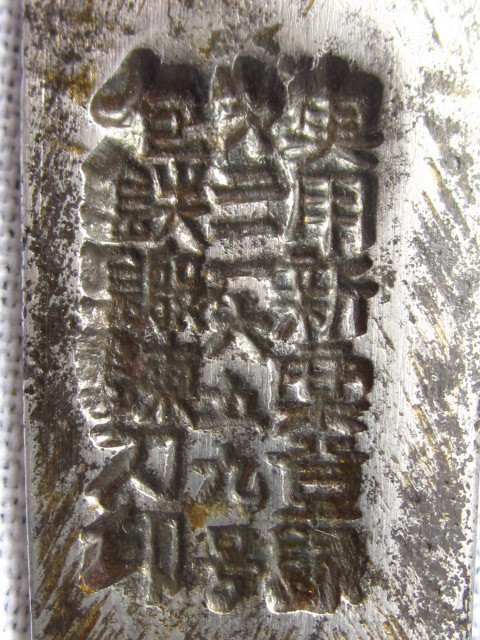
Hi, a blade is currently on sale somewhere that has this stamp on the nakago. I'm not sure if this is a machined blade or a real one, but that doesn't matter. What does this stamp mean? I don't recognize most of the kanji and I can't find my kanji book right now. What I see is the sign for new (shin - right 3rd), the number 2659 (middle), the sign for sword (tou - left 5th) Thanks.
-
Hi, I've been wondering. When a sword is polished it gets smaller. Although, unless there are deep damages that need to be removed, this "getting smaller" falls probably with in the range of a few µm it still means the blade gets smaller. What happens to the Habaki? After the first polishing it'll probably still fit like new, but how long does it take until you need a new one? The smaller the blade gets the more lose the Habaki becomes... And as a side question: If you need a new Habaki because of that, does this also mean you'll have to get your Saya reworked to fit the new Habaki? Thanks.
-
Hi, what is your opinion? Was this traditionally made? http://www.ebay.com/itm/251061760442 I've seen those with machines blades, but this one just looks a lot different... Thanks.
-
Hi, in my quest for further knowledge and perhaps a good offer I ran across this: http://daimyou54.web.infoseek.co.jp/B2-985/index.htm Plase take a look at the pictures of the ha-machi (almost at the bottom of the page). Right below the ha-machi there is a thin line right on both sides. What is you opinion? Is this a fatal flaw or just a scratch caused by the habaki? And what might have caused that flaw if it is one? Is it because the hamon runs off there? (I posted this here since this is less about the offer itself but the potential flaw.) Thanks.
-
Hi, I think I remember reading a thread where someone mentioned opening Date Masamune's grave and finding swords in it. That sounded very interesting. That is why: I am looking for photos and perhaps acompanying online articles about Japanese swords found during archeaological digs, grave openings/restorations etc. The photos should be of a good quality and size (nothing ridiculous like 200x300 pixles...). If there are text acompanying these photos (whether scientific, newspaper etc) even better. Everything should be available online and free. Thank you very much.
-
pre ww2 japanese sword? need help with dating and mei
Drago replied to Petersan's topic in Translation Assistance
Hmmm... I thought as much. But what does that mean? Was this sword made for the shrine, or as an offering for that god? Or was it made to give the wielder that god's protection? But if it was an offering, why was it turned into a gunto? -
pre ww2 japanese sword? need help with dating and mei
Drago replied to Petersan's topic in Translation Assistance
By date you mean that second photo? Are you sure that is a date? Kasuga can be a name or place (e.g. a city in Fukuoka prefecture or a larger Shinto shrine in Nara) and Daimonjin might be a name or title... -
I'd like to hijack this thread, I hope you don't mind. How do you recognize that this blade was oil quenched?
-
Oh, that is something new. (And I like that story about the Yoshiwara wakizashi) BTW: The "unusual menuki thread" is here viewtopic.php?f=2&t=8290

