Brian
-
Posts
21,858 -
Joined
-
Last visited
Content Type
Profiles
Forums
Events
Store
Downloads
Gallery
Everything posted by Brian
-
Grey, You are a genius :D Such a simple trick, and I was still using rubber bands. Great when you are storing that old saya before you can have repairs done. Heck...if you photograph or scan your saya pattern, and print that out and cut the strip from it, and use clear masking tape, you won't even notice it from a distance :D Thanks for a great tip. Brian
-
Every tsuba collector should have one
Brian replied to Rich T's topic in Auctions and Online Sales or Sellers
Ok..now that is just wierd Is that a large board to display tsuba on, or a tsuba with a tiny tsuba theme? Can't read the description. Interesting how the small nakago projections go through to the other side. It's all yours Rich, I'll pass :D Brian -
Very true Milt, good point. Brian
-
Agree with Franco, When the demand for sword fittings wasn't there anymore in the Meiji period, then the fittings makers turned to making anything else they could. Many kozuka makers turned to those fancy kitchen-type knives that use a regular cutlery knife blade, and on many of these we see these double sided kozuka. Not very sought after I'm afraid, kind of mass production. Brian
-
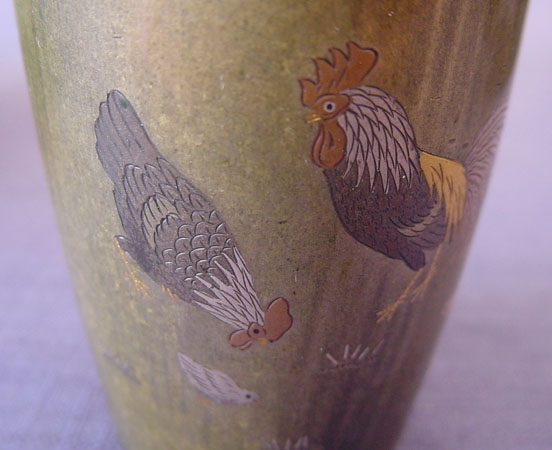
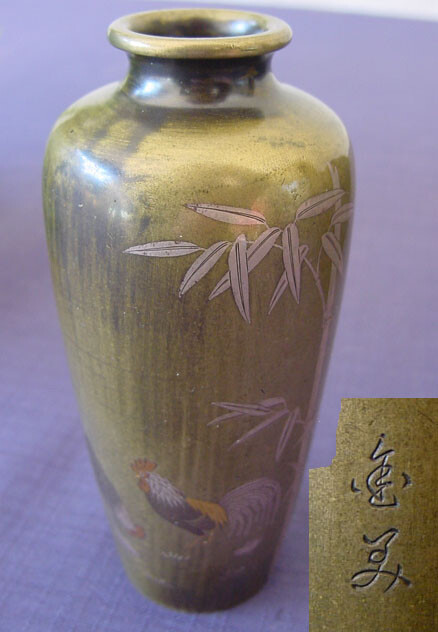
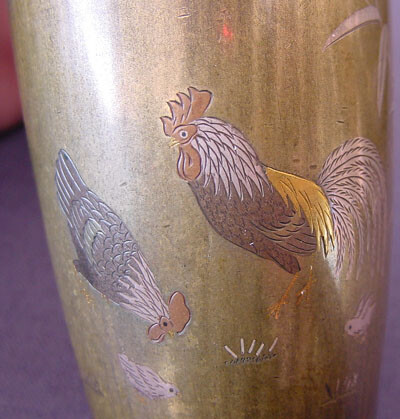
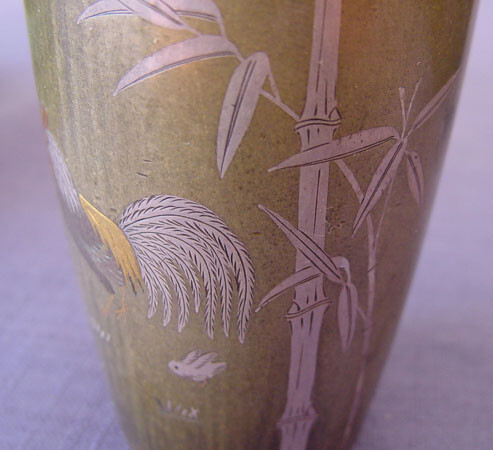
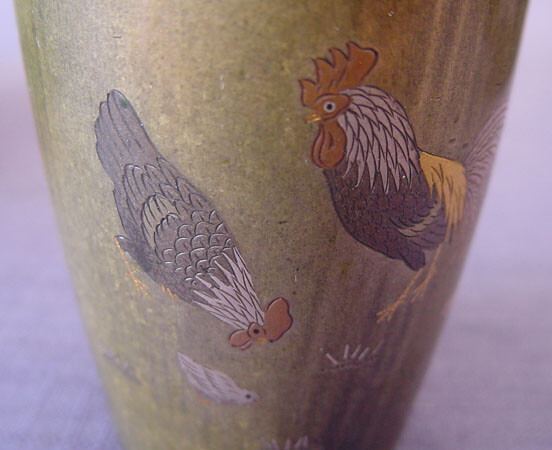
Hi Stephen, Yes, you have a point. To be honest, I can't really decide how this was done. I can't find signs that it is indeed inlay, but the detail is very fine, and it may have been done with the mercury methods or other means of transfering the thin overlay onto the base metal. There is lots of fine carving too that you can feel, and none of the contrasting metal is lost anywhere. Considering this is only about 10cm high, the detail is very well done. Fine chisel work on the feathers and bamboo that you can feel with your fingertips. It is definitely silver and gold on there, so not sure how it was applied. The other 2 do show signs of some inlay, but it is very fine work also in minute detail. Brian
-
Outstanding work Markus! :D Thanks very much. Even with my copy of "Dictionary of Japanese (Sôsho) writing forms" I was clueless where to begin. No idea who he was, but this will give me something to research. Regards, Brian
-
Thanks Pete, that's what I was thinking too. Don't have Haynes yet, although it is high on my list to get next. I was hoping, (since I think kao are often made up of a combination of kanji mixed together) that someone might have a clue. Agreed on the restoration. In this case, I was thinking more of the very long term soft cloth/pocket carry/open air method used to promote natural patinas on iron, and not any artificial chemical patina. But this would not apply much on soft metal tsuba like this I think, since the coloration comes from treatment and not age? Have no problem enjoying it as it is Btw - the darker areas are just reflections while taking the photos. It is actually a very even color except for the middle where the wear is evident. It reflects objects like a mirror. Regards, Brian
-
John, Yes, I think this is from Meiji, and with all those out of work metalworkers, I'd rather they did vases like this than make fuchi kashira into bracelets and jewellery boxes I agree that the original patina was likely the one visible around the neck. If so, then could this be shakudo? Unlikely I guess, just a thought. I would be scared to play with the patina, as any treatment might affect the inlayed metals. I guess this is why there are experts in this, but none in SA that I know about. Maybe Ford Hallam would have some thoughts on it. Signature is a difficult one to translate. Brian
-
While not strictly on topic, I believe the metalwork and inlay is related to koshirae work. I recently picked up this small bronze? vase from the estate of a sword collector, and would be interested in knowing if anyone can translate the signature. Not an easy one. There are 2 larger vases that are not signed, but have similar themes with roosters and foliage. The other 2 feature plum trees and roosters, unlike this one which has bamboo. I can see the patina has suffered, but I like them for the intricate mixed metal inlays. Thanks, Brian
-
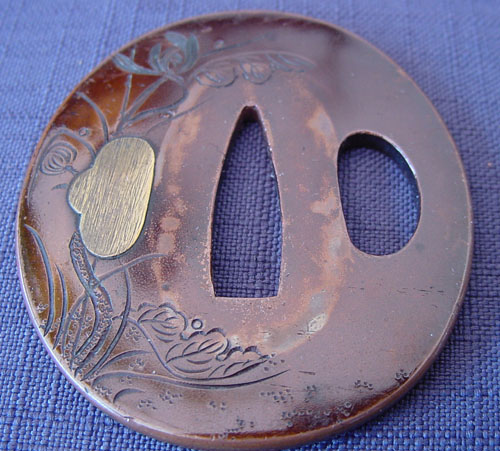
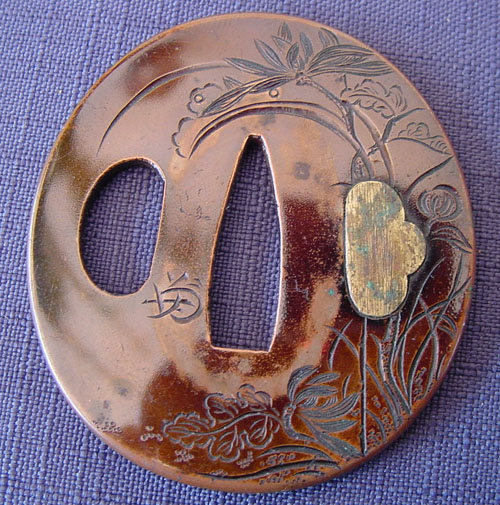
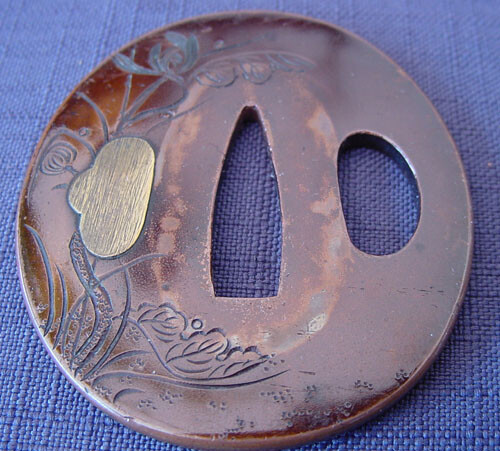
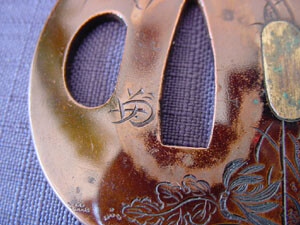
I have had this one for a while, and have never succeeded in identifying the kao on it. I have been through Shosankenshu, but after a hundred kao, the mind boggles and starts seeing things. Does this look familiar to anyone? The tsuba has (notwithstanding the patina damage at the seppa dai) a lovely and reflective patina which makes it hard to photograph. Very deep reflective mirror-like with a lovely coloration. I doubt I would ever be able to repair the lost patina, as I am sure it is chemical based and not age patina like iron. I am not sure of the metal. One of the soft metal alloys, maybe shibuichi? (color blindness doesn't help in describing it :lol: ) Any info is much appreciated. Brian

-
Nice kogatana Koichi. Is it in shirasaya? It is a good and difficult question to answer. I would personally avoid any artificial methods of promoting a patina. In this case, the kogatana was made purely as art, not as an accompanyment to a working katana. Therefore I would look at basic maintenance too keep it in good order and let nature run its course. I think keeping it in the shirasaya might allow the patina to develop over a few 100 years, but this should be done the natural way, and not be promoted by any additional chemicals or treatment. I guess I would handle it (the nakago) over time, and if natural rust forms slightly, I would wipe it off with a dry cloth, and maybe a drop of oil on the fingertips rubbed lightly. Eventually the handling should promote a natural patina, but maybe not in your lifetime Can't back this up with any references though, it is just my gut feel. What are the other opinions on this? What do the modern swordsmiths say about this? Brian
-
Indeed. Here is Dr Steins list of rankings: http://www.geocities.com/alchemyst/tosho.htm Regards, Brian
-
Hi Kris, I edited and rotated the picture to (mostly) the right way up. This should assist someone to translate for you. With that lower mekugi ana (hole) I would expect this to have been in 1944 pattern shin gunto mounts, but not sure if the rest of the fittings fit this profile. Higher grade of military seppa (spacers) but the age looks to me to be around WW2. We would need a few other pics to get an idea of whether this is a std machine made blade or something better, and which military pattern. I am sure someone will help with the translation shortly. Is there any other markings on the other side of the tang? This is usually where the date is. Regards, Brian
-
Thanks Pete, Quite an unusual tsuba that, and am I right that sekigane does this way is very unusual? Unusual mei too..what does it say, and can you tell us anything about it? Brian
-
Just wanted to get clarification on that tsuba. You say the nakago ana is too wide for the blade? If you mean vertically, then sekigane can be fitted to make it fit better at the top and bottom. But if you mean the thickness of the blade is smaller than the ana, ie horizontally across the tsuba, then I am not sure if sekigane would be the right way to go. You see the punchmarks on the tsuba usually to tighten the fit to the tsuba, but these are limited in the amount of gap they can fill. I don't think I have seen copper used often on the sides of the tsuba to tighten the fit, and would think that if this is the case, then this tsuba would be a bad fit for your sword (not to mention that I don't think it is a great tsuba either ) There is a good discussion of punchmarks and sekigane here: http://www.militaria.co.za/nihontomessa ... 59&start=0 Brian
-
Hi Paul, Yes, I see what you mean about the pics on the Fakes page. The link is to the page which is hosted by Rich T on his site. I think he will see this and correct the page shortly. Thanks, Brian
-
As I can't read Polish, I can't understand the page. But if, as you say, he is a modern sword maker, than I think it more likely this is a sword he made himself, and not a shortened Chen blade. As I said originally, it gave me the impression of a modern blade made by a knifemaker and polished the way they do. Is it possible he made the blade, and put it into original fittings? Brian
-
Just a friendly reminder to please sign all posts with a name and initial Thanks, Brian
-
Janusz, Another difficult one (what happened to all the easy ones? :D ) Just my novice opinion of course... The fittings look good, and genuine. Quite nice too. Edo period. The blade. Hmm. The blade looks original to me, although it looks to have been over cleaned and finished to be too bright. What disturbs me is the nakago (tang) as it is just not right. The filemarks, shape, wobbly shinogi line and patina are just off. Doesn't look to have much age on it. Mekugo ana looks drilled too. This makes me think of a longer katana blade that has been broken, and the nakago crudely shaped by someone not experienced in Nihonto. I don't get that feeling of "fake" but more "reshaped" Perhaps it is just that...a katana blade shortened by someone not an expert. I could be way off the mark...but all free advice comes with a money back guarantee The nice fittings and the lack of other damage on the blade might mean there is a fair sword in there waiting for some restoration. What say the others here? Edit to add: Looking at it again, something is niggling at me, and I can't put my finger on it. Could this be a modern blade by one of the custom knife/sword makers in the West, that has been heat treated and put into older fittings? Or maybe it was polished by one of the knife makers. Just gives me that impression for some reason. Hard one to pinpoint. Brian
-
How was the show in MN
Brian replied to seppuku's topic in Sword Shows, Events, Community News and Legislation Issues
Not sure if this was posted before, but here is a nice review of the show, with some extra pics: http://rallypointmilitaria.com/?p=9 Regards, Brian -
Thanks again, and let's not forget the constant and invaluable help provided by our all vigilant moderator Stephen. Long after I am in bed and dreaming about Kamakura tachi, he is uploading pics for people and policing the forum as he should. Don't think I could keep up without him. Anyone who run a forum will tell you that they can't do it without good moderators Just a public thanks to him here. Regards, Brian
-
Rich, Sorry to hear about the health issue, and we all wish you the very best. Our thoughts are with you. I assume the wording is a form email that you are sending out, so hopefully when you are eventually able to visit again you will see this. Please take care, and let any of us know if we can assist with anything at all. Regards, Brian
-
Hi all, I know this is a few days late, but I just wanted to send all of our Japanese members, visitors and their families our sympathies and best thoughts in the aftermath of this large earthquake. We all hope that you were not badly affected by this disaster, and please keep us updated. Our thoughts go out to you all. From all at the NMB. Regards, Brian
-
My 2c? Since you are asking for opinions, I go with Rich here. The old mountings at least have some history, whereas the new "decorations" would just look cheap IMHO. Gunto mounts may be plentiful, but displayed with tsunagi with the original blade in shirasaya shows its history and preserves it for a day when gunto mounts aren't so plentiful. Brian
-
Thanks for the comments all, much appreciated. Just out of interest, according to the stats, we have about 24 or more countries regularly visiting here: USA Australia United Kingdom Japan France Germany Canada Poland Netherlands Belgium Italy Denmark US Government Finland Singapore Austria US Military Switzerland Norway US Educational Israel Ireland New Zealand Sweden Brazil South Africa Luxembourg Amazes me too (Good to see some of you are US educational, and I am sure Milt will love the US Military stats too There are some others that are unresolved countries. Thought you might enjoy the stats. Regards, Brian