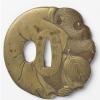
Iekatsu Posted Tuesday at 09:06 AM Report Posted Tuesday at 09:06 AM This is normal middle of the road work for the Edo period. The Nanako are not perfect, which is normal, perfect Nanako is something you only see at the upper end and requires significant skill. It has clearly been mounted and shows appropriate levels of wear for it's age. It has a true Fukurin, which can be seen where it joins at the Mimi and where it is damaged. There is no evidence of casting at all. 5 2 Quote
Exclus1ve Posted Tuesday at 12:29 PM Report Posted Tuesday at 12:29 PM I would take the position that this is a genuine, legitimate tsuba. The quality may be comparable to Nagoya work, but I think it is nevertheless a rather mediocre piece from the late Edo period, and definitely not a modern reproduction. The file marks on the nakago and hitsu-ana also look natural to me. Even on more expensive pieces, these areas were not always polished completely. If you look closely at the actual workmanship, you can see that the nanako was made with a hand tool: there are many sharp sections between the individual “dots,” and the tool marks are clearly visible. With casting, all those fine, sharp details tend to become smoothed out. As for the gilding, for some reason everyone seems to think that it should be perfectly even and uniform, especially on simpler pieces. That is not necessarily the case. Applying gold amalgam with perfect precision and evenness is not easy to begin with, and during the heating/firing process it has a tendency to spread beyond the boundaries that were originally defined. This photo is revealing to me. 6 3 Quote
Curran Posted Tuesday at 07:35 PM Report Posted Tuesday at 07:35 PM 7 hours ago, Exclus1ve said: I would take the position that this is a genuine, legitimate tsuba. The quality may be comparable to Nagoya work, but I think it is nevertheless a rather mediocre piece from the late Edo period, and definitely not a modern reproduction. The file marks on the nakago and hitsu-ana also look natural to me. Even on more expensive pieces, these areas were not always polished completely. If you look closely at the actual workmanship, you can see that the nanako was made with a hand tool: there are many sharp sections between the individual “dots,” and the tool marks are clearly visible. With casting, all those fine, sharp details tend to become smoothed out. As for the gilding, for some reason everyone seems to think that it should be perfectly even and uniform, especially on simpler pieces. That is not necessarily the case. Applying gold amalgam with perfect precision and evenness is not easy to begin with, and during the heating/firing process it has a tendency to spread beyond the boundaries that were originally defined. This photo is revealing to me. Thank you Victor for the well written breakdown. I think the OP's question has been answered. Like Mr. Sinclair, I worry that we freak people out too much with rapid fire dismissals. 2 1 Quote
Exclus1ve Posted Tuesday at 10:58 PM Report Posted Tuesday at 10:58 PM 3 hours ago, Curran said: Like Mr. Sinclair, I worry that we freak people out too much with rapid fire dismissals. Perhaps it makes us a little more attentive and vigilant) But above all, look more closely at the work itself. I think it’s genuinely difficult to fool someone in tosogu. The important thing is knowing what to look for. P.S. In this particular piece, take a close look at the highlighted areas. Between the dots, there is an incredibly fine and sharp ridge. In some places, the metal bends in a “wave” which simply cannot be achieved through casting. In other areas, the tool was worked into the same spot several times, creating many complex forms on the tiniest scale. This was done by a human hand. 2 1 Quote
Curran Posted Tuesday at 11:03 PM Report Posted Tuesday at 11:03 PM 3 minutes ago, Exclus1ve said: Perhaps it makes us a little more attentive and vigilant) But above all, look more closely at the work itself. I think it’s genuinely difficult to fool someone in tosogu. The important thing is knowing what to look for. P.S. In this particular piece, take a close look at the highlighted areas. Between the dots, there is an incredibly fine and sharp ridge. In some places, the metal bends in a “wave” which simply cannot be achieved through casting. In other areas, the tool was worked into the same spot several times, creating many complex forms on the tiniest scale. This was done by a human hand. Also, somewhat choppy chisel marks along the northwest edge of the front seppa dai. Who'd bother to fake that? I don't think they'd have come out so choppy if it were a cast job. 2 Quote
Exclus1ve Posted Tuesday at 11:09 PM Report Posted Tuesday at 11:09 PM Actually, I think the relief was simply carved out of the solid metal. It’s not an inlay, and perhaps that’s what gave some people a vague sense that something was off… 5 Quote
Spartancrest Posted Wednesday at 10:22 PM Report Posted Wednesday at 10:22 PM (edited) I think if we zoom in too closely on every detail we will always see a fault - the overall appeal of the piece is more important than the molecular makeup of the surface! Stand back a bit or you won't see the forest for the bark at the end of your nose. even the sharpest blade in the world is still serrated. Perfect nanako does not exist If it did it would not be handmade by any human. Edited Wednesday at 10:24 PM by Spartancrest 5 1 1 Quote
Kurikata Posted yesterday at 07:06 AM Author Report Posted yesterday at 07:06 AM Dear Members, First of all a great thank you for all comments on my tsuba. When I starterd this thread last week, I didn't expect such an interest on it. As a summury and with some statistics: 2 members think it is a modern one and 8 members think it is a late Edo one. Among the 8 members thinking my tsuba is legitimate: - 4 see a Nagoya Mono tsuba (or Nagoya Mono style) - 1 see a Mino style tsuba - 1 see a Kyo Kinko or Owari Kinko - 2 do not give a school or style. I don't expect sending this tsuba to shinsa due to the time and cost and due to the small price I purchased it. Thank you again! 5 Quote
Lewis B Posted yesterday at 08:03 AM Report Posted yesterday at 08:03 AM Nothing beats getting a divisive item in the hands of experts. Since you live in France you are close enough to get the opinions of the experts as the Japan Art Show in Utrecht or the NBTHK-EB who hold regular meetings in Solingen. The JAS has many prominent dealers, both Western and Japanese, in Tosogu and are only to happy to give their opinions. The NBTHK-EB President is Eckhard Kremers (enough said). 3 1 1 Quote

Recommended Posts
Join the conversation
You can post now and register later. If you have an account, sign in now to post with your account.