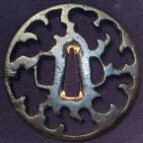
ROKUJURO Posted April 2 Report Posted April 2 2 hours ago, Spartancrest said: An inlay design to add to your group of images - the birds face right and left "outward" to the rim.... Yes Dale, I think so, too. But the pictured birds are probably not KARIGANE but CHIDORI? Quote
Spartancrest Posted April 2 Report Posted April 2 1 hour ago, ROKUJURO said: KARIGANE but CHIDORI What type of bird is this supposed to be? I don't know of any that look like this in reality. 2 Quote
Brian Posted April 2 Report Posted April 2 Actually, I really love that depiction of birds..likely geese. It is so "modern" that the depiction that way can only come from a nation that sees images depicted in bonji. A very futuristic depiction of a bird seen through an artist's eyes :-) 3 Quote
ROKUJURO Posted April 2 Report Posted April 2 I thought that these were CHIDORI. They have a very different flight pattern compared to KARIGARE. This depiction always expressed the erratic flight - often in large flocks - of plovers in an appropriate way for me. But that is just my interpretation. 2 Quote
Bugyotsuji Posted April 2 Report Posted April 2 1 hour ago, Spartancrest said: What type of bird is this supposed to be? I don't know of any that look like this in reality. Look at the Kamon on Shibata Katsuie’s kimono. 6 Quote
Brian Posted April 2 Report Posted April 2 Maybe doesn't even represent a specific bird, maybe just birds without a species. Never know... 1 Quote
ROKUJURO Posted April 2 Report Posted April 2 Piers, as you are living in the midst of Japanese culture, could you perhaps ask the opinion of the 'natives' about this? 1 Quote
MauroP Posted April 2 Report Posted April 2 The examples I provided are all from papered tsuba, and all NBTHK papers reported the subjects as karigane. The stylized birds with "twisted body' are reported as 結雁金 - musubikarigane. 3 1 Quote
ROKUJURO Posted April 3 Report Posted April 3 Musubi Karigane (結び雁金) is a traditional Japanese family crest (kamon) featuring a stylized wild goose whose wings are knotted or looped into a circle. It symbolizes "a bird that carries good luck and good news" and is closely associated with SAMURAI families, most notably the SANADA clan. It represents loyalty and is a variation of the Karigane (wild goose) motif. Key details about Musubi Karigane: Design & symbolism: It features a kari (wild goose), a migratory bird often linked to autumn. The bird is designed with its face facing left and its wings deformed/knotted into a circle. Samurai Crest: This crest was used by the Shinano-Sanada clan, as well as families like the Umino and Inoue. It was frequently used for armor, sword mountings (TSUBA), and other samurai gear. Variations: Often stylized as Shiri-awase Mitsu-musubi Karigane, where three knotted geese are arranged in a circle. Modern Usage: It is still recognized as a classic design in Japanese traditional arts, sometimes used on clothing or items related to Japanese history. Taken from the internet 4 Quote
FlorianB Posted April 3 Report Posted April 3 (edited) There must been an old Chinese story about binding slips of paper with messages into the feathers of birds. Thus musubi-karigane are bearer of good news and at least good luck as Jean mentioned. There was a thread on this motif some years ago: Edited April 3 by FlorianB 1 Quote
Curran Posted April 3 Report Posted April 3 On 4/1/2026 at 4:31 AM, MauroP said: There is great chaos under heaven; the situation is excellent. [Mao Zedong] Maybe the pieces in hand would narrow down a decision? Nope! It isn't science, it's a kind of kult. The experts don't consent even on the kind of birds... (clearly karigane, not chidori, IMHO). I understood #1, #2, and eventually #3 after another look to better perceive the 3-D and features. Leave final judgement till I had it in hand, or at least the room. Personally, I don't feel #4 is correct, and #5 I would have gone with Tosa Myochin unless something felt very different in hand. I think of this as a very popular Tensho 天正 era suggestive image. [I wish Ford were still here to argue with me about it.] You are going to see lots of interpretations from all over Japan, and the 3-D of the tsuba and working matter a lot. 2-D Black n White images are challenging. I sometimes wonder about the accuracy of old attributions done by mail correspondence with black n white photos. Especially with a design like this. 1 Quote
FlorianB Posted April 4 Report Posted April 4 (edited) I get the impression that the attributions are based solely on gut feeling. Yes, there are proofs presented: books and papers. But some people with knowledge and experience doubt these and state another opinion. Who’s right? What I'm missing here is an explanation of which detail point to one school or another. I'm thinking about for example the width of the bars, angles, shapes and proportions of the elements, the proportions of the elements to each other, composition, kebori and so on. These are things that can also be seen in pictures, and I'm ignoring details like tsuchime, tekkotsu, insides, and so forth, for which I would need to have the piece in my hand. Otherwise, it will remain just a „clash of opinions“ from which no one can really learn. Edited April 4 by FlorianB Quote
ROKUJURO Posted April 4 Report Posted April 4 Dale, these look like political KARI birds as they are right wing and left wing..... 1 Quote
FlorianB Posted April 6 Report Posted April 6 Sorry, to be a pain in the neck, but there was no reaction on my request for explanation of the ID-challenge-outcome, so at least I tried to write one by myself (concerning the initial three Tsuba based on the given attribution): „These three Tsuba with similar motif were made probably early Edo or Genroku/middle Edo period when the design came into fashion and was copied and varied by different schools/artists. The first seems to be the oldest because of it's surface, it is not as perfect as the others and the outer rim is plain while later variations show a kiku-gata. The rim itself seems in comparison a little bit meaty. The elements are still inside the rim, the upper parts of the slim daki-myoga fit into the inner bends. I presume the spikes in the bars left and right cite the wings of the birds what got lost on the others. The extraordinary form of the hitsu-ana looks like what we find in the Higo schools. So early Hayashi seems to be a good choice as inventor (?) of this design. The second one show more contrast in the width of the bars, the birds for example are very thin. That leads to Akasaka (probably 4th or a later generation with Higo-influence) which design often display distinct differences in thickness. The somewhat rustic appearance with imperfection in the elements and the different sizes of the hitsu-ana support this. The typical shape of birds with wings tending to be circles resemble Owari and differ somewhat from the roundness of the outer semicircles. The last one seems to be a perfection of the original design with polished plain surface and elaborately worked. The rim is like the first one stout, but sophisticated with slightly exaggerated dents. The birds have similarities to the first one and their shape echoes the curves at the edge. The daki-myoga are well done not just with kebori like the others but slightly niku-bori, too. The upper ends are cleverly integrated in the rim. This is similar on the second one but there the ends curve a little bit uncontrolled into the inside. All in all the third one gives a very harmonious impression known from Higo-Tsuba so Nishigaki seems a good choice.“ Because of the lack of my knowledge I apologize for errors in the argumentation and conclusions (maybe these lines are absolute nonsense at all) but I hope to make clear what was the idea. Certainly there mustn’t be such a rigmarole like mine, but it would be helpful at least simply pointing out important particulars to justify an assignment and to be remembered next time. 1 1 Quote
GRC Posted April 6 Author Report Posted April 6 On 4/4/2026 at 5:36 AM, FlorianB said: I get the impression that the attributions are based solely on gut feeling. Yes, there are proofs presented: books and papers. But some people with knowledge and experience doubt these and state another opinion. Who’s right? What I'm missing here is an explanation of which detail point to one school or another. Most attributions are based on a gut feeling... most papers are not judged by jury but by a single member, then the paper gets signed off at the end. Most of these judgements seem to be done in minutes, without any sort of diligence or consultation to databases of any kind (which is why the NBTHK frequently contradicts itself when the same tsuba gets re-submitted for shinsa) Proofs?! There are hardly any at all for anything that is unsigned from the pre-Edo and early Edo periods. Old books, and papers are just a loose guideline... and because of the author's own lack of certainty, they deliver plenty of opportunity to muddy the waters for current collectors who want to "know what they have". Some of these attributions have done more harm than good over time. It's exactly what @FlorianB proceeded to do, that we need more of... That's precisely the the type of thing we all need to be doing (and posting ) if "we" as a collective hope to get to something "better" than the vapid system we have now. ...or we can just keep flouting the papers people buy rather than the tsuba themselves. Not that I'm saying you are doing that Florian, but there are a ton of people who do... it is a money making machine after all, if you are lucky enough to get the "more valuable" school attribution in the lottery that is the current papering system). 4 Quote
GRC Posted April 7 Author Report Posted April 7 About these specific tsuba: I posted these three tsuba in particular in the hopes of gleaning some input from some other eyes besides mine and the papers and/ore attributions they have (which I generally do not trust, especially when “alarm bells” start going off in my head when I see what they are labeled as). I didn’t post these thinking I know the answer, not at all. This was “crowdsourcing” with the hopes of generating discussion. These are not common tsuba at all… sure there are plenty of cloud and geese tsuba out there, but this is a pretty specific variation on the overall theme. At first these tsuba all jumped out at me as being Higo tsuba because of the hitsu-ana shape, which is quite particular to them and is often a key point to identifying one of their tsuba. I was taken aback with the ko-Akasaka papers on the second one, but there is a distinct shift in the size of the hitsu-ana and the fineness of the chiseled karigane, and the relative proportions of the sukashi thicknesses… so I could see it as being something other than Higo. Until this point, I was unaware of Akasaka smiths doing Higo style hitsu-ana, I thought they typically stuck to their own shapes. Higo did have a strong influence on Akasaka afterall… something I sometimes see some people viewing the other way around… but I have always viewed it as Higo being the influence on Akasaka. I’d like to dig into the tegane-ato around the nakago-ana to see if I can dig up some similarities with other Akasaka smiths and Higo smiths… more evidence to gather to help build a more specific case for each or maybe keep the door open... time will tell. 5 Quote
GRC Posted April 7 Author Report Posted April 7 About “mass production” and crossover between schools: I'm going to start most recent and head back in time... From my personal research over the years, true mass production of the generic rote kind, really seems to have kicked into gear around 1700, mid-Edo period. There were lots of sociological, economic and technological shifts around that time that facilitated that. More rampant crossover between schools and smiths seems to have kicked in around the mid-1600s (after the establishment of Edo as a new capital city and the "sankin-kotai" which was the forced pilgrimage and residency of daimyo and their entourage of 100s-1000s of attendants including craftsman, every other year. That all started in 1635 but was expanded to include more daimyo as of 1642. So that's when many craftsmen from different schools were all in the same place at the same time, for extended periods of time and sharing ideas and techniques with one another. From my personal comparative analysis of tsuba from the same maker (of known smiths, with a known mei), from the Momoyama to early Edo period, there seems to have been more of an "exploration of a theme" in the creation of multiple variations by one smith, but they did not seem to make rote copies of any specific design (maybe some did once in a while, but I don’t have any examples of that yet). Successors in a school lineage do revisit certain themes from their predecessor/s but they seem to put their own little twist on the design, perhaps to distinguish their work from others and put their personal "stamp" on it. 5 Quote
GRC Posted April 7 Author Report Posted April 7 About “advancement of knowledge” in the field: People like Mitsuru Ito and Eckhard Kremers who have published books on specific collections of tsuba from particular smiths in a more analytical manner rather than just producing a picture book of accumulated tsuba from a particular school with no real analysis included. Markus Sesko of course needs to be mentioned because of his relentless efforts in translating Japanese texts, and the many years of him posting his blogs that frequently revolved around comparative analysis of small groups of similarly themed tsuba, sometimes by the same smith, and sometimes by different smiths. I always learned something whenever I read his posts. And then there's Steve Waszak with his years of dedication to Yamakichibei and Hoan tsuba... with a definitive book on the subject sure to come sometime in the future, which I hope to play some part in as I have also been diving deep into Yamakichibei, and separating out types of acid etched tsuba that often get mislabeled as Hoan. I have also been diving deep into all things “Owari-related”, trying to sort out the mess that is Kanayama, Ohno, Owari, and Ko-Akasaka (since they clearly had Owari roots), and trying to associate these with approximate time periods, trying to tie it all to cultural and artistic trends at various points in time. I apologize if I have left out any other publishers and bloggers from the list (like the “Zenzai blog” by Keisuke Nakamura, now that I think about it… he does this too, and I’m a big fan of what he puts together) Then there’s also some thoughtful insights and sharing of information on sites like this of course! At least this forum allows for the potential for some kind of proper, positive discussion. And just as an example, I realized I had two tsuba of clear Owari lineage, but that were also obviously divergent from the typical Owari tsuba. In comparing them, I realized they were made by the same smith who has yet to be described or named in some way. After posting the pair and pointing it out online, it tuned out that Eckhard Kremers had realized the same thing about this smith when looking at specific tsuba published by Sasano. Then he and I spurred each other on to do a deep dive into other publications and accumulated image banks, and we found a bunch more by the same smith. He has produced some extraordinary, unique designs that show a lot more "movement" compared to other Owari tsuba. His tsuba have gotten a variety of attributions from different sources, but as soon as you line them up, they are clearly all done by one smith. It's the "gut feeling" mislabeling under the current system that I think (hope?) can and should be course corrected over time, by doing comparative analysis in exactly this way…. I have also identified several other groupings of tsuba that I think point to the work of individuals smiths, rather than a broad label like "Owari" or one of the other Owari-linked groupings I mentioned above. Owari was after all, a significantly large geographic area with so many smiths with different styles over the course of the 1500s and 1600s. Anyway, It’s doable, but more people need to have these thoughts in mind when they are looking at examples and gathering up images of tsuba that allow for comparison (hopefully including some oblique and side views, and not just straight on black and white images!) Blah blah blah… when will this guy shut up… sheesh? I apologize for blathering, I will stop now Oh and no, I am not just presuming to throw my name in with all those that I mentioned above, out of some sort of inflated self-worth. But I'm putting in the effort to gather evidence, and trying to make sense of it all with an open mind and a critical view... which is what I share in common with all those I mentioned above. I hope to put together some kind of publication one day, but for now, I'm still gathering information and examples, and enjoying the obsession. 10 1 Quote
FlorianB Posted April 8 Report Posted April 8 (edited) Glen, my upset settled down while I understand Your motivation. I read Your posts not twice but thrice to absorb it. Thank You for the input! Gut feeling and doubts also also based on particulars which are worth to be discussed. We all know (or should know) that there is no system at all to refer to. Akiyama’s cautious suppositions became facts by the thankful descendants. And today the same: It’s easy to follow these "facts". Give me a paper and I can cling to it. The NBTHK folks are the experts so who am I to doubt it? But Your mentioned „money making machine“: I can’t believe they do it solely for the sake of money – there must be higher ideals. BTW proofs: Maybe tax lists (if available) could be significant? When I read „The Culture of Civil War in Kyoto“ by M. E. Berry there have been tax lists mentioned. Although the reference was given I was not able to get insight in these. I don’t expect details but it would be interesting at least to get the number of workshops at those times (not so many I presume). Edited April 8 by FlorianB 4 Quote
GRC Posted April 8 Author Report Posted April 8 2 hours ago, FlorianB said: Glen, my upset settled down while I understand Your motivation. I read Your posts not twice but thrice to absorb it. Thank You for the input! Gut feeling and doubts also also based on particulars which are worth to be discussed. Thanks Florian I agree 100% that there are LOTS of "particulars" that people, including the "experts" at the NBTHK, are using to make their judgements. I'm not proposing to discard everything and start over... but proposing more of a gradual refinement of pre-existing categories that were mostly conceived of by Akiyama, which essentially became a sort of ratified dogma over the years. I suspect that Akiyama's intention was to build such a foundation and have it continue to grow and evolve (especially because most of his work developed through regular meetings and discussions with other dedicated tosogu collectors at the time). I think that original intention somehow got skewed along the way, and needs a more conscious and deliberate effort to reopen the door to critical thought and grow into something even better. And that can only start with an open discussion that revolves around evidence based analysis, but also requires the participants to be aware of what has come before and what the current system is built upon. i suppose I have been pushing these thoughts on NMB for a number of years, in the hopes of pulling in as many people as possible, and hoping to push more people into this type of discussion. Thanks to digital images (even with their shortcomings due to viewing angle and lighting issues), we have access to more tsuba today than Akiyama could have ever seen in his entire lifetime... so I think it's inevitable that some of us will start to see some groupings and patterns that Akiyama did not pick up on. It's way easier for us to send each other some images of specific tsuba we have, than it was for Akiyama and his group of enthusiasts to meet in person once in a while, or send each other some oshigata rubbings! So to be honest, we can and should do more than just stay settled in with what's comfortable, and keep hanging onto those papers, even when we know the judgement seems to be off at times. 2 Quote
GRC Posted April 8 Author Report Posted April 8 3 hours ago, FlorianB said: But Your mentioned „money making machine“: I can’t believe they do it solely for the sake of money – there must be higher ideals. OK, perhaps... I guess that is just my assumption about the the organization, from an outsider's perspective, with a little dash of frustration and maybe a little too much "curtness" and "brevity" in the way I express it I'll try to tone down my commentary about the organization and stay focused on trying to "improve the system" as a whole. Quote
GRC Posted April 8 Author Report Posted April 8 3 hours ago, FlorianB said: BTW proofs: Maybe tax lists (if available) could be significant? interesting thought! Certainly. the annual koku (rice) stipend that various daimyo paid out to their retained craftsmen has been used in the past (when the records were available) to link certain smiths to certain times (and to presume their their relative "esteem" in the eyes of their daimyo). I wonder if tax records were kept at those times and even if a person's occupation was listed beside their name? The main problem is we don't have actual names for most Azuchi-Momoyama and early Edo period smiths... Quote
ROKUJURO Posted April 8 Report Posted April 8 Glen, as far as I know, in Japan, these organizations and institutions are private and usually not supported by the gouvernment, so they have to find ways to cover their expenses. This applies also to traditional/martial sport associations who have to charge members for taking part in their graduation system. Concerning the main subject of this thread (which I followed with great interest), I think that there is a big difference in comparing images and online material with hands-on experience. AKIYAMA SENSEI has certainly held thousands of TSUBA, and we should not underestimate the sensual/haptic side of TSUBA as classification help. Also, he was much closer to the SAMURAI era (born 1844) than we Westerners ever could be. So just from these facts, I have a tendency to trust him to an extent. I absolutely admire your energy and competence you put into this subject, but as I am not as knowledgeable, I am hesitant to throw the actual system over board as long as there is no other system I could use and rely on. Human-made classification systems will always have benefits and faults at the same time. So before we discard the "old", I think we should have new reliable evidence to work with. The question is where this could come from? Ten years ago, Robert Haynes wrote in JSSUS: ....After a year of studies at the home of Dr. Torigoye, and the translation of his doctoral thesis, TSUBA GEIJUTSU KO, 1960, I thought I had a concrete grasp of all I should know as a student of the fittings for the Japanese sword. How wrong I was! It would take to this day to sort out what I believed, from what my teacher believed and what his teacher, Akiyama Kyusaku, believed. In the end I have come much closer to the thoughts and theories of Akiyama than those of my teacher.... A strong hint for me that there is always movement in judgement and thinking. Just my two YEN. 1 1 Quote
FlorianB Posted April 9 Report Posted April 9 Concerning the tax lists: The book „The Culture of Civil War in Kyōto“ by Mary Elisabeth Berry is a more scientific book thus not easy to read and contain the history and development of Kyōto in the pre Edo-era. In chapter #5 she mentioned lists of products and manufactures which seem to have been assembled and published from time to time. The footnote No. 5 of this chapter (p. 324) says: „The earliest extant list of local manufactures and products is TEIKIN ŌRAI (…between 1394 and 1428) which notes 22 specialities for Kyoto and its environs. KEFUKIGUSA (… publ. 1645…) lists more than 1.800 products of the country, 39 percents of them issuing from the home provinces." (Kyoto no Rekishi vol.3, pp. 418-19) In the same chapter she cites „a rare census report of 1593 … listings 95 workplaces and shops“ in Kyoto. The footnote 36 (p. 327) says Kyoto no Rekishi vol.3, pp. 414-16, Kyōto chūsei toshi-shi kenkyū pp. 433-35 If those references will reveal some facts about Tsuba making in Kyoto I don't know, but it could be worth a look. Probably similar lists will exist from other towns, but I don't know. 1 Quote
GRC Posted April 10 Author Report Posted April 10 (edited) @FlorianB that all sounds like there's definitely some potential in those documents, especially with those specific date ranges too, which focus on some key points in time that we might gather information from. On 4/8/2026 at 2:58 PM, ROKUJURO said: I am hesitant to throw the actual system over board as long as there is no other system I could use and rely on. Human-made classification systems will always have benefits and faults at the same time. So before we discard the "old", I think we should have new reliable evidence to work with. The question is where this could come from? @ROKUJURO I think you may have misread my intentions, or maybe extrapolated them to an extreme point? My goal is not to discard, but rather to encourage a "ground up" evolution of the current system, rather than sticking to an institutionalized "top down" adherence to an outdated and antiquated system that has obvious flaws. Essentially, the idea is to slowly "force" change by gathering enough evidence to make specific cases for modification and refinement of the current system, because the evidence will speak for itself. Think of it like debugging a program after its initial launch... I think this program is in dire need of an update after 100 years of relative stagnation and maintaining "status quo", and I'm not the only one who sees it that way. And if "we" the dedicated collectors from around the world don't do it, then who will? Edited April 10 by GRC Quote
ROKUJURO Posted April 10 Report Posted April 10 Glen, I understand, but I have no idea how you could 'renovate' the existing system that is based on the knowledge and expertise of Japanese experts who have seen so many TSUBA and who have read special books that are not available to us. If you found a faulty classification or description and had the necessary evidence (which you found in literature sources that were not known to others?), would you then confront an NBTHK panel and discuss the matter, trying to convince them of your theories? Inducing substantial changes would require superior knowledge (also in NIHONGO) plus a lot of time and work, and I really have no idea how this could be done in praxi. Quote

Recommended Posts
Join the conversation
You can post now and register later. If you have an account, sign in now to post with your account.