GRC Posted March 30 Report Posted March 30 Ok I posted this somewhere else, but the membership in both locations is probably different even though there will be some obvious overlap. We'll see... it's my first time trying it. Up for a challenge? Does anyone want to hazard a guess as to the attributions for each of these three tsuba? They each got a specific attribution from different sources (and one of the members here is the source for one of them), but I'm curious to see what you might suggest for each. This isn't an attempt to pass judgement on anyone's "knowledge", it's an attempt to open a discussion and have some fun with it. Feel free to hazard a guess on any or all of them #1,2,3. 2 Quote
ROKUJURO Posted March 30 Report Posted March 30 Two NISHIGAKI on the right, an AKASAKA on the left? What do I win in case I am correct? Quote
GRC Posted March 30 Author Report Posted March 30 Hard to really know if there is a verifiable "correct" on any of these anyway... so who knows Well one has a stronger "most likely correct" than the others... I'll explain later. Solid guesses though Jean (not that I'm saying they are "correct" or not...yet) Quote
zanilu Posted March 30 Report Posted March 30 I will be wrong for sure, not my field of study, but since I am not scared to play the fool : #1 Nishigaki #2 Akasaka #3 Owari Ready to be corrected. Luca Quote
Spartancrest Posted March 31 Report Posted March 31 Well not this one anyway! https://www.ebay.com.au/itm/188197194660 big money! $47 1 1 Quote
MauroP Posted March 31 Report Posted March 31 I'm not about to play since I know the book where the first tsuba was taken (but I'm not so sure the attribution proposed by the book is correct indeed). The sekigane which broaden the seppa-dai could suggest that the first tsuba is the oldest... Quote
GRC Posted March 31 Author Report Posted March 31 @MauroP I'm with you on the attribution... it is one family's recounting of an item that was apparently passed down through multiple generations, so who knows what kind of embellishments were added onto the lore surrounding this piece as the years went by... like grandpa's fishing story where both the fish and the waves keep getting bigger ever time he retells the story But the claim does line up with that smith's plate texture, so maybe a grain of truth? I also agree that the first one is likely the oldest, and everyone so far seems to be picking up on it as well. The third one does appear to have a much smoother surface, and looks to be more black compared to the first two. 1 Quote
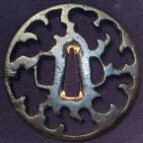
GRC Posted April 1 Author Report Posted April 1 Ok, I suppose there aren't any more people willing to offer a hypothesis, or everyone else is somewhat in agreement with what has already been stated, or just don't know... #1 Apparently made by Higo's Hayashi Matashichi (It's published in the Gustav Jacoby Collection... and if I am reading this google translation correctly, it was once in the possession of the Hosokawa and Nishigaki lineages up until the late 19th century. #2 NBTHK papers to ko-Akasaka (lacking in any sort of useful detail, as usual...) Google translation: No. 4015180 Certificate of authenticity 1. Tsuba (sword guard) with openwork design of ginger and wild goose motifs, unsigned, Old Akasaka. Chrysanthemum-shaped iron base with openwork, rounded rim. The item on the right has been authenticated as a preserved sword fitting by our association as a result of our examination, and this is certified. May 28, 2019 Japanese Art Sword Preservation Association #3 Nishigaki Kanshiro (according to a hakogaki by Sasano. This one is posted on tsuba.info and is listed as 2nd generation Kanshiro in the section on Higo tsuba. I was given the info through messaging with the owner of the tsuba, but I don't have any images to post of the hakogaki. I was also informed that this one has some signs of slight layer separation, opening the door to a possible Akasaka connection And just to muddy the waters.. here's yet another, actually closest to # 2 in that it has the larger proportioned hitsu-ana. #4 It's in the Owari section of Tsuba Shusei (the elephant book), and it describes it as: 65. Myoga and Chidori – A tsuba with a nice texture in a central recess. In an older style. Seppa-dai 3mm, kakumiri 6mm. And just to blur things even more... here's one from illustrations of ancient tsuba on uchigatana, by Keichiro Yokota #5 attributed to Myochin it's back to the smaller sized hitsu-ana but it has some alternate motifs at the top and bottom of the seppa-dai (instead of myoga/ginger), and a few other small embellishments in the way the sukashi elements were chiseled. So to sum up... a mish mash of attributions due to some overlapping physical features between schools and smiths. So we have published attributions and hakogaki to Higo's Matashichi and Kanshiro, ko-Akasaka, as well as Owari and Myochin. Then I also got some suggestions elsewhere for Kariganeya Hikobe as well. So the answer is ... still to be determined I suppose 6 Quote
FlorianB Posted April 1 Report Posted April 1 I had already considered it myself, without coming to a conclusion. Because of the many reproductions of a trendy design it is difficult to determine a school by pictures alone. Maybe the pieces in hand would narrow down a decision. 1 Quote
Spartancrest Posted April 1 Report Posted April 1 (edited) An "Owari" you might notice the birds are inverted - pointing towards the seppa-dai rather than the mimi. https://www.choshuya.co.jp/senrigan/抱茗荷雁金透鍔(鐔) 無銘 尾張/鍔/尾張 Afew in this older thread https://www.militaria.co.za/nmb/topic/44479-wild-geese-in-the-clouds/ Edited April 1 by Spartancrest More history 4 1 Quote
ROKUJURO Posted April 1 Report Posted April 1 Dale, your post implies an important question to me: In what direction do the KARIGANE fly when they are depicted that way? I always assumed the LONGER body part was the tail. Am I wrong? And there are more TSUBA with similar design out there! One from my little collection - no idea where to locate that one! 2 Quote
MauroP Posted April 1 Report Posted April 1 There is great chaos under heaven; the situation is excellent. [Mao Zedong] Maybe the pieces in hand would narrow down a decision? Nope! It isn't science, it's a kind of kult. The experts don't consent even on the kind of birds... (clearly karigane, not chidori, IMHO). 3 1 Quote
Bugyotsuji Posted April 1 Report Posted April 1 Now you have put the cat among the pigeons, Mauro. 2 Quote
Spartancrest Posted April 1 Report Posted April 1 3 hours ago, Bugyotsuji said: cat among the pigeons Well maybe a Cheshire cat amongst the karigane! 1 1 6 Quote
ROKUJURO Posted April 1 Report Posted April 1 Thank you Mauro, of course KARIGANE! I don't know why I mixed that up. The question remains: In what direction do they fly? Quote
MauroP Posted April 1 Report Posted April 1 1 hour ago, ROKUJURO said: The question remains: In what direction do they fly? Looking for auspices ("auspices" means "looking at birds") in tosogu is almost as varied as it is in nature. Birds may fly centripetally, centrifugally, or in circles (sometimes in the same direction, or occasionally in opposite directions). A brief treatise on “Tsuba Augury”: 4 1 Quote
ROKUJURO Posted April 1 Report Posted April 1 Thank you Mauro, I did not formulate my question properly. When KARIGANE are depicted as small symbols, where is their head and where is their tail, respectively? I am afraid I got this wrong in my interpretation, probably the longer body part is the head/neck? In a more naturalistic depiction, it is easy, like on this one below: 2 Quote
GRC Posted April 1 Author Report Posted April 1 1 hour ago, ROKUJURO said: I did not formulate my question properly. When KARIGANE are depicted as small symbols, where is their head and where is their tail, respectively? I am afraid I got this wrong in my interpretation, probably the longer body part is the head/neck? Well, now that you've brought the chidori/karigane issue into question, it's seems like an interesting question that I personally had never considered in this way before. I just always assumed the arc of the wings was the only factor that I ever considered in terms of "flight direction". But maybe your naturalistic goose tsuba might suggest the possibility of a forward facing arc for the wings of geese in flight? Also the head and body of some of these tsuba are relative short and stumpy while on others they are longer and more tapered. Is it just differences in craftmanship or actually supposed to be a different kind of bird? By the way, you weren't the only one to think "chidori" because some of the attributions I posted above did mention chidori rather than geese. I just outright discounted those statements as false and went with my gut that was telling me "geese". 2 Quote
GRC Posted April 1 Author Report Posted April 1 11 hours ago, MauroP said: There is great chaos under heaven; the situation is excellent. [Mao Zedong] Maybe the pieces in hand would narrow down a decision? Nope! It isn't science, it's a kind of kult. The experts don't consent even on the kind of birds... (clearly karigane, not chidori, IMHO). Mauro, your sentiment basically captures one of the principal driving forces in posting this thread in the first place. It's a thought that can't be ignored the more you go down the rabbit hole of trying to sort out the mess of attributions and sometimes outlandish papers that exist (yes, even the new ones... not just the old green ones). Another point that really needs consideration is that the classification system itself is inadequate when it comes to assigning attributions. That's exactly why attributions seems to be subject to whims and fads and "cultism" of sorts. As the system stands at the moment, it's far far away from being a "science". It's only by gathering more evidence and really gathering up a strong database that we'll be able to do enough comparative analysis to really break things down into proper groupings and many more "sub-groupings" than currently exist. Some of these sub-groupings may never get a genuine name to hang on them, but I genuinely feel that could slowly tease out some more specific attributions that could even point to a specific smith's work (regardless of whether they fall under a larger category's umbrella or just shows an "influence" from one or more groups). But hopefully we can put together enough visual resources to point to see to say, "yup this is one of that guy's pieces". One day... but I sincerely hope we can all start slowly chipping away at it, one grouping at a time. 4 Quote
GRC Posted April 1 Author Report Posted April 1 Back to direction of the wings... ughhh I give up LOL Sometimes they appear to have their wings arcing forward, especially when they seem to be taking a power stroke to get going: But then most of time they appear to have their wings arced backward, especially when they seem to be coasting/gliding: And there is also viewing angle and perspective to factor into it, which could alter the viewer's perception... so, um 4 Quote
GRC Posted April 1 Author Report Posted April 1 Oh and back to schools issue...pertaining to these specific tsuba. There was a significant amount of overlap and cross-pollination, including direct contact between smiths among the Akasaka, Tosa Myochin and a strong stylistic pull for both of those groups toward the Higo Kanshiro, so it's no wonder all these tsuba have very similar characteristics, but are getting all these different labels. Even some late Edo period Tosa smiths were known to work in an earlier ko-Akasaka style (but usually with their own twist, rather than just doing rote utsushi copies). There's a really interesting and informative article that describes the detailed nature of this stylistic "entanglement": A Story of the Tosa - Myôchin 土佐 明珍 By Mark Ceskavich JSSUS Newsletter Volume 50, no.3, 2018 3 Quote
ROKUJURO Posted April 1 Report Posted April 1 15 hours ago, Spartancrest said: An "Owari" - you might notice the birds are inverted - pointing towards the seppa-dai rather than the mimi. ..... I was referring to Dale's post above. Maybe we can find out how it is thought to be seen the Japanese way. Quote
MauroP Posted April 1 Report Posted April 1 Love the discussion, although I’m not very confident that we can eventually arrive at a solid understanding of tsuba attribution to a specific school. So, let’s get back to the details, which may become clearer as our thinking progresses. Let’s try to move from naturalistic to more abstract representations of wild geese: Now it’s quite clear how the more abstract pattern is oriented. 5 1 1 Quote
Spartancrest Posted April 1 Report Posted April 1 (edited) https://www.jauce.com/auction/s1224988813 a close look at the left hitsu and you get another "cat face" - a bit chubbier maybe we can classify a whole new style of hitsu by the type of feline species? Perhaps Dobby wearing some cat ears on the right? And yes there is a cat called "Dobby" he has FOUR ears - Edited April 1 by Spartancrest More images 1 1 Quote
Bugyotsuji Posted April 2 Report Posted April 2 Birds in sukashi tsuba must help provide strength to the construction, but surrounded by air, still be recognizable as birds (in flight). When there are numbers of them, as we observe them in the sky, first impressions will be important, especially so for the artisan since each has to be carved/cut out, in balance/harmony with the others depicted. Certain birds had symbolic meanings, so certain features may have been tokenly emphasized, but rarely in any sense accurate to nature. Each artisan may have had a quick formula, and then we find a lot of artistic crossover over the centuries, so pinning exact species down will be a rabbit warren. Bird representations can range from the general, as children draw them, to the exquisitely detailed as in Jean's geese above. Even so, the quick formula 'bird in flight' shape may be key to finding a particular tsuba artist within a 'school'. Kyoto Daigoro? 2 Quote
Spartancrest Posted April 2 Report Posted April 2 6 hours ago, MauroP said: let’s get back to the details, An inlay design to add to your group of images - the birds face right and left "outward" to the rim 1 1 Quote
FlorianB Posted April 2 Report Posted April 2 10 hours ago, GRC said: Another point that really needs consideration is that the classification system itself is inadequate when it comes to assigning attributions. Didn’t we already have the whole discussion in 2024? Good to remember the imperfection of the entire classification system but I can’t see any progress in creating a new one. Until then for the most of us it seems the easy way to stick to the existing one. I must admit the mass of crossovers and copies of a certain design are not helpful and – sorry I stubbornly repeat it – pictures alone are not sufficient. Concerning birds and the direction of flight: I believe that in most cases geese are depicted because they have a significance in Japanese culture. We know that geese are leaving Japan in autumn and coming back in spring and thus the motif is used in Haiku as a „kigo“, a word wich indicate the season. I think those birds are flying outwards are leaving, those with flight direction inwards are coming. Another aspect is their regular formation in flight. This could be the reason for the use in a regular pattern especially in the abstract works. In other cases certainly other birds could be assumed according to the motif (i.e. bamboo and snow are connected with sparrows). 3 Quote

Recommended Posts
Join the conversation
You can post now and register later. If you have an account, sign in now to post with your account.