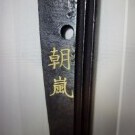
Volker62 Posted 22 hours ago Report Posted 22 hours ago a blade attributed to Naoe shizu Kanenobu refers to the lineage of swordsmith from the Naoe shizu shool (a branch of soshu tradition) Namboku-cho perode (14century) classic shizu style with a nickname kin zogan Gold inlaid signature " Asaraashi Moring storm" Theb Name Asaraashi /morning storm in this case, refer's to sharpness of this blade, whose cutting power is so pure and unstoppable that it leaves no traces 2 Quote
eternal_newbie Posted 22 hours ago Report Posted 22 hours ago If this topic interests you, @Hoshi and @Markus have an excellent Substack entry on the Ochiba ("Falling Leaf") Sanekage: https://nihontology.substack.com/p/the-falling-leaf Quote It is thus possible that the Ochiba name of the blade in question was not coined because it cuts so effortlessly like leaves falling off trees in a breeze in autumn, but as a reference to said story, meaning that the blade cuts so powerfully that it makes leaves fall off from trees… 1 Quote
Volker62 Posted 22 hours ago Author Report Posted 22 hours ago Rohan Asaraashi means literally "morning storm" and refers to strong storms in the morning which make it impossible for fresh snow to remain on moring peak's. but it can also refer to a heavy storm which makes you slip and fall on a wintery mountain, so we basically have here the same allusion as the nickname "Sasanoyuki" 1 Quote
OceanoNox Posted 19 hours ago Report Posted 19 hours ago https://ja.wikipedia.org/wiki/へし切長谷部 Heshigiri Hasebe is a national treasure on display in the Fukuoka Museum. The story goes that a servant was rude to Oda Nobunaga, who wanted to punish the servant. Said servant fled and hid under some kind of furniture. So Oda cut him by pushing the sword into him, not by swinging. Hence the name "Heshigiri" (cut by pushing). 1 Quote
Okan Posted 19 hours ago Report Posted 19 hours ago @Volker62 2 more blades with the same nickname. Bizen Osafune Katsumitsu Asa-arashi Owned by Matsushita Masatoshi Auspicious day in the 8th month, Eishō 1 (1504) Asa-arashi Ōwaki-ke futatsu-dō kiri-otoshi (cutting through two torsos at the underarm) Owned by Maejima Hachirō Signed Tomotsugu (kaō) 1 Quote
Alex A Posted 11 hours ago Report Posted 11 hours ago Have to ask. Regarding gold inlay "nick names". Any way to authenticate? Quote
Lewis B Posted 11 hours ago Report Posted 11 hours ago There is also a Kotegiri-Masamune https://markussesko.com/2013/06/25/the-kotegiri-masamune/ 1 Quote
ROKUJURO Posted 7 hours ago Report Posted 7 hours ago https://japaneseswordlegends.wordpress.com/2015/10/01/the-heshikiri-hasebe/ Quote
eternal_newbie Posted 3 hours ago Report Posted 3 hours ago 7 hours ago, Alex A said: Have to ask. Regarding gold inlay "nick names". Any way to authenticate? Not really, since anyone can call a sword whatever they want. As we've seen, there are several blades bearing the name "Asa-arashi"; there are also three distinct "Hocho Masamune", and many others. Sword names can also change, based on their owners or the circumstances around them. What you can do, with a great deal of research and historical records, is trace the history of a particular meito, as @Markus has done many times in his great blog (and subsequent two books): https://japaneseswordlegends.wordpress.com/ 1 Quote
Alex A Posted 1 hour ago Report Posted 1 hour ago Aye, famous swords do tend to come with more traceable history and provenance. Looks a good read that, thanks. 1 Quote
Rivkin Posted 13 minutes ago Report Posted 13 minutes ago (edited) There is an issue that only handful (truly handful) of blades today have continuous history established prior to 1550. So if the name is older than that, whether its indeed the same blade or not is often unproveable. Sometimes it gets funnier - until Meiji it was one (or many) blades that were associated with the name, today its one - but its not obvious that the one selected for the role Meiji and later is actually the best fit... Edited 6 minutes ago by Rivkin 1 Quote
eternal_newbie Posted 4 minutes ago Report Posted 4 minutes ago 6 minutes ago, Rivkin said: So if the name is older than that, whether its indeed the same blade or not is often unproveable. Especially with attributions changing over the times... e.g. Markus theorizes that the "Kotegiri Masamune" may once have been the "Yugakegiri Sadamune". Quote

Recommended Posts
Join the conversation
You can post now and register later. If you have an account, sign in now to post with your account.