Nobody Posted September 30, 2006 Report Posted September 30, 2006 The following picture of Tsuba can be seen on the site of National Died Library. The picture was drawn before 1859. Do you know what the sheet is? I know the answer. Quote
Bungo Posted September 30, 2006 Report Posted September 30, 2006 The picture was drawn before 1859.Do you know what the sheet is? I know the answer. if it's before 1859, then the sheet is mulberry bark paper. milt THE ronin Quote
Nobody Posted September 30, 2006 Author Report Posted September 30, 2006 if it's before 1859, then the sheet is mulberry bark paper. The point of my question is the purpose of the picture. English is always difficult. Quote
Nobody Posted September 30, 2006 Author Report Posted September 30, 2006 maybe Ukiyo-e model?Mike Hi Mike, It is unrelated to Ukiyo-e. Quote
pcfarrar Posted September 30, 2006 Report Posted September 30, 2006 A catalogue from a shop showing the designs that they sell? Quote
Carlo Giuseppe Tacchini Posted September 30, 2006 Report Posted September 30, 2006 Visual glossary for Tsuba's shapes in a Kodogu book ? Quote
Bungo Posted September 30, 2006 Report Posted September 30, 2006 upper right corner says............ daisho tsuba ? doesn't make sense there you already mentioned the year ( also appeared on upper right side )............. so my guess is , like others already mentioned, this is a page of catalog showing what tsuba is available. Milt THE ronin Quote
Nobody Posted October 1, 2006 Author Report Posted October 1, 2006 Hi, Catalog is not a bad guess, but it is not the right answer. Here are big hints. There are two types of Tsuba on the picture. The motifs of Tsuba have common characteristics. There are twelve Tsuba(s). Quote
Bungo Posted October 1, 2006 Report Posted October 1, 2006 Here are big hints. There are two types of Tsuba on the picture. The motifs of Tsuba have common characteristics. There are twelve Tsuba(s). twelve months of the year.... each represent a month............. piece of monchi ( or as we say here in the land od the Barbarians....... piece of cake !! ) Milt THE ronin Quote
Bungo Posted October 1, 2006 Report Posted October 1, 2006 6 shows the seppa dai clearly while the other 6 have the kozuka and kogai ana's( which incidentally resembles the kanji sho )........I really don't know what this means............ p.s. the design of some of the tsuba is not very good........ milt THE ronin Quote
Nobody Posted October 1, 2006 Author Report Posted October 1, 2006 twelve months of the year.... each represent a month............. piece of monchi ( or as we say here in the land od the Barbarians....... piece of cake !! ) Milt THE ronin Hi Bungo, Bingo! Almost correct. :D Further, the picture had a specific practical purpose. Does anyone realize? Quote
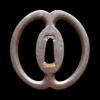
Nobody Posted October 1, 2006 Author Report Posted October 1, 2006 So, each Tsuba represents each month of the year. There are two types of Tsuba. As for one type, Nakago-ana and double Hitsu-ana look like a Kanji 小 (sho) which means small. BTW, lunar calendar (actually luni-solar calendar) had been used until 1872 in Japan. Quote
Nobody Posted October 2, 2006 Author Report Posted October 2, 2006 This is the answer. The picture is a calendar for 1859 (安政六巳未年). The calendar shows hollow months and full months of the specific year. A lunar calendar (actually luni-solar calendar) had been used until 1872 (明治五年) in Japan. The average length of a month was about 29.53 days. The actual length of a month was 29 (hollow month) or 30 (full month) days. The first day of the month was determined by dtermining the day during which the moment of new moon arrives. As a result, a leap month was necessary to be added every two or three years. Also, the permutation of hollow and full months was not fixed for each year. So, it was necessary to show the order of hollow and full months for every specific year. The upper right on the picture reads 大小鍔 (large tsuba and small tsuba). On the picture, small tsuba are expressed as tsuba with double Hitsuana. The small tsuba represent hollow months and the large tsuba represent full months. Each month can be identified with its unique motif as well as the order from upper right to lower left. Ref. National Diet Library http://www.ndl.go.jp/koyomi/nazo/01_bsall_c.html FYI http://en.wikipedia.org/wiki/Lunar_calendar Quote
Mike Posted October 2, 2006 Report Posted October 2, 2006 Thanks, that was educating. Same system is in use until now for Jewish calander. Here in Israel we are using both Gregorian calander and Jewish calander. Mike Quote
Brian Posted October 2, 2006 Report Posted October 2, 2006 That was an excellent and very informative post. Very intriguing to see how tsuba could be used in relation to a lunar calendar. Thank you for that interesting quiz. Brian Quote
Carlo Giuseppe Tacchini Posted October 2, 2006 Report Posted October 2, 2006 Interesting and... Diabolic! :lol: Quote
Bungo Posted October 2, 2006 Report Posted October 2, 2006 the kanji " daisho " at upper right corner puzzled me..........now i know why. Seppa dai............. dai the koz + kogai hole make up the kanji..........sho quite ingenious. I recall , as a kid growing up in the East , we used our knuckles to remember those " dai ( 31 days ) and sho ( 30 or less days ) months............ milt THE ronin Quote

Recommended Posts
Join the conversation
You can post now and register later. If you have an account, sign in now to post with your account.