sanjuro
-
Posts
2,100 -
Joined
-
Last visited
Content Type
Profiles
Forums
Events
Store
Downloads
Gallery
Everything posted by sanjuro
-
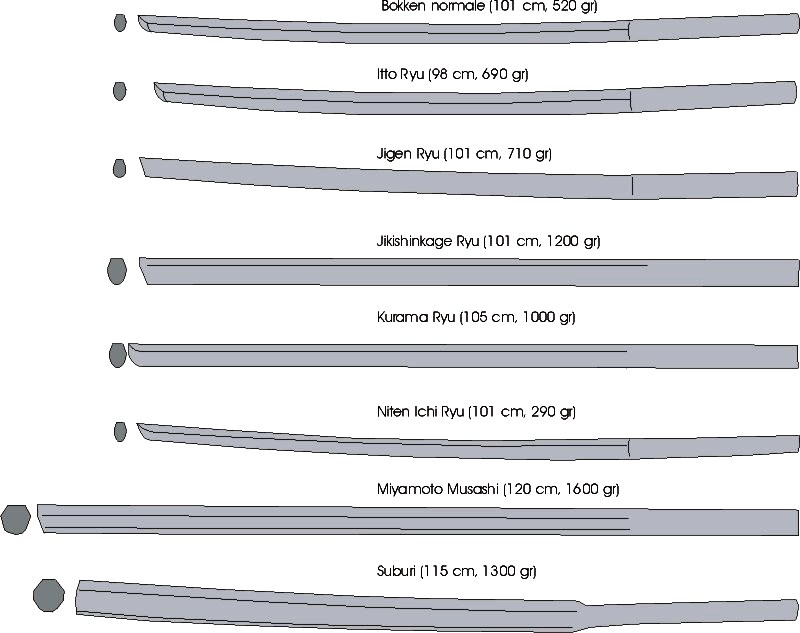
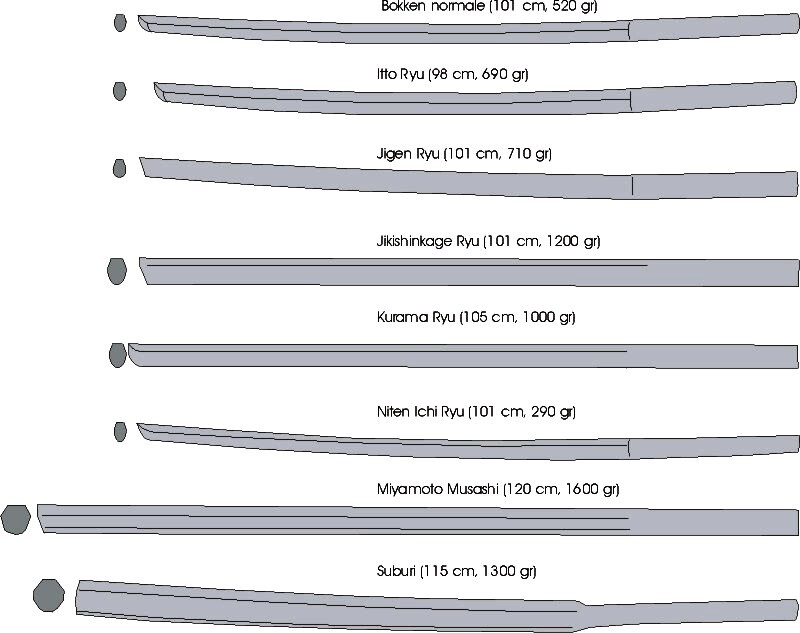
Gentlemen. If I may add my two cents worth: Of the many martial ryu that practice kenjutsu, only two stand out as having a straight bokken. The Jikishinkage Ryu and the Kurama Ryu. The Miyamoto Musashi Ryu also has a straight bokken although the Niten Ichi Ryu which is also associated with Miyamoto Musashi as its founder, uses a curved bokken. The rest all use a curved bokken. That is to say their bokken are curved to a greater or lesser degree depending upon the Ryu. These however are all special to the individual Ryu and are used only within the Ryu itself. The most widely accepted bokken is a curved oak weapon. We did have a thread about bokken a while back where a chart was published giving the various types, but damned if I can find it now. Below is a copy of the chart. I am sure Clive or Ken will correct me if I am amiss, and I mean no disrespect to the art of kendo in this observation, but Kendo as it is practiced today is more of a sport version of the the original swordsmanship practices of the samurai. Its a long time since I practiced it, but as I remember, it admits only one thrust (to the throat) and a single cut to the torso ( and I think also one to the wrist) and consists of mostly attacks to the head with a men cut. The cuts are delivered as a blow or a pushed cut (full contact) rather than a drawn cut. These are directed against a limited number of target areas on the body which are all armoured. Kenjutsu however,(with which I am far more intimately familiar), being a more complex martial art in itself, consists of an almost infinite variety of drawn cuts, dragged cuts, thrusts and slashes as well as tsuka strikes to various parts of the body. It is generally practiced as kumitae without armour (and minimal contact). The differences between Kendo and Kenjutsu are legion, although they both deal with swordsmanship at quite different levels they are complimentary to the art of swordsmanship overall.
-
Publish and be damned, I say. If there is such a law, it is broken a thousand times a day on the internet. So, can we save the armchair lawyer opinions and get back to the topic please? It was after all, about katanakake not copyright laws and the internet.
-
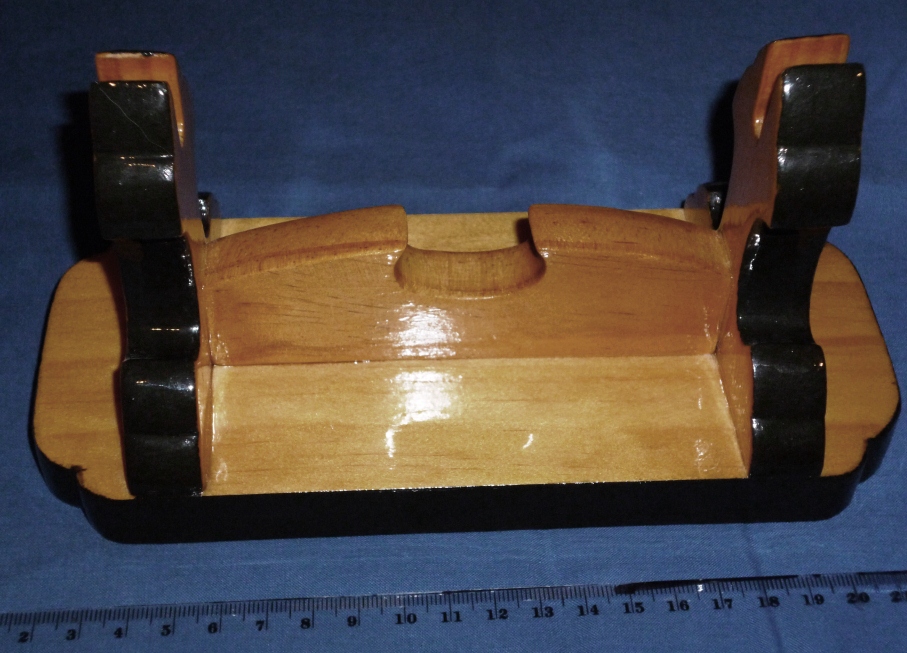
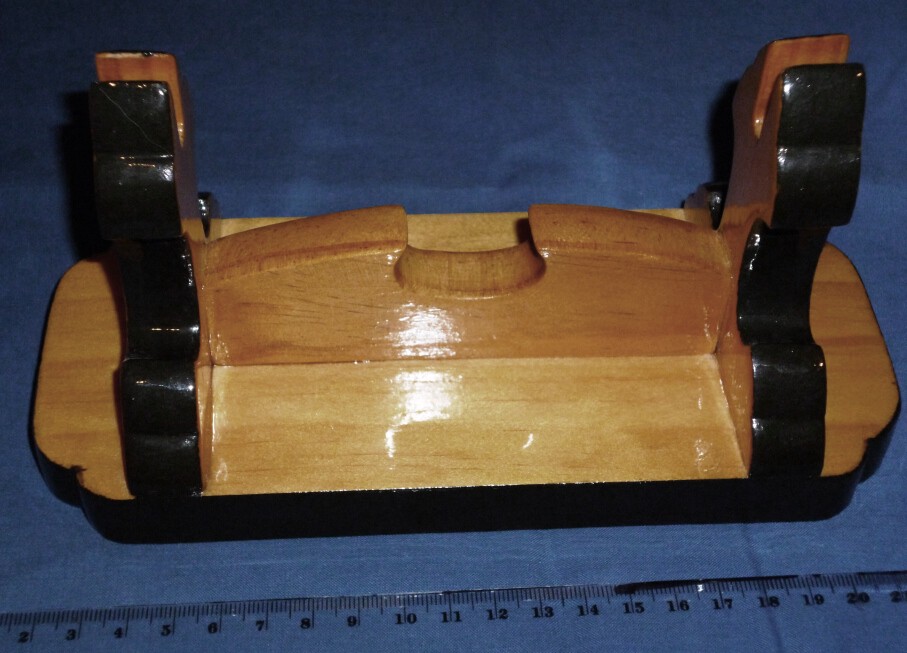
Whilst we are on the topic, has anyone ever seen a stand that is intended just for a naked blade? The pic attached is of one that I have which is just a copy I made of an old one my sensei used to own. I use this for when I need somewhere to put the blade during cleaning, when I need both hands free (Putting oil on cloth, refolding washi paper etc). I have never seen similar for sale. What would this be called in Japanese (apart from a crappy copy by a dumb Gaigin).
-
Guido. A very elegant katanakake/daishokake if I may say so. Do you have a 'thing' for the Tokugawa or was the specifics of the mon decoration merely an accident?
-
Cheap stuff aint good and good stuff aint cheap. What can you possibly learn or what lasting joy of ownership can you gain from a faulty blade that has an ugly flaw? You will always see only the faults and flaws that you have described, not the sword that it may once have been. In the rush to buy something because you wish to own a nihonto (any nihonto), coloured by the desire to get your hands on a bargain, you will only burn good money that can be better used on books or ultimately put toward a better sword. Now you have both clarity and logic that conspire to say "DONT BUY IT".
-
Thanks Franco...... Did you know there are actually living lizards called water dragons that are a popular pet????? There are dozens of the little critters for sale on the net. The search however did reveal some interesting stuff when I altered the search criteria a bit. Just to cap off the subject, the menuki are now in hand and are definitely iron, duly confirmed with a magnet, with gold nunome overlay. Not quite as crude as they appear in the sellers pics. Definitely in need of some TLC, but not beyond bringing back to some semblance of originality with a little careful attention. Maybe earlier than Edo, but not sure yet. This is a learning curve for me, Tosogu is not my area of expertise. Pics if interested when all the crud and rust have been minimised. Advice from 'those in the know' on how that may best be done would be most welcome. :D
-
Or better, just to leave it alone when you dont know what you are doing. Sword polishing is not a recommended area for experimentation. If the blade is worth the polish then give it to a polisher...... :D
-
Eric I'm not downgrading all lacquered katana kake as garish at all. I have seen some very tastefully lacquered katana kake. My argument is with the ones that are garish and the rather tasteless effect they have on a display of decent quality koshirae. What I consider garish and what you consider garish may differ of course and you have every right to admire whatever you consider to be high quality. Just for the record, I do not own a daisho (Nor do I wish to). My permanent collection consists almost entirely of tachi, about half of it in shirasaya. I have only two katanakake which are quite plain, one lacquered and one in unlacquered zelkova wood. I doubt you or any of the NMB members would find either of them remarkable.
-
Really, Eric????? Most of these garish katanakake were made mid to late Edo period, when most samurai were in hock to the rice merchants and there were very few rich samurai. In fact there were more merchants wandering around wearing swords than there were samurai. As to the westerners who suffer equally from bad taste as the Edo merchant class did... Well you made the call.... :D
-
Malcolm The deer antler racks are also widely used to rack other things. I have seen them used to rack flutes, parasols and walking canes also. As a katanakake they are often unsuitable as the fork in the antlers is too wide to support the saya without it leaning somewhat either to the front or the rear. Usually however, if it looks like a katanakake it probably is a katanakake. I must agree with Barry however, most katanakake are too garish. A true sword connoisseur would not display his swords on a katanakake that competed with the koshirae it supported for the eye of the viewer. :D Western tastes however sometimes run the other way and we see garish katanakake overpowering the koshirae that stands upon it. Given that most Koshirae are relatively restained in their decoration, the combination of an elegant koshirae racked on a heavily decorated and garish katanakake is very bad taste.
-
Guys. As their new custodian I too would like to know what the relevance of rain dragons is..... I believe they are also sometimes called smooth dragons, but references to them are not exactly prolific. Anyone with the information I seek and a willingness to share it with me will be very kindly thought of. Although I have been a nihontophile for many years, this is actually the first pair of menuki I have ever purchased purely because I like them. OK....... I have slightly wierd taste, but they are rather unusual. :D
-
Brian. I dont doubt that throughout history such a method of carrying a sword has been utilised with or without the benefit (read that as the inconvenience/aggravation) of standing orders. After all, some of the greatest innovators known have been soldiers in the field. Our military histories are littered with soldiers who made their own decisions concerning things with far more serious ramifications than the mere official method of carrying a sword. Its called initiative I believe. :D In my experience soldiers left to their own devices usually come up with the most efficacious way of achieving the desired result, often by working their way around the technicalities of standing orders and official edicts.
-
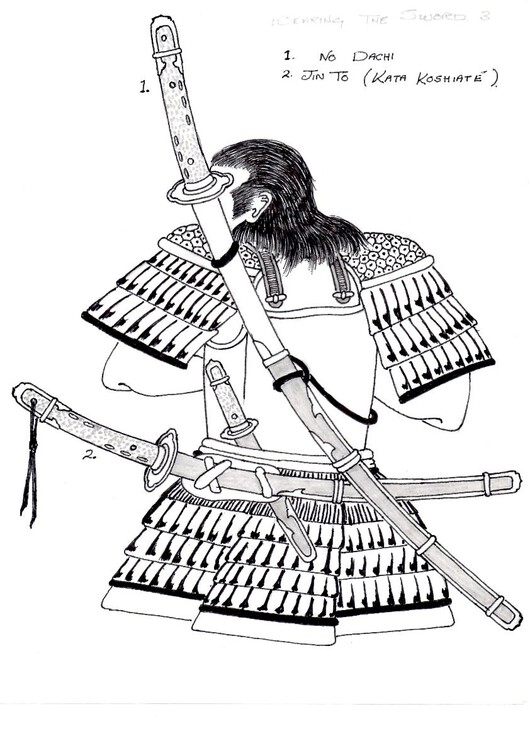
There is in fact a long tradition of swords being worn across the back by samurai on campaign, when in rough country, on lengthy marches and also on horseback etc. Nodachi were carried this way on horseback as far back as the nanbokucho and before. There isnt really much that is new in the variety of ways swords were carried, particularly since a samurai often carried more than one sword. A katana is not difficult to draw from this position (Hilt over right shoulder) as Thomas has observed. Drawing this way actually provides a very powerful single handed downward cut. Noto is a bit tricky though. Even a standard mounted katana with sageo and kurikata can be rigged to be worn this way very easily. Think of a rank of men in close order all wearing swords...... What would be the most comfortable and least troublesome way of carrying the sword over any distance?
-
Reihard. It beats me why you bother posting at all. For a man that holds so much knowledge, you seem only capable of arrogant, pointless/sarcastic observations. What a chronic waste!
-
It seems to me that the objective of research is to have it reach a fact based conclusion at its completion. To conduct research with the purpose of having it prove a conclusion that you have arrived at prematurely, is to limit its purpose and defeat the purpose of research itself. A researcher begins the task with a question he wishes to answer. Only at the completion of the research will he find the truth defined by the breadth and depth of his research regardless of any preconceptions. It is not important whether Adrian is correct at this point in his research or not. What is important is that he concludes the research with an open mind prior to announcing any conclusion it has led him to. Logically, only then are the facts he presents open to discussion and possibly to contention. Adrian: Take the entire journey without prejudice and by all means tell us the purpose of it and perhaps the ports of call along the way prior to announcing its ultimate destination and conclusion. The facts you discover may remain constant but your interpretation of them in the light of more complete knowledge may alter before jouney's end. It is disappointing that this thread is rapidly declining to the level of sarcasm and counter sarcasm. I would rather have had it be more productive with the massive engine of knowledge that this forum commands providing a balance of views rather than a meat grinder of derision.
-
Guido. You surprise me! I would have thought you would know in what way menuki effect swordsmanship. It goes like this: The collector /martial artist should never use a set of antique menuki on his training blade because when he has a set of antique high quality menuki in hand, the collector part of him goes weak at the knees and everyone knows you cant practice iaido et al if you are weak in the knees. :D (No danger of that with this set though).
-
Adrian. One wonders if you have been in contact with Carlo Tacchini of this forum? He has researched somewhat in this same area and has published work on his own website. He is also the source of the reference given above by Eric H on another forum. If memory serves correctly, he can be reached and his material downloaded on the tsubame website.
-
Just to continue this thread toward some sort of conclusion, I have just become the owner of these unusual menuki. The seller assures me they are indeed iron with a gold/gold alloy overlay. When they are in hand, I shall determine this one way or the other and report to those who may be interested.
-
Adrian. For what my opinion may be worth, I enjoyed the article immensely. Thank you..... Please keep us posted on your continuing research and findings. Theres also nothing wrong with your line of speculation concerning the origins of Masamune. It may not fall into line with the conventional Japanese view but it asks a very pointed question that deserves an answer.
-
Eric. If these belonged to the Uragami family then a check concerning their battle standards and sashimono design would tell you what you need to know concerning this being a sashimono terminal. I cant find anything in my sources.
-
Adam. Thank god someone doesnt take me too literally..... :lol: You do however bring to mind something that has always been in the back of my mind to clarify. As a daisho is displayed on a katana kake as a matched pair, and a tachi was often paired with a tanto, what would be the correct way to display a tachi and tanto pair either mounted or otherwise. I have never seen a stand meant specifically for the purpose. I'm in mind here of the fact that both a tachi and a tanto are often displayed singly on separate stands. How are they correctly displayed together? More to the point are they intended to be displayed together?
-
Adam My bad....... You have taken me very literally. The reference to the torii arch was only a general one. I refer to the overall resemblance of the arrangement, not the particular curve of a torii arch. One should really never display any blade edge down on a rack, and although it is permitted with a mounted tachi, it is only so when there is no tachi kake available. A mounted tachi is usually displayed alone or with another tachi on a katana kake, and not usually displayed as a daisho pair with a wakizashi. The two are generally considered incompatible on the same stand. It tends to look messy as you point out because one would be edge up and one edge down. On the other hand when in shirasaya, a tachi is displayed edge up. I doubt there are hard and fast rules with blades in shirasaya because shirasaya are considered as a storage mountings and not really intended for display.
-
I have always understood that tsuka to the right is not so much aggression as such, but more indicative of preparedness or mistrust. The right hand orientation came about during the warlike periods of Japanese history (which is just about all periods prior to the mid Edo), and applies to fully mounted blades. One had to be ready to fight pretty much anytime. A blade in shirasaya is more usually oriented with the tsuka to the left since it is not considered to be in an immediately usable mounting. Its a matter of choice which sword is displayed on top, although a fully mounted set of blades kept on a rack inside the house with the swords oriented tsuka to the right, would have been most likely arranged with the wakizashi on the upper rack since it is thought that this is the blade easiest to use indoors. We have however already had that particular discussion I think. Given my own preferences I'd rather have the longer blade on top, since the arrangement then proportionally resembles a torii arch.
-
Piers. I like it! Wavy line looks original..... Have no idea why, but no matter. Its a curio of indeterminate worth and I wish it were mine. :D (donations gratefully accepted since I have blown my budget for acquisitions for the rest of this year).
-
Need help to verify sword - SHIMADA SUKEMUNE
sanjuro replied to NihontoEurope's topic in General Nihonto Related Discussion
Martin. I think that perhaps an attribution to a school is about the most you can hope for. But good luck anyhow. Be sure to post the results :D