


sanjuro
-
Posts
2,100 -
Joined
-
Last visited
Content Type
Profiles
Forums
Events
Store
Downloads
Gallery
Everything posted by sanjuro
-
Theres not a great deal of traffic on the forum at the moment, and a question has been in mind for while now. How do YOU collect? Not what, nor who you deal with, but rather your method of collecting. How do you select an item for your collection? What criteria do you apply to a possible acquisition, and then when you have acquired it, How do you proceed to study it and install it in your collection. Is each item a seperate entity or is your collection itself the entity and each item a part of the whole? I fancy we each have our methods and criteria and that no two are completely identical. Its not a competition and there is no wrong or right way. Please feel free to share as I will do if this thread attracts any response.
-
Hi Charles. May I suggest you have a word with Andy Mancabelli at Yamabushi Antiques. The contact for the site is in the links section at the head of this page. Just go to the site and email him from there. Andy is probably one of the most knowledgable guys when it comes to Katchu, and he restores armours being himself trained in Japan. He will also know of other restoration houses if he cant help you any other way. Its a good place to start. :D Good luck with the restoration.
-
What do you think about that offer?
sanjuro replied to Drago's topic in Auctions and Online Sales or Sellers
Agreed Chris. A posting in the wanted section of this forum may also yield better possibilities than the 'blind buy' of an on line auction. Nobody on the board is going to sell you a bad sword. -
What do you think about that offer?
sanjuro replied to Drago's topic in Auctions and Online Sales or Sellers
Thats fine. Something that was said to me you might find helpful when you get enthusiastic about a sword. Swords are like horses. A good horse is never a bad colour, and a good sword never has a bad hamon. Look at all of the blade and the steel activity in the hada not just the pretty pattern on the hamon. Take your time........That pause while you consider the entire sword may save you from buying a dud. -
What do you think about that offer?
sanjuro replied to Drago's topic in Auctions and Online Sales or Sellers
Drago. Considering that for this price and a little careful shopping, you can buy a katana without flaws as opposed to a wakizashi with flaws, one wonders why (apart from the burning urge to own something that is acceptable as a nihonto), this particular unremarkable and flawed blade appeals to you. I'm not trying to be condescending, nor am I disputing your choice, but rather trying to see in this sword what you see and what draws you to it. -
What do you think about that offer?
sanjuro replied to Drago's topic in Auctions and Online Sales or Sellers
Are you buying a sword or a nice looking piece of steel with a swordsmiths signature on it? The signature is a secondary consideration to the sword. The sword confirms the signature, not the other way around. This is possibly why you are under the impression that its unnecessary to know a lot about swords in order to buy one. -
What do you think about that offer?
sanjuro replied to Drago's topic in Auctions and Online Sales or Sellers
Tobias. The sword in question has a crack and what appears to be an open fold, both situated in the ha at the monouchi. Neither of these are desirable in a blade. Personally I wouldn't touch this sword with a barge pole. 1.The seller is known to deal in less than high quality items. Most of his stuff is very average. 2. You are contemplating buying something on ebay when you are not really conversant with nihonto terms and obviously are not highly knowledgeable, and cannot tell a good blade from a mediocre one. It is not surprising under these conditions that most of us would advise you to gain more knowledge before buying and that buying on ebay for a beginner is extremely risky. Enthusiasm is one thing, but exposing yourself to this level of risk at your level of knowledge is quite foolhardy. Knowledge should precede aquisition and dealing with a reputable dealer will be a much less harrowing and potentially expensive experience. There are better blades to be had at similar prices and lesser risk. Sounds like gruff advice? Its not.... Its merely the truth -
I too tend to only wipe my blades with alcohol and apply a new coat of oil for normal cleaning. (I refer here to blades in full polish). Only once a year do I use uchiko and then it is removed with a light touch before reoiling. This is all a sword that is not in use needs. I have heard of the method that Barry detailed, but to be honest, it seems rather foriegn to me having been taught to apply uchiko along the shinogi on both sides by my sensei years ago. For swords in a lesser state of polish, the use of uchiko is dependant upon the result you wish to achieve, sometimes the use of uchiko will actually improve the polish by restoring it to a degree. Mainly however, since it is an abrasive, it dulls a polish with frequent use and heavy handedness and frequent use with uchiko will definitely ruin a good polish over time. I make my own when needed, and have always done so, using uchiko powder that I obtained directly from a togishi. I force filter the uchiko powder twice through silk before making up the ball so as to remove any gritty bits. Personally I would not trust any of the proprietry uchiko balls no matter how expensive they were. One simply cannot be certain what the ball contains as "Uchiko".
-
Jan. Just for the hell of it, first of all how would you describe it?
-
Look again George..... Look at all the characters not just the mitsu character. You are the victim of a messy mitsu. Hmmmm... Good name for an incompetent Tosho ....Messimitsu. :D
-
George. The original of the pic (whichever one it is) has been flipped thus reversing it, rather than revolved which would not have reversed it. At least it appears that way to me.
-
Chances are that you wont. The cost of the polish and repair added to the cost of the original sword, even given that it is a genuine mei, would still likely not be recoverable. If this is a consideration in the purchase then research the market price of blades by this tosho or similar, prior to spending the money on it or on any restoration of it.
-
Traditional Japanese Polish
sanjuro replied to drbvac's topic in Sword Shows, Events, Community News and Legislation Issues
I'm just thinking out loud here, Read this as ('rationalising his own epiphany'), so correct me if I am thinking amiss. If you are following 'tradition' then traditionally speaking, a sword was only polished if it was blunt, damaged or rusty. In fact polishing is really an extension of the process originally used to put a fine edge on the blade. Assuming that the sword you have is suffering from none of these, then you are breaking with 'tradition' by polishing that sword solely to bring out its blade qualities. You are in effect sacrificing tradition for art. If so, then why not get the most appropriate polish to achieve that end? -
The koshirae is also a very poorly cast version. Tsuba and fuchi are quite primitive. As far as the blade is concerned there seems to be a very wierd hamon (if it is a hamon) that wanders all over the place. It occurs to me that if it is a late war specimen, then why wrap the tsuka ito over a bare tsuka or a tsuka that at least has no same'? Too many things dont quite add up.
-
a Bunchin for a Munchkin??????......... Maybe not. Perhaps it was once set into something, a rim that carried some attachment device like a brooch.
-
Traditional Japanese Polish
sanjuro replied to drbvac's topic in Sword Shows, Events, Community News and Legislation Issues
Chris. Not so much 'the scoop' as you put it. I asked him that he keep the information fairly simple (I'm only a collector after all), and I am still trying to process all that he told me. It isnt a simple subject by any means as you know. The effect that it has had however, is that I am now rethinking my former preference for sashikomi polish. Yes, its a stylistic choice but it is so much more than that and one would be a fool to not listen to a togishi when he says your sword would take this or that style of polish better. At the end of the day the style of polish is suggested by the sword itself, and for the sword to suggest a sashikomi polish over a hadori finish there must be certain criteria to be met by the sword. Those criteria are what drives the togishi's recommendations concerning the type of polish. Comparatively speaking, few swords demand a sashikomi polish to the exclusion of a hadori polish. Not really a scoop........ an awakening (at least for me) perhaps. The 'traditional' thing is something else.... dependant upon what you think traditional really is. In fact, traditional is not polished to the point where you can clearly see blade features. Swords are weapons and you dont need a shiny blade with a flashy hamon showing in order to chop someone into dog meat. Polish to any artistic degree is not traditional in real terms. -
Thanks Chris... I was racking my brains for that word. :D
-
Traditional Japanese Polish
sanjuro replied to drbvac's topic in Sword Shows, Events, Community News and Legislation Issues
Brian. In all fairness to the togishi, this was in fact not said at all. The statement was to the effect that few still can perform a sashikomi polish, not that they had 'no idea' of how to perform one. It is more a matter of practice than of knowledge. I have it on fairly good authority that Apprentices to Japanese togishi are still taught how to do a sashikomi polish although they are not often called upon to do one, and most educated collectors leave the style of polish up to the togishi in any case. The Hadori polish is usually recommended/preferred for all the reasons stated, and it is only for particular swords that a sashikomi polish is actually a better choice of polish and would be recommended, again for the reasons already stated. How did I get suddenly educated you may ask, since I was the one asking the question about the differences in the two types of polish? .............I emailed Japan (several emails actually) and asked a togishi....... (Actually, I asked his apprentice) :D I also copped a fair lecture on Nioi and Nie which apparently is the crux among other considerations, of why one polish is preferred over the other. Incidentally, Thanks to Guido for pointing me to that article of his.... It was that which prompted me to email Japan for further clarification. -
As a wild stab in the dark. I would guess this to be a paper weight like the ones they use in calligraphy. It obviously doesnt fit on anything yet it appears more robust than a mere decorative plaque. It was obviously meant to be admired and the work seems quite good. Yep...... paper weight, or whatever the Japanese name is for one.
-
Traditional Japanese Polish
sanjuro replied to drbvac's topic in Sword Shows, Events, Community News and Legislation Issues
Dammit Chris! ..... Where the hell am I going to find a traditionally trained polisher on this board????????? :D Just kidding ...... Dont shoot me. Perhaps a polisher (recognised but not necessarily traditionally trained) out there would care to answer my question and enlighten me. -
Traditional Japanese Polish
sanjuro replied to drbvac's topic in Sword Shows, Events, Community News and Legislation Issues
Chris. An obvious question perhaps, but the answer to which may add some perspective to the thread. Why? By this I mean what are the difficulties or differences (apart from the use of hadori) In a sashikomi versus kesho polish ? The same or similar stones are used surely, and the stages of polishing are the same or similar (possibly fewer in the case of sashikomi). I'm assuming here that its the last stage of polishing that is fundamentally different or more complex. I'm not getting into the merits or demerits, just the practical differences. With luck I'll get an answer to this before the usual sh*t fight over polishing starts, and the thread gets closed. For some reason, polishing is the least understood yet most divisive subject among collectors. -
For what its worth, so do I.
-
Could be coincidence yes, though I tend to think not. Theres one thing you should take into account here though........ Franco (Nagamaki) and Jacques are infinitely better than me at kantei. I'm learning from them too. Thats why I ask so many questions, and perhaps challenge their opinions a little. This isnt a competition, its a classroom. :D
-
Heres the tanto I was comparing yours with: See how soft the hada looks, and the grayish colour of the steel? The nakago compared to yours is more antique looking also.
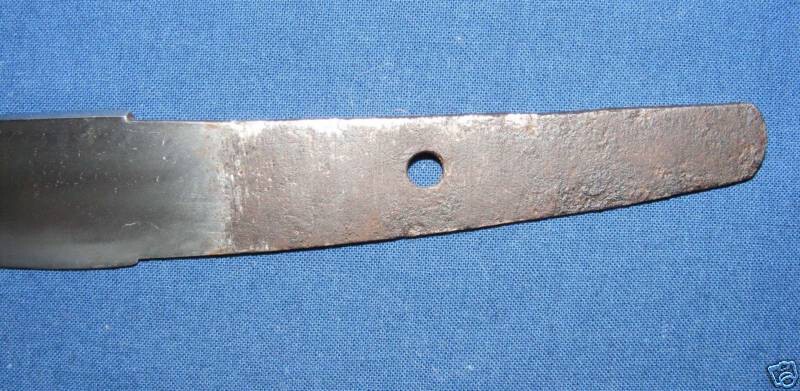
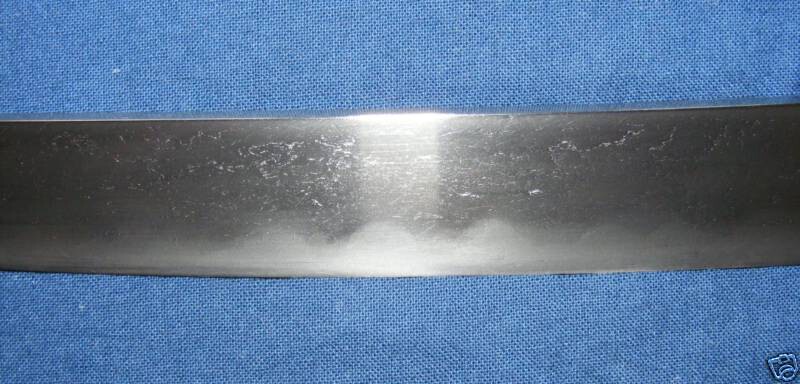
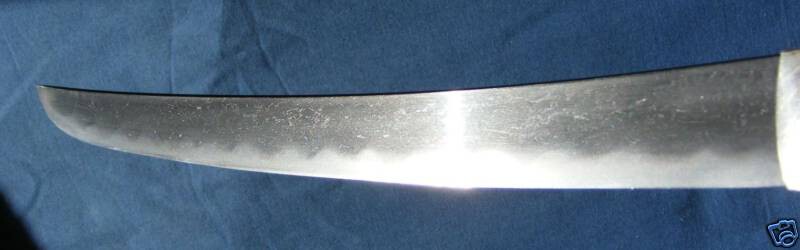
-
OK, the rest of my hypothesis. Mostly because Chris was the most likely guy to shoot me down and he hasn't. The sugata of this tanto is similar to a 15th century piece that I own so I am leaning heavily on that as a comparison. The hamon, boshi, and hada of this blade say shinto to me. The steel is bright, light coloured and flashy (not a derogatory term, but one that is used to describe shinto steel in comparison to koto steel), whereas a koto blade would be grayer and softer in appearance with a generally more pronounced hada. Plus as Chris has pointed out, the appearance is not a tired but rather a sharper, clean, newer look.



