sanjuro
-
Posts
2,100 -
Joined
-
Last visited
Content Type
Profiles
Forums
Events
Store
Downloads
Gallery
Everything posted by sanjuro
-
Nihonto as offerings to shrines....
sanjuro replied to CurtisR's topic in General Nihonto Related Discussion
No problem.... The only reason I know this, having asked that same question, was as a result of investigating a sword I am fortunate enough to own with no mekugi ana and a full koshirae also unpierced. The dedication is as I have described and there is a punch mark where the mekugi ana would normally appear. -
Nihonto as offerings to shrines....
sanjuro replied to CurtisR's topic in General Nihonto Related Discussion
As I understand it, having once asked the same question elsewhere of a buddhist monk, a sword made specifically for dedication at a shrine usually has no mekugi ana. The symbolism is one of purity since the sword cannot be used and has therefore taken no life. it is uncorrupted. Such swords are rare, and mark some special event. They often have a full koshirae, the tsuka of which is also not pierced for a mekugi. In conjuction with this, the dedication on the nakago when present, is deliberately placed so that should the sword be drilled for a mekugi, the dedication itself will be partially defaced. Thus if the blade is modified for use by the drilling of a mekugi ana, its purity and innocence are lost and the dedication is null and void. Old battle swords which were often dedicated to shrines of course had mekugiana, and these were as an offering to purify them after the taking of life and also after the user himself had died. There is a distinct difference in the intention and purpose behind the dedication of these two differing types of offering to the gods and kami. -
Just love the description...... I wasnt aware that shobu zukuri was a type of sori....... Just goes to show you can learn something erroneous every day "Cleaned to show the signature clearly" read as "ruined" if it was any good in the first place. Legit??? About as collectable as an O suriage gunto or showato.
-
Just when you thought it was safe to go back in the water...
sanjuro replied to Ford Hallam's topic in Tosogu
Sheesh HJ........ What did I say that deserved all THAT????? :? -
Just when you thought it was safe to go back in the water...
sanjuro replied to Ford Hallam's topic in Tosogu
Isnt it exciting? Just to think that in four hundred or so years there might be a group of people having this same discussion about Ford Hallam's body of work!!!!!!!!! And to add insult to injury some of his genuine works may well be prounced gimei by a shinsa panel! -
Just when you thought it was safe to go back in the water...
sanjuro replied to Ford Hallam's topic in Tosogu
I had to have a wry smile at the description in the Musashi.Sasano example. Whether or not Musashi himself made it is one thing, but the assumption that he became less harsh and cruel as he aged has no foundation in fact but simply reflects the romantic imaginings of the writer. Musashi won some sixty odd duels in his life, many of those vanquished he carved up like dog meat. He butchered an entire branch of the Yoshioka clan, including a 13 year old boy if I remember correctly. This is not a man that would get soft and mushy in his later years. (From Musashi to Mushysashi in a few years?) Having said that, It has become very difficult to seperate Musashi the man from Musashi the legend. He occupies a place in history similar to that of Amakuni. Much is written but considerably less is historically verifiable concerning the nature of the man himself. If his acts alone are to speak for him then he would have been a brutal and cruel man even in the context of his fairly brutal time and calling. None of this however takes away from the fact that he must have been an awesome swordsman. -
We seem to have come full circle in this topic, at least concerning funbari. The subject of funbari was discussed in this thread on pages 1 through 3 with Adam disagreeing similarly. This subject has I think become a pointless excercise not worthy of repeating. Clearly, any further explanations will be greeted by the same disagreements from the same quarter. Can we move on or is this going to become, as other recent subjects on this forum have done, a sort of nihonto 'groundhog day'?
-
Adam. What you have posted are not examples of funbari. Most are Shinto or Shin shinto katana (except the Shibata example) and all have a normal sugata for a relatively healthy blade that has not been extensively polished and become tired. This is often where those who have not seen funbari in the flesh as it were, make the same mistake. A koto blade with funbari may be tired from many polishes but unless it has been shortened and a degree of the original funbari has been lost, there will still be a marked widening of the blade in that lower 10 to 15 centimetres of the blade. This is where your statement of funbari being a matter of degree is at fault. What you have seen in koto blades that have been shortened is what is left of the original funbari, this will have differed according to the amount of shortening the blade has suffered. It is from that which has come your interpretation of what constitutes funbari. At least this is how it seems to me. :D
-
Eric H I salute you . You must be the last of a dying breed. Those who believe in the simple maxim "A tsuba is just a tsuba, but a sword is a SWORD". Just kidding......... :lol:
-
It is unwise and bad manners to comment on the practices of either ones own Ryu or other Ryu. However, it seems to me that if the pole doesnt surrender after being hit 13000 times, as wikipedia suggests, one might be better advised to go find a less masochistic pole to pick on.
-
Adam. Believe me , I am not confused about the meaning of funbari or to what degree it is present. Your example incidentally is a bit off. A steepening of the mune does not produce funbari. Funbari is a widening of the blade surface beginning at the machi and extending some ten to fifteen centimetres above the machi, and blending then with the normal sugata of the blade. (Like a man standing feet apart, it has been said). But I do know what you are trying to convey. Jacques. I have a blade at home that is a shinto/shinshinto tachi with a rather gentle funbari. It cant be anything but a tachi blade since the kissaki is Ikari O kissaki and it is almost impossible to use such a blade mounted as a Katana. Its also in an original full tachi koshirae of the period. When I return to Australia in a few days I'll take a decent picture of it and post it here. :D
-
Yeah..... and all that katchu hardware was made just for appearances, pigs fly and the cheque is in the mail. This is a quote out of context. It refers to the mental attitude of the warrior in a specific situation. ie, when he faces an enemy, not the presence or otherwise of defensive measures or the awareness that he may have to defend himself.
-
I dont follow your reasoning here. If a blade has no funbari then funbari IS NOT present. If it has any funbari of any measurable degree, then funbari IS present...... Ergo, funbari is either present or it is not. Maybe I'm missing something here. :?
-
HJ. This calls to mind the story about grandfather's axe........ It's had four new hafts and three new heads but its still exactly the same axe that grandfather used, way back when........ :D
-
Jussi. I'm assuming you are referring to the kitsunegasaki sword........ The tsuba of this sword is nerigawa (Laquered leather) . The fittings are indeed copper but 'fittings' refers only to the kanagu.
-
Christian I have never read a tsuba book that dealt in any meaningful way with the practical aspects of tsuba. Since this discussion is about the practicality of tsuba, my comment seemed appropriate. Ignore the gory bits if they offend you, but you cannot deny that the tsuba you are so fond of were once mounted on a weapon and had a very sinister purpose, whether you like it or not. Mariusz. You may well be right! Though we may be reaching some points of agreement here, perhaps our brethren of the forum are not... Who knows? We can only hope that reason prevails. :D PM me if you like, and I can try to answer some of your swordsmanship questions.
-
I'm with you on this Jacques, but then again I am but a poor martial artist who spends many hours each week with a sword in his hand. Mariusz has made some concessions in this discussion so I wasnt going to argue with his belief that tsuba stop people like me from clumsily cutting themselves. Not to belabour a point, but a swordsmans grip on the tsuka is never in contact with the tsuba at all. It rests in fact behind the line of the fuchi. For interests sake, a wet tsukaito is actually easier to grip than a dry tsuka ito. A wet tsukaito provides more friction to the grip. Many swordsmen when going into battle would wet the tsuka ito to give a better grip and to dilute the blood that ran onto it. Just a little bit of trivia..........
-
This is a matter of interpretation surely. The value and validity of a tsuba is in its function as a sword guard, a purpose it can only serve mounted on a sword. The value and validity of a tsuba shaped piece of art, not meant to be mounted, is purely as a piece of art possibly representative of a tsuba. if it is not mounted or mountable it is not a sword guard, hence the term 'tsuba like object'. This does not necessarily demean the piece as an art work. It merely describes its shape and resemblance to the real deal. It seems we are getting big on compromises now.
-
Mariusz Some few years ago, my old Sensei did some cutting tests as a demonstration to his students on copper and iron blanks shaped like tsuba. They were mounted securely both flat and on edge for the purpose. The Copper blanks were cut quite easily both on edge and somewhat less easily on the flat. The iron blanks (not forged but mild steel) resisted the cuts although on edge the blank was cut to a depth of some five or six centimetres and on the flat, only a deep cut mark was the result. I didnt consider this as a definitive sort of example because real tsuba were not used (for obvious reasons). The copper on edge cuts were quite dramatic. Not all were cut through but had they been mounted on a sword they would have been ruined beyond use. The steel blanks survived remarkably well. I dont know if you would consider this an exhaustive test in a real sense, but it was very indicative of relative strength of the materials. The blades used incidentally were a gendaito and a showa to. Not outstanding blades by any means, and less so after the tests. Sorry to the blade guys who think this is barbaric, but please bear in mind that gendaito and showa to at that time were almost worthless as collection pieces (The equivalent of $25 would buy either type, fully mounted ). Now the whole nihonto world will think I am a desecrator of collectable blades, but please remember I was not the person doing the cutting tests.
-
Ford. The comment I made was in a lighthearted vein, and taken as such at least by Chris to whom it was directed. After all, who am I to disagree with you and go against the opinion of the 'go to' guy, 'the last word in tsuba' man himself? I can explain my view in only one way. If I were to ever be involved in a sword duel using Nihonto, I sincerely hope that the sword in my hand would be equipped with a nice iron tsuba rather than a prissy copper ko kinko gingerbread tsuba. Regardless of who is right and who is wrong in this great tsuba functionality debate, when the chips are down its better to be safe than sorry. In such a situation, art would definitely be taking a rear seat. Your artworks ( and those of other tsubako) have their place I guess and I appreciate them for what they are, but not mounted on any sword of mine. Now lighten up a little, this is a discussion that has raged for decades among nihontophiles and experts alike. Its not likely to be resolved by such as we, and its good for a few years yet if we dont take it too personally or too much to heart.
-
Chris. I think the hypothesis that Christian is referring to is the one you have based on plain common sense, knowledge and logic! Some of which seems to have been lost or ignored by the champions of soft metal tsuba.
-
Not 'CAN ONLY' , Funbari can be found ORIGINALLY on tachi from the Heian and Kamakura periods. Which is to say that this is when the feature was most commonly incorporated on tachi for various reasons. Tachi did not simply jump from one style to the next in nice crisp gradiations with a specific time at which a particular feature promptly disappeared and a new one took its place. Old style tachi were still being made long after the end of the Kamakura period alongside the then current style, and they may well have included the feature called funbari. Indeed, there have been tachi made in deliberate emulation of Kamakura styles incorporating funbari as late as the Shin shinto period. :D
-
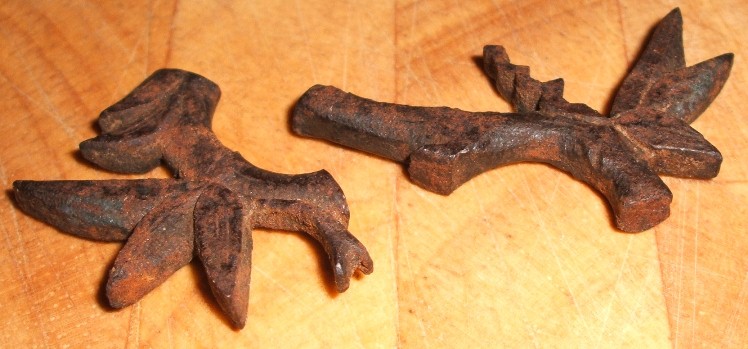
OK, for the sake of clarity I have posted pics of these menuki like objects below. first pic is face side, second pic reverse side. For all I know they may be chop stick rests but they sure look like menuki and are patinated like menuki. The larger of the two is 1 1/2 inches long. .


-
You had me fooled :D .