


sanjuro
-
Posts
2,100 -
Joined
-
Last visited
Content Type
Profiles
Forums
Events
Store
Downloads
Gallery
Everything posted by sanjuro
-
Firstly let me say well done for seeking advice prior to buying. You are at least aware that sometimes wanting to own a nihonto can lead you to making a precipitous purchase. Let this one go. It is no better than the first for different reasons and you can do better. If it is the blade that interests you then consider buying one in shirasaya. One is then not distracted by the koshirae. seek further afield for reputable dealers. The net has many and there are some that are members here. The commercial section of links at the top of this page has ones that we know are decent and know their products. Please stay away from ebay! read all you can get your hands on about nihonto, you will not regret it. Lastly, be patient. The blade will find you. In the meantime, the board is here to help and guide. Generally speaking, there is more knowledge on this board than in any other single place. You are already using it. May your sword find you soon. :D
-
Henry has a point. There is an assumption by some that a swordsmith could at will knockout a tsuba or two or that katchushi would belt out the odd tsuba just because they could. Both these professions were highly specialised and catered to patrons that ordered swords and armour specifically from the smith concerned. Each of these items could and often did take weeks to complete. That both katchushi and tosho would make tsuba is known, but surely these would have been made on the direction of a patron who preferred the smith concerned to make it for him. Otherwise and we are in danger of making the assumption that all of these professions tsubako, katchushi and tosho were merely common blacksmiths and not specialised artisans.
-
Do you use your nihonto for tameshigiri?
sanjuro replied to Hans Kondor's topic in General Nihonto Related Discussion
FBJ I come late back to this thread yet again in order to answer a question you asked. Why did I quit kendo? Actually I didn't. Kendo means the way of the sword and I have always followed it. I stopped practicing kendo the sport because apart from the physical exercise it bears little resemblance to the use of a nihonto. I sought to practice swordsmanship in a more traditional sense and yes, I suppose I have a koryu eccentric view of swordsmanship. Its not however holier than thou at all, nor is it elitist. Nor is it as you suggest any result of failure. It is more a desire for the traditional forms rather than the watered-down 'sportified' forms of the art promoted by the AJKF. A feature of the Japanese sword is its curvature. That curvature has a practical application which one cannot employ using a straight composite bamboo facsimile, to whit the shinai. A bokuto on the other hand being curved expands the use of the surrogate sword in a more accurate way and also makes possible some attacks and defences which are not replicable with a straight weapon. I practice kenjutsu and iaijutsu as well as tameshigiri. But whether it is a 'jutsu' or a 'do' form is not the issue here. Whilst the ryu I am part of is hardly of importance, KM mentioned that in the ryu whose teachings I follow, (the TSKSR), bokuto are used in sparring and yes, you can get hurt because basically there are no rules in kumitae and you can spar against weapons other than the sword such as naginata and yari, which I personally find more in tune with the reality of traditional swordsmanship. There is room in this world for all views practices and preferences, be it 'do' or 'jutsu'. Our inputs therefore are equally valid within the spheres of our individual experience. I see no point in a belligerent or antagonistic attitude toward someone because he chooses to follow 'the way' in a fashion that favours a method other than yours, or mine for that matter. Many are the paths that can lead to enlightenment. Obligatory smiley -
Mariusz. the tsuba I posted is 77mm in diameter and is 2.8mm in thickness. There is no tapering across the plate. Sorry I forgot to include these measurements originally.
-
As promised and I guess for a comparison to KM's tsuba. We'll Have to do with the rubbish pics I'm afraid. Other half has camera, currently in Denmark. I forgot she had it.
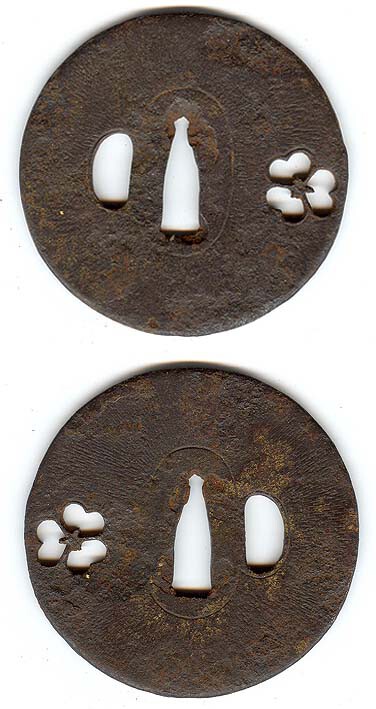
-
Marius. When it comes to tsuba everyone and I mean everyone, is a greater authority than I. When I get home I'll dig out the tsuba and attempt to take a few decent pics. The one's I have are rubbish and I wouldnt post them here.
-
Marius. I bow to a greater authority As I stated, I know pathetically little about tsuba but this one does bear a striking similarity to mine. Mine of course is a little more worn looking and it does lack that crispness you cited. The amida yasuri are not as pronounced on mine either, and the entire plate is only 2.2 mm thick. Ah well.......Back to the books...... I really should stick to blades...... Tsuba both fascinate and confuse me.
-
Sengoku Jidai/Momoyama Katchushi. (1500 to 1600) The seppa dai is a fairly squat oval, which is why I say Momoyama. Also I have one very similar which is definitely Momoyama. One must bear in mind however, that I know pathetically little about tsuba. Nice piece of iron.
-
Hi Andrea. Depending upon your budget, these are things you must take into account with this particular blade. Whilst the koshirae is in good condition it is not original to the blade. So very few koshirae are, and it is adviseable to divorce them from the blade for the purposes of this sort of assessment. A pretty koshirae does not indicate a good blade. The blade in question has a very badly decayed nakago for its age. The red rust indicates it has not had very careful owners. The blade is quite tired. By this I mean it has had a few polishes and has lost in part its original sugata (shape). I would expect a shinto blade, if it is a shinto blade, to be a little fresher. The blade is out of polish and has nicks in the edge. There is also some evidence of rust pitting just above the habaki moto, all of which if removed would further reduce the hamon and sugata of the blade. You have not mentioned the price, and indeed it does not really matter. There are better blades out there. If all you want is a tanto that looks nice on display the koshirae is OK but that is as far as it goes. I suggest you look at some of the tanto available from reputable sellers and compare them with this example and you will see what I mean. Just my initial thoughts
-
May the Gods of nihonto forgive them!
-
Are aluminium sword blades the forerunner of the rubber bullet?????? Meant to intimidate but not inflict lasting harm. :D Yes, I know about Iaito..............
-
It does look just like too much oil, as John suggests. However, there is one other possibility. If there is any wax on the the blade surface, (and it is not unknown for some uninformed previous owner to wax a blade in order to protect it from rust), the oil will react this way. I had a blade some years ago that did this whenever it was oiled. Wax was the problem. In my case it was old fashioned car polish that had been used on the blade. A good clean down with alcohol should strip off any wax if it is present.
-
OK. Obviously they arent meant to look like this. We dont want to remove the darkened areas between the lobes (Petals for want of a better term) of the design. What we are looking for is an antique finish where uniformly the low spots are tarnished and the high spots are silver. I'm going to stick my neck out here so wait for others to comment and either approve or otherwise of the two methods I'm going to suggest. (1) Get a silver cloth. This is a microfibre cloth that is impregnated with a dry silver polish. They are available from some hardware stores and jewellery supplies shops. Antique dealers and jewellers use them to clean delicate silver objects. The method is to dampen a small area of the cloth and wipe gently over the surface until the required finish is achieved. Just wash in clear water and dry. (2) This is an old remedy and slightly disgusting. You need a cigar (best) or a cigarette (you wont have to smoke it) Light the horrible thing and just let it burn. After a while there will be a fine ash deposit which is what you need. Use a microfibre cloth for this. Mix the fine ash with spit on the cloth and wipe reasonably gently over the surface of the seppa until the required finish is reached. The ash is such a mild abrasive that it cannot harm natural patina but it will remove tarnish. It does dry to a cloudy mess. just wash in clear water and mild soap and dry. Throw the cigar away or smoke it according to personal habit. Dont use this on other silver mounts at all, or on tsuba. Now wait for the comments from others before you try either of these methods. Its OK, I can handle the adverse comments. :D
-
First a question..... How bad is the tarnish? Is it black?
-
Wrong oil or too much oil. When all the interstices in the steel are full of oil, the new oil you put on will bead. Try leaving the blade dry for a little while between cleanings. Too frequent cleaning and oiling will have this same effect. if you arent using the sword, ie if its just in shirasaya or koshirae the need for cleaning is minimised. I live in a fairly dry climate and my collected swords in shirasaya are only cleaned and re-oiled twice a year at most. Even this is probably overkill. My iai sword is cleaned after each use as is my shinken which is only used for tameshigiri. Both of these blades are only mounted in koshirae for the purpose of being used. Any other time they are kept in shirasaya. :D
-
We are speaking here of seppa. We are not speaking of habaki or other tosogu like sayajiri. Seppa made of silver or foiled with silver were meant to be kept polished or rather not allowed to tarnish to black. What has already been said is that they should be kept free of tarnish, not by abraiding them with a metal polish but by wiping them with a soft cloth or a chamois. What will happen over time is that they will maintain a silver finish and the fine crenellations will darken as they are supposed to. Hence an appreciable level of ageing and patination.
-
Franco. Since you make this claim, clearly you are familiar with the practice. Would you care to educate us as to that process, or is this just an assumption?? We are talking about silver here. I'm sure that we all know the difference when one is dealing with shibuichi and shakudo which were not only patinated but deliberately alloyed to allow their patination. Clearly, the deliberate patination of such alloys is intended to fix a certain discolouration, and should not be cleaned away. Plain unalloyed silver on the other hand is only patinated by sulphides, and that beautiful blue you refer to is merely an early stage in normal tarnishing. How did the artisan fix the tarnishing process at this given point?
-
The above having been said, I agree that silver habaki, seppa etc should be kept as they were intended and polished. (or rather not allowed to tarnish) The silver foiling of seppa was to produce a polished and bright finish, as were habaki. Dammit! why have a silver habaki or seppa that has been allowed to become tarnished. Tarnish isnt always patina, Wabi, Sabi or some other esoteric accumulation of crud. Sometimes its just plain lack of attention. The trick is to distinguish desirable patina from common or garden variety dirt and tarnish. A caveat however......... There was a patinated silver finish which we call oxidised silver, Basically a dull blackish sort of appearance, which was intentional and not meant to be cleaned. It is rather a dull and finely granulated finish by comparison to silver that was intended to be polished, and should be easily distinguished.
-
Do you use your nihonto for tameshigiri?
sanjuro replied to Hans Kondor's topic in General Nihonto Related Discussion
Caveat Emptor! like George says, Be careful what you wish for! The Japanese bamboo used for tameshigiri is green bamboo. Native to Japan and China and I think also Korea. Its the running variety and is almost impossible to get rid of once it takes hold in open ground. It loves rocky soil. The runners can lie about two to four feet down and will break into solid concrete given time. Not bad for grass! (even a super grass). :D -
Curtis. This has been discussed here frequently. What kind of oil, how much, how often etc, on so many occasions it has almost become a ritual. Search topic will probably bring up several threads. FAQ likewise. Not that we dont like to talk, but rehashing such basic information has limited appeal, and the info is easy to find. :D Basically, a fine layer of oil when in shirasaya and no oil (Dry blade) when in koshirae. A shirasaya has a gutter at the sayajiri for oil to drain to, and a saya does not. This is one reason you need to keep a fairly close eye on a blade mounted in koshirae.
-
Do you use your nihonto for tameshigiri?
sanjuro replied to Hans Kondor's topic in General Nihonto Related Discussion
Also chiming in here a little late, but a comment by FBJ concerning Nakamura's attitude to iaido rather bothers me. I was prompted to comment here only because this is closer to the original poster's question concerning tameshigiri. Only in the West where we have only an incomplete appreciation of Japanese swordsmanship, is there such an obvious link between Kendo and Iaido. This has been promoted by the sieta gata techniques of the Kendo Federation. Iaido in the the various ryu that teach it as part of swordsmanship, is a discipline, a Do or way. Kendo is a SPORT, stylised from true traditional Japanese Kendo and watered down to be safe in practice. In reality, Kenjutsu is more closely aligned with iaido since what follows after the initial draw and cut in iaido kata is clearly kenjutsu rather than the stylised 'hitting' (rather than cutting) that Kendoka employ in their sport. I dont wish to start an argument about definitions in martial arts, but lets deal with facts rather than misapprehensions. See... I put a smiley at the end so no one gets offended. Its hard to argue with a guy thats smiling at you. :D -
Obviously this is aimed at the super rich. After all, $80,000,000 is hardly pocket money. If the science (and I use the word very loosely) is so reliable and this is indeed a genuine nihonto, then why has it not been polished to show the features of the metal. Obviously, there is some reason, and that may well be that the blade has no features that would identify it even as Japanese let alone as a high quality nihonto. If the science is so reliable, then surely the best way to verify this and silence all critics is to have it polished and presented at Shinsa. Why has this not been done? because any kantei is going to prove this to be a fake. So who would buy an overpriced, out of polish, unpapered blade on the strength of some hitherto unproven and possibly bogus science. No-one. I for one, dont think that the owner would sell this sword, hence the prohibitively high price. The first step any new owner would take is to verify the blade, and any attempted verification would prove it to be a fake. No..The sword is a vehicle to promote something of far higher value. It isnt the sword that is ultimately for sale gentlemen, methinks its the software. One buyer for this software would net the Tamoikin syndicate far more in the long run than this pathetic fake. One sale to a large organisation involved in the antique market would in the longer term potentially benchmark the antique market, and ultimately inflate all antique and art prices. Just a thought........ Paranoia perhaps????? Maybe I'm wrong
-
I for one find it hard to believe that Forbes magazine has allowed itself to be led into lending their name to this. One wonders if they were taken in by the scientific mumbo jumbo being touted as proof. Or even have they seen the reports that apparently exist but will not or cannot be made available to the public for some reason. Something about this, (in fact many things about this) smells distinctly fishy.
-
Would that be moles or days????? :lol:
-
Mr Trepshin. I have read all that is here and what is contained in the Forbes publication. I have also discounted that which is total rubbish and defaulted to the standpoint that the koshirae is purportedly from the 16th century and the blade is a fake, therefore the oldest possible date you can claim for the whole sorry assembly is the 16th century. I'm sorry, but no one is listening to the attempts you are making to justify this sword's claimed age and value. Moreover, the more you protest, the less credible you seem.
