tosogu_eu
-
Posts
40 -
Joined
-
Last visited
Content Type
Profiles
Forums
Events
Store
Downloads
Gallery
Everything posted by tosogu_eu
-
Bump; anyone has any ideas regarding the mei/ school/ artist?
-

Tsuba at 151,000 Yen and Rising ?????
tosogu_eu replied to cluckdaddy76's topic in Auctions and Online Sales or Sellers
270,000 now! Wow. Well... it's large! -
In fact I also had a kogatana in my collection of a similar fashion. Quite nice, very finely made. Best,.Alex

-
Wow. Tough one... Masayoshi? But it's relatively hard to see. Maybe anyone with better eyes.
-
It was a pleasure talking to you last year, Leen. See you tomorrow! Best, Alex
-
How long is that 2nd one, Arno? The two nakago-ana are interesting. Can be indicating a significant nagase (80+cm?). Best, Alex
-
Its so interesting: From the post, you can likely already tell which LLM this was. This kind of "significance" would be seen by Chatgpt or Gemini, right? these overly positive, highly encouraging, and sometimes sycophantic responses to keep the user engaged. Its commonly referred to as AI Sycophancy or "automated Flattery". This behavior is dialed up specifically to make the user feel good, dependent, or emotionally attached so they continue using the LLM. If you don't prompt to challenge critical thinking from the AI or (let it) validate the results. Not blaming anyone here, I just honestly find it very interesting (working in Big4 Tech environment with heavy AI engagement). Best, Alex
-
I think that is exactly my feeling, when i look at that tsuba. But does anyone have a clue where to put the artist or the mei? Such a work tetsu, without a larger school or anything behind it, leaves me a bit puzzled.
-
No one with any idea?
-
Site Trouble Yesterday?
tosogu_eu replied to Bruce Pennington's topic in Forum Technical Details and Maintenance
Also true for Europe/ Germany. But fortunately, now it's working. Got that error: DNS_PROBE_FINISHED_NXDOMAIN -
Always good to have people close by in Europe. Do we see you in Utrecht, Lex? Best wishes from Frankfurt. Alex
-
Study/Kantei: Sōshū-den Wakizashi (Hiromitsu / Akihiro circle?)
tosogu_eu replied to SwordStudent703's topic in Nihonto
Exactly. And this isn't really about any expertise or studying nihonto. A tachi would need 60 cm Nagasa, kissaki to hamachi. This is purely about logic and numbers. Your numbers: 63.5 total length - 5 cm current cut down mei - 3 cm habaki = 55.5 cm nagase at MAX. so even if the mei startet right under the habaki. Which is 99.9% not the case: that thing never was a long enough. -
Study/Kantei: Sōshū-den Wakizashi (Hiromitsu / Akihiro circle?)
tosogu_eu replied to SwordStudent703's topic in Nihonto
Still, a tachi from Nambokucho would've been significantly longer. The sugata of that time was mostly impressive in size. Tachi were regularly exceeding 90cm. Even if a tachi was on the very lower end of 70cm nagase: you Waki has 63.5 cm total length now. You have to deduct I guess 5 or 6 cm for mei, another 3 or 4 cm for the habaki. So there is no chance that even in theory, your sword ever was a tachi or katana. Well, only if the smith signed his work as horimono, way before the munemachi. Just kidding. So if you want to learn about swords; you maybe want to change your direction on this particular piece a little bit. And I agree, it's a beautiful and interesting piece. Best, Alex -
Those are some nice pictures, thanks for sharing! I like the Wakizashi. Send them to a togi?
-
Would it be possible to share some pic's of the blades?
-
Well, the tsunahiro is also pretty cool I guess. I have a Muromachi Wakizashi from the 2nd generation. The tsunahiro lineage is still active today, plenty of Generations and heritage here ... they even trace their family history back to Masamune. And Ray; no words - lightning quick. How do you do that? (:
-
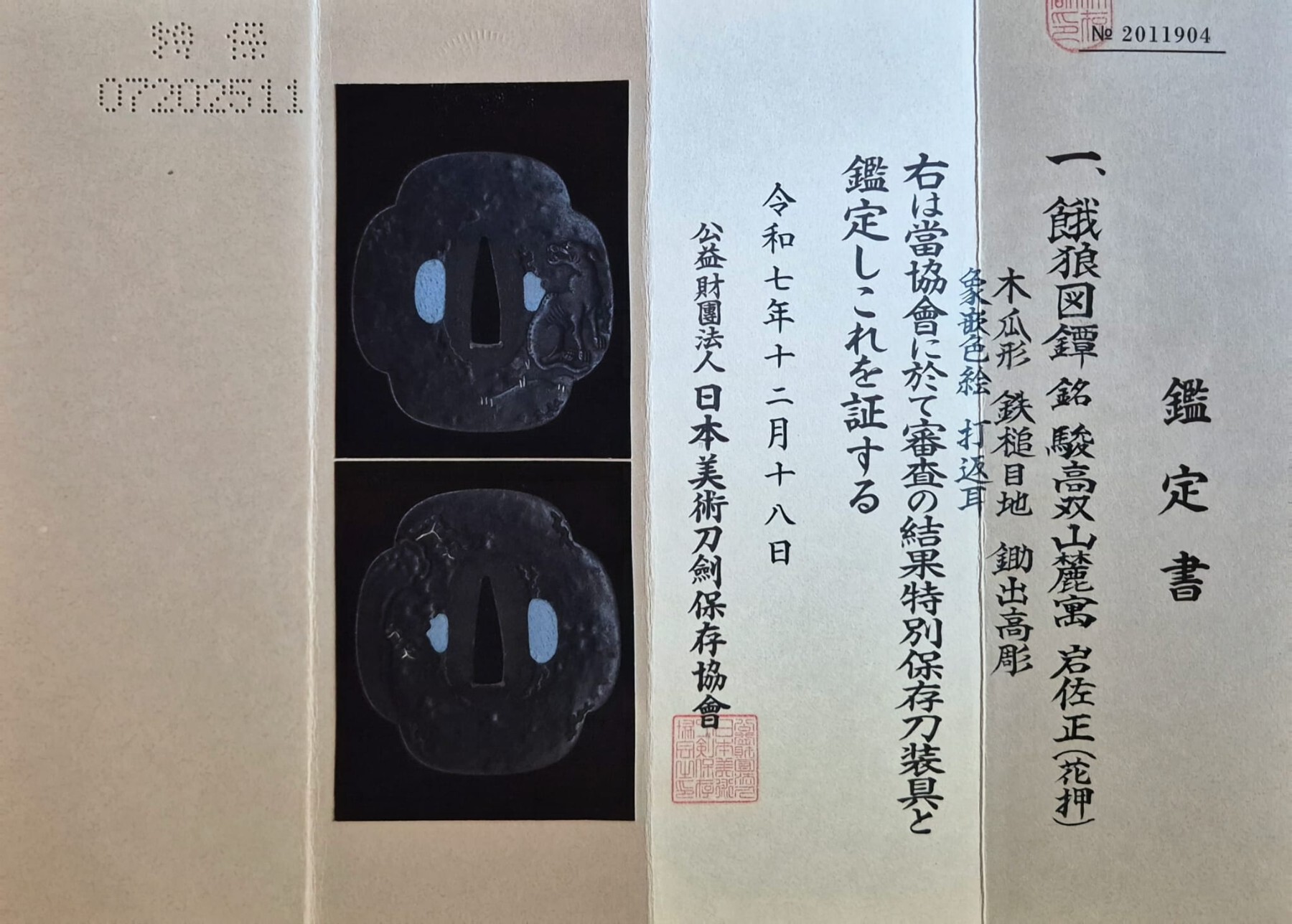
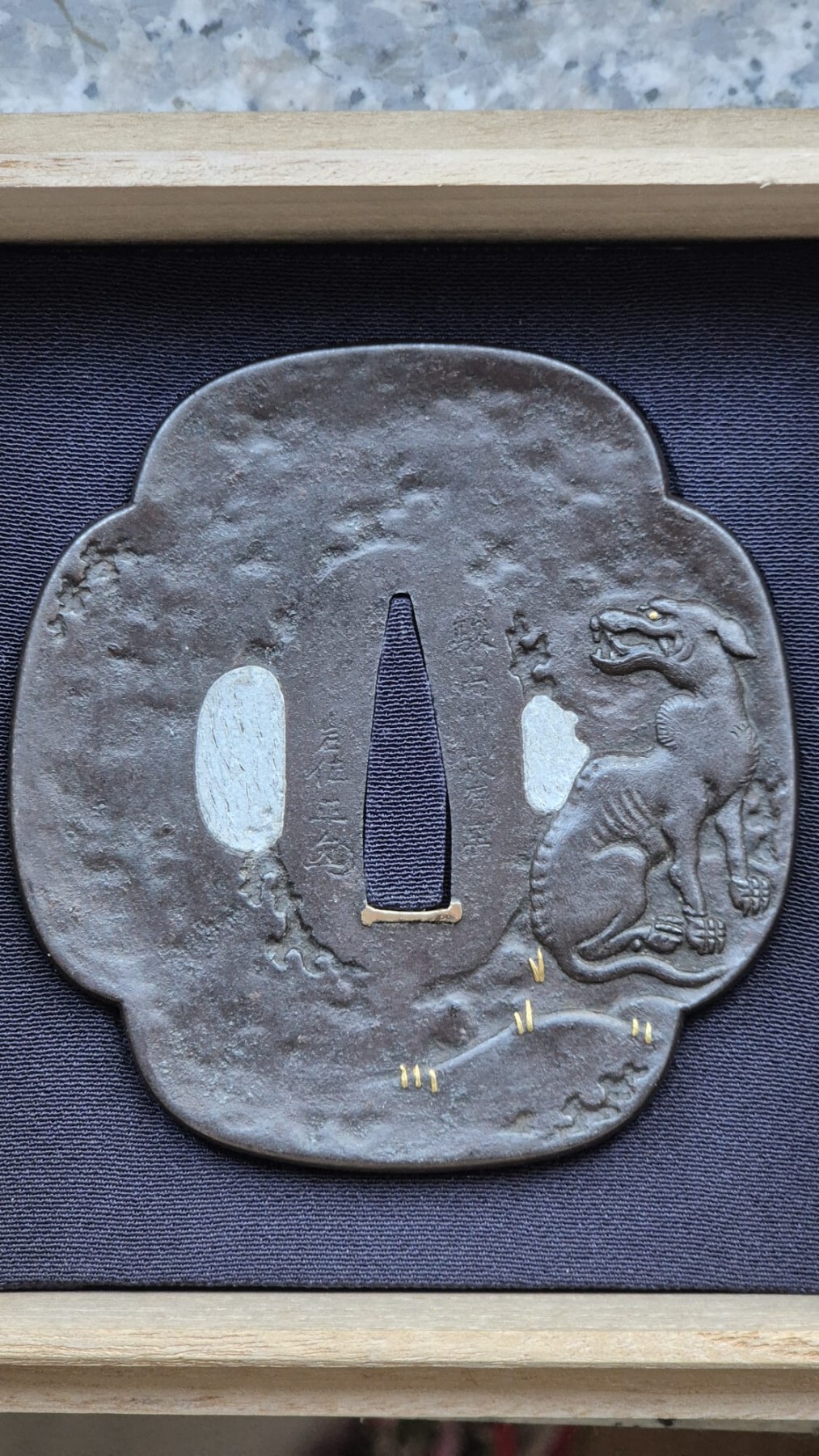
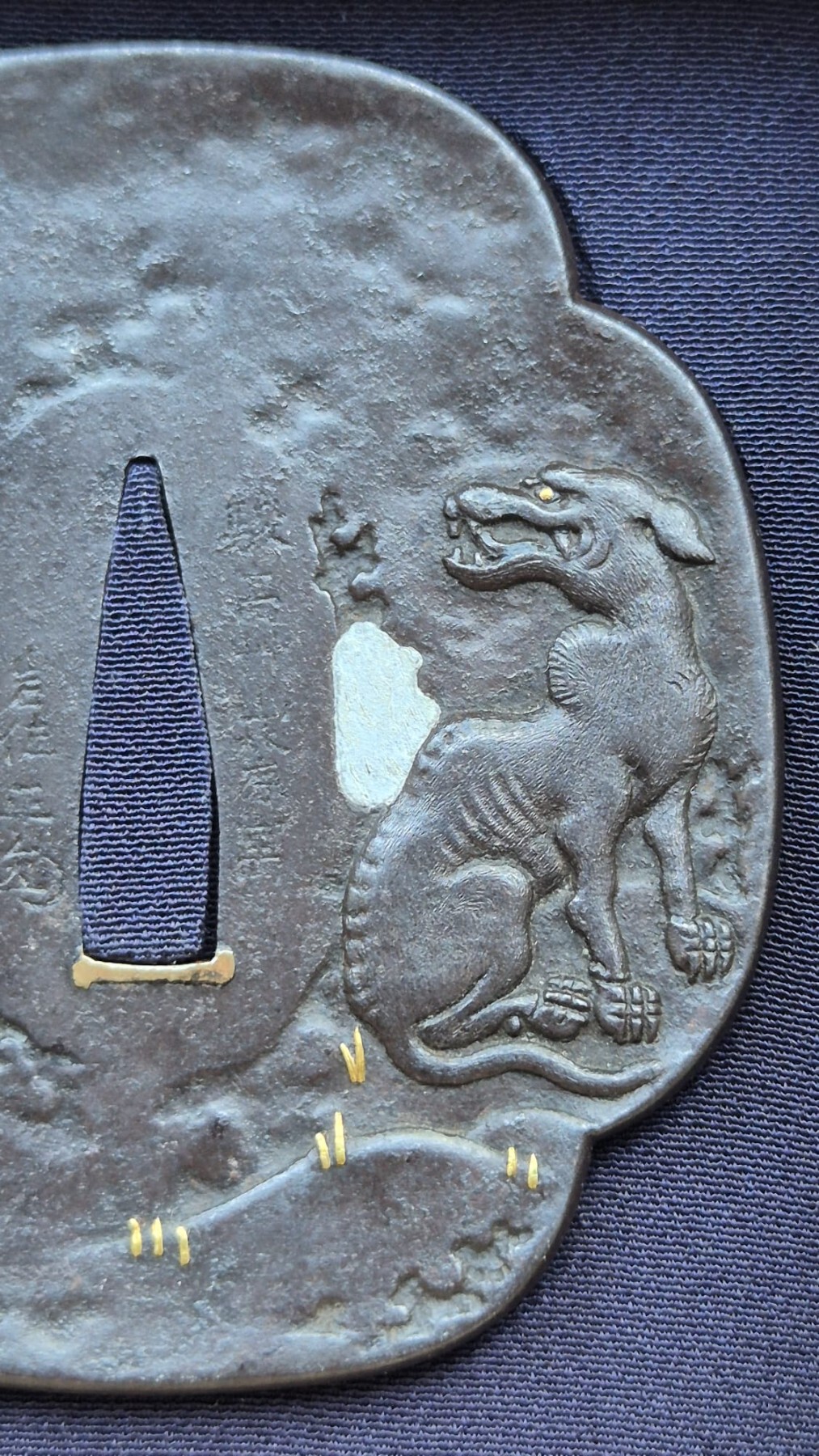
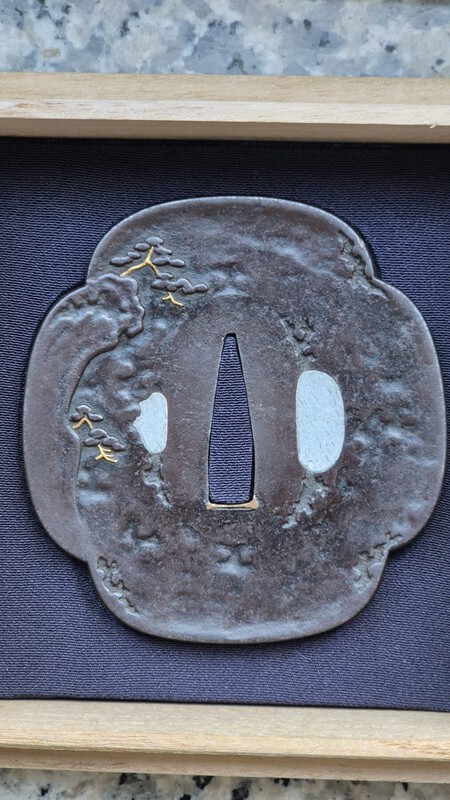
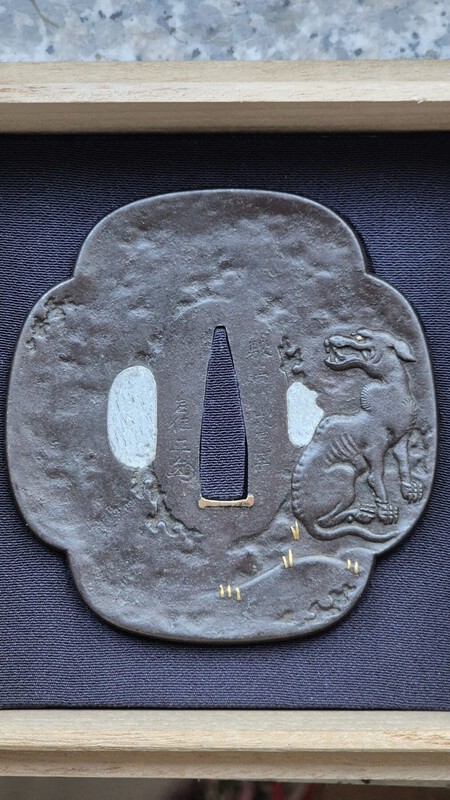
I recently received results from the NBTHK shinsa but it lef me puzzled. So I would like to ask the community for any information on the maker and school of one of the pieces, which came back Tokubetsu Hozon. The piece: Iron mokko-gata tsuba with a starving wolf (餓狼図, garō-zu) in sukidashi takabori. Kin-zōgan for the eye and claws, shirogane-zōgan and lead(?) Ategane. Tsuchime-ji ground, uchikaehi mimi. The composition reads as a two-sided landscape, the wolf inhabiting the terrain implied by the omote. Signature: Two columns beside the nakago-ana on the ura: Right column: 駿高双山麓寓 Left column: 岩佐正 (花押) I read this as: "Residing at the foot of the twin mountains in Suruga Iwasa Masa [kao]." Or is there another reading? The 駿 abbreviating 駿河国 (Suruga province, present-day Shizuoka). The 双山麓 as a geographic locator, can only be Fuji-san or do know other twin mountains? What I am trying to establish: The Iwasa school in metalwork does not appear in the principal English-language references I have access to, and I have not found 岩佐正 in auction records or published catalogues. I would be grateful for any of the following: Has anyone encountered signed work by 岩佐正, or other Iwasa-signed tosogu? Any Haynes Index entries for Iwasa metalworkers would be particularly useful. Thanks everyone. Cheers, Alex


-
Hi there, its a beautiful piece and I honestly like the way ypu approached the restoration very much. Its beautiful and even though it is out of polish; it remains a lot of its aesthetic a Beautiful nihonto. Congratulations on preserving this beautiful sword for the coming generations. Best, Alex
-
My 2 cent; this is a 19th cent. Ubu Wakizashi, mumei with some below average fittings and in a rather rough condition. Ubu (not shortened) and mumei (not signed) together with a rather late work around 1850 or even meiji; it does likely not hold grear value.
-
Really cool idea and a great tool indeed. Thanks so much hoshi! Its so important that we lower barriers and help people to access these beautiful topics of nihonto and tosogu. This is my little contribution, still a lot of work todo and a complete different approach. But maybe some will find it helpful. https://tosogu.eu/ Best, Alex
-
Bonham's Arts of the Samurai
tosogu_eu replied to Kanenaga's topic in Auctions and Online Sales or Sellers
For some it seems to be the provenance of Alan Hartman. Some mint pieces. -
Seems that I ve only touched the surface, thanks a lot for that valuable input and additional sources, Tim!
-
Thank you Tim! This is exactly the input and background that I was looking for Since I dont have access to all the primary litr. and catal. of the "old days". Will see if I can work that piece of information into a version 2 for A. Moslé. You will find it here in day or two: https://tosogu.eu/alexander-g-mosle-the-collection-he-could-not-give-away/ I have a lot of sympathy for Moslé since we share the the first name and the place of birth. Best, Alex
-
Thank you so much! A) for sharing that great tsuba, l love the color of the iron and also the motive is exquisite! B) for that correction, because I was actually not sure in the first place. What also kind of confused me, is that there was a french philosophy professor, also in the 1800s by the same name.
-
Thanks for the additions. Please take a moment and have a look at my page. You will already finde some essays: would love to hear your feedback Behrens: https://tosogu.eu/w-l-behrens-the-taste-for-the-archaic/ Church: https://tosogu.eu/sir-arthur-herbert-church-the-chemists-eye/ Joly: https://tosogu.eu/henri-l-joly-the-man-behind-the-catalogues/ Baur: https://tosogu.eu/alfred-baur-the-collection-that-became-a-museum/ Vever: https://tosogu.eu/henri-vever-the-art-of-seeing-twice/ Krohn: https://tosogu.eu/pietro-krohn-the-Japanese-argument-for-danish-design/ Halberstadt: https://tosogu.eu/hugo-halberstadt-the-collection-he-could-not-keep/ And the German collectors of course: Oeder, Jacoby, Brinkmann, Fahrenhorst, Tikotin...