

cabowen
-
Posts
6,786 -
Joined
-
Days Won
10
Content Type
Profiles
Forums
Events
Store
Downloads
Gallery
Everything posted by cabowen
-
That makes much more sense...thank you Moriyama san....
-
Is this katana worth a buy?
cabowen replied to bobtail44's topic in Auctions and Online Sales or Sellers
-
Naniwa ju Gassan Aoryushi Hidekazu
-
Ko Kachushi Ko saku (old work of early kachushi....) .... seems a bit redundant....
-
Sorry, yes, it is 3 sun 2 bu 5 rin.
-
Now I see it...Sorry Grey! Thank you Morita san for making this a whole lot easier! 6 small flowers in sukashi 2 sun 3 bu 5 rin (size) Torigoe Kyodo That should give you the gist of it...
-
Always helpful Grey to post a picture along with the box... Off the top of my head, my first guess is, from the right: Tsuba mumei Tetsu ji shin maru-gata Hana ko 16 ? (maybe 16 petals ???) Ishime Ji 3 sun ????? Ko Kachushi Tsuba Ko saku Showa 37 Nen Sho gatsu Shimajiro ?? (writer)
-
Is this katana worth a buy?
cabowen replied to bobtail44's topic in Auctions and Online Sales or Sellers
Papers are from the NBTHK-no one of any great consequence???? $1000 for a Hozon papered blade in decent condition? I don't think it's such a bad deal. No treasure, but what do you expect for $1000? You can hardly buy a mass produced Seki WWII gunto for that anymore... -
Nioi and nie are both martensite. They only difference is their physical size. If you search the Japanese literature you will find this specified in nearly every metallurgical examination.
-
Nioi and nie are the same thing, differing only in size. If it is too small to see the individual crystals with the eye, it is nioi. Using a loop makes nioi appear to be nie...
-
http://www.seiyudo.com/ta-120712.htm
-
There is a concavity in the center of them; that is where you put your fingers to slide the door. The outside edges are flush with the door.
-
they have a recess that mounts through the face of the fusuma (sliding door) and is secured with small tacks through the inner wall of the recess into the fusuma frame. They come in all sorts of designs, shapes, etc. They are one of the few decorative elements in a traditional Japanese room.
-
Sometimes a horimono is redone but it is expensive and unless the blade is worthy, usually it is left alone. Some prefer the polished down look as this is confirmation of age. Others prefer to restore the horimono. Personal preference I suppose. The only consideration for restoration is to be sure the person recutting is first rate and will do nothing to diminish the work.
-
The gimei one....
-
I think I will leave the mei to you to figure out as it is not very difficult.
-
Horimono reads Hachiman Daibosatsu see http://en.wikipedia.org/wiki/Hachiman for details. Is this mumei?
-
-
It's more or less case by case. Some are clearer from the side, some from the top. They can indeed be hard to spot if very skillfully done. Most are pretty obvious once you have seen a few and know what to look for...There have been a few threads on this site in the last few months with fairly clear examples.
-
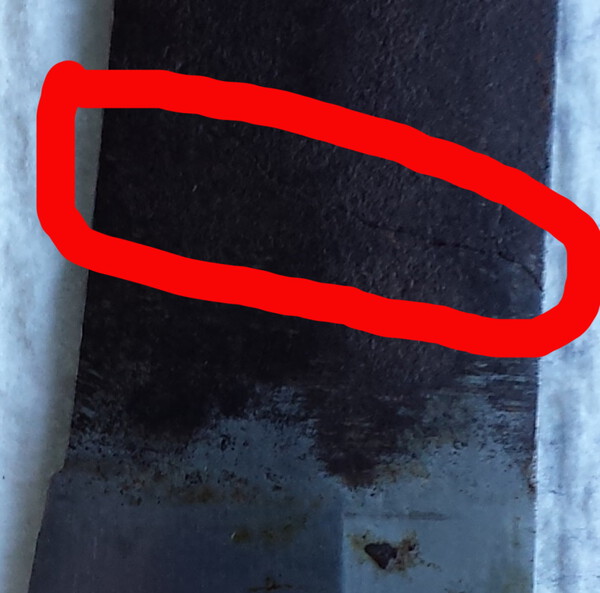
The nakago looks very odd-no wonder since it was welded on. The tsuka-ito looks like it was done yesterday. I agree with Franco, save your money. This is a train wreck.
-
The kantei-sho says "den", meaning the sword has attributes consistent with the smith named and his group. They are not saying he specifically made it. It could have been made by a student or other affiliated with this smith. One needs to keep in mind the purpose of a shinsa, which is to judge the quality and authenticity of a blade so that the product, a kantei-sho, can be issued. Elucidating the process by which this is achieved is not part of the product. I can't argue that it would be highly informative and is, in fact, the central focus of kantei meetings, which the NTHK-NPO holds on a monthly basis. There is simply not time for the team to record the whys and hows for every blade that comes through, in any case. The kantei-sho is an excellent starting point for the owner to begin their own study and research should they desire.
-
What exactly does the kantei-sho say? Does it say Den Masamori? The kantei-sho lists the hada, hamon, boshi, etc. From these, you can do your research as to why the shinsa team arrived at their conclusion. While it would be nice if they showed all of their "work", but as is common in college text books, the "work" is left to the reader. Look at it as a learning opportunity....
-
Nice sword walks up to my flea market table
cabowen replied to tokashikibob's topic in Translation Assistance
I don't think the defaced area was the name of a person who ordered the blade as the position is wrong and there would be no place for the date. I think the date was removed for some unknown reason. -
I wouldn't be so sure....


-
There is very little mention of Tanaka Akinori in any of the literature. I have seen a few of his blades through the years. They were decent but nothing exceptional. I think he is one of the many smiths that spent a short time at the Nihonto Gakuin and went out to make gunto for the war effort.



