cabowen
-
Posts
6,786 -
Joined
-
Days Won
10
Content Type
Profiles
Forums
Events
Store
Downloads
Gallery
Everything posted by cabowen
-
What makes you say that?
-
No need to be sorry! Appreciate the guess- I suspect the hidden mei played a part in it!
-
Steven Seagal's collection
cabowen replied to w.y.chan's topic in General Nihonto Related Discussion
Nice to see the rich enjoying their wealth.... -
Kajiyama's yasuri-me are usually kiri and his nakago is shaped differently....his choji isn't usually this exuberant.
-
Kajiyama or Kotani?
-
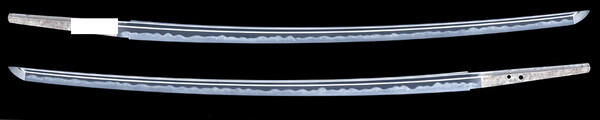
This blew me away....Anyone care to ponder a guess as to the period and smith?


-
"Nihonto Shokunin Shokudan"!
-
I emailed him too but he is at the Chicago show currently....
-
http://www.ebay.com/itm/FINE-Japanese-HAND-MADE-SAMURAI-TANTO-OLD-SWORD-SIGNED-DATED-IN-POLISH-SHIRASAYA-/360910599102?pt=LH_DefaultDomain_0&hash=item5407f2b3be Here's an old samurai tanto fresh from the vet... and made in Heisei 4 by Louis Mills from Michigan....
-
I find the koshirae more interesting than the blade....the blade strikes me as nothing special. Screaming deal? not to me, but then I collect taisho/early showa blades, so what do I know?
-
This shape (which by the way is actually called u-no-kubi (cormorant's neck) is seen in the works of Unji, Mihara group, and other Koto Bizen smiths. It was also revived in later Shinshinto and seen often in the tanto from Taisho and early Showa by smiths from the Gassan group and Horii Toshihide. It is relatively rare but that in and of itself really doesn't make it any more valuable. Shinsa would be a good idea. If you want to get it to shinsa there are several people I can recommend who could handle this for you. PM me if you wish to pursue this.
-
Actually, the book I meant to list is called "Gendai Toko/Kinko/Shukugata Soran" also by Ono. They all give loads of info on modern smiths and craftsman (togi, shirogane-shi, saya-shi, hori-shi, etc.) that I have found useful. "Nihonto Shokunin Shokudan" has lots of great pictures and in depth info on several craftsman like Ozawa Masatoshi (Okimasa student) and Nagayama Kokan. It is similar, but perhaps a bit deeper take than Kapp's "Craft of the Japanese Sword". I have found these books useful for giving a broader, fuller picture of the world these modern smiths work in. I find it helpful and interesting to explore their world from the inside...I find it adds greatly to my appreciation and enjoyment of these swords to have some sort of deeper connection, or understanding, of those who made them. It gives these swords a 3 dimensional aspect that allows me to appreciate them not only as beautiful art but also as photos in a way of the character of their makers. I remember meeting with Kotani Yasunori and his pals at his home in Kure quite a few years ago now...I was trying to ask him in my poor Japanese about the mental part of sword making...He kept talking about his work schedule, the process, etc., when suddenly his 95 year old Buddhist priest friend banged the table and said, "He wants to know about the sword maker's spirit!" I don't know if he found my line of questioning too personal and was avoiding answering or if my Japanese was just too crude....Perhaps a bit of both because even after his friend made my questioning clear, he didn't really get too deeply into the inner mind of the smith. Then again, these old school smiths considered themselves simple craftsman, not "artists" like some of the later generation and thus perhaps less prone to deeper introspection about something they simply "did" rather than thought too much about. I wanted to give my rationale for these books but am perhaps drifting off topic....sorry!
-
Ian- Here are some "must haves" for any gendai enthusiast: Gendai Toko Meikan by Ono Nihonto Shokunin Shokudan by Ono Dai Nihon Token Shoko Meikan (reprint available through Jinsoo Kim) Nihonto Meikan by Homma and Ishii Tosho Zenshu by Shimizu Nihonto Oyobi Nihon Shumi published monthly by Kurihara Akihide from around Showa 11 through 20 (very hard to find) There are others but they are nearly impossible to find and/or specific to certain areas, smiths, etc. Of course these are all in Japanese. There are English titles available but they are hit or miss with errors which can lead you astray. Another resource is the internet. You can find a lot of info not in print if you have the time to wade through it...
-
kanekado
-
It is almost certainly an example...
-
Can you post a photo of the signature?
-
The blade appears modern. Who made it? The quality of the horimono appears average-not as bad as some we have seen here but nothing exceptional. By the location of this horimono, I would be inclined to suspect that it was indeed added to cover flaw(s). Normally, it would have been located closed to the ha/mune machi. Good horimono can add value, bad or those added later to cover flaws, if awkwardly done, can detract from the value.
-
Ah, merci.....
-
Request for Katana mei translation from a beginner
cabowen replied to Edfest's topic in Translation Assistance
Long line of Tashiro Kanenobu smiths in Seki... -
While not exact, suriage is simply shortened, o-suriage greatly shortened. When the majority of the original nakago has been lost, it is usually called o-suriage, 3/4 of a centimeter would not be considered the majority of the nakago unless the nakago was originally around 2 centimeters long.... Like many things, it is a judgment call made using common sense...
-
Munechika (gimei).
-
What is visible looks very nice. Looks to be a Muromachi period blade with later koshirae.
-
I had thought it sold once before No clue....maybe it has sold again (?) I find the auction title a bit misleading as it was not made for a shrine.
-
It's a real export piece, circa Meiji. Usually the blades in these are very crude and poorly made. This looks a little better but more (and better) photos are needed to say for sure.
-