cabowen
-
Posts
6,786 -
Joined
-
Days Won
10
Content Type
Profiles
Forums
Events
Store
Downloads
Gallery
Everything posted by cabowen
-
I own a blade my this smith. Picture below. It has a suguba yakidashi and large kobuse-choji hamon. Clearly there was a link to the Yokoyama Sukenaga group as this sword is nearly identical to their works...Very good sword. Dated Bunkyu 4.

-
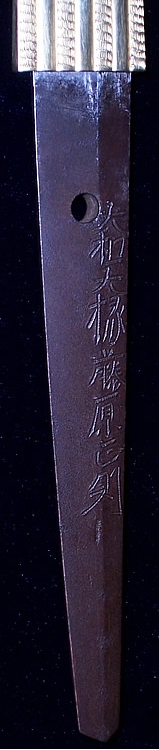
This isn't the kanji for kuni. it is the kanji 図 meaning "design". 桜花 is sakura flower so the meaning is "sakura flower design"....
-
Ujisada of Matsuyama in Bitchu....
-
Then stop arguing with me!!!!! 8-)
-
make a full set of mounts and reasonable cost...that is an oxymoron.... Anything custom made is going to be very expensive.
-
I think it is only rational to assume that "subsequent use" must mean the use for which they were originally intended and designed, that is, as weapons, not as paperweights, wall hangers, etc. Indeed, modern made art blades are fully functional. The key in the definition is "subsequent use", not "potential" or "possible" use. They are not made to use. They are made for collectors. As we all know, swords can no longer be worn and the use of one is now illegal. They have become an anachronism....In time, they will become artifacts... I have to believe that few would call anything newly made an "artifact", even though it may meet the first definition above. In common usage, "artifact" carries a nuance of age. That is why, in my interpretation, there are swords that are neither art not artifact. We can surely agree to disagree.....
-
I disagree. Modern made "art" blades fail with respect to the first definition of artifact given above as they are not made for subsequent use. The definition of artifact that I apply in this case is the second one above, i.e., handmade and characteristic of an earlier time. I would also argue that this is the definition most people would give when asked. Therefore, as far as I am concerned, it is entirely possible for a modern made blade, for example, an iai-to, being neither an artifact nor art.....
-
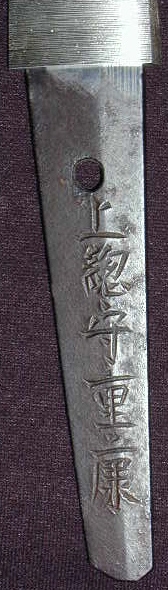
kanbei no jo is the smith's name/title, like yosazaemon no jo, etc. roku dai me means he is the 6th generation the bottom left says the blade was bestowed or gifted..I can't make out the last kanji....
-
I would contend that swords can be either, both, or neither. An old sword has history and is an artifact. It may or may not possess the qualities that make it also art. A new sword has no history and thus is not an artifact. It can, if it possess the right qualities, be art. Artifacts become such simply because time has passed. All old swords are artifacts. It is an objective quality that can not be argued as it is simply a function of time. Art is entirely subjective. Collectors/connoisseurs decide which swords are art and which aren't. Age has no relevance.
-
Gunto by Kanesada- Translation on Saya please
cabowen replied to BRUNROX's topic in Military Swords of Japan
Actually the date of presentation is September 4, 1954.... -
Maybe for the same reasons that rice is so expensive in Japan.....Assuming that prices are set by supply and demand in markets which are neither free nor governed by the rules of capitalism is erroneous.....
-
One is Bizen Osafune ju Yokoyama Sukenaga with date 7th year of Tenpo, 2nd month the other one is Sukeie, but no mention of this smith in the Meikan. The nakago resembles very well that of Ozaki Suketaka a shinshinto smith. I would bet this smith is related.....
-
Kato Jumyo was a decent smith. Note the finishing of the nakago and the quality of the mei as compared to the usual Seki gunto. This is how a professional smith finishes his work.....
-
yoshida yoshitsugu of seki. saya is not original to the tsuka. Looks put together from parts...Seki stamp indicates non-traditional construction. Showa, WWII era gunto blade.
-
This shows that swords can also be valued for their historical significance. As has been rightly pointed out, there are indeed yakinaoshi Juto and above. The sword has to have highly significant historical importance to reach such a designation. Few blades have the history necessary to overlook yakinaoshi in the main and thus the overwhelming majority are considered to be something less than art....
-
You are most welcome...Hope the photo was helpful....
-
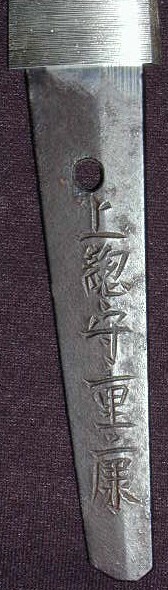
The blade looks better than most of the cheap fakes but the nakago looks extremely amateurish. The kanji are poorly cut (those on the ura don't even look like they were cut by a Japanese), the yasuri-me are very roughly and incorrectly done, the shape of the nakago and the fit of the habaki are crude- it looks much more like a chinese fake than a Japanese sword. If you compare this to a properly finished nakago I think you will see what I mean....Here is one for comparison:
-
Maaaybe Tadazaki ???? 忠崎 I am sure one of our Japanese members will be along to give a definitive reading....
-
it is definitely a fake....
-
Certainly from a practical standpoint, if you collect swords as artifacts and revel in the history and romance, there is nothing evil about yakinaoshi, rather, it might, like kirikomi, be perceived as enriching the historical significance of the sword and make it all the more desirable. Actually, taken to the extreme, those that shudder at the thought of dumping a gunto koshirae because it it part of the swords history should probably not have a problem with any sort of usage induced flaws. Even polishing a blade might be considered as removing some part of the history of the blade....But that is a debate for another day.... If you collect from a sword as art standpoint, yakinaoshi is indeed fatal for a blade as the most critical process in its creation has been done by a different, and unknown hand. It is no longer the work of the smith who signed the blade. Imagine a hole burned through the face of the Mona Lisa, patched, and repainted by an unknown artist....
-
Custom knife making is big in Japan and there are some licensed smiths who also make knives. Some make western style and some make traditional folded, quenched blades. There are many western knife makers as well making traditional western style blades with a Japanese style hamon...
-
The other kanji read Nihonso 日本荘 and are the name of his forge. The top kanji are the location, which is in Tokyo. The rest you have correctly translated....
-
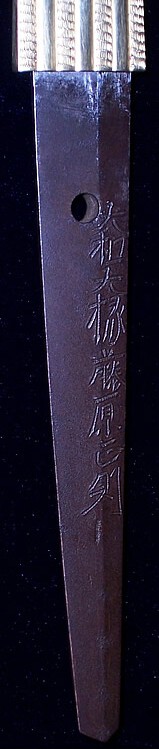
here are signatures of the shodai and nidai. Which one, if either, do you think it is?

-
Yes. Check out some of the testing done by Naruse during the war. Check out Masahide's writings and his reasons for a return to Koto techniques.
-
Not an accurate analogy. Cutting tests are not designed to fail all blades, only the poorly made ones. And not all blades fail, unlike your witches..... As I mentioned, it does indeed depend on what was cut. Surely any blade can be expected to fail if it is used to chop concrete blocks. That would be an accurate use of your witch analogy. However, when blades are tested, as they have been historically, the ones that pass have been considered to be of good workmanship while those that break or crack, are considered to be of lesser quality. We can not say that a blade with a hagire is of inferior workmanship, out of hand, without knowing what it was exposed to. This is part of the reason why Koto blades are given more latitude than newer blades. We know that there were few battles fought and little cause for damage to later blades, thus they are judged more severely.