cabowen
-
Posts
6,786 -
Joined
-
Days Won
10
Content Type
Profiles
Forums
Events
Store
Downloads
Gallery
Everything posted by cabowen
-
Of course there were talented smiths in Seki during the war, and Watanabe Kanenaga was certainly one of them, along with Kanehide. There were a few others as well but the percentage of good to bad is so low in Seki that it is much easier to just ignore them all.....Additionally, I have never been a fan of the sanbonsugi hamon....it makes me sleepy. But as has been said, to each his own......
-
It's a Seki blade.....my opinion on Seki blades should be clear by now.... And if I had known it was on active auction, I wouldn't have said anything anyway.... Best of luck!
-
Looks like a Chinese fake.....Showa date.....appears to be march 13, 1974...
-
Katana Tang identification - Please help.
cabowen replied to QuinnE's topic in Translation Assistance
Thanks! Here are a few more picts! Sadamune copy by deceased mukansa smith Enomoto Sadayoshi....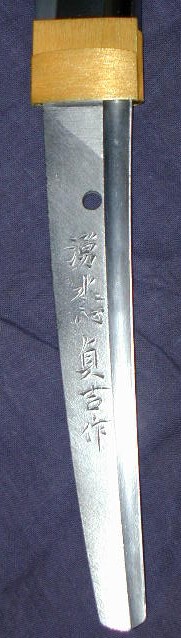


-
Kashu Kanezawa ju Tsujimura Denzaemon no Jo Fujiwara Taka (hira) This is the sandai Kanewaka. They signed Takahira at first.
-
Nagasa: 112.2.cm (44") Weight: 4.7kg A HUGE sword.
cabowen replied to estcrh's topic in Auctions and Online Sales or Sellers
They are not swords, they are pole arms..... -
Nice daisho.....
-
Quite long at 30"....If the signature is good, after polish, it should be worth at least 3, maybe 4 times the closing price.....A bit of a gamble....
-
Kanenaga
-
Hmmm, in your last photo, it looks to be off by a good 1/8"....in the other photos, it varies from ok to off....Hard to say.... The yokote, shinogi and ko-shinogi, should all intersect, forming what is called the mitsukado, or "three corners". If these three do not meet exactly, something is not correct....
-
Katana Tang identification - Please help.
cabowen replied to QuinnE's topic in Translation Assistance
These pictures are close to useless for any identification. How about something like this:

-
I was thinking the same thing....
-
Katana Tang identification - Please help.
cabowen replied to QuinnE's topic in Translation Assistance
Very doubtful. Can you post a picture of the nakago from a bit further away so we can see the whole of it? A few pictures of the blade would help as well... -
Nagasa: 112.2.cm (44") Weight: 4.7kg A HUGE sword.
cabowen replied to estcrh's topic in Auctions and Online Sales or Sellers
Quite a few of these were made in shinshinto... -
militaria is a much bigger market....
-
Nagasa: 112.2.cm (44") Weight: 4.7kg A HUGE sword.
cabowen replied to estcrh's topic in Auctions and Online Sales or Sellers
Bingo..... -
While I can not say there are no gimei nagamitsu or emura blades around, again, the odds are quite slim. Gimei are made due to the financial incentive. There simply is none in Japan (for nagamitsu or emura). Are there people in the West cutting gimei? I suppose there would be some incentive, but if someone had the skills, why not make fakes of even more valuable swords? It makes no economic sense. I suppose anyone could scratch in a "nagamitsu" but who would be fooled by anything less than something reasonably close? Both of these smiths are known to have a large variety of mei and large variation in how they were cut. Workmanship and quality is also all over the map. This points to many hands making and signing the work. While a sanbonsugi might give concern, it is rare but not unheard of for smiths (and their students) to experiment. I have seen a Koyama Munetsugu (shinshinto), a smith who worked primarily in the Bizen den, in sanbonsugi. I know of modern smiths who work in the Soshu den making choji on a rare occasion. Rare, but done. Later war work often differs substantially as well from earlier work, especially among smiths with a large workshop full of "assistants". For a long while, and still in some places where the sun rarely shines, it was thought that Nagamitsu and Emura were the same person. I cleared that up some time ago and that was the first and last time I gave much time to these blades...I have seen literally hundreds of these blades over the years and the overwhelming majority are mediocre gunto with poorly finished nakago. Perhaps good, utilitarian blades, but not even close to an "art" sword. Compare one to a Yasukuni blade sometime to see the difference between craft and crude....Clearly there is an interest in the West in the work of these two smiths, which remains an unfathomable mystery to me...To each his own I suppose.... How to tell a gimei showa era blade from the genuine???? Generally speaking, the same way you separate the two in any period-by the blade. Luckily, if someone is interested in gendaito, there are many more examples extant which expedites the study and comparison. A few guidelines also exist; pay extra attention to: -anything in a new(er) shirasaya without gunto koshirae. -anything by a Ningen Kokuho smith. -Gassan works. -the top tier smiths. -special orders by famous or "known" people. -blades being sold in Japan. There are still few gendai fakes and by being alert it is, as yet, a small problem.... -
-
It does appear that the hamon is either extremely narrow and close to the edge or runs off in places. The shape is quite unnatural and one can presume it has either been amateured or seen severe abuse. That aside, for $200, why not????
-
Shira Saya & Mei Translation needed on Tanto
cabowen replied to Edward G's topic in Translation Assistance
Soshu ju Tsunahiro Sayagaki is dated showa 18. -
help with identifying this blade and its markings
cabowen replied to mrniceguy2282's topic in Translation Assistance
It was most likely made with western steel and quenched in oil. It may or may not be forged. That is what the showa stamp at the top of the nakago (tang) means.....It is not a nihon-to. These blades are called showa-to and are considered factory made. -
help with identifying this blade and its markings
cabowen replied to mrniceguy2282's topic in Translation Assistance
WWII era blade made in Seki by non-traditional means..... -
If it were stainless the nakago would not have this type of rust on it.....
-
Date is Koki 2603 Nen 9 Gatsu Sept., 1943
-
I have several blade by this smith. Tomida Sukehiro was in the Kato group and worked in Tokyo. He was a Rikugun Jumei Tosho. Would appreciate some pictures if you have them!
-
Please translate this and help me learn to do it myself
cabowen replied to jason_mazzy's topic in Translation Assistance
Gimei Inoue Shinkai, without a doubt. Pick up a copy of the book by Koop and Inada called "Japanese Names and How to Read Them".....