

cabowen
-
Posts
6,786 -
Joined
-
Days Won
10
Content Type
Profiles
Forums
Events
Store
Downloads
Gallery
Everything posted by cabowen
-
I don't think this yoshi 義 is the reading for either of the swords pictured in this thread. The translation shown in the link above is incorrect in my opinion. The correct reading is katsu 勝.
-
Not like I have not been wrong before but If it is yoshi, I would like to know which yoshi kanji it is as I can not find one that looks even remotely close.....
-
If the blade was made by Gassan Sadakatsu I could understand it...Naohiro was an average smith....Smells fishy to me....
-
That should be Katsumasa...勝正
-
Not so much that defects have come to the surface but the core steel has been exposed by polishing away the skin steel.....Grey is right- this is a sinking ship financially.....
-
this old soldier is very tired.....
-
Shirasaya is most likely not original but made in the war era. The inscription on the shirasaya may have been done around the time the shirasaya was made. It is the name of the swordsmith and owner....
-
You are most welcome.... Perhaps the shape is similar but Hayama Enshin's work really bears no resemblance to this standard WWII Seki gunto.....
-
Jirotaro Naokatsu Tenpo 8 Nen Chushu Made by Jirotaro Naokatsu in the middle of Autumn, 1837. It appears to be a wakizashi. If the signature is good, it is quite a valuable sword....
-
服部正広 Hattori Masahiro
-
Many period uchigatana are 26-27inches long with a disproportionately short nakago. They were made to be used with one hand, more or less......
-
If you haven't, please get the book The Craft of the Japanese Sword, by Kapp. Also, 21st Century Sword Smiths by Tsuchiko san is a must....
-
you can contact me too as I know many smiths and have placed orders for dozens of people...see my web site below....
-
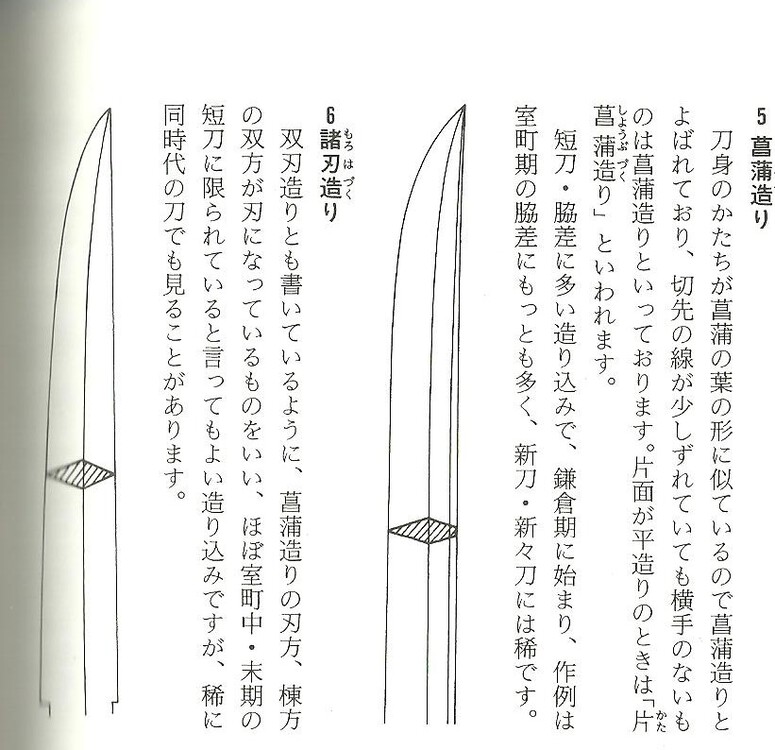
If Nakahara isn't your cup of tea, here is another source and explanation- this is from Tokuno. He explains that sometimes blades with a ridge line that ends a bit before the point are also called shobu-zukuri. The drawing speaks for itself...
-
Yeah, I see under magnification it stops about a mm short....I think it is close enough to give you the idea....
-
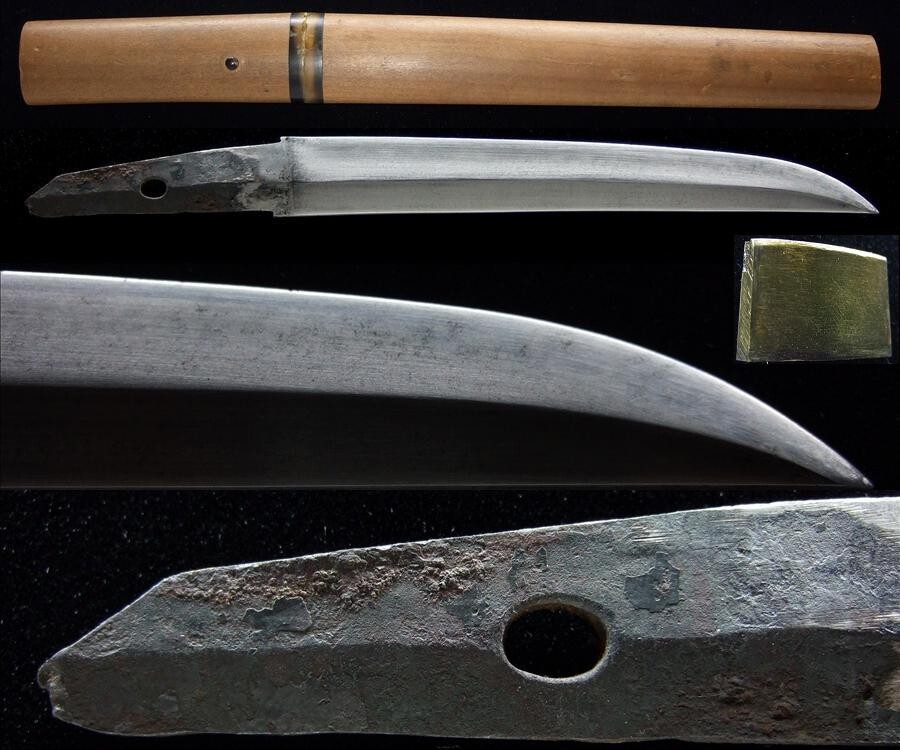
Of what? And what does an oshigata prove? Here is an example of a true shobu-zukuri shape:
-
As Jean has noted, anyone that has seen an iris leaf knows the shape. A true shobu-zukuri blade is per Nakahara's definition. I have seen it defined this way as well in other books. While some call it shobu-zukuri when there is simply no yokote, if the shinogi does not terminate at the tip, it is not the classic shobu shape and is thus a rather loose usage of the term. Perhaps we can agree to call it a modified shobu-zukuri.... There is plenty of precedent to back up Nakahara's definition, never mind his background and experience. I would think, however, that there is room for both usages.....
-
See Nakahara's description on page 19 of his book.
-
The top photo is not a true shobu-zukuri shape. True shobu-zukuri has the shinogi running to the very tip like a moroha-zukuri.
-
I am familiar with the terminology but to say that masame is running is a bit of an oxymoron.....
-
Need help with signature on antique katana
cabowen replied to aphelion's topic in Translation Assistance
This is a copy, without question. Please look at the workmanship in the nakago (tang). It is very crudely shaped and finished. The kanji are poorly cut and without any meaning in this context. The tsuba as well is very crude. Compare the shaping, filing, and cutting of the kanji to this example by an average WWII era smith: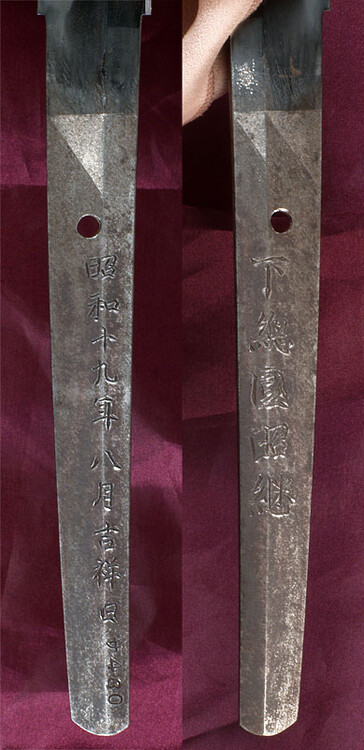
-
So it's Gimei? What do we do with it?
cabowen replied to george trotter's topic in General Nihonto Related Discussion
There are always more swords...... -
never heard of nagare masame and am having trouble picturing that......
-
Your photos are taken to far away, are too small, and don't show important detail like the nakago...If you repost some closer shots, you will have a better chance of getting more signal and less noise....
-
Since I am the first one to offer the opinion that the blade is a nagamaki naoshi, I will state my reason why: it is simple- the vast majority of blades made in this shape are nagamaki naoshi (not naginata-naoshi). Shobu-zukuri, while rare in wakizashi, is even more so in katana. My experience has been the opposite of Keith's- I have seen very very few original, katana length, shobu-zukuri blades. Keith, you must have a tractor beam to have seen so many ubu examples... My opinion on this blade is based solely on probability and less than optimum photos. Could it be an original, shobu-zukuri katana? Sure. Would I bet on it? No. It needs to be examined in hand for a definitive answer....


