cabowen
-
Posts
6,786 -
Joined
-
Days Won
10
Content Type
Profiles
Forums
Events
Store
Downloads
Gallery
Everything posted by cabowen
-
I have no photo but the condition is rather common in old blades....
-
Maybe it was one of those trick habaki with the expandable waist band!
-
I had someone give me several such swords once and I gave them to a swordsmith to cut up and reforge into a new sword....
-
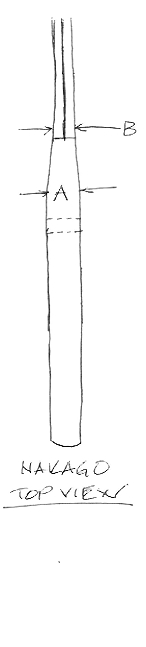
How can a habaki fit tight to the sword at position B below when it has to be wide enough to fit over the nakago at A? Physically impossible.....

-
I have also seen them removed and then rusted over with a little shoyu to get them into Japan....
-
Two reasons why habaki do not fit correctly: Habaki on blades that have seen many polishes will rattle due to the fact that the nakago will be thicker in the middle than at the hamachi, thus it has to be wider to fit over the widest part of the nakago. Habaki will also rattle and fit poorly if they weren't made for the sword. You can always see a few people at sword shows carting around a beater blade looking for a habaki to put on it....They almost never fit correctly....
-
It is nearly a physical impossibility for one man to forge by hand a katana. Therefore, smiths have always had help. When the power hammer came along, it allowed smiths to work alone. The last group of smiths to work without power hammers and with sakite are those that worked at the Yasukuni Tanrenjo in the 1930'-1940's....
-
Sad to say but polishing this would be a waste of money. It is a shame to see the large and hideous kizu in an otherwise attractive blade. Since they are in the ji and ha, there is nothing that can be done about them. Unsigned blades with kizu of this type will generally not be economically viable polishing candidates....
-
Stated simply, the polish does not do the blade justice..... To explain in more detail Jason, here are the obvious shortcomings: 1) The hadori work is too thick and misshapen. The blade would seem to be done in either hitatsura or have extensive muneyaki. Generally, on a long blade, this would not be highlighted with hadori down the length of the blade. The one large dip along the back shown in your photos is in particular out of place. It is a clear sign to anyone familiar with proper polishing that this is the work of an amateur. 2) The hada looks frosted. This is common in the work of amateurs as well. I can not speak to the foundation work as this is not readily observable from photo. You can point the blade so that it reflects a bare round light bulb and move the blade so the image of the bulb moves up and down the blade. Watch the reflection of the bulb. It should be a circle and stay a circle as the reflected image moves down the blade. If the surface has dips and swells, which indicate a wavey and thus poorly done foundation, the bulb image will distort back and forth from a circle to an oval and back again. I am willing to bet yours will distort... A blade such as this one is very difficult to polish and really requires a trained professional to bring out the best in the blade. This is a good example of how an amateur polish can actually hide the best in a blade.... I hope this is of some help to you....
-
Is that hadori down the back of the blade???
-
Thanks for sharing something interesting.... If you would like to send to the US for the October shinsa, please email me.....
-
Likely a traditionally made blade but you need to post photos of the nakago (tang) as has been said above.
-
And, to be complete, the correct term is futasuji-bi......
-
It was a type 3.....Cost me $35 earned cutting the lawn twice a week for a whole summer....
-
Yes, it is called kantei and it is what a shinsa team, like the one coming to Minneapolis this October, does.....
-
I have edited my post to correct the mistake.....
-
Thanks....first I have seen. Interesting that two of them have blades by the same smith, Kanehide.....
-
tsukamaki is superlative....
-
Thanks for the kind words...Yes, on a ledge halfway up a hill, overlooking a small creek and waterfall 50 feet below....Hill behind isn't so steep that we have had any issues with slides (fingers crossed!).... Agreed that better pictures would help but I think the owner has the best chance of accurately dating this....Still an interesting and informative exercise...
-
Wish my books were indeed available but they have all been in storage the past 6 years while I work on this: Hopefully they will be unpacked this year! Good luck with your move.... Utsuri is by its nature a bit elusive. The literature is fairly clear on the changes in the location and shape of utsuri in Bizen blades and how these changes relate to the time of production. Hard to say much on a particular blade from pictures....


-
Translation help with katana on ebay
cabowen replied to gtstcactus's topic in Translation Assistance
WWII era, mass produced, oil quenched, non-traditional gunto..... -
Help with Kyoto "Yoshimichi" Sword.
cabowen replied to tesscoothome123's topic in Translation Assistance
Speaking plainly, with a fake signature and very poor quality horimono, I wouldn't put any money into this even though you paid next to nothing for it. You can surely sell this at a profit as is, after which I would use the money to buy something collectible. More books and further study couldn't hurt either.... -
This is not a traditionally made blade. Oil quenched, probably western steel. Has anyone ever seen a traditionally made blade in these olive green, iron fitting, type 3 mounts? I have seen hundreds of these (maybe more!) and not one has ever contained a traditionally made blade.....One of these was my first sword, purchased when I was 12 years old.....
-
No, after the war swordmaking was prohibited until the 1950's and then only smiths licensed by the government could make swords. To be licensed you had to pass a proficiency test. Ersatz means not real or genuine, or inferior replacement....... Mizukage was never deliberate. It does occur on some blades near the hamachi as a result of the original heat treatment (seen in the horikawa school) but it is generally a sign of a re-hardening...
-
there are several observable effects with the utsuri suffix- there is basic terms related to formation: nioi utsuri, nie utsuri, shirake utsuri (seen mostly in Mino school blades and is more a shapeless mist like effect); terms related to shape: midare utsuri, bo utsuri, etc....Then there is tsukare utsuri, which is an effect that resembles utsuri but is in fact the result of overpolishing and a big negative.....