cabowen
-
Posts
6,786 -
Joined
-
Days Won
10
Content Type
Profiles
Forums
Events
Store
Downloads
Gallery
Everything posted by cabowen
-
 Well, personally, I have found this thread educational as I have learned a few things from it.... :D YMMV....
 -
Guess I misunderstood?
-
Is there a yaki-dashi? Are there imo-zuru? Thick sunagashi? Masame in the shinogi-ji?
-
Seems the OP just wanted to share thoughts and generate discussion. I don't believe he expected anything other than wild speculation, broad generalizations, and shots in the dark....We did learn what Bob Benson purports to think...It's all good fun....
-
Kiyoshige 清重
-
I find no families with this name either- a tea shop, the personal name of a Chinese artist, a ceramics company.... Is it safe to say it isn't a mon?
-
康 廣 I still think it is Hiro...Look at the direction of the strokes...
-
It usually results as a consequence of the forging being in masame.
-
Maybe Hiromitsu 広光 (old form for hiro)...
-
It is the family name...Yamatoshi is one reading 山寿 (old form of toshi)...
-
I stand corrected as it seems there are indeed at least a few good works done with a short mei. Most I have seen weren't so good; seems the sue koto smiths of this group get lumped in with others as mentioned that made a lot of practical blades. I'll keep my fingers crossed that this one turns out to be one of the good ones... There are something like 18 generations of Fuyuhiro in Wakasa, where the shodai is said to have been the son of the nidai Soshu Hirotsugu (there's the Soshu connection), another 5 generations or so in Izumo, and at least 9 generations in Aki. Then there are handful of others that worked in Bizen, Mino, etc. Thus, it may be tough to pin down a short mei to a specific smith.
-
That is very true....I thought it would be interesting to get more details but it would seem I must be content with what I have....Thanks again!
-
Maybe Tadamitsu?
-
Rare tanto published in 1935 was discovered in my collection
cabowen replied to Christian Chaffee's topic in Nihonto
The lower right describes the workmanship (chu-suguha, etc.) The upper left says it has great value as research material (because it is signed and dated I am assuming)... -
At past sword shows that I have been involved with, one of the most commented on exhibits was one that had a few blades with a wide variety of flaws which were circled in black marker and numbered. I made up an explanation sheet keyed to the numbers to give people an in hand example of many common flaws. Something like this could be done at all shows I would think.... 10 years ago I begged the NTHK-NPO to put their "Token to Rekishi" journal on line in pdf form so they wouldn't have to ship it out every 2 months. Too radical an idea at the time I suppose...Perhaps I will bring it up again...I might also pursue the publishing of their oshigata collection on line in some form for reference as well....
-
Why thank you! Did I really say "not made for battle" and not "made for its intended purpose" ???? If I did, it was an oversight.... and in that case, thanks for pointing that out! :lol: As I mentioned above, there is a long tradition of making swords for shrine and temple offerings. It is, and has long been, one of the "intended purposes" of nihonto...
-
hantan 半鍛 literally means "half forged". It was a shortcut method developed in the early 20th century to save time. The steel wasn't folded as many times as normal and thus you get these large, wide seam lines in the hada of the finished sword. Seems I had a type-o above...."hanten" should be "hantan"-perhaps the root of your confusion- sorry!
-
Thanks George! I will look into the newspaper idea... Smiths traditionally made swords for both combat and protection (the sword that takes life/the sword that gives life). They have been frequently made as offerings to shrines to appease the gods with hopes of protection for many hundreds of years-this is a very old, established, traditional "purpose". It isn't a modern departure or contrivance, rather, one of the primary usages of an item with both martial and religious purposes... Curiously, the sword was without a tsuba....hmmmmm..... significant??? :lol:
-
Wow, thank you so much for your research Morita san! That was very kind of you.... I'm surprised that there are no records...That is sad news...
-
Thank you for the kind words and for passing it by! I plan to go to the Asakakunitsuko-jinja when I am in Japan next year to see if I can get any further info on the sword.
-
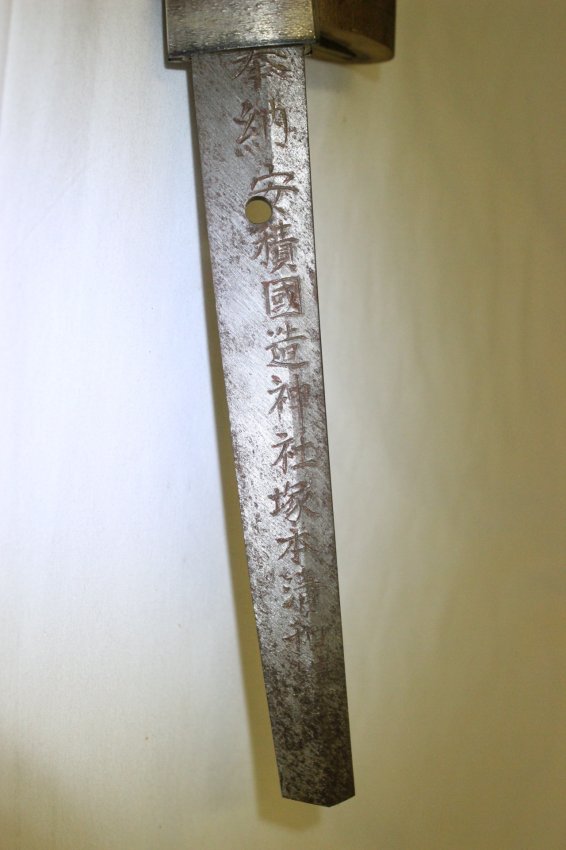
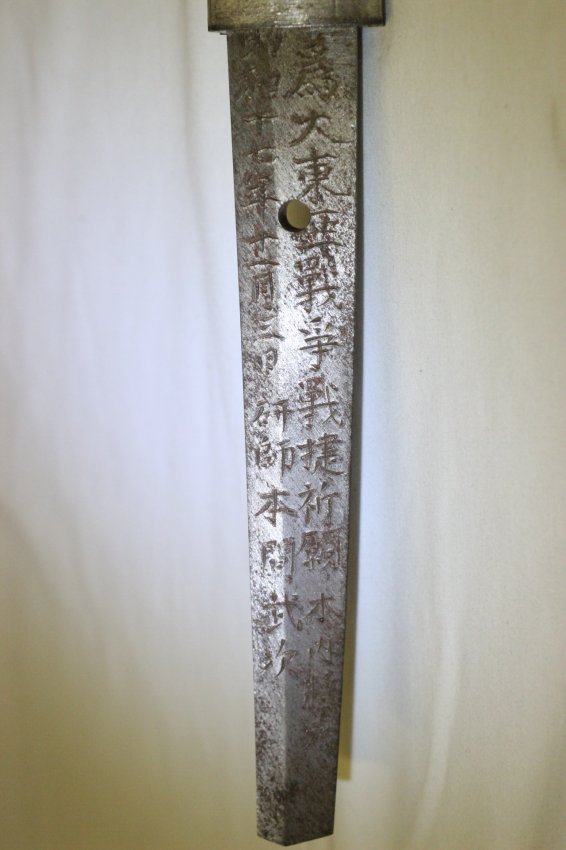
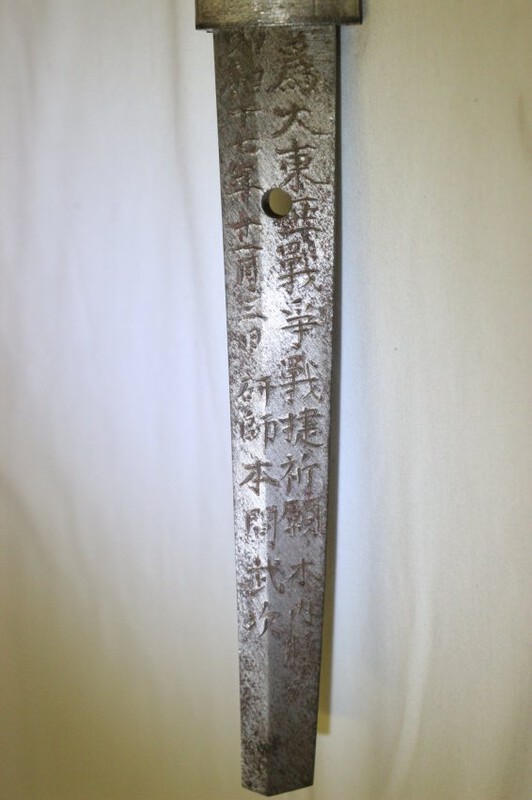
Thank you Morita san....It does look very healthy and in good condition. Very unusual to have the date down to the day, the togi's name, and maybe the sayashi's name as well (can't quite see the last few kanji so I am guessing here). Clearly this was made and presented in earnest and with deep conviction. Yes, a silver habaki....
-
It looks like a hanten iaito....I would agree with your assessment above...
-
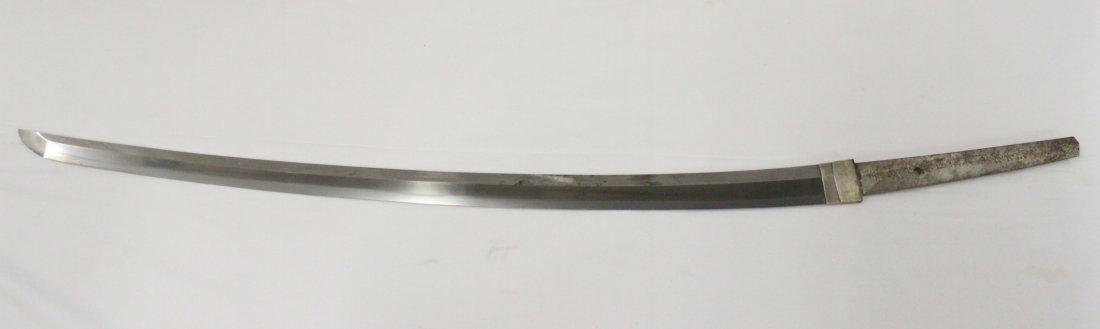
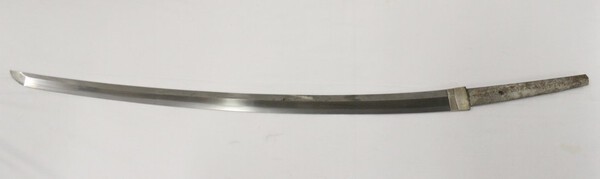
Thanks! Added a shot of the blade...Looks pretty good to me....
-
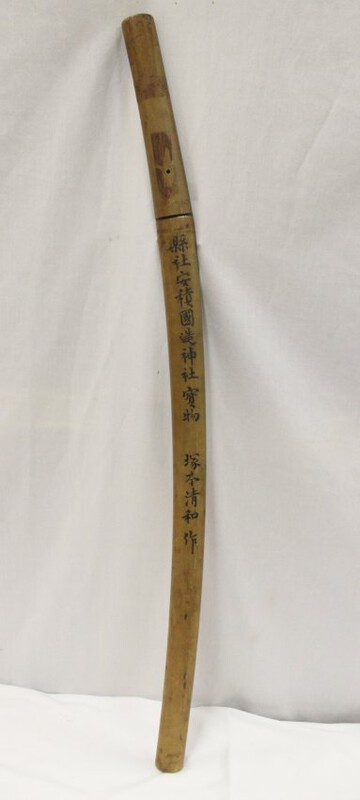
Just bought this from an online auction- was surprised I got it as lately I have been outbid at every turn... Very rare blade by Tsukamoto Kiyokazu, brother of Tsukamoto Okimasa. A genuine "shrine blade" made for his local Jinja in Fukushima city. It has the name of the polisher, Homma Taketsugu, listed as well on the nakago. Very unusual... I have another blade by this smith and if this one is anything like it, I will be thrilled...

-
Looked to me like the signature started out "Yamato"...I could certainly be wrong....