Conway
-
Posts
554 -
Joined
-
Last visited
-
Days Won
1
Content Type
Profiles
Forums
Events
Store
Downloads
Gallery
Everything posted by Conway
-
There are a few other examples of this stamp recorded in Mal Cox’s Showa Swordsmiths of Aichi Prefecture (Owari and Mikawa) found in the download section.
-
There’s so many small details you notice when you start to compare swords in-hand rather than by picture. I just recently noticed the slight variation in the aluminum tsuka. @Kiipu Do you know when Iijima stopped producing? Would their final production have ended by fiscal year 1944 since their swords in the 160,000 range still have the brass tsuba?
-
You already had this translated a few weeks ago… It must be hard to search through your own posts because you title them all the same.
-
Hey Michael, Have you seen it in person or are you basing your opinion off the photos as well? The habaki is a style commonly found on these kyu gunto. The fittings look fine to me. Obviously, there are many factors that dictate how well a blade fits 100+ years later. If your friend bought it cheap, then he should be pleased with his purchase…. Although people have differing opinions on what constitutes “cheap."
-
Hey Sam, Maybe you could post a list of specific photos or patterns you are looking for so members can message you links or pics from their collections.
-
Hello Mark, What you have is an arsenal produced “zohei-to.” As Brian alludes, these are almost the Officers version of the Type 95 NCO sword, since the blade construction is similar. The stamp resembling three cannon balls is the Kokura (originally Tokyo Artillery) Arsenal stamp. The ho stamp - ホ is for the Kokura factory number 1. The fittings are very nice and you should definitely show pictures of the individual details of the tsuba and spacers.
-
Checks all my boxes except the price… Looks like the saya cover was originally made for a Type 98 based on the indentations in the leather where the haiken is located.
-
The smith is Murayama Kanetoshi and it’s dated a lucky day in February 1939. Do you have better pictures of the nakago? The pictures cut off part of the Mei and the other characters on the date side are not well-focused.
-
Hi Jess, These Type 19 kyu gunto were non-combat swords with plated blades. As can be seen by the throat piece on the scabbard, the scabbard itself would originally have been chrome or nickel plated. These are very common and in its present condition it would probably be worth about $150.
-
Nihonto? Japanese Naval sword for sale
Conway replied to Jan Pirecki's topic in General Nihonto Related Discussion
It’s dated 二千六百二年 - 1942. -
Nihonto? Japanese Naval sword for sale
Conway replied to Jan Pirecki's topic in General Nihonto Related Discussion
The characters in the mei are incorrect for Horii Toshihide. A possible Showa smith using this mei is Toshihide (敏秀), real name Asai Kazue. Here is the excerpt from Markus Sesko’s Swordsmiths of Japan: TOSHIHIDE (敏秀), Shōwa (昭和, 1926-1989), Gifu – “Toshihide” (敏秀), real name Asai Kazue (浅井一衛), born October 18th 1916, son of Toshimasa (敏正), he worked as guntō smith and died November 5th 1952 -
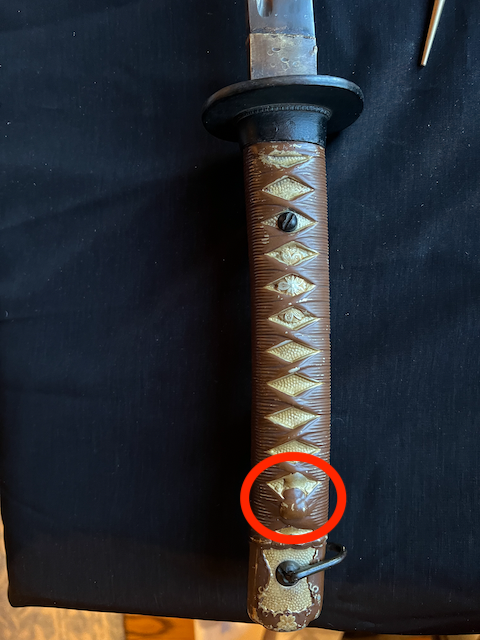
@Scogg I thought you were maybe talking about this other casting flaw which Stegel points out in this Warrelics thread: Japanese nco nagoya sword
-
Are you referring to what looks like a glop in the casting? Here is an example in the 202,000 serial range: WWII Japanese NCO OFFICERS SWORD SIDE LATCH & MATCHING NUMBERS ON SCABBARD #Y59
-
Already posted here:
-
I was just referencing what’s posted above. Maybe a mistake in your chart if you don’t have a picture recorded.

-
I’m in the same boat with you. I know some people here feel a gunto is incomplete without the tassel or knot, but I try to avoid purchasing these unless I find them in-person. It's hard to shop for tassels by pictures alone.
-
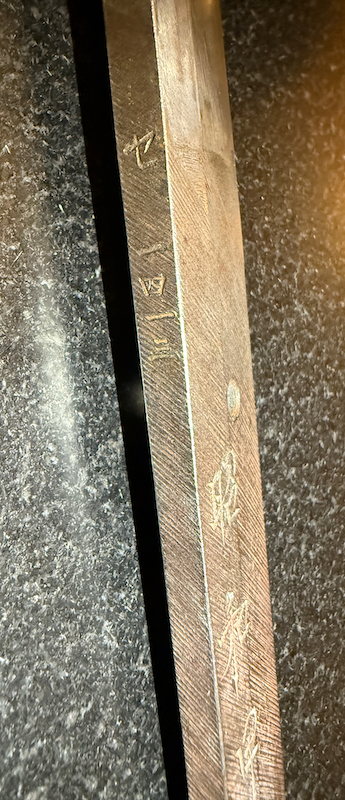
Ah you’re right! The top stroke would be shorter than the bottom if it was a two. Good catch. Looks like there are consecutive numbers recorded now (セ1143 and 1144).
-
@Bruce Pennington Here’s another Spring 1944: セ 一一四三 that’s not listed in your table. Maybe you haven’t seen this one yet sold Here
-
The mei looks like it was done with an electric engraving tool. Just look at how many small strokes there are in each character. I believe whoever made this was trying to pass this work off as one by a well known Edo period smith - Kunikiyo.
-
-
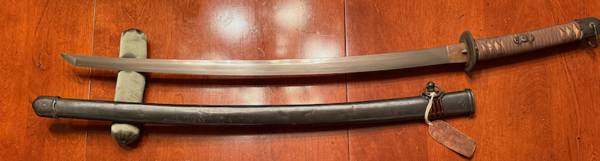
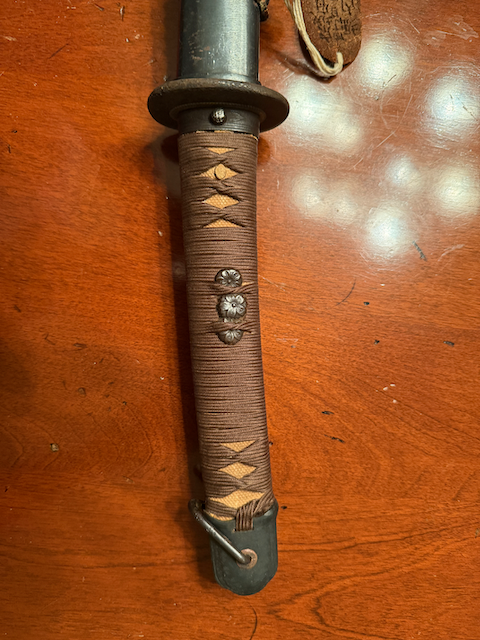
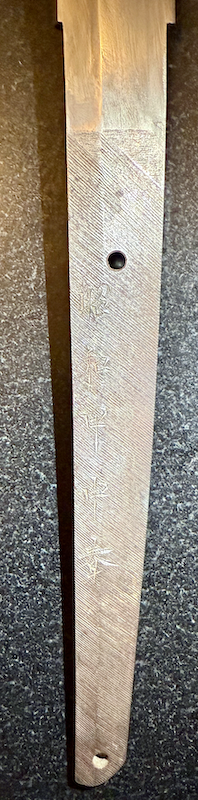
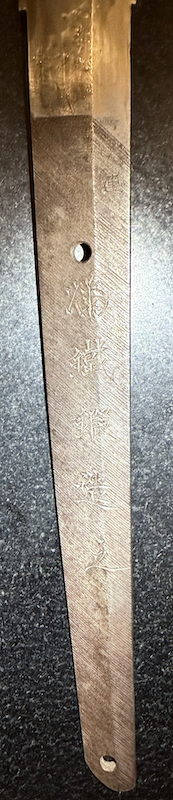
Here’s another example. Spring 1944 with ren stamp 連 and serial セ se 一四一三: It’s in overall excellent condition.
-
35” is quite long for a non-dress blade in kyu gunto mounts. Looks to be in nice condition too. A good find!
-
@Nobody Thank you very much, Moriyama san.
-
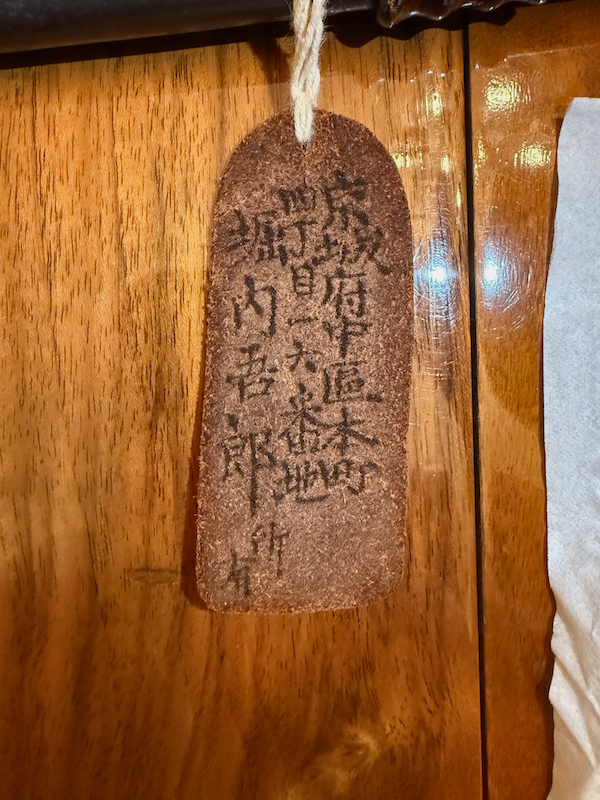
Greetings, I picked up a sword with a return tag and I am having a little trouble with the full translation. The characters are carved into the leather. So far, I’ve got 堀内吾郎, as a name- Horiuchi Goro on the far left hand column with the bottom 所有 (property). I can also tell that right hand column is referencing a city/capital. Second column from right - 4th district, 16th house. Any help with the right hand column and correct pronunciation of the owner’s name would be greatly appreciated. Thank you. Con
-
Hi Frank, This smith is Akiyoshi. This sword was posted on NMB previously: