
Soshin
-
Posts
2,928 -
Joined
-
Last visited
-
Days Won
3
Content Type
Profiles
Forums
Events
Store
Downloads
Gallery
Everything posted by Soshin
-
Hi Marcello, The nanako-ji on the tsuba as well as the color of the patina of the shakudo is fairly poor. The poor color is likely due to the very low gold content. High quality shakudo with have a wonderful rich even dark blue-black color and have about 6% gold. Take a look at the Goto tsuba the guys from Tetsugendo.com posted on the tosogu board. This will give you a good reference of what great shakudo nanako-ji looks like on a tsuba. I would say that the tsuba was likely made in the Meiji Period and I would consider it Shiiremono (仕入物). On the bright side I don't think it is a Chinese fake. Yours truly, David Stiles
-
Hi Mike Y., Thanks for the photos of the wonderful Hikozo Higo tsuba. Having such wonderful examples to study are wonderful. I just going to set back, read, and learn. My current personal tastes are in line with the tsuba (T-143 Kyo Sukashi Tsuba) your currently have on your website that is on hold. :D Yours truly, David Stiles
-
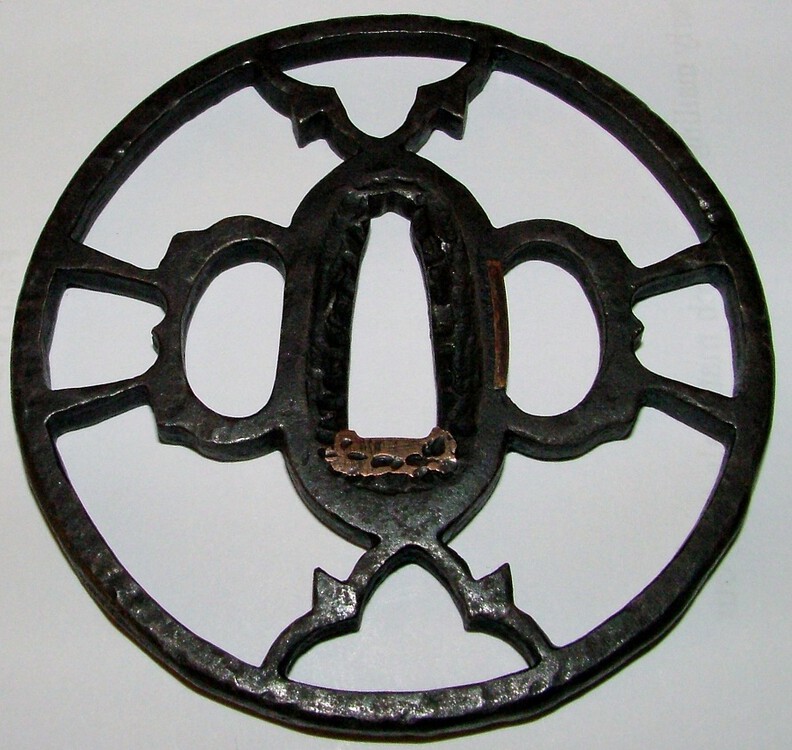
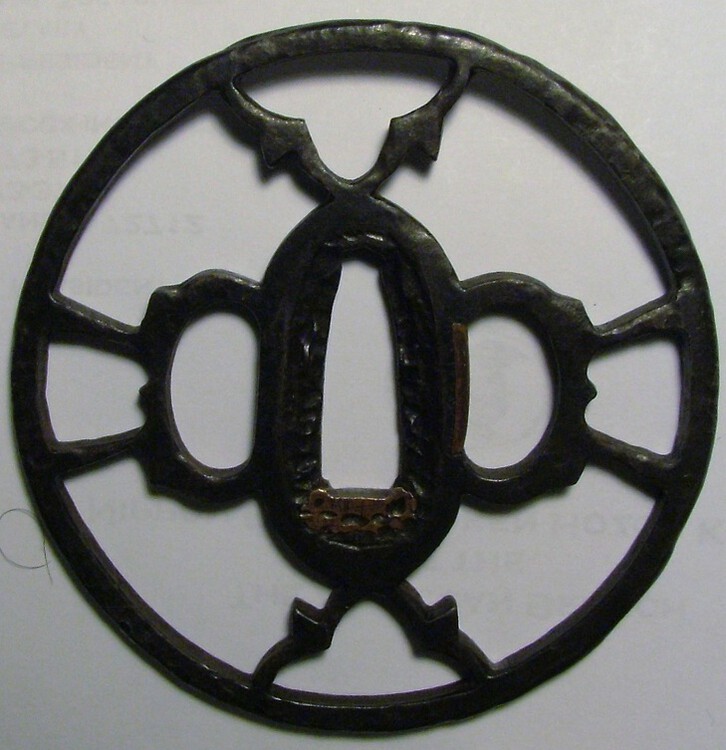
Hi Everyone, How about we go from smilies to tsuba photos? Here are two photos I have of the tsuba before and after the process. From the photos not much can be detected. In hand the tsuba no longer has a whitish waxy film on its surface. Yours truly, David Stiles
-
Hi Everyone, Relax the weekend is almost here. Just a quick note. I was cleaning off wax from a tsuba I purchased from Japan where much of the Ibota wax had oxidized and created a white film on the tsuba. I cleaned off the old wax using the method discussed on Jim Gilbert's website. I rubbed the iron tsuba with a plain cotton rags and used old pieces of piano keys to remove all of the dirt and rust trapped by the old wax. I then heated the tsuba whiled holding it with cotton gloves and a cotton rag with a hairdryer to a warm temperature so warm to not allow the tsuba to be held with a bare hand. I then applied the Renaissance Wax and then worked the tsuba some more with another clean plain cotton rag. I will be posting before and after photos soon. I wouldn't recommend this type of process to anyone first starting out or working with a valuable tsuba, a kinko tsuba, or a tsuba with soft metal inlays. Yours truly, David Stiles
-
Hi Robert and Ford, Thank you Robert for asking the question and Ford for providing details. I have a can of Renaissance Wax just setting around. Yours truly, David Stiles
-
Hi Everyone, Thanks for posting a really nice tsuba! :D We all know that the shinto gods such as Raiden are all into the high end kinko works by the Goto school. :lol: Yours truly, David Stiles
-
Hi Marcello, Could you try to take some better quality photos of the tsuba that are in focus in the correct orientation? This would aid in identification. Overall color looks strange in the photos but it could just be the quality of the photos with poor lighting. Yours truly, David Stiles
-
Hi Ed, Nice write up about the significance of the mantra which is the design of the menuki. The mantra has been the focus of tosogu and koshirae since the Muromachi Period. I do remember seeing on the Yamabushi website a whole koshirae focus on Nichiren Buddhist designs a few years ago. It has long since been sold. This mantra is central to the practice of Nichiren Buddhism. One minor point which I can nitpick is that political party Sokugakkai is only associated with the Nichiren Shōshū (日蓮正宗) and not Nichiren Buddhism as a whole. I hope everyone finds the additional information helpful. Yours truly, David Stiles
-
Hi Everyone, I remember reading that some of the early Saotome tsuba also had mantra motifs of the Nichiren-shu on there surface. The Nidai Norisuke tsuba discussed above would be really great to take a look at. Now for the more on topic comments. Mounting this menuki set on a Gendaito sounds like a good idea. Overall they don't look like a bad reproduction and were made in modern Japan (i.e. Gendai). Yours truly, David Stiles
-
Hi Roy, Thanks for the nice comment about my website. I am glad you enjoyed it. Its still a work in progress. I just added another tsuba research write up on the Azuchi-Momoyama Period webpage. It's a nice small (i.e. for wakazashi) to the best of my knowledge Ko-Shoami tsuba. The owner before me was thinking it dated from the Muromachi Period. It is very thin at 1.5 mm at the rim and about 2.0 mm at the seppa-dai. Here is the direct link: http://mysite.verizon.net/vzeo23jk/id18.html. Yours truly, David Stiles
-
Hi Everyone, In asking my question I was just thinking that the tsuka and it's placement reminded be of my tsuka that I purposely placed the menuki in the reverse position as recommended by my school of batto which has its origin in Owari province during the early part of the Edo Period. I was just thinking that the original owner might have practiced the same or similar style of batto. Thank you John for providing additional information. Yours truly, David Stiles
-
Hi Roy, One quick but important question about the menuki mounted on tsuka. Are they in the palms of your hands when hold the tsuka with two hands? This is assuming you holding the tsuka with two hands as if your are doing iai or batto. Yours truly, David Stiles
-
Hi Fred, Thanks for posting so many wonderful photos of high end Nanban tsuba. :D I have a two nice ones but nothing like the ones you posted. Thank you very much for sharing. Yours truly, David Stiles
-
Hi Chris, Thanks for the clarification about the reading and meaning of the Kanji for the age of the tsuba. As well as the meaning of den (伝). Hi Curran, Don't have any Saotome tsuba of the same age to compare this tsuba to in terms of hardness. I was under the impression that the hot stamps were used by both groups. In the informaiton chart I posted above in the tread the hash # is listed as a Tenpo (Tempo) hot stamp design. More importantly I was right about the age of the tsuba. I am very happy with the shinsa result. :D Yours truly, David Stiles
-
Hi Curran, Thanks for sharing your very nice example. Chris Bowen helped me with the translation of the kantei results. The tsuba didn't paper to Saotome like I was thinking it would it papered to something different but related. It papered to "Den Tenpo" (伝天法) with the note in English "late Muromachi". The Kanji I think written are "Muromachi Suki" (室町末期) which literally means the end of the Muromachi Period. I think the den (伝) means in the tradition or legend of. The Saotome and Tenpo schools are closely related have some overlap in craftsmanship, designs, time period, and location. Yours truly, David Stiles
-
Hi Everyone, Just received what I think is a early Saotome tsuba I started this topic about from the broker who submitted it for me to the NTHK-NPO shinsa. Looking at the white write-up sheet from the shinsa it was given a total of 74/100. This means that the tsuba will be issued a Kantei-sho which equivalent to the NBTHK Tokubetsu Hozon paper! :D All of the notes are in Japanese so it will take some time to translate. One part I can read off the to of my head is "late Muromachi" written in Romaji with the 室町 Kanji near by. I remember that this time period is the origin of Saotome school. Yours truly, David Stiles
-
Hi Peter, I would agree mostly with Steve remarks and thanks for presenting such a interesting topic for discussion. Owari tsuba of the different schools are always in demand. I find them personally very pleasing to look at and to collect. I know that Higo tsuba are in high demand and often enjoy higher prices more so then what I think they should. This is just my opinion and reflects my own collecting interests. I would personally say that the above point about Nanban tsuba that Steve makes it one of the reason I am attracted to them and enjoy collecting high-end quality Nanban work. Currently I am looking for Nanban with strong European influences. I find Japanese stylization of both European and Chinese aesthetic sensibilities specifically during Edo Period while the country was under a almost country wide policy of isolation from foreign influences very interesting. Yours truly, David Stiles
-
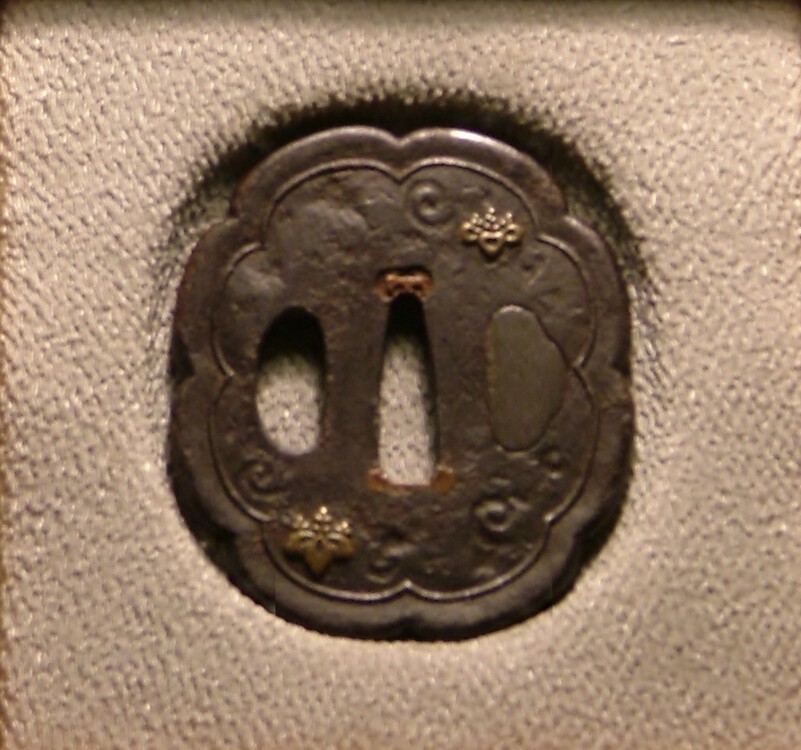
Hi Alan, I checked my books and refreshed my memory. The name often repeated by the branch (waki) school in Edo was Myoshin not Myoju. If you remember Myoshin was the 3rd generation master after Myoju the famous 2ed generation master of the school in Kyoto. They would often sign the school name as discussed above but would use the go Myoshin plus kao. Sorry for the confusion. I am not sure why this tsuba is just signed Myoju plus kao. The dragon while cool isn't the second kamon. The second kamon is the triple diamond shape called matsukawabishi (松皮菱) in Japanese. The design extends across both side of the tsuba. Can you see the two completely different (not variations of the same kamon) kamon design on my tsuba which I think is a late Umetada school work? (Sorry for the focus issue in the photo.) Yours truly, David Stiles
-
Hi All, I would say the tsuba is likely the work of the late Umetada branch school in Edo during the late Edo Period. Their were a few different late Umetada artisans in Edo using the Myoju go with kao. I would need to do some book searching to provide more details. When they did sign Umetada they would often do the hippie thing and use a plum blossom stamp plus (忠) or use the original kanji (梅忠). The twin kamon design is often seen in both iron and soft metal. What I see in terms of metals are copper, silver, gold, and shakudo. I have what I think is a late Umetada school work in iron with soft metal inlays with a simlar two kamon design. Just my two cents. Overall I like the tsuba thanks for posting. Yours truly, David Stiles
-
Hi Everyone, Just wanted to post a follow up about this tsuba. This a explanation of the Kanji I was able to translate on the Omote side of this tsuba. I was helped by my Budo sensei and his library of Kanji books. The top Kanji at 12:00 is atama (頭) and the kanji over top of Daruma head is soko (底). The two Kanji between them is unreadable due to thumb rubbing. The Kanji at about 10:00 AM is yon (四). The Kanji at about 8:00 AM cannot be identified nor can the one at 11:00 AM. I will be taking this tsuba with my to the sword show and shinsa in Tampa Bay, Florida in February of next year. I will be submitting it for NTHK shinsa and likely asking Jim Gilbert, Iwamoto sensei, or others if they could provide any more details about the design and what Kanji are and their meaning or significance. Yours truly, David Stiles
-
Hi Curt R., Looking at the tsuba I would say that it is likely a partial wheel openwork design (han-kuruma sukashi zu 半車透かし図). This is a common design. Yours truly, David Stiles
-
Hi Everyone, Heard back from Chris Bowen about the tsuba I started this topic about. The tsuba passed NTHK-NPO shinsa in Minneapolis, MN this past weekend. Once I get it back with the paperwork I will post more information about the shinsa results. Yours truly, David Stiles
-

Minneapolis Shinsa and Show
Soshin replied to Jimmy R's topic in Sword Shows, Events, Community News and Legislation Issues
Hi Everyone, Just heard back from Chris yesterday night. My tsuba that I submitted passed shinsa and therefore was not determined to be a extra large Chinese belt buckle. Thanks for posting photos of the show. I wish I could have made the trip. Yours truly, David Stiles -
Hi Henry, Here is a link to another tsuba made my the same Myochin artisan who I think made my tsuba: http://blog.goo.ne.jp/tsuba_001/e/fab8bff2a87f7f9d4145266da38cd3ed. Notice the similar patina color of the iron and mokume jitate (木目仕立). The resolution prevents the direct comparison of signatures. The tsuba is listed as a Shipo Tsuba because of the Cloisonné inlay designs done by another artisan. The complete mei (銘) on this tsuba is (神道五鐵鍛明珎紀義信). The longer mei might because this is a katana sized tsuba also using the techniques of another artisan. The tsuba came up in a Japanese Google search for of Ki Yoshinobu "紀義信". This might be an example of two different artisans working together to make a wonderful tsuba. The tsuba plate maker being the same person or related to the person who made my tsuba. Just some ideas. Yours truly, David Stiles
-
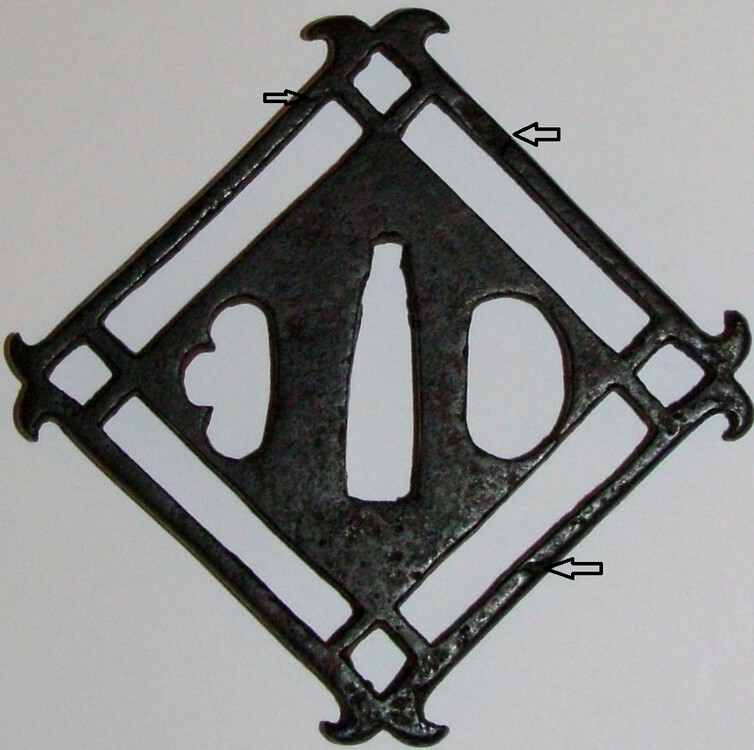
Hi Christian, Thanks for providing a similar example. I would agree about dating my tsuba to a earlier period possible as early as the Late Muromachi Period to the Momoyama Period. Stylistically I would include it in the Ko-Shoami school. There are medium sized concave shaped tekkotsu along the rim as well. A interesting note about the ura side of the tsuba is that there are three places that look like there are are some very old sword cut damage to the rim. Here is a photo with the damage highlighted with black arrows. Additional comments are always welcome. Yours truly, David Stiles