
Soshin
-
Posts
2,935 -
Joined
-
Last visited
-
Days Won
3
Content Type
Profiles
Forums
Events
Store
Downloads
Gallery
Everything posted by Soshin
-
Hi Everyone, The ko-sukashi (small openwork) design is call either shippo or itomaki Japanese. The first term shippo means "seven treasures" in English. The second term which I have also seen used to describe this design means a spool used to hold string. I would agree with Ford as to the age of the tsuba likely late Edo Period trying to copy the styles of the Momoyama Period and the early part of the Edo Period. Overall I like the tsuba. Thanks for sharing. Yours truly, David Stiles
-
Hi Guido, I will PM you the name of the style shortly. It is a koryu batto that does not emphasis the practice Tamishigiri. The only reason I am saying this is for the reason stated by Keith G. I also don't like using antique Nihonto either. I much prefer shinsakuto or gendaito blade with modern fitting and mounts including menuki. Just my two cents take it or leave it. Yours truly, David Stiles
-
 Hi Everyone, I just booked my flight and hotel room for the Tampa Japanese Sword Show and NTHK Shinsa. I will be there from 11:00 AM on Saturday, February 11 until 3:00 PM Sunday, February 12. I am hoping to attend the Q & A section on Sunday as I will be submitting a tsuba for NTHK Shinsa on Sunday morning. I will also be touching base with some longtime American collectors at the show. Would be great if I could also meet some people who often post to the Nihonto Message Board that would be great. I will be bringing four tsuba including the one I am going to submit to Shinsa for discussion. Thanks and happy holidays. Yours truly, David Stiles
 -
Hi All, I agree with Brian suggestion. I would mount these menuki on a martial arts Nihonto training sword. That's assuming Curtis does some type of Japanese sword drawing art like iaido or batto. I practice a style of koryu batto which very different then the more common gendai batto styles. I would not use any antique menuki for this. Yours truly, David Stiles
-
Hi Curtis, The menuki look like a modern cast set. The overall detail is fairly poor and below even high quality cast sets I have seen more recently. They do have a interesting story attached to them. I would stop buying until you go to the Tampa show. Once you get there and see all of the reasonable and much better antique menuki out their you will quickly lose interest in such a set. Just some friendly advice take it or leave it. This reminds me I need to book my tickets for the show. Yours truly, David Stiles
-
Dear Andy, Nice menuki too bad its matching partner is missing. The detail wonderful and the back side also looks good as well. The color of the shakudo looks very nice. It could be the work of the Kyo Kinko group. Try to upload higher resolution photos to the NMB site and your link often try to push me to other website with ads. Yours truly, David Stiles
-
Hi Ford, Yes very nice menuki set! :D Thank you for taking the time to post some good photos of them for everyone to see them. I'm still surprised your not working for a Daimyo (大名) yet. Wait wrong century for that. :lol: Yours truly, David Stiles
-
Hi Ed, Its good that you are researching the tsuba design using different sources focusing on period banners, armor, and clothing. I think this is a good approach to dating the tsuba as family kamon and banner designs did change over time and there evolution are for the most part documented. Yours truly, David Stiles
-
Hi Ian B., You could be right. It is really hard to tell in the photographs having the menuki set in hand would be the only way to determine for sure. The corrosion does have a reddish color to it but it might not be iron rust. Yours truly, David Stiles
-
Hi Curtis, I would say middle to late Edo Period. Generally I aggree with the seller on eBay. Yours truly, David Stiles
-
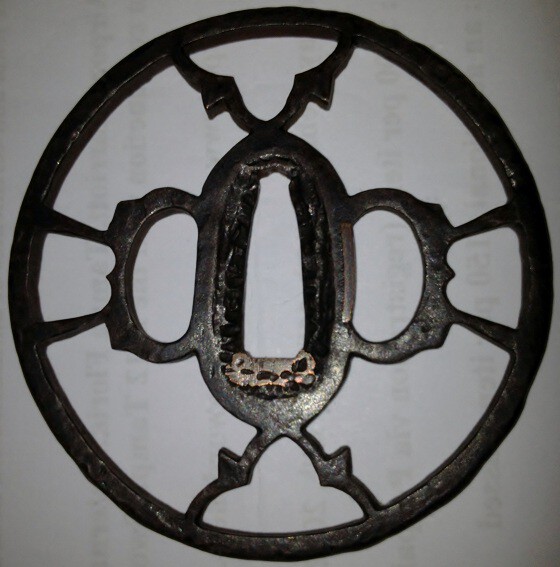
Hi Everyone, I updated the original post with new and better photos. Here is another Owari Sukashi tsuba I have with a similar motif with the wild geese (karigane 雁金) in twin pairs but the kozoku hitsu-ana is in the shape of Japanese ginger (myoga 茗荷). This I am dated about the same time period of the middle Edo Period but is sized to fit a katana at 7.8 ✕ 7.6 cm with a 0.45 cm thickness at the rim. The very wide seppa-dai seen in both tsuba is associated along with the thick ji-sukashi with Owari Sukashi as well as the Kanayama Schools. The rim has linear tekkotsu which might have been exaggerated by rust damage to the rim which has since been removed. Yours truly, David Stiles

-
Hi Curtis R., It looks like the menuki are made out of iron because I see what I think is red rust. I haven't seen many menuki sets made out of iron. Do you have any photos of the reverse side? Yours truly, David Stiles
-
Hi Ed, I would agree the design does match very well. In the case of the tsuba the central line found in the painting is replaced by the seppa-dai and the nakago-ana. Still not sure how it could mean void or emptiness. Thank you. Yours truly, David Stiles
-
Hi Ed, I not sure how the Japanese Kanji for mu (無) meaning emptiness or void is related to the design of the Kanji on the tsuba. I am fairly sure the modern Japanese Kanji with this meaning has underwent simplification from the original archaic Chinese ideogram. Could you provide a picture of the painting you are referring to? I think this would be helpful to David. Yours truly, David Stiles
-
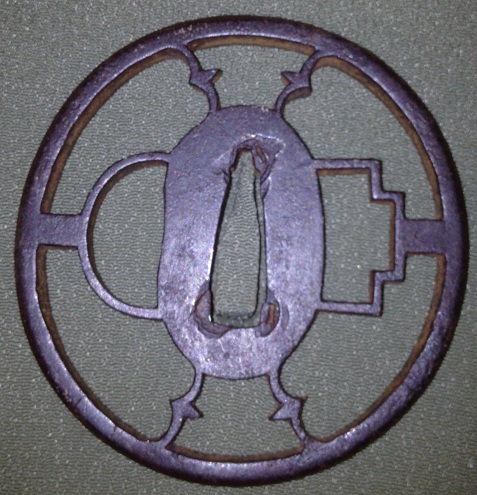
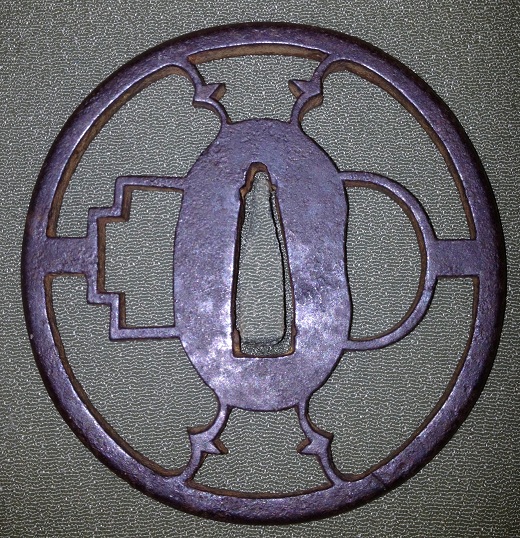
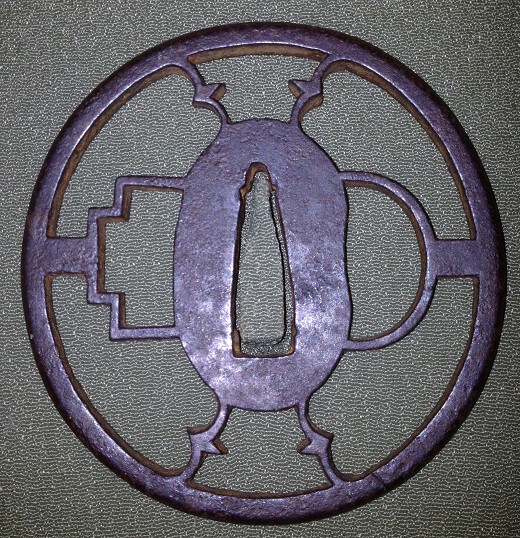
Hi Everyone, Here is a new Owari Sukashi tsuba I picked at a discount price for Christmas on the NMB's sales section. It is a small tsuba at 6.8 cm X 6.5 cm with a rim thickness of 0.45 cm. I think it is intended for a wakizashi. The iron and craftsmanship is very characteristic of the middle Edo Period Owari Sukashi school work. I am sill trying to figure out the designs on either side of the seppa-dai. Does anyone have any reasonable ideas? The designs above below the seppa-dai are wild geese (karigane 雁金) that are often rendered in twin pairs on ji-sukashi tsuba of many different schools. Thanks in advance for taking the time to answer my question. Here is a very similar tsuba that sold at Yamabushi Antiques recently: http://www.yamabushiantiques.com/TSUBA74.htm. P.S. Updated the photos that are clearer then the original ones I taken of the tsuba. Yours truly, David Stiles

-
Hi David, I was told by multiple sources offline and online not to boil a iron tsuba in tea. I have tried the iron tsuba into white cotton pockets. I think this approach is fine with helping to build patina. Cycling a freeze cycle has work for me as well making sure no red rust is allowed to develop. This might work on your tsuba as the rim has the thin patina that shows up as grey spots. Hope you find the information helpful. Another general good rule of thump is to go slow and don't use any strong chemicals. Yours truly, David Stiles
-
Hi David, From looking at the mimi the patina looks a bit thin and heavy rust was likely removed at some point. I have a Edo Period Owari Sukashi tsuba with a similar problem it was over cleaned in my opinion in Japan. It has very prominent tekkotsu that are artifactual and the result of heavy rust being removed. I am not seeing any of the large tekkotsu found on ealry Kanayama tsuba. Thickness and over all size is also consistent with either Momoyama or ealry Edo Period Kanayama school work. Thanks for taking the time to provide the additional information and photo. Hi Rich, Thanks for the additional information. Yours truly, David Stiles
-
Hi Mariusz K., To develop my idea some more of it being a Kanayama school tsuba from Owari Province circa the Momoyama Period. The tsuchimei-ji and glossiness on the surface is fairly clear both are often seen in Kanayama tsuba. The large over sized seppa-dai in proportion to the rest of the guard is often seen in Kanayama tsuba as well. The ji-sukashi design is not as complex or involving as many different design elements as you would see in Owari Sukashi tsuba in my opinion. Having additional information from the owner would be helpful as I think it would confirm my theory. I would suspect the tsuba to be small in size and thick with many tekkotsu "iron bones" along the rim. I would also expect the rim to be either square or rounded square in shape. This is often seen in Owari tsuba of all schools. I posted awhile back a Owari tsuba I purchased on eBay for about $90.00 USD a few years ago and it papered early this year to NBTHK Hozon to an Owari school circa the late Edo Period. It had the rounded square rim and is small and very thick in size. Photos of it are up on my website for reference. Yours truly, David Stiles
-
Hi Lance, I still think the ji-sukashi design is likely archaic Chinese characters. The design element above the seppa-dai is a weight used in money exchange. Please see the following link discussing it on a Kyo-Sukashi tsuba: http://kodogunosekai.com/2011/10/27/kyo-sukashi-testu-ji-sukashi-tsuba-%E4%BA%AC%E9%80%8F-%E9%89%84%E5%9C%B0-%E9%80%8F%E9%8D%94/. I Hope the author of the blog replies to the thread as he is very knowladge about Owari tsuba. The design element below is likely another archaic Chinese character. Hi David, The more I look at this tsuba it reminds me of mid period (i.e. Momoyama Period) Kanayama school work. Would love to see photos of the rim and have measurements including thickness. Nice story very different them many of my stories about finding a nice tsuba. Most of my stores just involve me saving money and waiting awhile. Yours truly, David Stiles
-
Hi Everyone, It could very well be a archaic Chinese form of a Kanji character. Sasano had some Kanayama tsuba in his last book with Kanji designs that also remind me of this tsuba. It could also be a Bonji character. Here is a link to a website I found really helpful in researching the following tsuba in my collection that has a Bonji character done in in-sukashi: http://www.onmarkproductions.com/html/buddhism.shtml. All of the Buddhas, Gods, etc. have Bonji as well as Kanji associated with them. After having seen a fair amount of Edo Period Nobuie copies I am starting to think my tsuba belongs to the Owari Nobuie School. The Bonji on my tsuba is for Fudo-Myo-O. Here is a direct link to my website to view the tsuba I am referring to: http://mysite.verizon.net/vzeo23jk/id20.html. I hope you find this information helpful. Yours truly, David Stiles
-
Hi Pete, Thanks for posting such a interesting tsuba for discussion. I would say it was a heavily altered and likely repaired Hizen school tsuba. Yours truly, David Stiles
-
Hi David, Nice Owari Sukashi tsuba. Having some views of the rim would be great. I will do some searching and see if I can come up with something in terms of what the stylized Kanji characters are. Off the top of my head nothing comes to mind. Yours truly, David Stiles
-
Here is some translation of the tsuba signature. Yamashirokuniju 山城國住 (right of the nakago-ana) Umetada Mune? 埋忠宗? (left of the nakago-ana) The last Kanji I can't read. Having a detail photo of the tsuba directly in front would be helpful or just a scan. Camera flash is also making it hard to read. Please sign your name or some part of it on your posts. I hope you find the information helpful. Yours truly, David Stiles
-
Hi Everyone, I aggree with Guido's point I think there were wonderful works of art in all time periods. I like this tsuba regardless of age. It reminds me of a friends kagamisni tsuba that I dated to the Momoyama Period. I'm not completely condvenced with Sasano's early dating. Yours truly, David Stiles
-
Hi Marc, Really nice tsuba. Don't have any idea who made the tsuba as these type are not my strong point. Thanks for sharing. Yours truly, David Stiles