
Soshin
-
Posts
2,932 -
Joined
-
Last visited
-
Days Won
3
Content Type
Profiles
Forums
Events
Store
Downloads
Gallery
Everything posted by Soshin
-

False advertising for those that know
Soshin replied to cuttingedge59's topic in Auctions and Online Sales or Sellers
Hi Everyone, I agree with Kevin if he does business across state lines in the USA then the FBI is a better option in my opinion then the local police department. Alternatively if he has shipped anything via the USPS or used the USPS in performing a crime then contacting the postal inspection service is a good idea. I have seen offices of the postal inspection service at a regional sorting facility near my home and they do carry guns and handcuffs just like any other police officer in the USA. I remember hearing stories about someone who was locked away for a long time (10+ years) in federal prison after being caught and convicted of a Nihonto related thefts and scams. The name of the man has been forgotten by me but is well known to more senior collectors in the USA. -
Hi Junichi-san, Good question. I wrote a article for the JSSUS newsletter two years ago about the development of the Tosho tsuba (刀匠鍔). The Ko-Tosho tsuba (古刀匠鍔) are very early, thin, and with small openwork (ko-sukashi 小透). Here is a link to a online verison it: http://www.nihontomessageboard.com/articles/JSSUS_Tosho_Article.pdf. In terms of warfare and the changing use of the sword I am sure it would have affected tsuba development and style of construction. I remember reading that in early periods (Heian and Kamakura Periods) the bow was a more important weapon then the sword. Most of the more common Japanese martial arts (i.e. Karate-do, Judo, Iai-do,Batto-do, and Aikido) date to after the Meiji Restoration. The oldest type of Japanese martial arts referred to in Japanese as Ko-Budo (古武道) or Koryu (古流) generally date from the Edo Period. The style that I practice only dates to about 1690~1700 (i.e. Middle Edo Period). I am sure there are older martial arts still around but how much older I am not really sure. Even if the martial art school is old it has likely changed over time particularly in the Edo Period.
-
Hi Miha G., I have both of these books and they are excellent references that I still use today. Keeping in mind that I started my study back in 2001. I fully recommend both books. I purchased the second book off of eBay for a very reasonable price. Mariusz K., and a few other collectors do not like eBay but from my experience I have had a good overall experience buying and selling in the World Wide flea market.
-
Hi Miha G., Still I find your comment strangely vague when I first read it and when your repeated it above. It might be cultural or a language usage differences. Not a big deal keep studying, searching the forum, and check out all the websites in the links section. P.S. Administrator and moderators when is posting a tsuba from about the same time period showing a similar texture (i.e. finish) to the iron off topic? No need to reply to this topic just send me the answer via PM so that I can learn and move forward.
-
Hi Miha G., Buy tsuba that you like don't try to please strangers on the internet that often don't even give their full name while criticizing. *hijack removed - Admin*
-
Hi Miha G., What do you like or attached you to this tsuba that you purchase it?
-
Hi Grev, Good job. Keep up the good work, study hard, and don't forget to save.
-
Hi Grev UK, I would suggest you save your money and not buy either one. The first one looks like the surface is way overworked characteristic of many low quality tsuba from the late Edo Period to early Meiji Period (i.e. Mito and Aizu Shoami). The last one has some major loss of brass inlay that greatly detracts from aesthetic appeal of the tsuba in my opinion. Trust me from my own personal experience if you buy such tsuba you with later regret it and then spend a long time selling things at 1/5 the price you paid on eBay because you just figured out that there is much better tsuba out there at fair prices if you look hard enough and save your money. I hope you find this information helpful.
-
Hi Grev UK, I haven't had much time for NMB this week in general but I am making time this weekend. The first one is my favorite of the bunch you posted. To me it looks like a mid to late Edo Period Myôchin (明弥) school work. Nothing spectacular but the mokume (woodgrain) texture is nice and the design as discussed is interesting. What is the tsuba measurements including thickness?
-
Hi Everyone, Stephen rises a good question. With the high cost of eBay fees how can people continue to make any money doing what they are doing.
-
Hi Curtis R., Your date sounds reasonable to me for your friends tsuba. I would date the tsuba from around the later part of the Edo Period circa 1770-1868. I hope you find the information helpful.
-
Tsuba Otaku Website Updates
Soshin replied to Soshin's topic in Auctions and Online Sales or Sellers
Hi Everyone, Made some updates to my website yesterday. Here is the direct link: http://www.tsubaotaku.com/. Take a look and enjoy if you have some free time. Feel free to contact me if you have any questions. -
Hi Mark, Thank for the photos. Good to see at least one person from my local club made it out to the show. Maybe next year for me.
-
Hi Ken W., Wish I had that much money to give. It is a nice sale of tosogu and nihonto at the Bonhams auction in mid May.
-
Hi Tom H., The measurements were stated above as 9.7 cm long by 1.6 cm wide. The weigh just measured is 28.3 grams. The thickness I have trouble accurately measuring.
-
Bonhams London : Some nice fittings and koshirae
Soshin replied to Curran's topic in Auctions and Online Sales or Sellers
Hi Everyone, Curran, I was emailed about this auction yesterday by Bonhams. It has some really nice tsuba coming up for auction. I hope the international shipping isn't a problem with tsuba or other tosogu. I am not going to have any money saved up by the May 15th date of the auction with the three purchases I did in March-April. Getting the auction catalogue for future reference and the jokes as Peter F. pointed out is a good idea. I was able to saved one tsuba new to my collection from this auction as the previous owner lives in the UK. (He might have other tsuba from his collection in this auction.) I will be submitting my new tsuba to the NBTHK shinsa later this year. P.S. Here is one of many tsuba I like from this auction: https://www.bonhams.com/auctions/21861/lot/127/. I feel sad just looking at it when I am broke. -
Hi Curran, This tsuba is in my opinion a early Heianjo-zogan tsuba and not a Onin tsuba circa the late Muromachi Period. To me the inlay are likely patinated brass to give a more orangish color. Here is a link to a tsuba at Grey's site that I think has a similar colored soft metal inlays: http://www.japaneseswordbooksandtsuba.com/store/tsuba-%26-kodogu/t185-iron-sukashi-brass-inlay-tsuba. Reading the Japanese descriptions of other similar color inlaid tsuba examples in the link provided by Mauro P. they say brass inlay. This is just my two cents I hope you find it helpful.
-
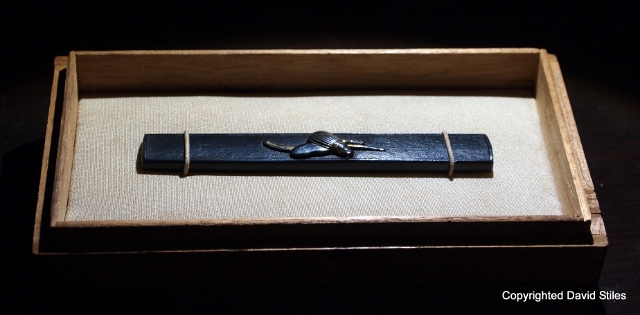
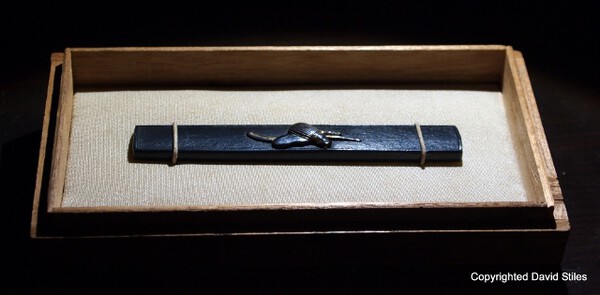
Hi Everyone, I purchased and just received a vintage kiri wood display box with a nice white silk pad from Japan. The very dark shakudo contrastes nicely with the light white background. Here is a quick photo I did of my Ko-Kinko kozuka in the new display box. I going be be adding photos of all of my tsuba in their own display boxes to my website. I already have it for some but will do the remaining ones over the weekend. Enjoy... P.S. I have been doing some more reading on the Kodogu no Sekai Blog and came across this interesting Ko-Kinko kozuka: http://kodogunosekai.com/2011/07/13/ko-kinko-kozuka-%E5%8F%A4%E9%87%91%E5%B7%A5%E5%B0%8F%E6%9F%84-%E5%AE%A4%E7%94%BA%E6%99%82%E4%BB%A3/. Rich T. makes the following observations about the Ko-Kinko kozuka: I think it is worth noting that my kozuka has very similar design trait with the tea implements being located in the center and showing a sense of perspective much like the dragonfly. My kozuka is also a little shorter (9.7 cm long) and with the same exaggerated width (1.6 cm wide).
-
Hi Greg, Very nice tsuba. I think it would be attributed to the Aizu Shoami school circa the late Edo Period. I often day dream about finding such a tsuba at a flea market and then selling it to Ken with a 1,000% profit margin. The fantasy would climax with me buying something off of Curren's website.
-
Hi Mauro P., Thanks for being part the discussion and offering your examples. Sorry but I don't understand the above sentence. Can you please clarify?
-
Hi Junichi-san, Another important point I remember was that at each point along the hierarchy starting with Goto and ending with kyo-kanagushi there was a spectrum of quality at each level. Sometimes high and low points in the quality spectrum of one group would overlap with other points along the hierarchy. I see this with my kyo-kanagushi menuki example. I hope I am making my points clear.
-
Hi Junichi-san, Here is a Kyo-kanagushi (京金具師) NBTHK Hozon level papered menuki set: http://www.japaneseswordbooksandtsuba.com/store/tsuba-%26-kodogu/t162-papered-solid-gold-shishi-menuki. They are solid gold and while the workmanship isn't at the level of Goto or Waki Goto when they use solid gold they are still nice. Grey D. made some minor mistakes in his write up as the attribution on the NBTHK paper is Kyo-kanagushi (京金具師) and not Kyo-Kinko (京金工). Here is a good NBTHK Hozon papered example of Kyo-Kinko (京金工) menuki on eBay: http://www.ebay.com/itm/141261394219?ssPageName=STRK:MEWAX:IT&_trksid=p3984.m1423.l2649. (I have only been watching it because I don't have any money. ) Generally speaking "Kyo-Kinko" is a higher attribution then "Kyo-kanagushi" I was told. I hope you find the examples helpful.
-
False advertising for those that know
Soshin replied to cuttingedge59's topic in Auctions and Online Sales or Sellers
Hi Everyone, While his restoration work might be amateur and likely leave antique Nihonto worst off then before. I would be surprise if he would be outright sealing Nihonto. One reason if you ship to him from the USA via USPS just bring in the postal inspection service and file a frand claim. For the most part this is the type of crime they handle on a regular basis. -
Hi Everyone, I reminder back six months or a year ago that Pete K. did a ranking of different Kinko attribution based on a quaily scale and Kyō-Kanagushi was at the bottom. Generally speaking NBTHK does not paper shiiremono with that said the Kyō-Kanagushi attribution is a low one.
-
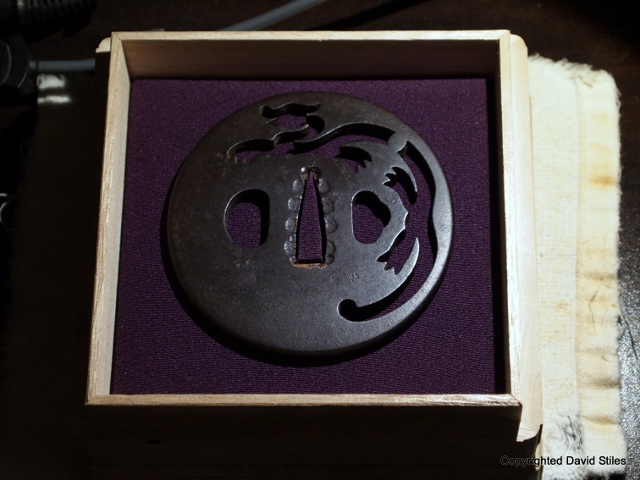
Hi Everyone, Having a few references for examples of the 3rd and 4th generation Akao school master signatures would be helpful. The reference cited in Haynes's Index are from Toso Kinko Jiten Taikei by Wakayama Takeshi for both entries for the 3rd and 4th generation master. With a book name like that submitting it to shinsa would likely be much cheaper. I also did a photo of this tsuba in its display/storage box on my desk. Enjoy and thanks for any help provided.