
Soshin
-
Posts
2,928 -
Joined
-
Last visited
-
Days Won
3
Content Type
Profiles
Forums
Events
Store
Downloads
Gallery
Everything posted by Soshin
-

Iwata Norisuke Tsuba on Juyo-Bi and related article
Soshin replied to Curran's topic in Auctions and Online Sales or Sellers
Hi Curran, Just read the Norisuke article on your website. I very good and concise read about the subject. The only thing that keeps popping into my mind is when will the other Norisuke tsuba be up for sale? P.S. Just a bit of sarcastic humor on my part no need to answer. The current tsuba you have on up on your website is very nice. Fully recommended it to anyone who has the money. -
Hi Pete, I have already agreed to purchase this tsuba. Once I own it I will take nice photos of it including clear photos of the mei. You will be one of the first persons I share the photos with.
-
Hi Pete, The Kanji (ato 後) does means late. I forgot to post that in the opening of my topic. After the nidai Nobuie there were different generations working in various areas: Joshu Nobuie, Kashu Nobuie, Akasaka Nobuie, and Owari Nobuie during the Edo Period. How do they correspond or relate to the Godai Nobuie or later generations? Or are they unrelated? How does this relate to the (ato nobuie 後信家) tsuba? To me the tsuba didn't look like the typical late Edo Period Nobuie tsuba you find out there on the internet. But then again I could be wrong but I have never seen one of these late Edo Period Nobuie tsuba papered by the NBTHK.
-
Hi Sebastien V., Here is a list of a few kantei points that make me think it is Owari and not Akasaka. 1. Overall thickness of the plate being greater than 5 mm. With exception of the 3rd generation Akasaka master Akasaka tsuba generally are not that thick. 2. Owari tsuba didn't have any characteristic shape of the ryo hitsu-ana. They do look like they were intended for soft metal inserts. 3. The shape of the rim which looks to be a rounded square shape (kaku-mimi ko-niku). Would need to confirm it with a side view. 4. The elongated and rounded shape of the seppa-dai. The Japanese term for that is "koban gata". The shape of a Edo Period gold coin. Generally speaking Akasaka have smaller and more narrower seppa-dai.
-
Hi Everyone, Just a quick question to our resident Nobuie experts what does the term (ato nobuie 後信家) mean in the context of a old NBTHK Tokubetsu Kicho paper dated 1967? I have never seen this type of attribution before. From my memory the tsuba looked liked it dated from Azuchi-Momoyama Period as I was able to examine it for over an hour back in May at a semi-local Japanese sword meeting. Sorry no photos of it but I was able to find this similar tsuba on a Japanese dealers website: http://www.seiyudo.com/tu-098144.htm. The NBTHK Hozon attribution is just to "Nobuei (信家)". Thanks in advance to any answers received.
-
Hi Sebastien V., The first tsuba I agree with your impression likely Meiji Period. The second tsuba looks like a Owari Sukashi tsuba to me. I can discuss some kantei points if you like in my attribution to Owari.
-
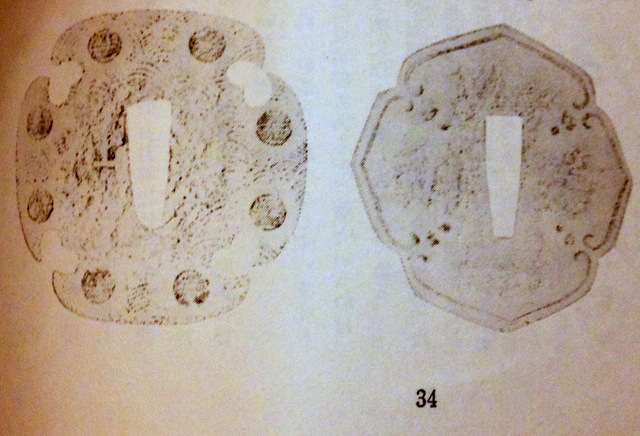
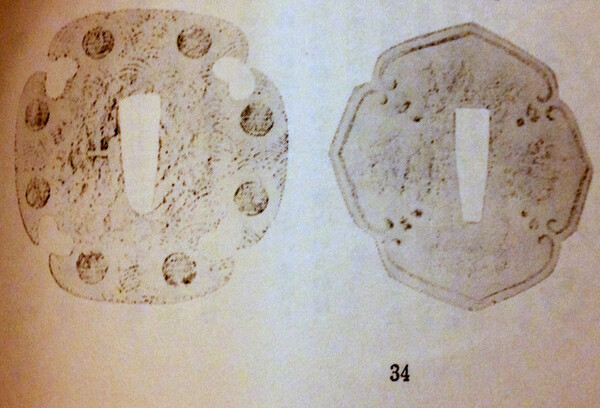
Hi Curran, Here is a photo from page 34 of Tsuba Geijutsu-Ko. I own both books. The quality of the original reproduction (likely a charcoal rubbing) in the book isn't very good hence the even poorer reproduction in Tsuba An Aesthetic Study. I hope you find this helpful.
-
American polisher... Eric Roush
Soshin replied to silverfox2965's topic in General Nihonto Related Discussion
Great to hear this topic had a happy ending. -
Hi Nathan M., My honest opinion is that you should keep saving your money. The tsuba in question while I agree with Ford is not broken is in my view boring and uninteresting. I have purchased from the seller before on eBay without any problem and some of this NBTHK papered items can be fairly good. Here is a link to the first NBTHK Hozon papered tsuba I ever purchased and it came from this seller on eBay: http://www.japaneseswordbooksandtsuba.com/store/tsuba-%26-kodogu/m118-iron-sukashi-tsuba-paper. I still really like this tsuba and its wonderful rim.
-
Hi Everyone, The diabolical thing is Facebook keeps asking me "Are you friends with Guido Schiller?". This makes me wonder if Facebook has a "friends" feature do they have a "nemesis" feature as well. P.S. Back to the topic at hand Steve any better photos of your tsuba?.
-
Peasant Polish- Opinions
Soshin replied to ancientnoob's topic in General Nihonto Related Discussion
Hi Jon and Captain Obvious, I completely agree. Has the sword in it's current state been photographed and discussed on NMB? Is it worth even a peasant polish? If there is such a thing as a peasant polish. -
Peasant Polish- Opinions
Soshin replied to ancientnoob's topic in General Nihonto Related Discussion
Hi Jean, Wasn't going to reply and I even edit my post to try and avoid confusion please read it. Would anyone pay any fee to have something that is part of their collection lost in a foreign country for 6-8 months? P.S. This is my final reply. The subject is now closed with the exception I still want my tsuba! -
Peasant Polish- Opinions
Soshin replied to ancientnoob's topic in General Nihonto Related Discussion
Hi Peter, Sent you a PM don't want to hijack this topic with my own problems. -
Peasant Polish- Opinions
Soshin replied to ancientnoob's topic in General Nihonto Related Discussion
Hi Everyone, My advice to the person who started this topic is just to buy Nihonto in good polish. The polish doesn't need to be perfect but just good enough to see and study all the major details (i.e. hada, hamon, boshi, etc.). I started this policy back about seven years ago and it has served me very well and forces me to save more money for a purchase. Never dealt with Chris Bowen but have met him in person at the NTHK-NPO shinsa at the Tampa show and seems like a great guy. I sent a tsuba with a rain dragon design back a year ago to Bob Benson for NBTHK shinsa submission. Here is a link to photos of my tsuba: http://www.tsubaotaku.com/#!Higo-Tsuba-/zoom/c1jbk/i0mdh. It waited about six months in a safe in Japan when his agent forgot about it. His agent is a very elderly Japanese man that makes me feel bad when I press the topic of my tsuba when the man's wife or son passes away. The tsuba passed NBTHK shinsa and was issued Hozon papers to Higo in December 2013. I paid the shinsa fee in February 2014 right before the Tampa show. Right now I am not in the mood to send anything to Bob until he gets a new agent in Japan. I talked to Bob by telephone many times and in May and he didn't know the status of my tsuba in Japan. He wanted me to mail something for the June NBTHK shinsa but I declined as I wanted my rain dragon tsuba back first. This is just my experience take it or leave it. Not sure the same thing would happen with a sword but question that comes to my mind why chance it. In the past I have used Bob Benson submission services for other tsuba without this much trouble. My Japanese wife has advised me to not to send anything more to Bob Benson as he does charge a broker fee for each item on top of the standard shinsa and shipping fees. I will likely just buying something off of his website as he is a nice guy and has personally contributed to my understand of the Nihonto and Tosogu via the many NBTHK lectures at the different shows around the USA. I hope you find my advice and information about my experience helpful. P.S. I wanted to add this to better make things clear so that there is no confusion. Based upon some of the replies this already occurred. (Gotta love the Internet. ) Starting last year after the rain dragon was sent and lost by the very elderly Japanese agent I told Bob that he is no longer allowed to send any of my tsuba to him. Bob is cool with this and is willing to hand carry my tsuba into Japan for submission and later for pick up. This basically means that when I see him at the shows I ask him if he is going to Japan anytime soon and if he can submit one of my tsuba and pick it up a few months later. I also remind him not to send my tsuba to his agent. This was done very nicely last year with my high end Nanban tsuba: http://www.tsubaotaku.com/#!Nanban-Sukashi-Tsuba-/zoom/c5om/image2px. -
Hi Steve, Your photos is not at the best angle to see the whole tsuba and it composition. Can you post a full view of the tsuba front and back and provide measurements?
-
Hi John S., The funny thing is Google says I have reach the viewing limit for this book. :lol: I think it is about time for me to purchase it in the very near future. I use some of Markus's other publications fairly often. The connection between Shimizu and Hirata schools was that 1st generation Shimizu Jinbei was the nephew of Hirata Hikozo. The Nishigaki school started as a branch off of the Hirata school. Some references cite 1st generation Nishigaki Kanshiro as being a student of Hirata Hikozo and others but him as a student of Hirata Shōzaburō and starting when the third generation Hirata gave up sword fitting making to work only as a valuer precious metals. :? Not sure how this relates to fittings makers from Sendai area who were hired later in the late Edo Period as retainers of Hosokawa family. This is all very interesting nonetheless.
-
Hi John S., Thanks for the reply good to see I haven't alienated everyone on this message board. That might explain it being a place near or in Edo and also located in Musashi Province. The names kumagaya(熊谷) and kumagai(熊谷) are similar readings of the same two Kanji characters. Here is an example of a work by the kumagai metal work circa the Meiji Period using inlays. http://www.fareastasianart.com/stores/Shippodo/items/1251007/item1251007fareastasianart.html I completely lost and confused with this statement. Other than knowing that there was a Nishigaki school I don't know of any connection between the 5-6th generation Nishigaki masters, Ikkin, Ichijo, and the Jingo school. :? I am aware that Nishigaki Kashiro and Shimizu Jinbei had a connection of different types to Hirata Hikozo at the beginning of the Edo Period. The third generation Shimizu learn his craft as a fittings maker from the second generation Nishigaki Kanshiro due the great age difference between second and third generation Shimizu. The second generation Shimizu was likely dead or in poor health when the third generation Shimizu was of the correct age to become an apprentice in the craft.
-
Hi John S., Thanks for translating the body text of the tsuba description. Haynes in Tsuba and Aesthetic Study lists the names of the following artisans as members of this school during the late Edo Period: Yoshitsugu (義次), Yoshiyuki (義之), and Genshichi (源七). I think these names are listed as there are still likely signed examples of their work. They were all were retainers of Hosokawa family in Edo. I still think the name "Kumagaya (熊谷)" might be a place in Edo where the school was located or something similar such as the name of the Akasaka (赤坂) school. Late this morning I was able to examine four sets of Higo style fuchi-gashira that a local collector and friend owns. Three sets where iron and one was shakudo done clearly in a Higo style that made me think of the Kumagaya school. One set of fuchi-gashira had a base soft metal of shibuichi and had very fine inlays of gold and shakudo. The surface had a combination of a smooth and textured finish to the shibuichi. Here is another Edo Higo school tsuba I found on Fineswords.co.jp that they list as just "Edo Higo (江戸肥後). http://www.finesword.co.jp/sale/kodougu/htm/2001_3000/2051_2100/2098/k2098.htm
-
Hi John S., Thanks John. I was able to handle the caption text and 熊谷派 (kumagaya-ha) would translate to Kumagaya school. Not sure the origin of name Kumagaya. In Tsuba and Aesthetic Study Haynes gives the name "Kumagaya" as an alternative name of the Edo-Higo school. Could it be a location in Edo? The most often used metals for inlay were gold and silver sometimes on the same tsuba such as my example. Haynes discusses that they were retainers of the Hosokawa daimyo and that they made other tosogu in addition to tsuba. The overall composition and the contrast of the designs I find nice on this tsuba even though the iron looks a bit boring and plain.
-
Hi Everyone, Has anyone ever heard of the Kumagaya school? I came across this nice tsuba on Fineswords.com listed on 5/31/2014 and the name of the school did not "ring any bells" in my head. Here is a link to the tsuba in question: http://www.finesword.co.jp/sale/kodougu/htm/2001_3000/2101_2150/2149/k2149.htm. The rim pattern reminds me of some of the tsuba made by the independent not a member of any school but still a retainer of the Hosokawa clan Nakane Heihachiro or a nice example of the so called Edo Higo school. The text discusses "Edo Higo" but I cannot read the remaining part of that sentence. I love the gold and silver nunome-zogan on the omote and ura respectively. Any help with the school or translating more of the paragraph text would be helpful.
-
Hi Brian, Sorry about copying the typo in my first reply and not paying attention. I am thinking he means to say "K. Morita".
-
Iwata Norisuke Tsuba on Juyo-Bi and related article
Soshin replied to Curran's topic in Auctions and Online Sales or Sellers
Hi Curran, Being an American I would like to say I really like this tsuba! :D This week I will try to make time to read your article. -
Hi Ford, Thanks for the helpful information that I will keep in mind. I have seen more of this gold paint placed on antique tsuba lately like the linked example.
-
Hi Steve, In answer to you question. If K. Morichi is correct the guy with the spray on gold paint I was hoping he had stopped a long ago.
-
I can see visiting this exhibit would bet a great chance to see some of Pete's collection as he doesn't own or will get a digital camera anytime soon. I wonder if the museum will be producing a catalogue of the exhibit. The Yankee blood in me can't imagine me visiting south Florida in the Summer. I can imagine the airplane tickets are cheap. :lol: