
Soshin
-
Posts
2,932 -
Joined
-
Last visited
-
Days Won
3
Content Type
Profiles
Forums
Events
Store
Downloads
Gallery
Everything posted by Soshin
-
Hi Everyone, If this tsuba was Kinko I would likely agree with the Umetada call but to me the Kodai Higo, Kodai Jingo, or Edo Higo is more appropriate specifically with such a rim. That not to say that the late branch of the Umetada school in Edo could not have made this tsuba and left it unsigned. On late tsuba like this the use of many different techniques were being used by many different groups.
-
Hi George T., Be very care with the bone around the soft metal inlays on the tsuba. Also be ready to stop the rust removal as your goal is not to make the tsuba look like new but to prevent damage to the details of the design by the rust.
-
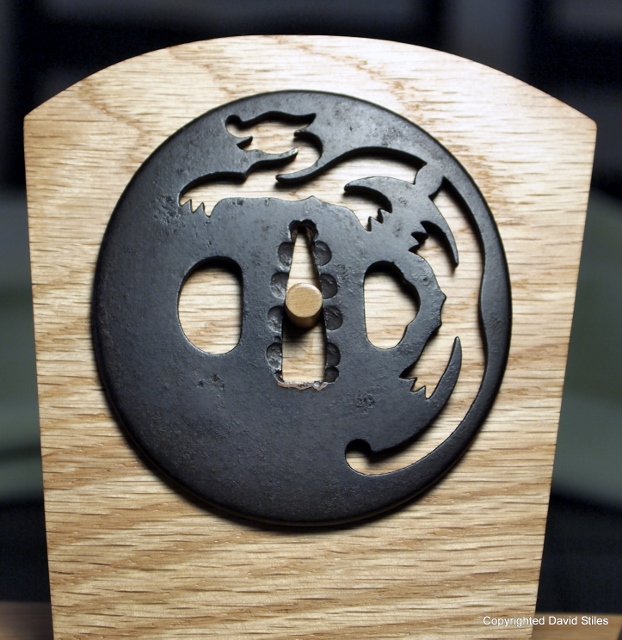
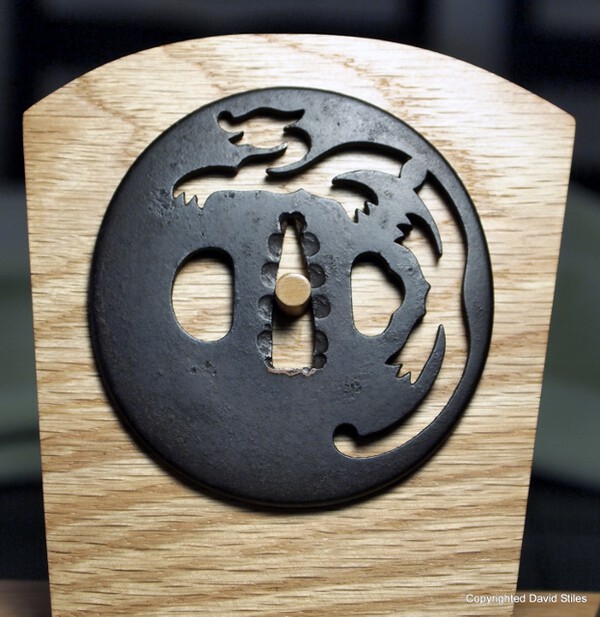
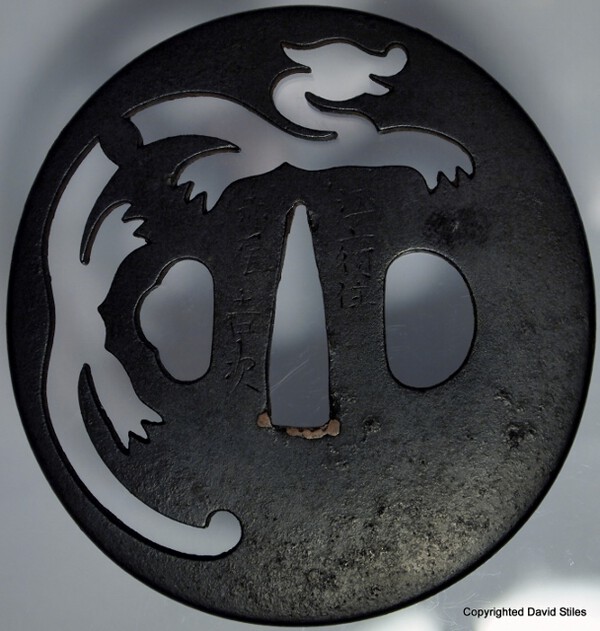
Hi Everyone, I did some photos of a new iron tsuba with a rain dragon (ama ryū 雨龍) design done in negative openwork (kage-sukashi 影透). I purchased it at what I consider a fair price at my local Nihonto club meeting last month. The measurements of the tsuba are 7.3 cm wide by 7.7 cm high. The thickness at the rim is 3.8 mm but ticker at 4.5 mm near the center. The omote nakago-ana is nicely finished with round shaped decorative chisel marks (kesho-tagane 化粧鏨). One the ura side there is a finely cut signature (mei 銘) that reads as follows: Left: Akao (赤尾) Yoshitsugu (吉次) Right: Kofu Ju (江府住) From my research over the weeks I think this tsuba was likely made by the third or fourth master of the Akao school both which used the same artist name "Yoshitsugu (吉次)" followed by the location information "Kofu Ju" previous two generations with the same name use "Echizen Ju" or something similar. Bob Haynes in his index comments on page 2352 that to separate the third and fourth generations by signature is very difficult. If anyone can help with that please reply or send me a PM. The school by this time was located in Edo but was still directly employed by the daimyo of Echizen Province. The forge of the iron is markabley flawless with a silky smooth polish and beautiful patina with deep brownish-black color. The balance and shape of the rounded rim is also excellent. A good tsuba with a very fun design in my book. Please feel free to comment and discuss. :D
-
 Hi Ed, This photo was taken from the Tampa show magazine this year so I think Bill Green is planning to have another Baltimore show. If there is a Baltimore show I will be there with a table as well as taking time off from work to attend all three days. :D
-
Hi Mariusz K., I sold a few nice tsuba (without that much of a mark up as the example provided) on that dead horse you are hitting. :lol:
-
Hi George, I agree with Lee it looks like Higo. My only disagreement is I am think it is circa the 19th century say the early to mid 1800s. The style of the hitsu-ana and how the design is done reminds me some what of the Jingo school. The relatively large size and thinness of the plate is consistent with very late school work and possible Edo Higo copy as per Guido's comment. Not sure it is just the lighting in your photos (looks like you used the on camera flash) but the tsuba looks very rustly.
-
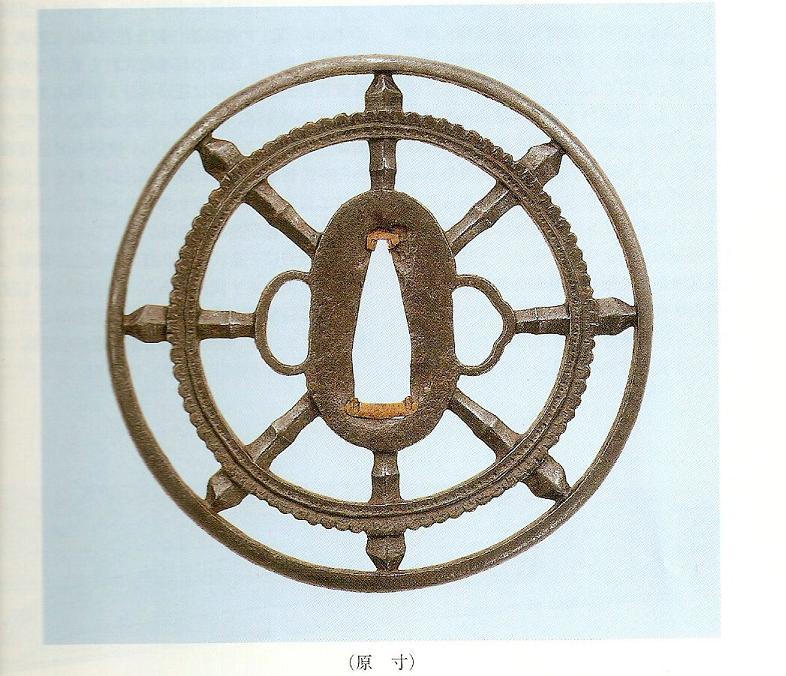
Hi Junichi-sama, The design is not a Dharmachakra (rinpo 法輪) "Dharma Wheel" because it has twelve spokes and not eight. Why this is important is because in Buddhism there is the "Noble Eightfold Path" and not the "Noble Twelvefold Path". Hindu, Jain, and Sikh Dharmachakra often have many more spokes of the wheel or other symbolic changes. If you look at numerous antique examples the Buddhist Dharmachakra designs in tsuba always have eight spokes of the wheel. I know this by association as my wife is a lay Buddhist Dharma teacher in a school of Japanese Buddhism. I also personally characterise and associate my religious views as Buddhist. Attached is an example taken from a issue of the NBTHK Token Bijutsu. It is a Jyuo level Ko-Shoami tsuba from the Muromachi Period with a Buddhist Dharmachakra design done in ji-sukashi (地透). Your tsuba I think the openwork design is likely a wagon wheel. Here is a Ko-Katchushi example also attributed to the Muromachi Period from Sasano's first book on Sukashi Tsuba. In terms of the age of the tsuba I agree with Pete K. it looks like a modern tsuba to me. Sorry to say the patination of the iron was also done poorly in my opinion along with the how the sukashi was cut as noted my Pete K.


-
Hi Jim K., Thank you so much for posting a link to more of this modern masters wounderful work. :D
-
Hi Curtis R., I can't add much to what you already have. The Kinai school in Echizen Province made mostly sukashi tsuba of dragon, Aoi leaves, and a few other designs and your tsuba is clearly solid (ita) but the clam or other shellfish is fairly common subject matter for the school. Based upon your signature and workmenship I would say your tsuba is a school piece and not gimei.
-
Hi Ian C., I have seen these type of iron kozuka come up at my local auction house just last year. I examine a whole lot full of them (4-5 pieces). I never bid on them even with the low estimate because they gave me the feel of vintage Japanese reproduction circa the Taisho Period or early Showa Period (i.e. early 20th century). Sorry I can't be of any more help.
-
Tsuba Otaku Website Updates
Soshin replied to Soshin's topic in Auctions and Online Sales or Sellers
Hi Everyone, I made some major updates to my website late yesterday after my day job. Here is the direct link: http://www.tsubaotaku.com/. Constructive feedback and comments are always welcome and enjoy. :D -
Hi Peter F., Did it ever have a koshirae? Was it always in a shira-saya?
-
Hi Ian C., I have seen it on tsuba of the Tetsugendo school. Here is an example: http://www.japanesesword.com/Images/Fittings/808fittings/808t1/DSCN6788.JPG. I have never seen it on kozuka before. Do you have an example?
-
Hi Ed, No the Yagyu tsuba is being worked on and will likely be in a condition in the future for it to pass NBTHK Hozon. As it was at the Tampa show it would not pass. Ok, agreed I am not going to discuss specific of the trade. Terry purchased his tsuba because he likes old rusty tsuba. I accept that now end of discussion and yes I was a bit over the top with my comments and I apologize. I purchased the Yagyu tsuba because the design is a classic one found in the Yagyu family record and relates to some critical concepts in Yagyu school of swordsmanship. I am being tough them in my school of Batto that came from the Yagyu school of swordsmanship in Owari Province. Here is more information: http://www.koryu.com/guide/seigo.html.
-
Hi Everyone, Roman, thanks again for the information. Higher resolution photos of this kozuka will be up on my website shortly that are better seeing fine detail. The link to is below in my signature. This naive nanako-jita, dark black shakudo, and fine mon design makes me think Ko-Kinko (古金工) workmanship circa the Azuchi-Momoyama Period. This was likely a country work produced in some remote province and not in the capital of Kyoto. At shinsa it would likely get a generic Ko-Kinko (古金工) attribution confirming Pete's statement.
-
Hi Ed, Yes I have made mistakes so has everyone. Well the Yagyu tsuba (Edo Period) was traded at the Tampa show to a long time collector for three tsuba from his collection. I don't discuss deals in detail with collectors that are not on NMB while on NMB! I not discussing this anymore. P.S. How many US collectors can fix a fire damaged tsuba and have it later pass Hozon or higher at the NBTHK?
-
Hi Franco, Thanks for the obervation. I really can't tell if the shakudo was repatinated or not. Whould like other opinions about this. The nanako-jita has a fair number of scuffs, scratches, and is worn down in places. The deep color is also consistent from the omote to the ura with its polished finish.
-
Hi Ken, Nice for another Budo person to chime-in. I first trained seven years with a aluminum bladed iaito and then made the change to to a real steel blade (ie Showato in Budo mounts) this year. I pratice Yagyu Seigo Ryu Batto. I had no problems and it turned out much better. The Showato has a much better real iron tsuba (had some rust I needed to deal with but much better then the tsuba that is the topic of this post) that does a great job of balancing the steel blade. My teacher commented the new real sword is much better balanced then the iaito that I had which had a fake cast brass sukashi tsuba which made the sword very tip heavy.
-
Hi Everyone, The color and darkness of the shakudo reminds me of Ko-Goto works but I don't know. In conclusion the piece has a good provenance. P.S. I am planning to keep this kozuka a while. If anyone has a good quality kozuka box they are not using please let me know.
-
Hi Roman, It might have been. Many of these old iron tsuba from that era and before were covered with black lacquered. Here is another tsuba on my website that shows signs of black lacquer application: http://www.tsubaotaku.com/#!Nanban-Saku-Tsuba-/zoom/c211q/image1f5e. In particular very near the raised rim. Below is a tsuba featured in the NBTHK monthly journal and was issued Juyo papers. It displays the black lacquer very nicely.

-
Hi Pete, Still thinking... Any help would be great. Here are some additional photos taken today. The first is the kozuka next to my shakudo Ko-Kinko tsuba. Something I noticed that isn't completely clear in the photo is that the shakudo color of the kozuka is deeper than that of the tsuba. The second photo is of Kozuka showing the height of the main design (mon 紋) above the nanako-ji (魚子地).


-
Hi Pete, Going back to the coloring method used on the design. Markus Seseko's handbook lists the following bit of information about these gold + mercury amalgam => heat vaporization techniques to color in the case of my kozuka shakudo. They are two separate techniques one that uses gold or silver powder and the other that uses thin sheets of gold or silver. In conclusion I think my kozuka is relatively old circa the Azuchi-Momoyama Period. The question of where and who made it I will leave to another topic unless it is directly related to determining the age of my kozuka.
-
Hi Pete, I have been using Markus Sesko's Handbook of Sword Fittings Related Terms. I have also been using Kodogu no Sekai blog to help me with terms along with the provided visual examples. The term used on Richard Turner's blog site is (kin iroe 金色絵) which means "gold coloring". The use of heat and mercury is a common thermal application method on tosogu. In answer to your second question. The kosuka would have likely been worn by a cultured samurai that enjoy the Tea Ceremony and/or enjoyed reading the Hundred Poems of Chanoyu. The jita is shakudo nanako-ji (赤銅魚子地) that is very fine and was applied linearly along the horizontal plan of the kozuka. In a few places the nanako looks like they are worn down a bit which may or may not indicate age.
-
Hi Jean C., So why comment in such a manner. I haven't made any claims of its importance other than the previous owner was thinking it dated from early Edo Period or before. Not that old in the great scheme of things and does not in anyway indicate historical importance . So far this kozuka has been a great learning experience thanks to Pete and Malcolm and it only cost me $125.00 USD. P.S. You are correct the term inlay may not be correct in this context. A better term I think is coloring (iroe 色絵). Hi Malcolm, Thank you. I will do some more research about the theme.
-
Hi Pete, Ok examined the gold some more under hand glass magnification and I retract my (uttori うっとり) answer. I think the method used in the gold inlay is (kanagaki かながき) this method is done with gold dust mixed with lacquer. It is also a early inlay method for both gold and silver and can produce this (suri hegashi) effect. The kozuka maker likely inlaid the whole design and then rubbed off the gold and lacquer from the high points of the design to create a worn effect reflective of the wabi-sabi aesthetics of the tea ceremony of Sen no Rikyu.