
Soshin
-
Posts
2,934 -
Joined
-
Last visited
-
Days Won
3
Content Type
Profiles
Forums
Events
Store
Downloads
Gallery
Everything posted by Soshin
-
Hi Stephen, The mei is hard to read but I think it might say: Yukiyasu (幸安). He is in the Haynes Index but just not a lot of information about this artist that did work in the Shoami style. Here is the information. Not sure what "early Shoami style" means in this context. Sorry about not being a big help on this one.
-
Hi Brian, Haynes has a tosogu artist index and Hawleys has a swordsmith index. I have found a tsuba mei in Hawleys because the tsuba was made by a Tosho known to make tsuba. The example which is the topic of the tread is not a Tosho tsuba. Both books are not a meikan. A text with photos used to determine if a signature is judged authentic.
-
 Hi Grey, What wonderful news! Very much looking forward to it. :D
 -
Juyo-Bi.com : Estate Tsuba #3 and #4
Soshin replied to Curran's topic in Auctions and Online Sales or Sellers
Hi Curran, I was just referring to the thickness measurement it should read 8 mm and not 8 cm I presume. Regardless everyone of your unsold tsuba is a rare treasure. Even if I had the money not sure which one I would select because all look great. Back to work for me. -
Juyo-Bi.com : Estate Tsuba #3 and #4
Soshin replied to Curran's topic in Auctions and Online Sales or Sellers
Hi Curran, The measuments of Ko-Akasaka tsuba says 8cm thickness. That's amazing! :lol: But in all seriousness you have some really nice tsuba for sale. -
Hi Ford, Thank you so much for the detail explanation above. I am aware of how menuki are basically made but your explanation was very helpful with connecting the important points to understand the process better and the importance of the filemarks at odd angles on the back surface of the menuki. P.S. I am in the market for some high quality menuki and this topic has been very helpful with educating me before I buy.
-
Two Kanji, One Reading, Different Meaning...?
Soshin replied to Soshin's topic in Translation Assistance
Hi Everyone, Thanks everyone for the replies. This makes sense as the attribution on one tsuba was (den Kyo-Shōami 傳京正阿弥) circa the middle Edo Period and the other tsuba attribution was (den shōwa saku 伝昭和作) circa the late Shōwa Period. This simplification of the Japanese language and how many Kanji characters are written happened after World War II. To me this means the person writing the certificates wanted to use the original Kanji (den 傳) for the antique tsuba and the simplified modern Kanji (den 伝) for the vintage tsuba. Having a native speaker input would be helpful just to confirm this. -
Hi Everyone, I was looking at two different attributions for tsuba in my collection written by the NTHK(NPO) this evening and was wondering what was the difference in meaning, nuance, or context between (den 伝) and (den 傳). I checked a few different references and the meaning looks to be nearly identical or very similar. Is there any difference between the two Kanji given the context of a Kanteisho for tosogu or are they just interchangeable? This request is just for my own edification both tsuba are not for sale. Thank you for taking the time to help.
-
Hi, The middle one looks like a Shōami School tsuba circa middle to late Edo Period. The other tsuba to the left and right has been correctly identifited by others in my opinion.
-
Hi Ford, Good obervation about the diagonal file marks on the back surface of the menuki. I missed that but can clearly see them after you pointed them out. I am still of the opinion that these are cast reproductions.
-
Hi Ford, Been doing some study of fine menuki with NBTHK papers in hand at the last Tampa show. Thanks for the information this does not sound good for the collecting hobby of fine antique menuki.
-
Hi Stephen C., I have given up selling on eBay altogether because of all the fees on top of the base fee PayPal charges.
-
Hi Thomas, Thank you for taking the time to post the additional photos they are very helpful. This type of signature on menuki is call tanzaku-mei (短冊銘). I am of the opinion that the set look cast the small flat plate with the signature (tanzaku) on the backside looks like it is part of the cast. The small plates (tanzaku) should show signs of have been carved with the signature and then inserted as separate pieces after the menuki were completed. The central pegs again something that is added later and sometimes adjusted or lost also look like they were part of the cast. There is a old lesson that the backside of menuki are can tell you a lot about the quality and authenticity of menuki in question.
-
Hi Thomas, Not going to say one way or the other. Can you post better photos? The lighting is really poor with the shadows being cast on the menuki and focus is a bit off making it very hard to read the signature.
-
Hi Brian R., Thanks for the reply. Funny thing is I don't remember seeing it on Curran's website at all. Curran my senior in the hobby by about ten years had a discussion about this tsuba via email back in April and I committed to the purchase then after seeing good photos of it. The remarkable detail and refinement is something very clear in hand but is a bit hard to capture in any photo. Hi John S., I know what you mean. The very first brass tsuba I remember seeing when I first started to collect were ones found on Shin-Gunto mounts and wasn't impressed at all. The pre-modern brass with black lacquer and a age patina is a whole different story.
-
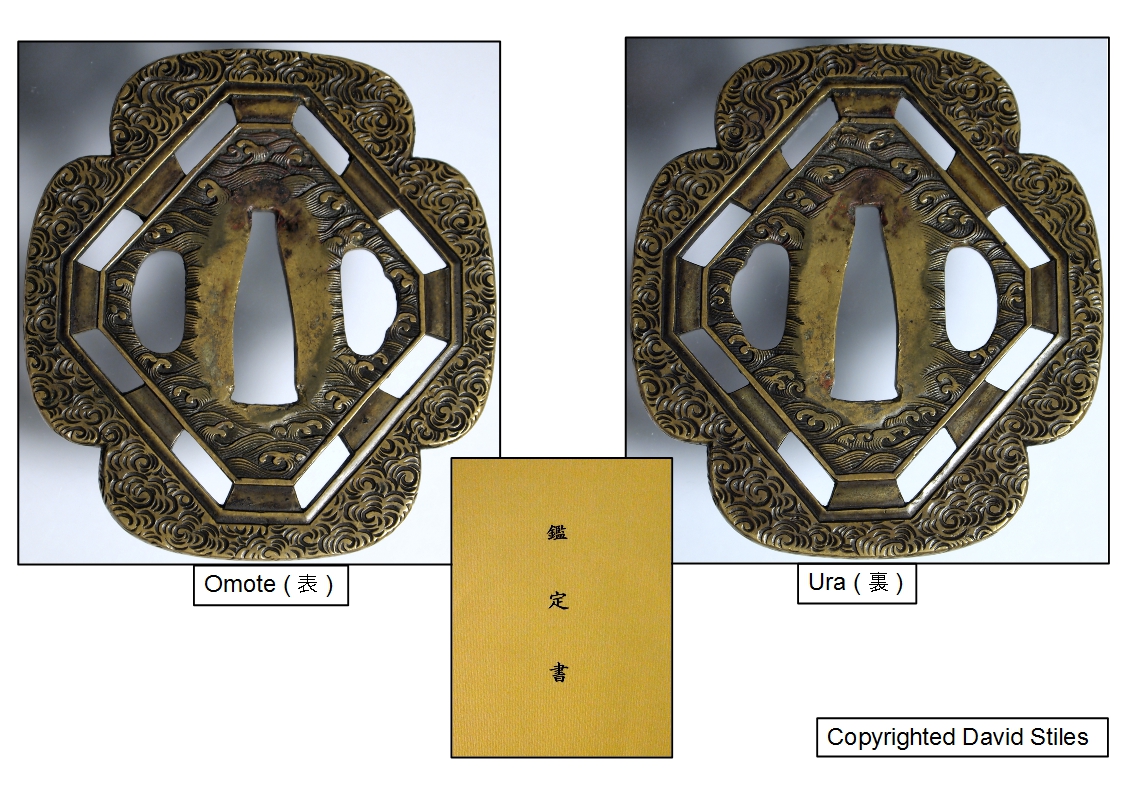
Hi Everyone, Just wanted to post some photos I did of my first brass tsuba and newest addition to my collection. I had to save money for about two months to afford this fine tsuba. This is an important point to new collectors out there that frequent NMB that it is sometimes necessary to wait and save your money a while for one fine tsuba when it is offered to you by a more senior collector. The tsuba is from Hirado Province located on Hirado Island modern day Nagasaki Prefecture circa the middle Edo Period. A partial write up and additional photos are on my homepage of my website at http://www.tsubaotaku.com/. The tsuba has a NTHK Kanteisho paper attributing the tsuba to Hirado Province. This would be a good tsuba for Richard George's VR technology as the cloud design covers all parts of the rim. The tsuba was once in Jim Gilbert's collections and his notes can be found here on this website: http://home.earthlink.net/~jggilbert/hoan.htm. It is the last tsuba on the webpage. This is the only Hirado Kunishige tsuba I have ever seen in person or in books using small openwork design (ko-sukashi 小透). The other techniques are fairly common to works done by Kunishige. Enjoy and feel free to comment and discuss.

-
Hi RKG, Good eBay fine. I purchased a nice vintage kozuka box from this seller recently. I love the rim edge on this tsuba it does a good job of contrasting with darkness of the plate surface. It can be clearly seen on the VR images when you turn them. Thank for sharing.
-
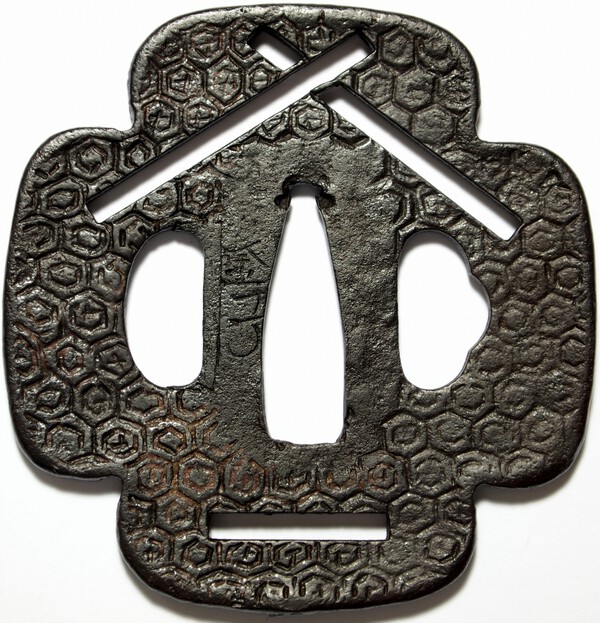
Hi Everyone, Completely agree with Brian and others. Looks like a crude case iron reproduction that isn't hard to spot. The low amount of cash could have been spent on books or savings for a real tsuba.
-
Hi All, Looking at the repost of the photo the condition of the iron surface is fairly poor. I can see someone doing some major damage to the thin sukashi if he/she wasn't very careful when dealing with active rust.
-
Hi Nathan M., Here is the online reference: http://www.shibuiswords.com/tsuba.htm#nobuiye. Have read it offline before just don't remember where. It might have been in one of Haynes's books. My opinion agrees with Ford's more often then he likes acknowledge publicly. Late 16th Century to early 17th Century done in armor makers style.
-
I agree likely fire damaged or just some very serious rust damage. Either way not in very good condition.
-
Hi Everyone, Just as a matter of correctness I need to state this. Current thinking says that the Myochin school only produced armor during the Muromachi Period as the demand was great. The first tsuba made by members of the main line artists of the Myochin family do not appear until around the time of Myochin Munetoshi, 21st master of the family circa 1625. Saotome a branch of the Myochin school started a little earlier during the Azuchi-Momoyama Period. I came across this information while researching Nobuie. I have what I think is a early example of Azuchi-Momoyama Period Saotome tsuba on my website.
-
Hi Nathan M., Good to hear you picked one. Be sure to post nice photos of it on NMB when you get it.
-
Hi Ford, I already commited to the purchase of another tsuba weeks before seeing this topic so I was never in a buying situation. Looking forward to your observations when you get it in hand.
-
Hi Ford, I can't examine that lemon because it has long since left my collection. But I do remember that it had a separate interested piece of iron if I remember correctly. Here is another old photo I found of the tsuba on my computer which might be a little bit better. If someone out there on NMB has it please post a better photo. To determine if it is cast or if it has such a insert.