
Soshin
-
Posts
2,932 -
Joined
-
Last visited
-
Days Won
3
Content Type
Profiles
Forums
Events
Store
Downloads
Gallery
Everything posted by Soshin
-
Hi Pete, Thanks for reply. I remember telling Mark Jones, Grey Doffin, and others this at the dealers dinner Saturday night at the Tampa show the reason for not attending the Chicago show this year. I can't make the Chicago show this year nor participate (i.e. submitting something and asking questions) in the NTHK shinsa as I normally do because I will be going to Japan in April for a few weeks. This is mostly a family related planning trip but I will get one free day in Tokyo to do all my nihonto related actives in around greater Toyko.
-
Hi Everyone, Received some feedback from the Tampa show about this tsuba which I had on display only. One issue that was raised was that I should consider submitting this tsuba for NTHK yushu-saku shinsa. Never seen any yushu-saku tsuba before therefore I have no reference point to judge the likelihood it would pass. Does the NTHK publish a book or magazine with them much like the NBTHK does with its Juyo Nihonto and Tosogu? I have seen NBTHK Juyo Kanayama tsuba before in the monthly magazine.
-
Hi Grey, I am going with Ko-Kinko styled tsuba made by Ford Hallam for a class on the patination of soft metals. P.S. Before anyone takes my comment the wrong way the comment above was intended as a joke. LOL!
-
Hi Grev and Pete, Agree with Curran and Grey 肥後鍔 Higo-tsuba Dandyism Expressed Through Iron from the JSSUS is a good economical primer about Higo tsuba with fair number of examples with color photos. Some more information about the so called Edo Higo tsuba makers. They belonged to Kumagai Family of Edo that were retainers of the Hosokawa Family, Daimyo of Higo Province and were employed during their forced migration every other year to Edo as part of the Tokugawa alternate attendance policy for every daimyo. They were best known for their talent at inlaying of designs often using different soft metals of powdered gold and/or silver. They were active in producing all types of sword fittings not just tsuba and also sometimes imitate other Higo School's work.
-

Tampa Tampa Tampa!
Soshin replied to Peter Bleed's topic in Sword Shows, Events, Community News and Legislation Issues
Hi Everyone, It was a very good show for me. Was able to see and study many fine tosogu all three days of the show. I was able to move everything off of my table that I wanted to and get a couple of really nice tsuba. I would like to personally thank Grey Doffin for his honesty and integrity in a deal we made on Sunday. P.S. With permission from the owner here is some Higo eye candy for all who couldn't make it. Please try to make it next year.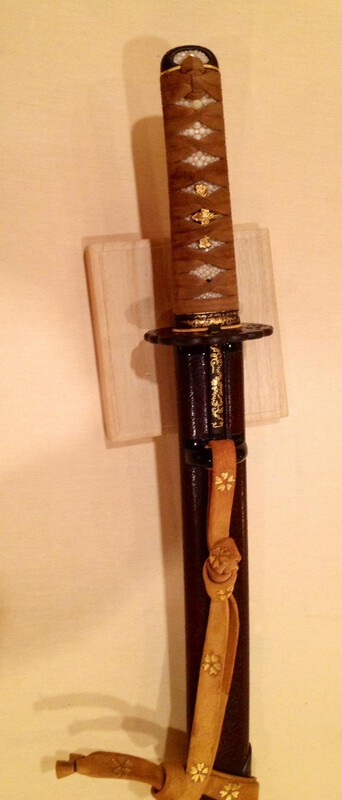
-
Hi Pete, Nice Higo tsuba! Thanks for sharing. Looking at the edge of the inside surfaces of the openwork design has a unevenness and "rat chewed" like appearance that I was told was characteristic of the Nishigaki School of Higo Province. The lack of multiple soft metals and/or inlays methods isn't typical of Edo Higo School.
-
Tampa Tampa Tampa!
Soshin replied to Peter Bleed's topic in Sword Shows, Events, Community News and Legislation Issues
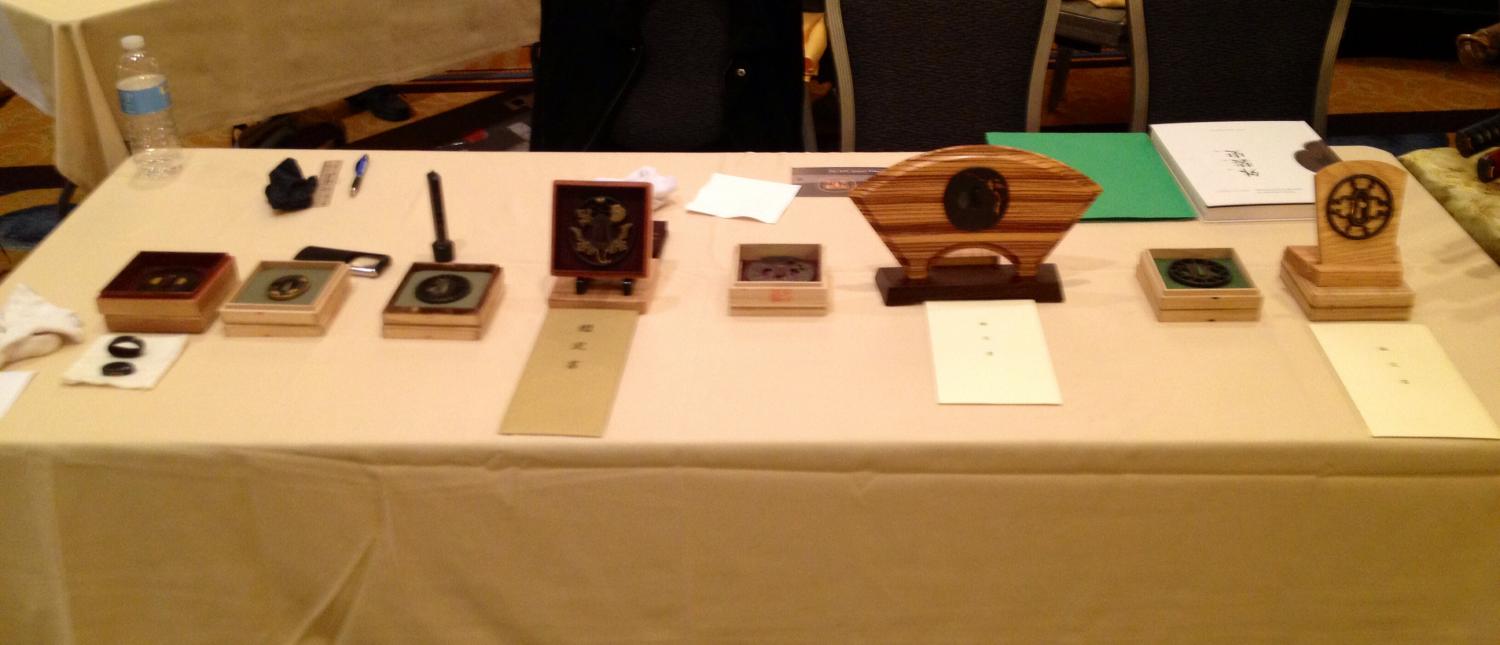
Hi Everyone, Here is a photo of my table on Friday of the show. Enjoy.
-
Tampa Tampa Tampa!
Soshin replied to Peter Bleed's topic in Sword Shows, Events, Community News and Legislation Issues
Hi Peter, What just doing some packing for the show. Tampa is a fairly short flight for me so I will be leaving bright and early on Friday morning to the show and have everything setup by noon. I will be their for all three days. I am sharing a table with Curran and the table number at the Tampa show is 57. I will post some photos of the show for the people unable to make it. Take care and hope to see you at the show. -
Hi Peter R., I have a hakogaki for a tsuba by a well know late nihonto expert Kanzan Satō. I don't think it adds anything of value to it as it is a tsuba box and not a sayagaki. I am basically just agreeing with what others have already said and citing a personal example.
-
Hi Everyone, I really like Markus blog as well. Lots of very helpful free information.
-
Hi Bruno P., Thanks for the additional photos I was able to make out Heianjô jû (平安城住) part of the signature which is on the ura side. I checked out Markus Sesko's Signatures of Japanese Sword Fittings Artists and they had only one entry for a artist named Tadanaga (忠長) who was based in Hizen Province and not Yamashiro Province and therefore is not the maker of your tsuba.
-
TAMPA SHOW
Soshin replied to lbkmd43's topic in Sword Shows, Events, Community News and Legislation Issues
Hi Everyone, Just a quick note. The start date of the show is Friday, February 20, 2015 and the show run until Sunday, February 22, 2015. I am sharing a table with Curran and the table number at the Tampa show is 57. I will post some photos of the show for the people unable to make it. Take care and hope to see you at the show. -
Hi Bruno P., Reading in Tsuba An Aesthetic Study Mr. Haynes lists a few signatures found on Heianjo Zogan tsuba but notes that many examples are unsigned . They are as follows: Nagayoshi, Kaneshige, Yukihisa, Yoshiye, Yoshihisa, Shigemitsu, Shigeyuki, Kanesada, Munetoshi, Masamoto, and Munetoshi. While Mr. Haynes doesn't state that all signed examples are Edo Period I am of that opinion based upon examples I have seen. Can we have a better view of the signature if possible? I would also like to learn more about the Chuo tokenkai. Where they located in Japan and if they are still active as a group.
-
Hi Chris, I think these statement sum up my tsuba perfectly. The wabi/sabi aesthetic principles as defined by Sen no Rikyū was clearly in play in the conceptualization of my tsuba by its maker.
-
Hi Steve, Can you give us some other examples besides sword fittings of how the new Azuchi-Momoyama tea culture had an affect on the art aesthetic of things far removed from the tea ceremony itself? I am asking this question because I want to learn and I also find it intesting that the tea ceremony would have such a profound effect on items not at all used in the tea ceremony such as a katana. For example where thier tea ceremony style homes, riding saddles, and pajamas used by samurai?
-
Hi, I don't think the tsuba is from the Muromachi Period and nor does the hakogaki state that. All the tsuba from the Muromachi Period are not signed by their maker. Beginning in the Azuchi-Momoyama Period you had the very first artists signing thier work. These include the artists like Nobuie, Kaneie, Hoan, and Yamakichibei. Your tsuba likely dates from the early to middle Edo Period. While Heianjo Shinchu Zogan School tsuba are not often signed there are a few examples in first half of the Edo Period. All in all the tsuba looks good and you have a hakogaki that adds to the history of the tsuba.
-
Hi Peter Reusch, Thanks for the link to the nice example with a really great custom fitted display box. At the beginning of the year I was in the market to find one really nice example of the Kanayama group for my collection that focuses on the different groups and schools of Owari and Higo Provinces. I was considering this tsuba you linked to with NBTHK Hozon papers on Nihontocraft website and another tsuba with NBTHK Tokubetsu Hozon paper to Kanayama on a Japanese dealers website. This other tsuba is no longer on the Japanese dealers website.
-
Hi, It looks like a Nagamaki to me. The nakago and blade looks too long for to be a Naginata. It would have also been mounted on a much shorter pole if a Nagamaki.
-
Hi Steve, Pete, and Brian, Thank you and yes that is why I was presenting the information from the different sources I found two of which are very interrelated in the classic teacher and student relationship. I think Sanno Museum dating of 16th Century for its Kanayama tsuba is more accurate which includes the late Muromachi Period and up to and including the Azuchi-Momoyama Period.
-
Hi Everyone, Just some additional notes mostly to myself but I think other can benefit as well. I did some checking of earlier text such as Tsuba An Aesthetic Study by Robert E. Haynes copyrighted 1994 and Tsuba Geijutsu-Ko by Dr. Kazutaro Torigoye copyrighted 1960. I have copies of both books. Robert E. Haynes states in this translation that Kanayama tsuba evolved around the middle Muromachi Period and likely wise Dr. Torigoye states in Japanese in his book Tsuba Geijutsu-Ko (時代―室町中期) which basically means "Middle Muromachi Period". It appears Sasano dated some of his Kanayama tsuba in his collection even earlier to the early Muromachi Period. I also examined the more modern Japanese book Bushi no Issho: Sukashi Tsuba (武士の意匠透かし鍔) by Sanno Museum copyrighted 1999 and the earliest dated Kanayama tsuba are dated to the Muromachi Period (16th Century) basically meaning the late or end of the Muromachi Period by referencing the 16th Century. Seeing how I can't be sure my tsuba wasn't made before 1568 the most accurate statement I can make in terms of production period for my tsuba is from the late Muromachi Period to Azuchi-Momoyama Period (circa 16th Century).
-
Hi Mauro, You did a good job. Glad you enjoyed yourself on this kantei. Tsuba of this age and quality don't come along so often. I will have this tsuba in my collection for a very long time. I am thinking of turning this kantei write up into a short JSSUS article for thier newsletter.
-
Hi Pete, Ok I understand what you are getting at. I think the dating for production period from the late Muromachi Period to the Momoyama Period is a more realistic dating of my tsuba then what is written on the NTHK paper. I am also lacking evidence that the tsubako relocated to the new castle town of Ōno during the Bunmei Era (1469) produced any tsuba that were Kanayama style.
-
Hi Pete, Yes I listed a link to Jim Gilbert's website in my references. I also contact Jim to discuss this fine tsuba. I agree with not taking Sasano dating as orthodoxy but after comparing the published examples in his book, my tsuba, and what was written on the NTHK paper it all looks consistent. Just would like to see early to middle Muromachi Period Kanayama tsuba outside of the Sasano books to see how similar or different it is to my tsuba. I have some old English Token Bijutsubu issues in English I will check. I will also do more searching among my own reference library.
-
Hi Steve, Yes you did a great job with the kantei and was only a single point away from real point score on the worksheet. Talk about being able to quantify quality. The hyōan "bottle gourd" has a Chinese cultural origin and deep association with Taoism. I agree with you in terms of the tea taste of the Momyama Period. The thickness of the plate isn't as great as some Momoyama Period Kanayama and Owari examples I have seen. I also noticed that different layers of iron are visible along the inside surfaces of the sukashi. I have observed it in this Kanayama tsuba as well: http://www.bushidojapaneseswords.com/uploads/3/0/1/5/3015097/6061208_orig.jpg?225 Do you or anyone else have a Owari or Kanayama tsuba example from the early to middle Muromachi Period to share? It would be helpful for my study.