Matsunoki
-
Posts
3,701 -
Joined
-
Last visited
-
Days Won
70
Content Type
Profiles
Forums
Events
Store
Downloads
Gallery
Everything posted by Matsunoki
-
Happy Christmas Jean! Nice bold tsuba.
-
…….unless you’re an elk☹️
-
Yes shakudo does contain gold in varying proportions. ….and therein lies the crux of the matter. lower quality compared to what? Compared to other similar tsuba (Soten or otherwise….iron or otherwise)? Compared to other Shakudo tsuba? Compared to Nagoya mono? (search on this forum for this topic……you will find it enlightening and a great place to start) How long is the proverbial piece of string? …..and it also depends on your own “taste”
-
Like Lewis (great advice there), I say this a lot as well…… One of the best ways to start developing an “eye” if you cannot physically handle a lot of pieces is to study past auction results. Usually you get a few decent images and can often see the price they sold for, when and where they were sold etc. Images can be enlarged if of sufficient quality enabling the finer details to be examined. You will not learn everything but you will start to be able to discern what “quality” looks like and what quality costs. It’s just my opinion and others will disagree but I think it’s far more important to recognise quality, both in artistry and manufacture than it is to chase Mei. It’s the same principle that is applied to swords……buy the item, not the Mei A good place to start….(and your tsuba is fine around that price imo) https://www.bonhams.com/search/?chronology=past&query=Tsuba
-
That depends on what your local ivory laws are. It’s an admirable objective but the law might get in your way☹️ If it is legal to sell them where you are you could just put them in a sale and donate proceeds to a suitable charity. Google should tell you. I join you in your hope! All the best.
-
Sadly your hunch is correct. It’s a very sad state of affairs which the politicians and law enforcers of the world have all failed to deal with for a variety of reasons…..mostly ignorance or monetary.
-
Correct.
-
Also it’s worth knowing that nowadays one of the more commonly used methods to restore gilding on Japanese metalwork (including tsuba) is not done by amalgam nor by zogan (of any type) nor by foiling or leading, ….it is done using modern masking fluids and electrolysis whereby immersion in the gold plating fluid deposits gold on the exposed areas ie it is electroplating. Modern masking fluids can facilitate very precise plating and different colours of gold are available. The skill lies in the base preparation and the precision of the masking. This is where these overflows and “bleeds” can occur. In the past I have had tired shakudo tsuba both repatinated and then re gilded in worn areas by someone who knew what he was doing. When done well it is virtually impossible to tell it from gold butter gilding. When done badly or carelessly the results can look like the tsuba in question. But anyway, it may be totally original but simply not the best quality.
-
Simply looking at the quality, imo this is not made by any “master” let alone a highly rated one. The workmanship is very basic…..and that’s being kind.
-
Victor, I am not seeking an argument, merely pointing out what I see on the tsuba in question……which is poor quality workmanship in my opinion and possibly touched in with later restoration. Unless we have it in our hands we cannot be certain.
-
Zacke do make some very optimistic comparisons …….citing other auction results. Good marketing but always best ignored.
-
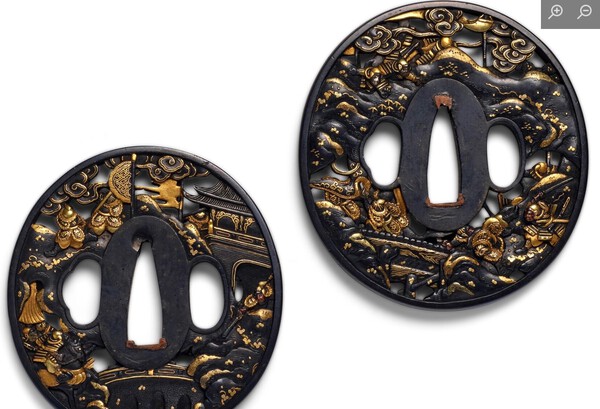
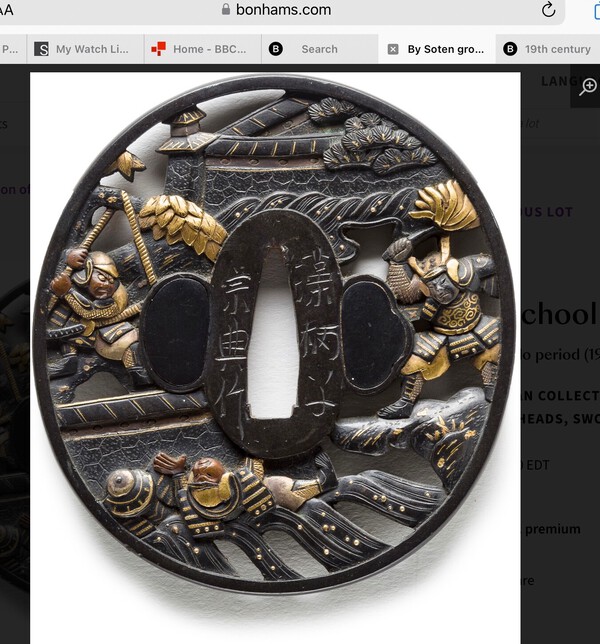
Just for comparison…….

-
I am very suspicious. It lacks the typical Japanese precision in the gilt work. When you look closely a lot of the “gilding” looks like very careless restoration or maybe even paint. Look at the way it has “bled” beyond its intended area. I haven’t compared it to a lot of other Soten but to my eyes it’s dubious. Could be genuine but just tarted up. Personally I’d be asking them to have a closer look…..and I would not pay yet.

-
Can anyone help me with these Shibuichi (I think!) plaques?
Matsunoki replied to Laura's topic in Other Japanese Arts
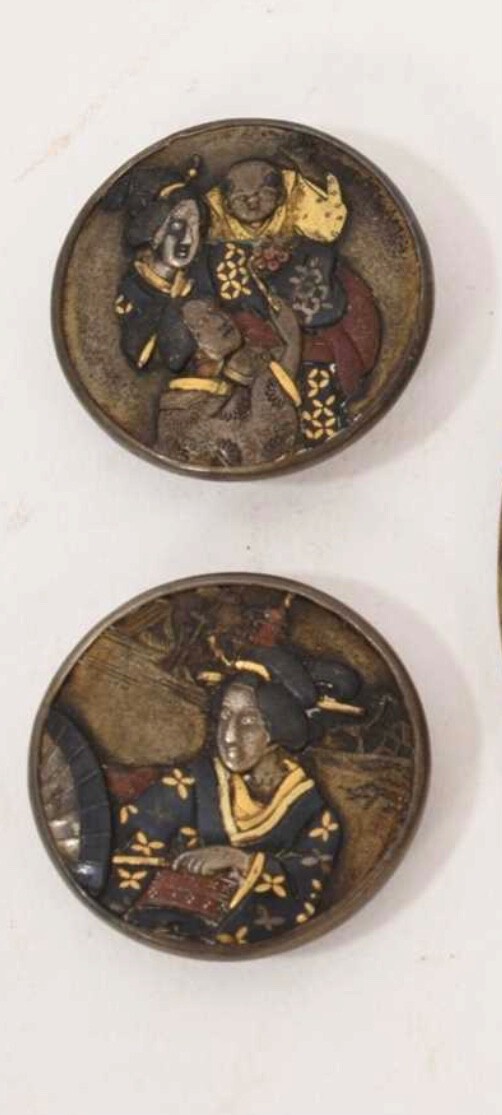
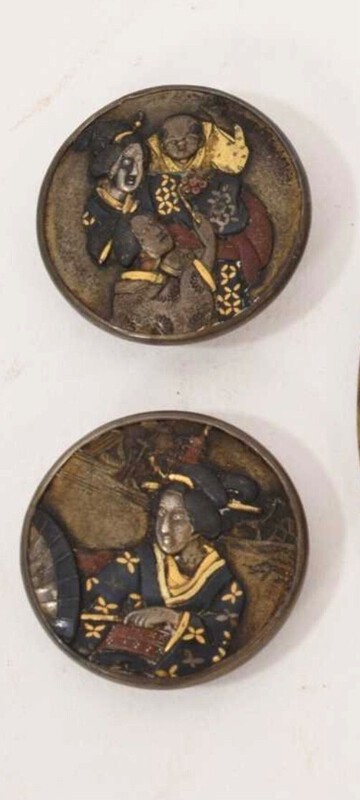
They are made in two different ways….. 1. “Proper shakudo plate with proper mixed metal zogan or 2. shiremono pressings with just multi-patination onto a plain thin copper sheet ie as per many kozuka 1. are usually fine work and if recognised….expensive 2. Usually fool innocent eyes and are thus horribly overpriced and result in buyers remorse …..but sometimes you get lucky🙂 -
Can anyone help me with these Shibuichi (I think!) plaques?
Matsunoki replied to Laura's topic in Other Japanese Arts
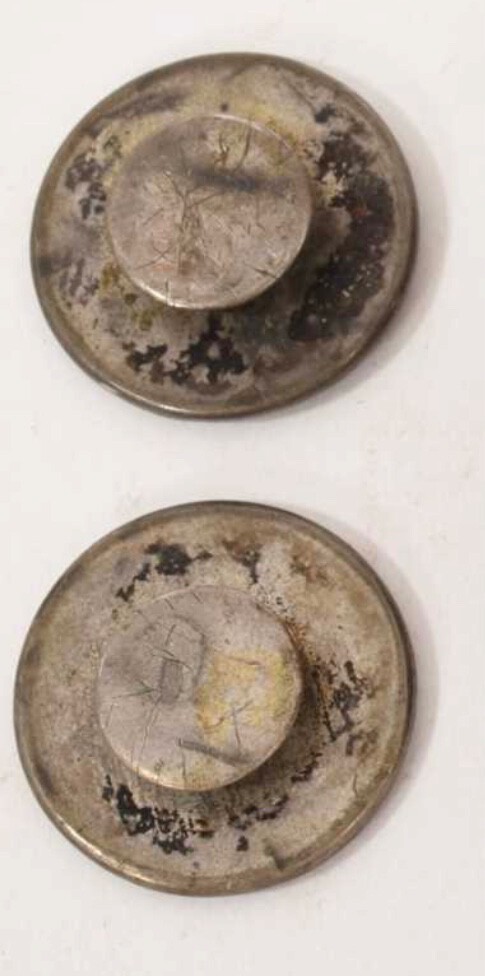
Saw these thought of you 🙂 Stumbled across these which suggests buttons/studs. They are nothing to do with any netsuke.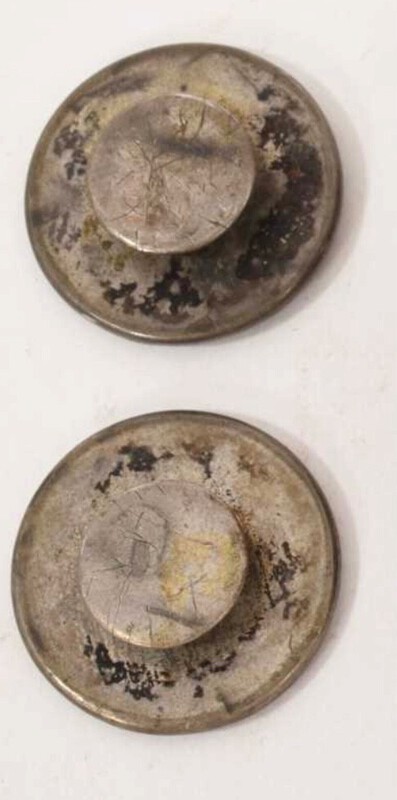
-
One thing to bear in mind….. usually it is better to leave something unrestored than to restore it badly (that applies both aesthetically and financially) Bad restoration can leap at your eyes far more harshly than the consequences of the passing of time. Also be careful when using modern materials especially glues that do not allow a second chance.
-
Mick, whoever did those legs was seriously good. That is excellent restoration work of the highest quality (imo). They look original to me.
-
@Davis Mick, did you replace some of those leaves in the first image? which pieces have been replaced in the second image?
-
This veneer is about 0.3mm thick and very difficult to work on without shattering or cracking. Also it would give you just a flat surface whereas the missing flowers will be several mm thick with quite deep carving. Moulding from an existing good flower will give that depth and detail and probably give a better impression than just a flat surface. Also beware inhaling the dust when grinding….
-
@hddennis Howard put this into Google search…….. “mother of pearl effect resin moulding” it seems to be possible.
-
@hddennis Hi Howard without doubt these cabinets were made in workshops by teams of specialists. There would be cabinet makers, lacquerers, carvers etc…..all specialist in their own fields. However one constant was the quality overall. You would not find poor quality flowers (no matter how many of them were needed) on a good quality cabinet. They might not be the same species of flower or the same material but they would all be constant quality. The Japanese would not usually spoil the ship for a ha’peth of tar.Having said that quality did drop and corners were cut in later Meiji all in the pursuit of $$ So imo the remaining flower that you show next to the bird is later. Your cabinet is a large one of complex construction with many quite good inlaid lacquer panels. When new it would have been quite a sight and very expensive. Another option you might want to explore is whether you could find a plastic moulder who could run you off a batch of these possibly even with a mother of pearl effect (as seen in many buttons) He could use the remaining good ones to create a mould. Or maybe even have a go yourself using some of the resin moulding stuff that is available nowadays….but that is way outside of my knowledge! Good luck!
-
Hi Howard, your cabinet is, as you say, Japanese and dating from the mid Meiji period when such things gained enormous popularity with both the gaijin in Japan and worldwide via a buoyant export market. Some can be mind boggling quality. Yes I have (now retired) spent years restoring such things (as a hobby, not a business) for some of the UK dealers. Missing inlay is obligatory on these! I used to actually carve whatever was necessary….be it shell or coral or ivory etc but it is very time consuming and therefore rather expensive. You need a specialist workshop set-up. I doubt you will find anyone to actually carve replacements nowadays but another trick is to search for simpler panels (made in their 1000s) and very often heavily damaged and thus very cheap. It is sometimes possible to “harvest” elements of inlay that can be adapted far more easily to either fit in or even stuck straight over the top of missing areas. Flowers, leaves etc are common and thus quite straightforward. Faces are a real pain, they hardly ever fit, usually looking the wrong way or the wrong size which usually means a lot of hard work or a vaguely acceptable compromise. The best advice I can offer is to look for panels (auctions etc) in the hope of “do it yourself” repairs.
-
The women in the bath house is Japanese Meiji tourist….more a small okimono than netsuke The one behind it….an Oni?…..looks more promising, maybe. Image?
-
Zodiac animal group…..Japanese tourist Meiji.
-
2 Men smoking…..what Piers said Kingfiser with fish on lotus leaf…..looks resin fake Toads on bamboo shoot….modern Chinese fake Dutch/Mongol archer…poor attempt at a popular Edo subject. Modern. Possibly Chinese but more likely Japanese tourist. Shishi (seal?)..low quality modern. Looks resin but apparently has cracks so not sure …..imo….from images.