Matsunoki
-
Posts
3,673 -
Joined
-
Last visited
-
Days Won
68
Content Type
Profiles
Forums
Events
Store
Downloads
Gallery
Everything posted by Matsunoki
-
Can you show a couple of high res images? (we cannot access yahoo auctions in uk)
-
If only the whole world could display similar “appreciations” to those expressed in this beautiful video. Thanks Jean.
-
It is worth bearing in mind that during Meiji (and into Taisho and even Showa) the demand for Japanese ivory carvings was massively fuelled by the export market. In response very high numbers of poorer quality pieces were produced quickly by workshops whose skills were nowhere near those of the carvers of preMeiji domestic pieces. The artistry is often very wooden and the detail and subtlety largely absent. However the demand was there and the customer base often lacked any real knowledge regarding “quality” and thus items such as Kirill shows us arrived in vast numbers. It is easy to jump to “modern Chinese” but imo many are Japanese…just mass produced quickly by unskilled artists. Without doubt (imo) many of the pieces on this thread could be argued both ways. Some are obviously modern, others…hmmmm. Sadly no treasures though.
-
Dani, your images are upside down. Get em the right way up and I’m sure you’ll get some comments.🙂
-
This gives some interesting info……. https://en.wikipedia.org/wiki/Jitte
-
@Exclus1ve Victor How on Earth did you find that?…..or did you know who he is?
-
Middle hall, rear wall. Table 81. See you there!
-
The flat head shape (possibly suggesting a depression containing water) made me think of a Kappa, but the face, hands and feet are not typical. Maybe the Kappa king??? Dunno. One for @Bugyotsuji perhaps.
-
Anthony, OK…..your kozuka is a “shiremono” which is the term used (in the context of Kozuka) to describe a mass produced cheaply made item designed to look like far a more expensive mixed metal inlaid piece. Basically the whole top plate is pressed from a thin piece of copper alloy to create the high relief effect and then multi-patinated and gold plated (as opposed to true mixed metal inlay) to look like shakudo, silver etc. This is then joined to a solid base plate and finished to look like a normal kozuka. Often a thicker than normal base plate is used to create the impression of “weight in the hand”. Some even get signed but that is usually an attempt to mislead. The one you have is a well known variant and I even saw one at last weeks Arms Fair. Sometimes two pressed plates with the same subject matter are joined together and used as cutlery handles and put into sets for export to the west. However sometimes real kozuka, often of considerable quality and value got used in cutlery sets and they are can be very exciting. It is important to be able to tell the difference because….about 30 years ago at a big antiques fair I came across a set of 24 cased knives and forks with silver blades ….all were superb quality genuine kozuka. I asked “how much” he shouted to his partner “how much do you want for those Chinese knives and forks” …the answer was £65. The antique gods smiled on me that day. If you decide to stick with this interest being able to discern quality is vital…..the same applies to tsuba and all other fittings. I apologise if I disappoint you, but these things fool a great many people. Happy hunting. PS….why not come to the Birmingham Arms Fair in June, happy to show you some better pieces (you don’t have to buy anything!!🙂)
-
On balance I think I’d still take a gamble. Can’t be sure from photos.. Been interesting hearing your views Jeff. Now, back to this nice Shiraz🙂 Keep well.
-
…and so could I🙂 That Chinese horimono is a bit unnerving. Can you get a higher definition of that dragon….id like to compare the detail. There is something about the dragons heads on this sword that possibly do not look quite right…..or perhaps it’s my old eyes. We know the Chinese can make some frighteningly convincing blades…..have they figured horimono out as well. Again I’d love to know how it’s done.
-
Interesting thank you. Do you know how these are made…..hand engraved or mechanical or….whatever?
-
My vote is genuine old sword badly neglected and subsequently badly mistreated with gimei added at some point. One of those gambles…..personally I’d roll the dice. I love a gamble.
-
Anyone else getting random delays loading stuff? At times just seems to get stuck on the wheel of death. Other times takes up to a minute to load or move. Using iPad but all other sites and apps seem fine when this one is misbehaving.
-
Interesting. Please can you show me one with horimono anything like these?….deeply cut into the shinogi-ji.
-
Modern forgery or old forgery? You think those horimono are “fake”?
-
Anthony…..would you like more info on the kozuka?
-
Yak hair, often used to trim a variety of armour components…..mostly Kabuto and Menpo. (Just the opinion of a total beginner!)
-
I can only see the background material through the nakago and kozuka ana so I guess the sukashi design does not go all the way through. Is it flat on the other side? Or some sort of backing?
-
Quality doesn’t look anywhere near good enough for Goto work……but just my opinion. Are those flowers plated rather than silver inlay? Is that plate that is wearing off?
-
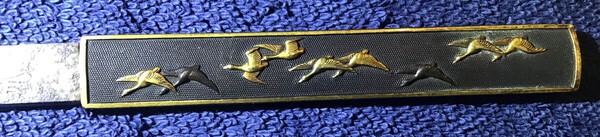
Help please. Goto school? Kozuka mei
Matsunoki replied to Matsunoki's topic in Translation Assistance
@uwe Thanks again Uwe. Oh well, not Goto….but still great quality. Pretty certain the geese are solid gold. Appreciate your help. All the best. Colin -
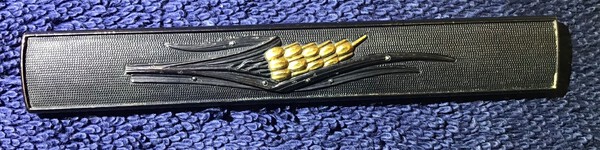
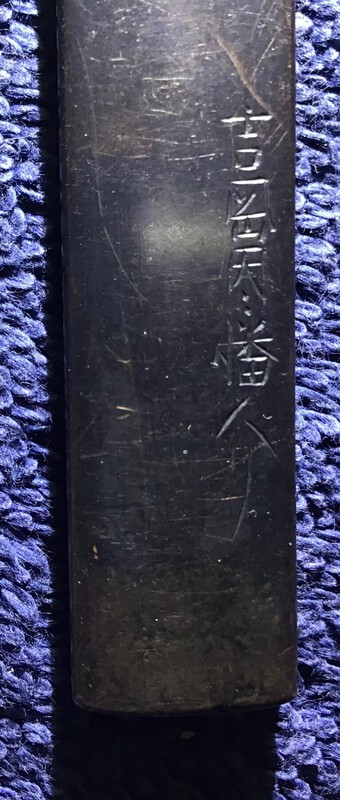
Another Goto school? Kozuka mei. Help please.
Matsunoki replied to Matsunoki's topic in Translation Assistance
@uwe Thanks Uwe, much appreciated. In hand it is far better than my crappy image. High quality heavy shakudo so chances are it’s legit. Apparently often mistaken for Goto and ranked as highly. Direct retainers of the Tokugawa shogunate. That was a nice surprise. All the best. Colin. -
With many thanks in advance again. All the best. Colin
-
With thanks in advance and apologies for the poor images. All the best. Colin.

-
Yep, I’d buy that suggestion. Occam’s razor in action. 🙂