GRC
-
Posts
756 -
Joined
-
Last visited
-
Days Won
14
Content Type
Profiles
Forums
Events
Store
Downloads
Gallery
Everything posted by GRC
-
@sabi commented on the flawed reliance on the apparent "age of the sukashi walls" in the selected passage. Using this flawed logic, the appraiser switched their initial appraisal time from early Edo period (sometime in the 1600s because the Edo period was from 1603-1868) to the middle Muromachi period (sometime in the 1400s because the Muromachi period was from 1336-1573). So the appearance of the sukashi walls (INCORRECT METHOD!) overrode the appraiser's initial judgement of an early Edo period production date, based on the the aesthetics and characteristics of the tsuba itself (CORRECT METHOD!). In doing so, the appraiser backed up the date of production by some 200+ years, and presumed that the tsuba he was appraising must have been an early forerunner of the typical tsuba of this type. as @sabi pointed out, a tsuba can easily be rusted (through any number of means... feel free to search for methods online... so the degree of rusting of the sukashi walls cannot be reliably used to date a specific tsuba. An additional inherent flaw in this approach is that it must assume that all tsuba have been held under similar storage conditions for their entire existence, and that they their surfaces have never been altered or resurfaced (which we all know is not the case as we have all seen many examples of resurfacing and repatinating). This is an amazing assumption, especially given that the appraiser also identifies that he thinks the hitsu-ana may have been altered at some point. So why assume the surface treatment would be untouched while other features of the tsuba could be altered? It just doesn't make sense. The other problem with the selected appraisal passage is the very idea that such a sukashi tsuba could have been produced as early as the middle of the Muromachi period (a topic that will be tackled separately...). There is absolutely no evidence to support the idea that a sukashi tsuba like this was produced at such an early date.
-
Back to rusty sukashi walls... This post by @Tim Evans is what sparked my initial post on this topic: Just for context, Robert (Bob) Haynes is one of the foremost Japanese sword fittings authorities in the US, having studied with Dr. Kazutaro Torigoye in Japan in the 1960's. There is a lot of useful tsuba material by Bob on the Shibui Swords site, Elliott and Bob collaborate a lot since they live near each other.
-
Hi everyone, I would like to start a series of threads that anyone can contribute to with their own observations or topics to then dive into. This began on a separate thread that started to get sidetracked and the idea to start a separate thread was proposed by Steve @sabi. The thread was "Water wheel and cherry blossom" if anyone is interested. I would like to propose that each topic get its own thread so that the discussion can stay focused on that idea, rather than having one extremely long thread that meanders and jumps between many separate ideas. So let's use the same title format: "Established ideas that need to change - #: topic to be discussed" Here are some ideas I have, just off the top of my head... Established ideas that need to change - 1: Rusty sukashi walls Established ideas that need to change - 2: The timeline of tsuba production Established ideas that need to change - 3: Pre-Edo period schools*** Established ideas that need to change - 4: Reliance on papers ***this one may even need some subcategories to tackle each school specifically (Owari, Kanayama, Ko-shoami, Kamakura-bori, Ohno, Kyo-sukashi/Heianjo sukashi)
-
Hi Florian. Please note, I am most certainly NOT mocking the person. I have the utmost respect for what Haynes has contributed to this field. We all stand atop some of the foundations he has laid. However, I will unhesitatingly point out flawed theories that don't hold up to scrutiny or that are unsupported by evidence. So on a general note, a person's overall contributions to a field of research should not prevent others from pointing out any ideas that are incorrect. The whole notion of reliance on and preservation of rusted sukashi walls needs to be undone. This idea will lead to false judgements of age and worst of all, lead to the eventual destruction of the very art objects we all seem to appreciate. So from my perspective, i see this particular idea as "dangerously flawed". Now let's move this train of thought to a new thread, as was suggested by Steve, so we don't continue to hijack Deanna's thread Starting one now...
-
Fair enough Steve. My apologies to Deanna. I will start a new thread and add more thoughts on the matter tomorrow I hope. Oh by the way, I wrote "Wakiyama" as the original source of many of these theories, but it's actually Akiyama ... was just looking at some wakizashi before that and had that word on the brain
-
lol thanks Evan ... "rusty sukashi walls" as justification makes me laugh and cringe all at the same time or "don't clean the rust away from the inner walls of the sukashi, otherwise you won't be able to tell how old it is"... ughhh
-
It's definitely an Edo period tsuba that was made in some quantity. Especially given the "peace and tranquility theme" "Kyoto area" seems reasonable... but could have been made anywhere really, and likely by a "shop smith" from an atelier of some sort. ...which fits with Haynes' attribution to "later Heianjo" attribution. *Note that people once called sukashi tsuba made in the Kyoto area "Heianjo sukashi tsuba" because they were assumed to be from the Heian area (location not time period)... which also means that it wasn't a specific "school" per se, just likely made in that area according to the trends in "tsuba fashion" of the time. The broad "Edo period, unsigned Shoami" bin would also be a likely default attribution by an organization like the NBTHK. There's no way this was made in the Muromachi period. There were no sukashi tsuba that looked like this before the Edo period. Certain aspects of it yes (like the dot inlays), but not the whole package together, especially the carved waves and that type of sukashi aesthetic. That's pure supposition and fantasy on Haynes' part... largely because he's following the hypotheses of Wakiyama in the early 1900s, which later became doctrine through the writings of Torigoye and also Sasano (who wrote in English and therefore established these ideas for English speaking collectors and enthusiasts). ...and hate to break it to you, but the site that was listed as an excellent reference from the foremost expert and associate, is rife with errors and false attributions for unsigned pieces. They are certainly a wealth of knowledge on signed pieces of the Edo period (for which there are often records and supporting period documentation of smiths and their genealogies), but are often egregiously wrong on many of their statements and attributions for unsigned pre-Edo pieces. I don't mean to ruffle anyone's feathers, but the we need to start course correcting some of these false assertions as a community. It's the only way we'll be able to make any progress in this field that still has so many unknowns. oh and good morning everyone, hope you all are having a lovely weekend
-
Wayyyyy off topic, but just finished looking through this thread. um... did anyone else notice this, or was it just me?


-
Not unfinished at all... it's very much intentional, and I have seen that exact motif and design multiple times. I like the modernist simplicity of the design, with one fan completely cut out as a negative object in the design, and the other filled in as a positive object, but with a "broken/punctured" look that refers back to the empty space of the completely cut out fan. I think it's a very appealing play on positive and negative spaces. I have to say yours is one of the nicer ones I have seen... I say that mostly because your "broken/pierced fan" looks more "natural" than others (ie. better executed in my opinion), and the plate of your tsuba looks like it has some "surface texture" to it, rather than a typical mid to late Edo period smooth plate that I have seen on others. So at the very least, I can definitely say this particular one was made with more care and attention to craftsmanship than others I have seen. No one can tell you the "school" with any certainty (just best guesses based on accepted tropes with no evidence to back it up ).. especially when it comes to unsigned pieces like this. Personally, I have never seen one of this with a school name, so the "school" is arbitrary... ...probably opened a can of worms with this last statement, but it's the truth.
-
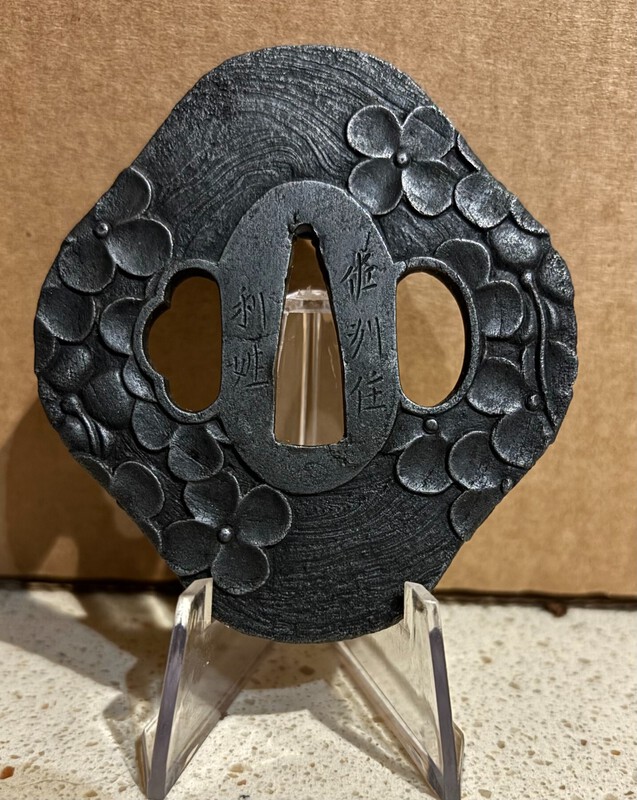
And I have always had a soft spot for this Sado island mokume tsuba, with high relief flowers that were shielded from the acid etching.

-
ok... hope to fan the flames a little with this finely acid etched one... but I need to do some work to derust this one and get it looking the way it should


-
Hi everyone... haven't been on in a loooong time...life gets in the way sometimes Here's my contribution: a whole botanical garden in this kamakura-bori tsuba...


-
Genji incense game is a good call Jean
-
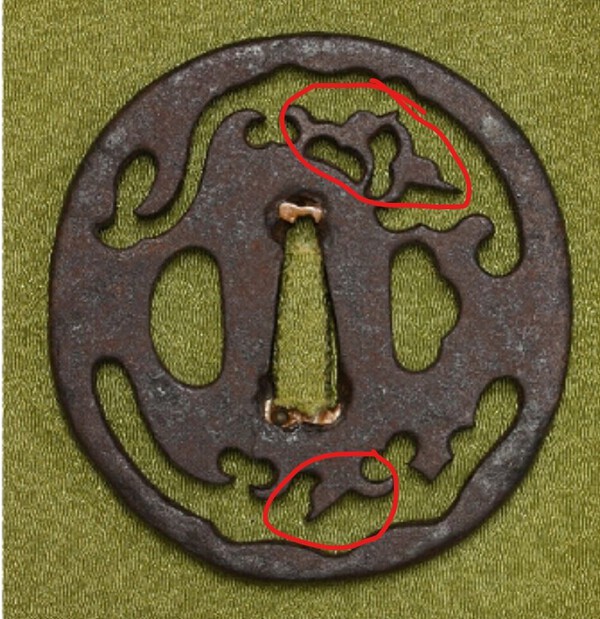
I personally don't know Eckhard so have not thought to ask... If someone else knows him personally, then by all means, feel free to see if he's interested in taking a look. By the way Dale @Spartancrest I'm pretty sure that top tsuba is 3 stylized chidori flying over waves of water. You can even see the outline of the eye on the three chidori.
-
I meant "highly conserved" in that the motif is very similarly executed by both smiths, with only the slightest of variations. I have also seen it on a third tsuba in the past, but lost track of that one before saving the image. When a design is repeated fairly faithfully by different makers, it suggests that it was a "familiar symbol" to the people of the times, rather than just being some random abstraction of a mist theme. By the way, both tsuba above are likely mid to late Edo. I suspect the one on the left might look older because of the exposed mokume texture. With something like this, I wouldn't think that either tsuba is copy of the other, but rather, both are just recreations of some other art work that showed this design. I'm also thinking "other art form" as the original (like Ukiyoe maybe) , because I can't say that I've ever seen an example of this design done by some famous tsuba smith, which would warrant others making utsushi of it. Florian, there's definitely a mist element to this... but It's got more than just mist, and perhaps smoke or clouds in the design. ...and "Big bird in a nest" from mr. Big Colin, if these are representations of kanji, I'd suspect someone would have spotted what they might be already... so I'm thinking they're probably not kanji. Good guess though still a mystery for now...
-
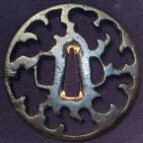 I always get the impression of puzzle pieces with this motif... hence the title of the thread It's obviously not puzzle pieces though. Is it something as simple as a steaming kettle with a lid? The kettle being the large sukashi on the left, and everything else is smoke and haze? The fact that the design is so highly conserved from different makers, makes me wonder if we have another case of some famous Ukiyoe print getting copied onto tsuba designs... I'm hoping someone has seen a reference to what this represents.
.thumb.jpg.0a9a503ce71cbb732034e5679291ec10.jpg)
-
Nice cloud work on that one Colin. The geese presented to convey different distances is a nice touch too. ...and Mr Big comes in with a link that gets us another Ukiyoe reference for tsuba designs
-
Yves, it would likely cost you far less to be patient and wait for a larger period piece to turn up, rather than to have someone make you a new one. I know these were made in fair quantity (I've seen a fair number come and go), but I'm not sure how often one pops up that that is appropriately sized for a katana. I've never really kept track of the sizes of these tsuba... As has been stated many times throughout the existence of this forum, it is amazing how grossly underpriced these period pieces are. You certainly couldn't have one made today for the price that a period original sells for (...unless we're talking about a masterpiece from a handful of top level smiths of course... then a modern repro would be cheaper). Ah... I see Ford beat me to it while I was still typing It is unfortunate to see that Ford isn't doing commission work anymore though.
-
There's far too much bitterness, and a tendency towards bullying on this forum... it's a sad state of affairs. All the points made could have been done without the heavy handedness and it would have been far more effective. Whatever experience any of you have with whatever subject, there are far better teaching strategies than the ones being employed in this thread. Simple summary: The fundamental core principle is that no one should remove a patina from Japanese metalwork (or any decorative metalwork for that matter) unless they are already knowledgeable and practiced at reapplying it correctly. So yes, it's "too late now" in this case, by why be so aggressive and demeaning about it? This tact is not going to stop some other inexperienced person from doing the same thing in the future, and all it does is create ill feelings for Vitaly (and others I'm sure), and a lack of desire to post anything else on this forum. This whole field will die off if new people continue to be treated like this. We'll just be left with a bunch of old guys and a lot of ineffectual strutting about... All I'm suggesting, and I think Dale @Spartancrest is too, is that we can and should do better than this.
-
Hi Yves, Mid to late Edo smaller sizes around 7cm were for wakizashi, so the non-samurai merchant-class could wear them. Highly decorative tsuba, like those from the Choshu and Bushu schools (and most late Edo schools for that matter), would definitely be making a lot of tsuba that size for those buyers. These tsuba were made by skilled caftsmen, but the themes and motifs were made to suit the wants and trends of the public. The mid to late Edo periods had a surge in the production of sword fittings, while there was decline in sword production (I forget the exact reference for the declining sword production, but there are many references about the increased production of fittings). I think it is safe to say that the majority of sword fittings at that time were mostly "adornments" and trendy fashion pieces for non-samurai. Even the ones that were larger and made to fit katana, were worn by samurai who were essentially bureaucrats, and hadn't seen a battle in 100s of years (ie. the descendants of the warrior class). So even those larger tsuba were "statement pieces" for wealthier individuals among the samurai-class who were going out and about in public. As OceanoNox (Arnaud) pointed out, tsuba sizes were often larger (8cm+) in the Muromachi period, then decreased in the Momoyama period (lots of 7cm works from the Owari group of schools/smiths), but then the wearing of the daisho (katana and wakizashi) became a law in the early Edo period. The sizes of the katana and wakizashi were also regulated by this law. Although the size of the fittings was not regulated, I'm sure the standardization of the daisho sword sizes would have brought the average size of the tsuba back up to 7.5cm in the Edo period (as Arnaud pointed out). To muddy things a bit, there was a stylistic revival of many Momoyama styles in the late Edo period, where some larger sized utsushi (either homage pieces or outright copies) were made. So keep that in mind, when looking at a tsuba that is over 8cm... make sure you know what you're looking at. The Momoyama period was really the time when there was the most creativity and exploration of artistic design in tsuba. Most mid and late Edo period tsuba are just rehashes of designs that came before, and the focus was more about detailed craftsmanship rather than abstraction and/or creativity. Even the painterly arts in Japan trended towards detailed realism as the Edo period progressed (there are books on that specific trend... can't recall titles at the moment). Sorry, I started off with the intention of providing a short answer, but then it snowballed...
-
Great article Luca. I think it makes a lot of sense to push for the separation of the Mukade-type from the Shingen-types. By the way, I have a Japanese book that has a small section on late Edo period tourist tsuba, and the Mukade type was included in it! I started looking through the ones I suspected it might be in, but haven't found the right book yet... as soon as I find it, I'll post it I seem to recall it said something to the effect of "the Mukade type appear to be newly made (late Edo), but it is possible that there may be some that have some age (but it was only a suggested "possibility", and an unspecified age)". Gotta find it...
-
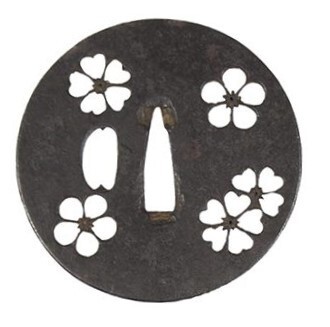
Here's another "Tosho" example with both a complete and partial ume flower, like Grev's, but without the raft. And a kamakura-bori with partial ume and a complete katabami or sakura flower in sukashi: And another "katchushi" style tsuba with a partial ume, and complete katabami or sakura flower: so, the partial ume flower sukashi was definitely a recurring motif of the times. ...and just for contrast, here's one with a partial katabami or sakura flower:
-
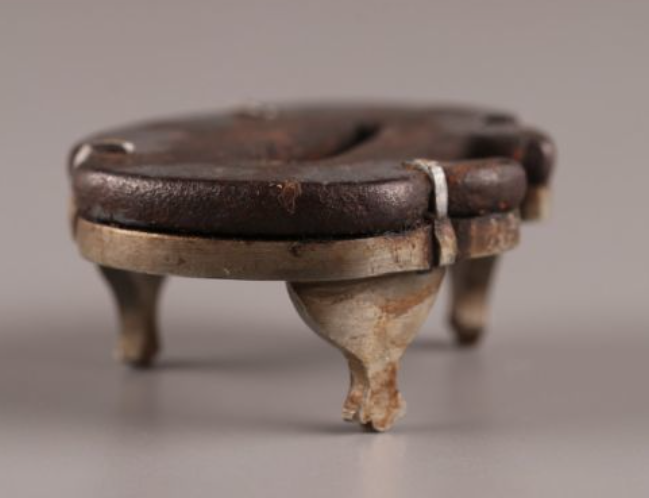
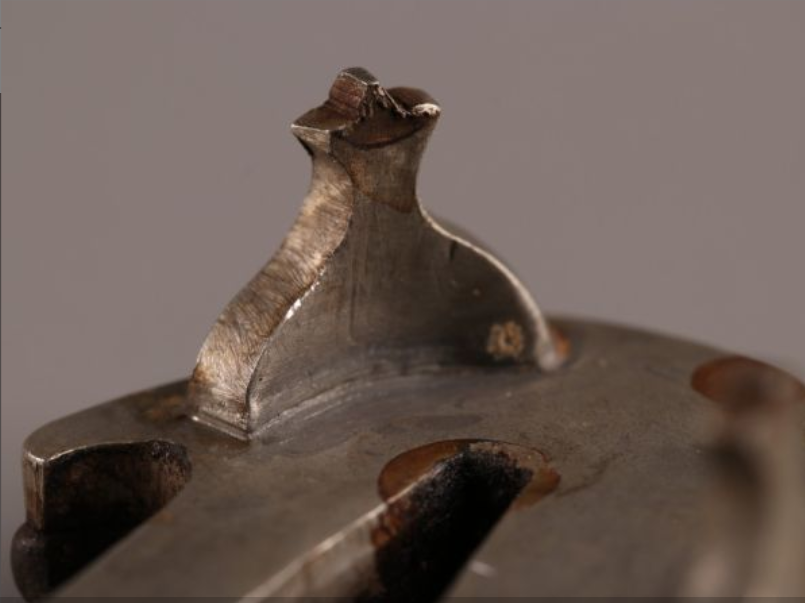
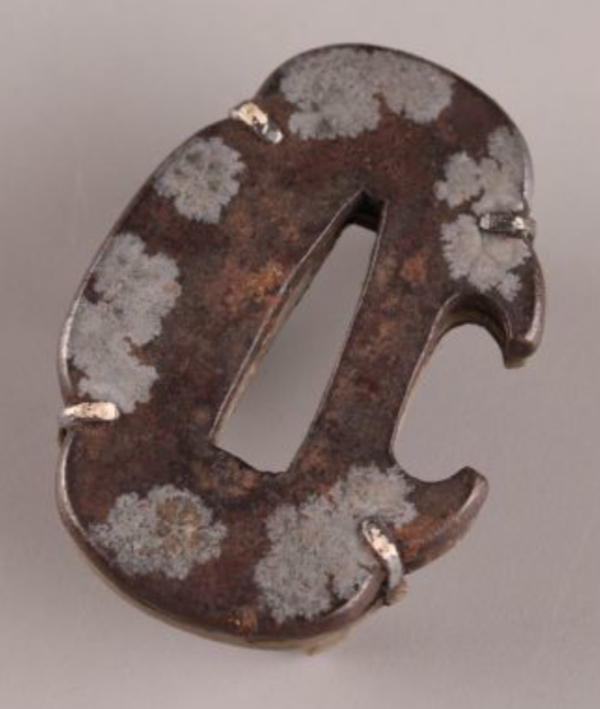
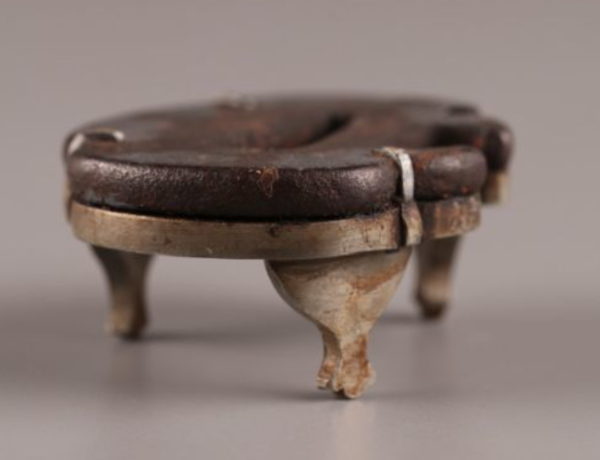
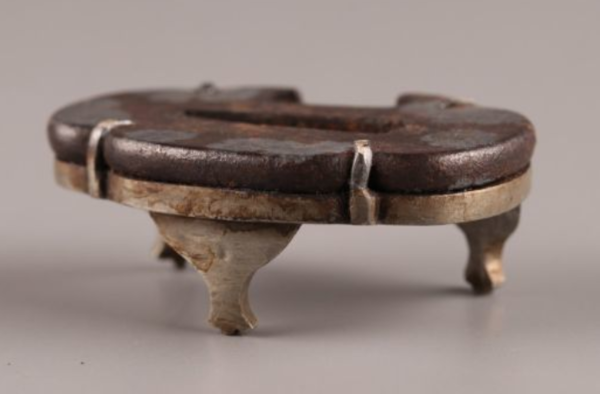
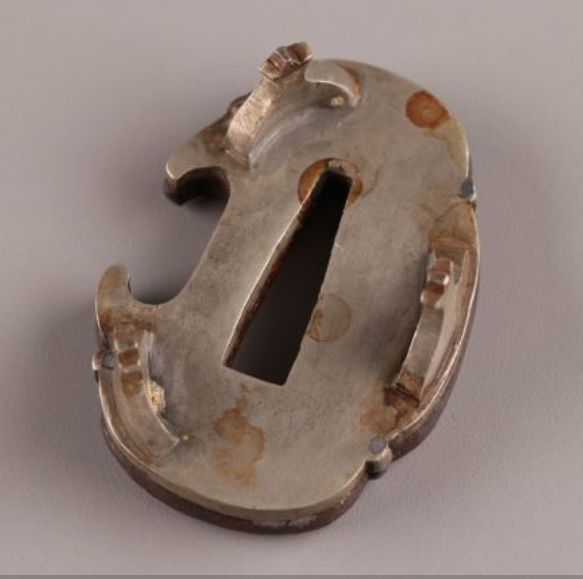
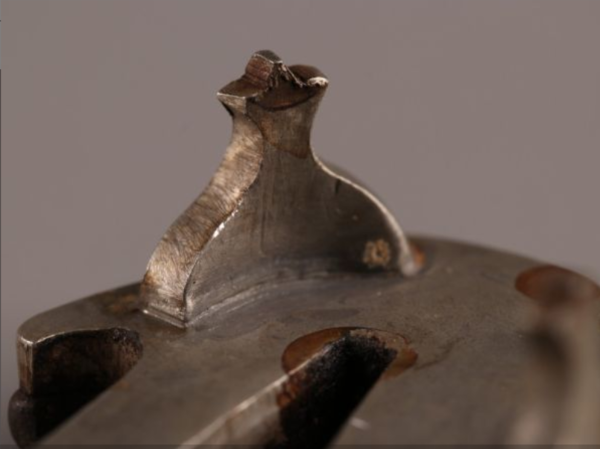
@Matsunoki I wasn't terribly convinced of that suggested use either... but if it had a glass pot beneath it, sitting between the three prongs (legs), then the tsuba would always be at the top anyway (to satisfy the aesthetics). I assume that the nakago-ana would have been where the writer would dip their writing implement through to get access to the ink in the theoretical glass pot below... It's a fun theory though And ya, there was definitely a lot of work that went into repurposing this tsuba, for whatever its intended use.
-
Here's an odd one... the seller suggests it was used as an inkwell. If that's the case, I assume there was once a glass or ceramic jar that the three prongs fit onto. For the samurai calligrapher
-
The bottom half of the design looks like a cloud with the tip of a crescent moon poking out towards the right... So, mistletoe on a moonlit night? Could be a reference to a specific poem or specific scene in a story or play (I have no idea which one though).







.jpg.ad9f64a521047ebbaf37c1d6b391da91.jpg)