
Dan tsuba
-
Posts
856 -
Joined
Content Type
Profiles
Forums
Events
Store
Downloads
Gallery
Everything posted by Dan tsuba
-
Hello Derek! You make a valid point and thank you for your opinion. However, it all comes down to what the collector can afford at a certain time. I don’t have deep pockets. I live from one social security check to the other. I can only afford so much a month to spend on my hobby, because before you know it any extra money I have is gone and I have to start over with the cash that I get each month. Yes, with the money I have spent over the years with my mediocre tsuba I could probably have bought only a few really prized tsuba! But I would have to lock those prized tsuba away in a bank safety deposit box! Unlike probably many tsuba collectors, I don’t buy my tsuba to resell them and make money! Instead, my inexpensive tsuba are hanging in several rooms in my house for me to enjoy on a daily basis! And someone has to give those lower level and mediocre tsuba a good home! And who is to say that you can't learn as much from a mediocre tsuba as you can from a prized tsuba? We all collect in our own way! Onward! Onward!
-
Hey Deanna! Very nice tsuba for a great price! If you know how to discern real tsuba from fake or reproduction tsuba, there are still deals to be had out there! And yes, I have a few trusted sellers out there who I have bought real antique tsuba from the Edo period and they give a fair deal (and most of those dealers are in Japan). So I tend to buy from those sellers again and again. And especially purchasing those tsuba with a limited budget (like I have!). I try not to spend over $150.00 for a tsuba. But sometimes I do go over that amount (but not by much), especially when the piece calls out to me to just go ahead and buy it (which has happened before!). Keep on looking for tsuba that you can afford and then learn from the piece. Like I said before (somewhere!), this is a great hobby! Onward!
-
So, I was just fumbling around on the internet (again) and found these really cool videos of a guy making wrought iron tsuba (using modern tools). The first video shows how he can achieve different surface designs on tsuba, and the second video shows the outcome of using wrought iron that is rusted to make a tsuba (who knows, maybe all those Tempo type tsuba were not all hand hammered?). I hope you enjoy these videos as much as I did! https://www.youtube..../watch?v=ahLY8QgawNI https://www.youtube..../watch?v=_kpa0uxSuOU Onward!
-
- 1
-

-
Here is something neat from the internet. It explains and shows pictures of a lot of cast-iron sand-casting defects! Have you seen some of these defects on tsuba that you have? I know that I have seen some of those cast iron defects on one or two (or three!) of my (about) 150 tsuba! Below is the weblink- https://vietnamcasti...and-casting-defects/ Check out the pictures under Pinholes, Blowholes (see Open holes), Cut and washes, Metal penetration, and Fusion. Especially those Metal penetration and Fusion pictures (pictures attached below). I think something like that Metal penetration or Fusion (and an Open hole) appears on a papered NBTHK tsuba that I showed in one of my previous posts here (I have included those pictures again below with the NBTHK papers). Interesting pictures and information on that weblink! Onward!


-
Thanks, Robert! I understand what you stated in your previous post. However, the question of whether or not an iron tsuba is cast or hand forged is an important aspect of the piece to many collectors (at least I think so!). That is because it all comes down to the dollar bill in today’s tsuba market (my opinion). A buyer may want to purchase a rather expensive tsuba that he believes is hand forged. But what happens if he ever finds out that the expensive tsuba he purchased is actually cast iron (one day when a cheap non-invasive metallurgical test is developed to discern the difference between hand forged and cast iron – kind of a do it yourself at your home test!) That is why I keep posting on this thread. To try and show members that some Edo period tsuba may have been cast, and not hand forged. Maybe looking at a tsuba for specific signs of possible casting (as I and others have shown pictures of possible cast iron Edo period tsuba on this thread) will help tsuba collectors question whether the piece is hand forged or possibly cast. Onward!
-
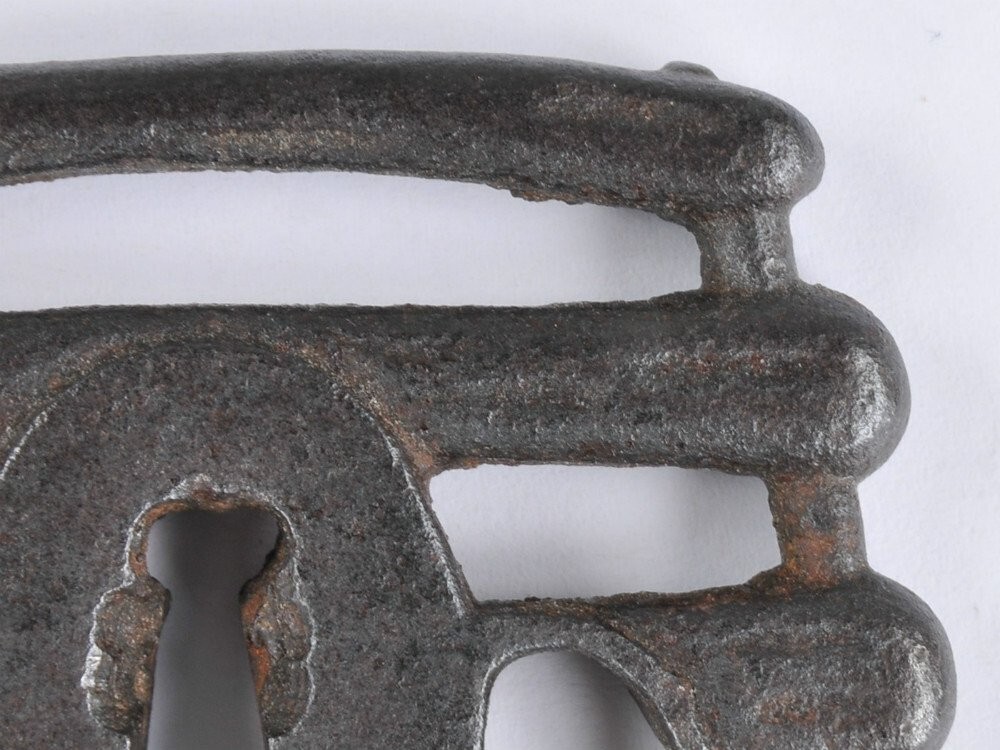
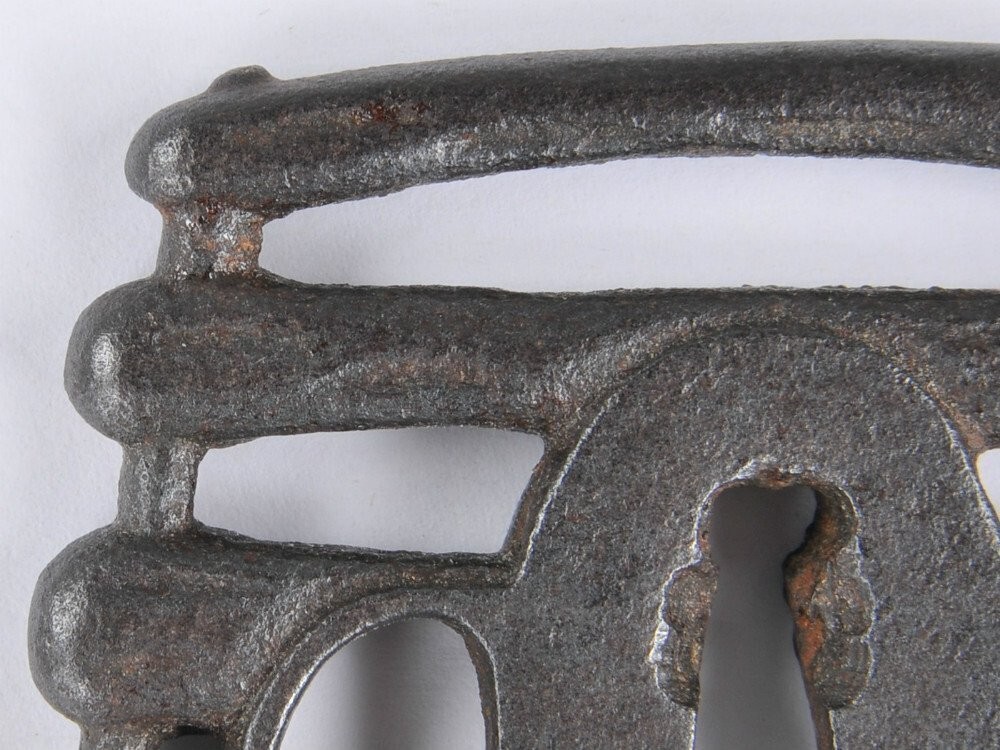
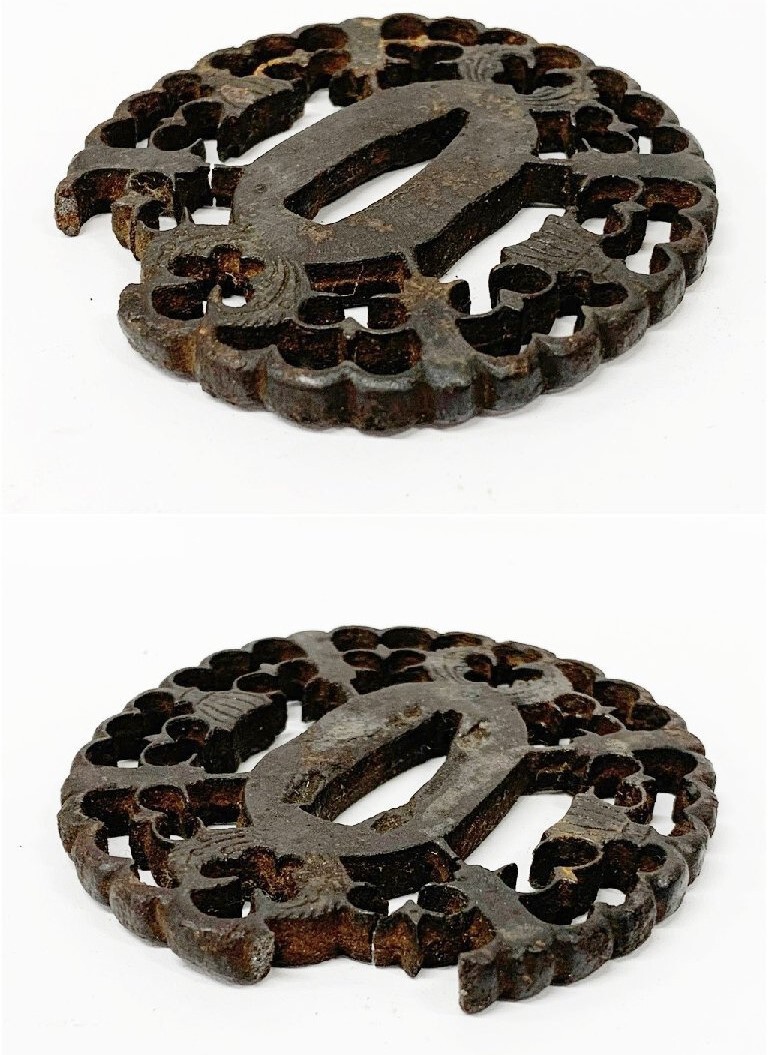
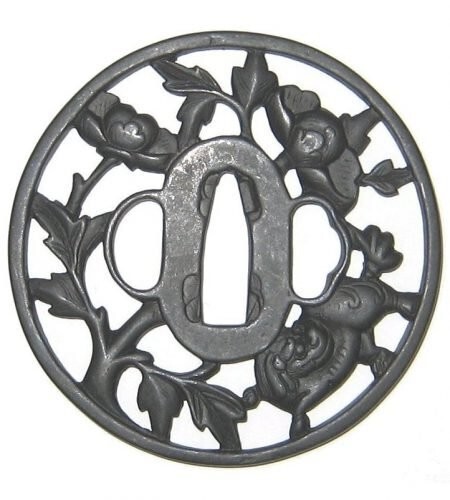
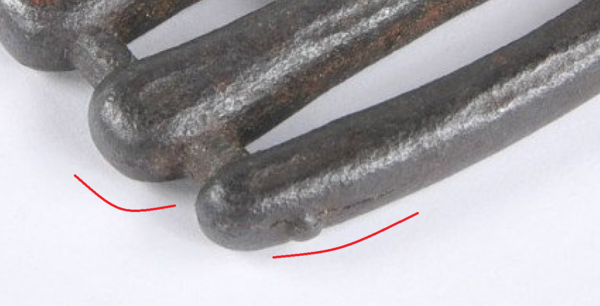
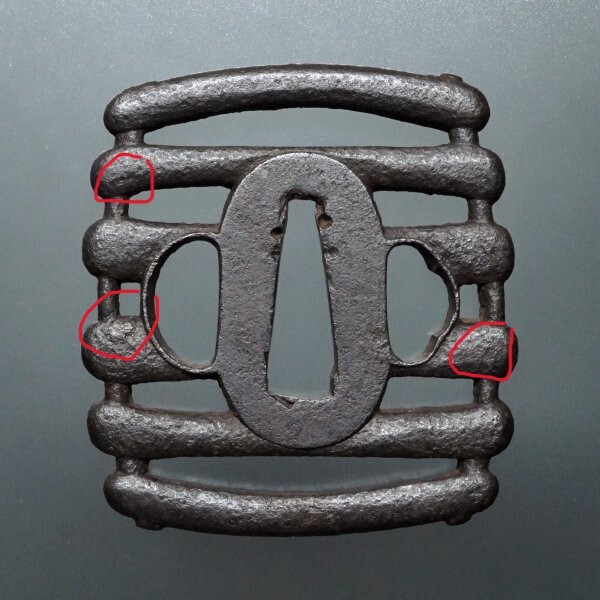
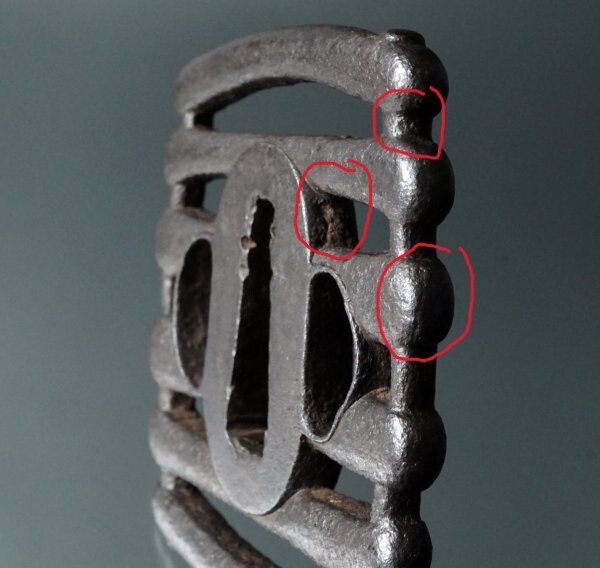
Hello all! Well, I am back on this thread. Why? Because I have come across too much new good information on cast iron tsuba. If I don’t post it now, I will forget about it! Heck, I even forget where I sometimes leave my walking cane (that’s what happens when you’re old!). So, included are pictures (picture 1 and 2) that are of newly made cast iron tsuba cast by the lost wax method. Notice the amazing amount of detail that can be achieved with that method! As stated by the dealer, which can be found at this link- https://www.jauce.com/auction/o1149602781 “I am selling an iron Japanese sword tsuba. This product is from a workshop specializing in Japanese swords for Iaido in Seki City, Gifu Prefecture. It will be a contemporary work. The material is iron, and it is made using the lost wax method. They are produced by casting using wax molds (commonly known as precision casting).” Also, Dr. Lissenden in his master’s thesis on Namban tsuba describes the lost form (wax) method (found on p. 130) that may have been used in making Namban type tsuba. His thesis can be found at this link- https://etheses.dur....4129/1/4129_1648.pdf So, moving on, Pictures number 3.4.5, 6 and 7 show an NBTHK papered tsuba that could very possibly have been made from cast iron. That tsuba was for sale at this link- https://www.jauce.com/auction/m1160847457 Notice the unfiled casting flanges in some of the openings of the tsuba. Also notice small casting flaws that can be seen, if you look carefully. And notice that the nakago-ana is bottle shaped. A feature that I have found on many cast iron tsuba. Also shown in pictures 8, 9 and 10 is another similar motif tsuba as the ones shown before. It can be found at this link- https://www.jauce.com/auction/r1148317429 It is an NBTHK papered tsuba, which I think is cast iron. In these pictures I have circled (also in red) several (what I determine to be) casting flaws. Anyway, just my opinions! Onward!




-
Thanks Tim! I understand what you stated in your post. “The cup shaped tsuba were influenced by the swords worn by Europeans. Anything European was exotic and fashionable in the 16th century and later.” But how the Japanese used the cup shaped tsuba on their swords is completely different than how the Europeans used that shape on their swords. When mounted, as described in my post of Nov 17, 6:48AM (and as shown in some pictures on the above posts) the bowl shape of the tsuba on a Japanese sword would face towards the sheath (saya). On a European sword the bowl shape would be facing away from the sheath. My drawing of how a Japanese sword would be with a Wangata tsuba (top of drawing) and how a European sword would be (bottom of drawing) is attached. So were the Japanese trying to emulate the European hand guards, or was it something else? If my memory serves me correctly (which is always an iffy thing!) not a lot of those Wangata type tsuba were made.

-
Hello again Deanna! I would like to refer you to this thread (a thread that you were the author of-well done!)- https://www.militaria.co.za/nmb/topic/50495-sand-cast/ and my posts on that thread dated Friday (Nov 15) at 7:17AM and Friday (Nov 15) at 2:21PM. I know that me stating and showing stuff that goes against the status quo on this forum is always risky! And yes, the tsuba you showed has a few good (small and not deep) tagane-ato punch marks in the seppa-dai (which could indicate that the tsuba is a hand forged tsuba). Could those punch marks be made or appear on a sand cast cast-iron tsuba? For the answer to that I refer you to this thread- https://www.militaria.co.za/nmb/topic/47640-tagane-ato-punch-marks-on-tsuba/ But those posts are just my opinion on the subject! Oh no! I can see all the downvotes coming in for me now! But when you go against the status quo thinking on this forum, you must prepare yourself for all sorts of negativity (as I have experienced in the past-but then again maybe this forum is now changing for the better!). Oh well, keep posting stuff and learning from the replies to your posts. Tsuba collecting is a fun and super interesting hobby! Onward!
-
Here is a thought about those tsuba books shown in the previous post by Spartancrest. A customer goes to a tsuba craftsman to buy a tsuba. The customer does not see a tsuba that he wants to buy that is on display. So the craftsman shows the customer a catalog of diverse tsuba styles, designs and motifs (that are styles and designs developed by different schools of tsuba craftsman spanning across Japan). The customer flips through the pages of the catalog and finds a tsuba that he likes. He then orders that tsuba, and the craftsman makes it for the customer. I never thought of that before! Made to order tsuba in the Edo period. I think that is a definite possibility!
-
So, I was thinking again (which maybe isn’t a good thing!). When a tsuba is attributed to a school of tsuba craftsman, my first thought is that all the craftsmen were trained by the same teacher (as in a school-western thought!). But couldn’t several different craftsmen several hundred miles (or thousands of miles) apart make the same style of tsuba without having been taught in that specific school of tsuba makers? In that sense a school would be “a group of artists under a common influence” that definition was found here- https://www.merriam-...om/dictionary/school Especially if there is no mei on a tsuba, most any master tsuba craftsmen could have made the same style of tsuba with an example of that style made in a specific school of tsuba makers. Or am I just overthinking this!
-
Wow! Great videos! That tiger tsuba is beautiful! So, those videos have energized me to try my hand at making and adding a simple motif to a copper plate. I mean I am an old retired guy and have nothing else better to do than to try and make a copper tsuba (at least it would keep me busy!). It seems like it would be a great learning adventure! I will need to study techniques and acquire the proper tools. Although the videos shown here are helpful, does anyone know if there are any other videos (or DVDs) that can take me through the initial steps? Thanks!
-
So, what I find of interest is how those Wangata (bowl shaped) tsuba would have appeared when mounted on a sword. Now I remember reading somewhere (can’t remember where!) that the kozuka hitsu-ana on a tsuba is always placed on a sword so it is that hitsu-ana that is always worn closest to the wearers body. On the Wangata tsuba shown in the previous posts, that would mean that the dish shape (not the bowl shape) of the tsuba would be mounted and placed against the tsuka of the sword. The motifs on those tsuba could then be seen by a viewer looking at the front of the sheathed sword in its saya. When the sword is drawn from the saya the bowl feature of the tsuba could then be seen by the viewer (probably not a good place to be to view the bowl feature of the tsuba!). Now I wonder why a bowl type tsuba was made? Did it have something to do with weight distribution on the blade? Or was it just an artistic choice of the purchaser of the tsuba? Maybe tsuba were made in a bowl shape so the wearers thumb couldn’t slip off of the top of the tsuba when releasing the sword from the saya and drawing the sword? Could it have been less expensive to make because a motif only had to be made on one side of the tsuba (although I would think that for a tusba craftsman to achieve that bowl shape had to be more work than a flat type tsuba)? I have seen only a very (very and again very!) few tsuba made in that Wangata shape. My thoughts are that it had to be a special order for the tsuba craftsman to make that type of tsuba. Or will this remain just another unanswerable mystery of tsuba? Onward!
-
Wow, Stephen! Super cool! Thanks for the illiustrations, information, and pictures! With respect, Dan
-
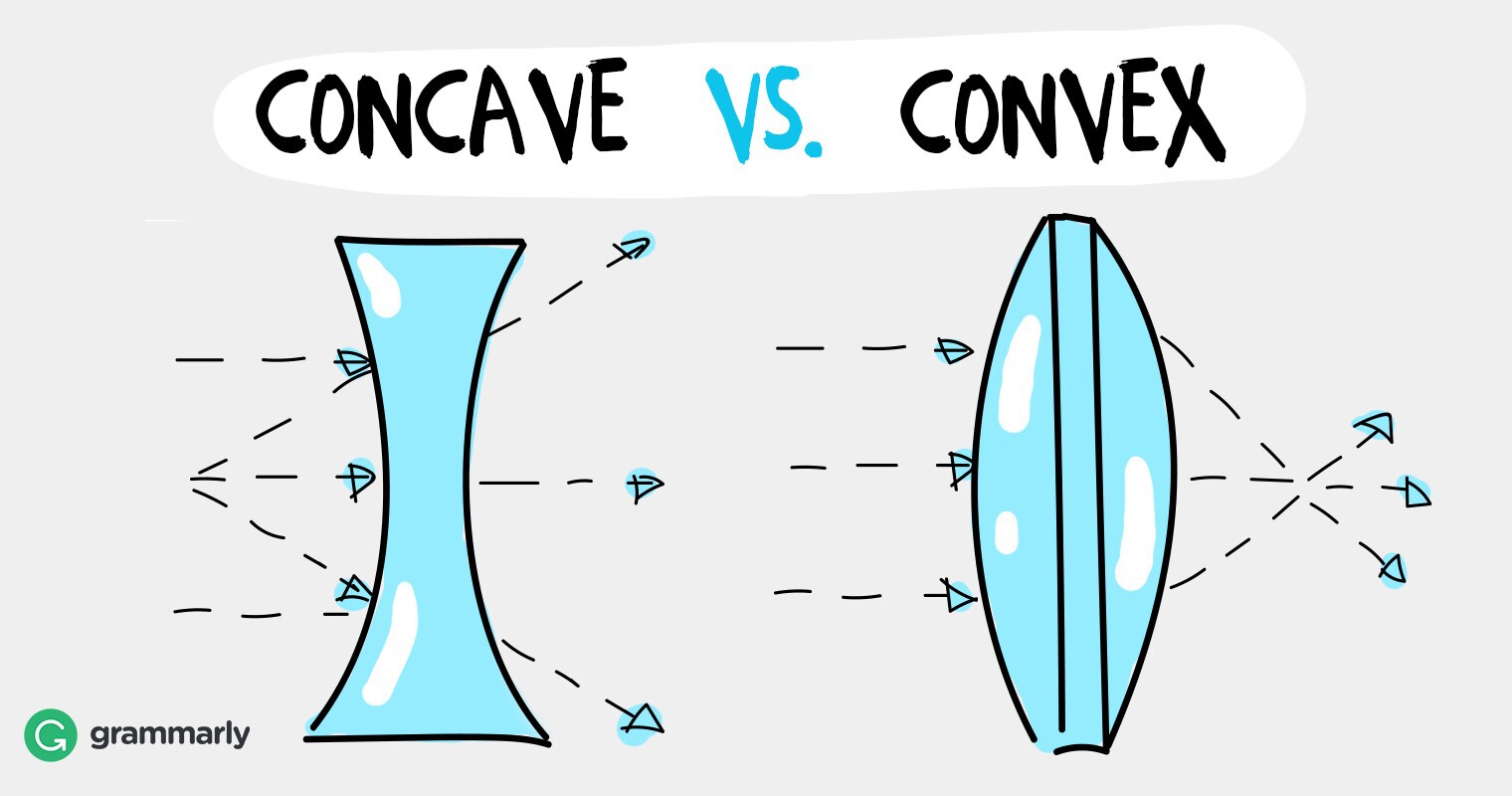
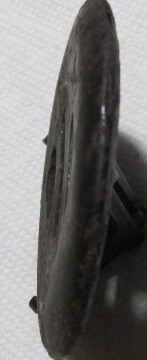
So, out of my collection of about 150 tsuba only a very (very) few are in a concave or convex shape. I figure for a master tsuba maker to forge that type of shape probably took a lot of extra work! Why was that concave or convex shape done? Was it to distribute the weight of the tsuba differently on the blade? Less weight towards the blade and more weight away from the blade for a concave shape. More weight towards the blade and less weight away from the blade for a convex shape. Or was it just an artistic choice by the craftsman? Anyway, I have included pictures of one of my concave and convex shape tsuba. When I purchased these tsuba I had no idea of their concave or convex shape, since no pictures showing that shape of the tsuba were shown and the seller did not describe the shape in his listing. Only when I received the tsuba and hefted them and placed my fingers over them, did I become aware of the concave or convex shape of the tsuba. I think it would be interesting if members could post pictures of what they have! Onward!



-
Thanks Robert, for your support! You stated that- “But Japanese craftsmen are amazing in their ability to painstakingly achieve textures and effects.” Yes, that is very true as can be seen by all the different surface textures that the master craftsman have achieved on tsuba. But why would a master tsuba craftsman that made a hand forged tsuba want to make the surface texture of that tsuba appear as if it was sand cast? I mean the master tsuba craftsman must have known that a hand forged tsuba would fetch a much greater price than a tsuba that appears to be sand cast. Maybe a tsuba surface texture that appears as sand cast, is actually a sand cast tsuba? I need to invent a cheap non-invasive metallurgical test to discern the difference between forged iron and cast iron! Yeah, right! Like that will ever happen! Ha, ha, ha, ha, etc! Onward!
-
Skulls, bones, and grave markers—An interesting tsuba
Dan tsuba replied to brentlewiis's topic in Tosogu
Hi Lucian! Nice and interesting tsuba! The Seigaiha Diaper design (the interlocking circle design on the seppa-dia) may indicate that it is a Namban type tsuba. I refer you to page 76-78 of this paper- http://etheses.dur.a...4129/1/4129_1648.pdf It will be interesting to see how members intrepret the motif and the mei! Onward! -
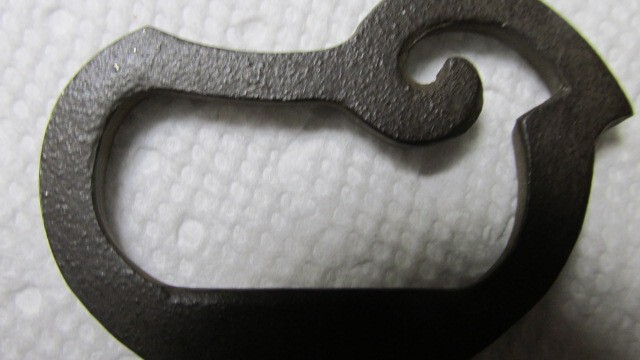
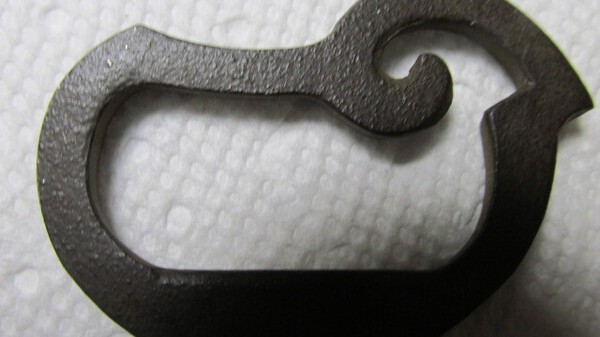
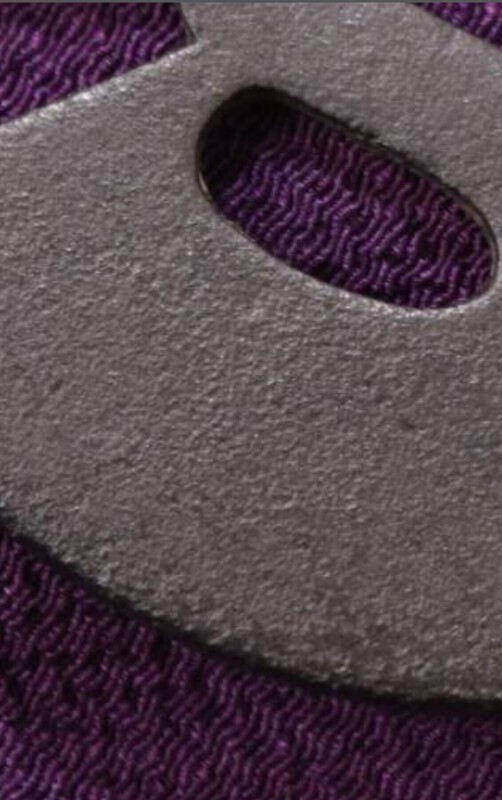
Hey Deanna, Just wanted to include some pictures for comparison. Included below are pictures of a sand-cast cast-iron bottle opener that I have (crafted in Japan by a current 16th generation kettle maker using the old methods). Information about that kettle maker can be found here- https://www.teadeale...KAejtyYoyaYoX2QOILTX and here- https://craftland-ja...zuki-morihisa-studio You will have to excuse some of the wear on my bottle opener because I have used it to open several bottles of beer! I have also included the pictures of the tsuba from your post. I am not saying that the tsuba shown in your pictures is sand cast cast-iron. What I am saying is that my bottle opener is sand cast cast-iron! Onward!




-
Hey Deanna. Welcome to the forum. This is a great forum and a wonderful place to learn. About that tsuba being sand cast. That is an insighful and relevant question. By the texture of the surface of that tsuba, it may actually be sand cast cast-iron. But who knows? The only way to know for sure is to subject the piece to non-invasive metallurgical testing. But who has the money to afford that! I like that tsuba. Whether it ever turns out to be sand cast cast-iron or not. If you win the bid, just enjoy the piece and learn from its history and motif. Although I don’t know what the motif represents. There are extremely knowledgeable members on this forum who I am sure will help you with what the motif is. Onward!
-
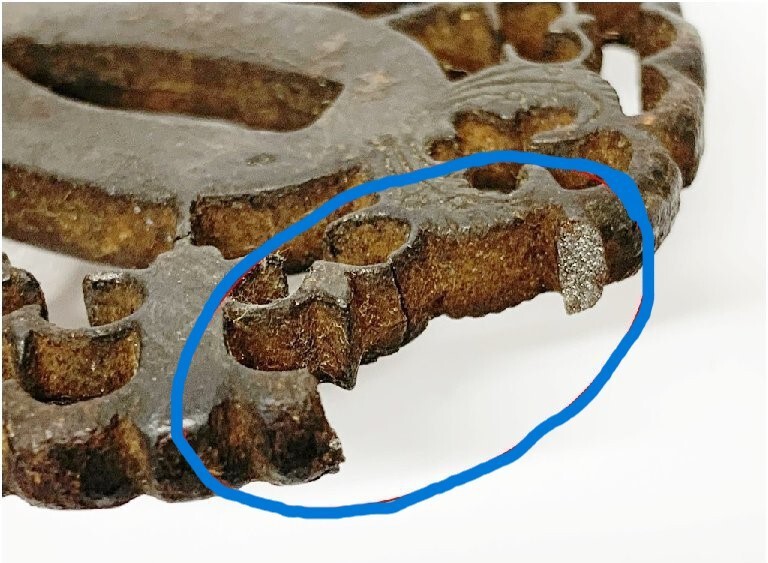
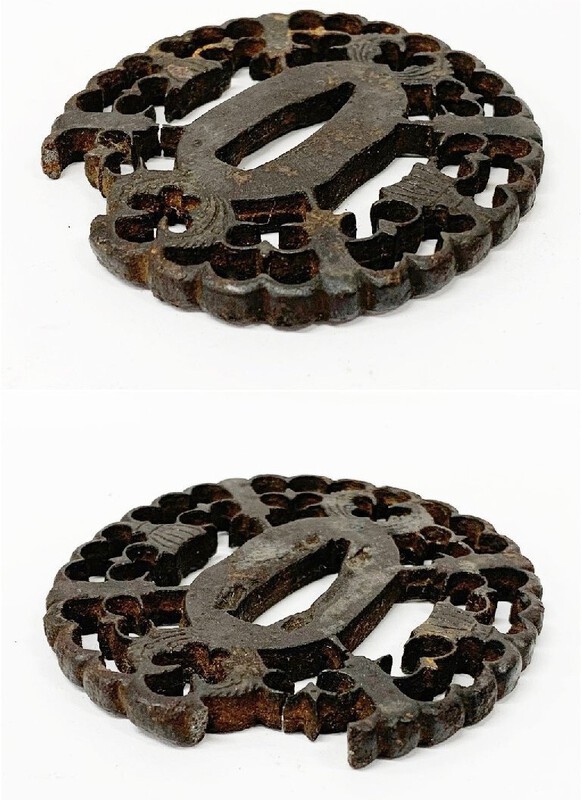
So, in my first post on this thread I wanted to show members what a broken piece of cast iron looks like. Well, a broken cast iron tsuba is shown in picture number 1 and 2 below. Compare those pictures (showing small grainy or sand type raised and lowered areas) to another cast iron tsuba shown below. That other cast iron tsuba was shown on my post on p. 12 of my "Tsuba casting molds?" thread. (and yes, we all remember that thread!) -with explanation on June 26, 2023- picture 3 below-which you might have to zoom in on. And let us not forget that I show pictures and state a reference here, unlike many members on that privously mentioned thread (oh well, let's not go there!). I know that is a tiny area of that particular tsuba that was chipped off (on purpose if you read the post), but you can still notice the sand type texture of that exposed tiny piece. So, my opinion is that the picture of that chipped tsuba referred to above is a cast iron tsuba. I am pretty sure it would take a lot more effort to chip a small piece from a wrought iron tsuba than it would to chip a small piece from a cast iron tsuba (since cast iron is very brittle). Pictures number 4, 5 and 6 shows a different broken cast iron tsuba for comparison (smaller areas of cast iron shown). Now compare those pictures to the broken piece picture of wrought iron shown below (picture number 7). Big difference! A good website that explains and shows several pictures of broken wrought iron is shown below (I got the picture from that website)- https://islandblacks...st-for-wrought-iron/ Anyway, the good news is that I didn’t have to break my cast iron skillet to show what a broken piece of cast iron looks like! Hurrah! (and as a side note- I did not damage any of the tsuba shown. All pictures are from the internet!)




-
Who knew? I was researching Edo period cast iron water kettles on the internet and found some interesting stuff. So besides cast-iron water kettles (tetsubin) the Japanese kettle makers also made cast iron items to pour sake. Those items were called Chosi. Below are two websites that show and describe Edo period Chosi. They have some nice and interesting motifs on them. Interesting stuff! So, I guess we could include Chosi on this thread also! https://www.trocader...do-1750-relief-Ebisu https://japaneseanti...%AD%90-sake-kettles/
-
Hi Robert, I don’t know about the wabi aesthetics, but I like your tsuba! My kind of tsuba, old and rusted (like a majority of my tsuba in my collection of about 150 of them). I don’t bother much cleaning them up. If I wanted an Edo period tsuba that looks perfect, I would just go ahead and buy one. But I would have to spend a lot more money for it (and I can’t afford that!). Enjoy and continue to learn from your very nice tsuba (and I know calling your tsuba very nice is just my opinon -others may disagree). With respect, Dan
-
Thanks Robert for the information and your assistance and support! Much appreciated! With respect, Dan Addendum- So, Robert. What are your thoughts that non-destructive metallurgical testing would be the only way to determine if a tsuba is made from cast iron or is hand forged (without destroying the tsuba)?
-
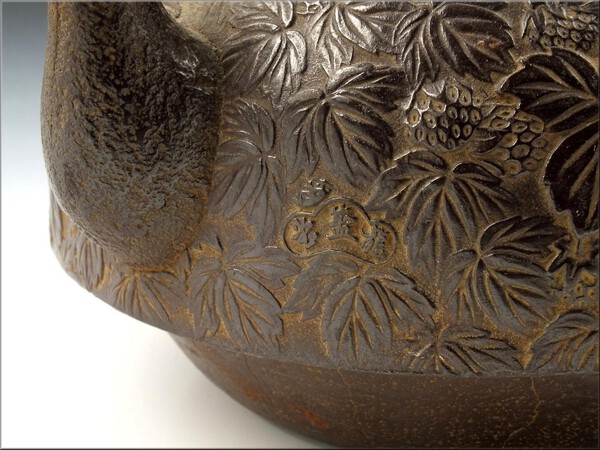
This may be interesting and fun! So, how about sharing pictures of Edo period water kettles with some amazing motifs? I found this one described below (pictures attached). “Rare Signed Edo Period Japanese Iron Tetsubin Tea Kettle! This wonderful early Japanese iron kettle is decorated with relief leaves and berries around the body and on the lid, the lid having a figural berry finial. It is signed with a three character mark to the right of the spout. It dates from the Edo period and measures approximately 8 + 5/8 inche tall to the top of the handle (4 + ¼ to the rim of the lid) by 8 inches across including the spout. It is in excellent condition with a rich patina, as can be seen in the photos.” From this website- https://www.worthpoi...nese-iron-1809543934

-
Thanks Jake! I agree! So what is the solution to this enigma? Onward my friend, and with respect, Dan
-
So, I am “signing off” of this thread for a while. According to many members during the course of this thread, there were no cast iron tsuba made in the Edo period. So that would mean that all cast iron tsuba made in Japan started to be made the day after the Edo period until the present time. Right! That makes no sense to me at all and is totally unbelievable. Some members are ignoring the innate ingenuity of the Japanese kettle makers, the ability of the Japanese to identify a profitable business venture, and the cast-iron sand-casting abilities of master kettle makers that may go back several generations (a current kettle maker in Japan goes back 16 generations!). Some members state that there has been no evidence shown of cast iron tsuba made in the Edo period. Have they even read this thread in its entirety? This thread has taken the dedicated effort of several members over the last (about) 2 years and 10 months. Those dedicated members have backed up their posts with stated references and pictures. It is not just about opinions, as several members over the years just seem to only state opinions but conveniently overlook to state their references. Either you believe (as I do) that cast iron tsuba were made in the Edo period, or you are just flat-earthers (non-believers). Wait until a cheap non-invasive metallurgical test for cast iron is developed. We will see then who is right and who is wrong. Until then, we can just keep arguing about this thing until hell freezes over! Once again (as in the past), I think I will take a break from this thread for a while. Don’t all cheer! Ha, ha, ha, ha, etc!