george trotter
-
Posts
3,002 -
Joined
-
Last visited
-
Days Won
14
Content Type
Profiles
Forums
Events
Store
Downloads
Gallery
Everything posted by george trotter
-
Hi Baz...great article on Kunisada meis. I can see I really need to go back and have another look at this sword and also get the dry dust off the tang and try to get decent pics...then sit down and do some careful study (hamon BTW is same as illustration 1b). I also have a few reference books with gimei and shoshinmei examples. I may try tomorrow I think. Thanks again Baz. George.
-
Hi all, Thank you for these comments. Very interesting. I also used these Fujishiro oshigata and found that some of the strokes are close so it "could be" shodai...but as you say, although the blade matches the School/period etc, a gakumei is one of the easiest ways of gimei of a lower quality blade. I will see this sword again this week and try to take some clearer, more revealing blade and overall pics....it will be interesting for this discussion....ultimately however, as Reinhard says, its proper appraisal needs to be done with sword in hand, and even then, it would still have to be confirmed by shinsa, but this is a good learning discussion....Thanks all, I will post new pics if they turn out good enough. George.
-
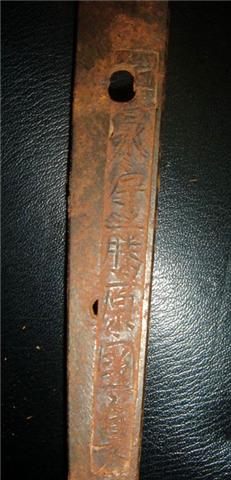
Whew...you guys...like facing a tag team... Anyway, thanks Carlo...I'll remember that advice next time I consult Hawley. In my first post I said I was "fairly sure" it wasn't the mei of 1st gen...I then asked the "group" for their comments ...so far there has been advice on the generations/Hawley, but I actually wanted feedback on the mei. Since the blade is definitely correct for the mei/school/period, so much so that I was able to pick it before removing the handle, (so the mei and the blade are definitely connected)....can I ask again...can you guys examine the pic and give me your opinion of the mei? Thanks all, George.
-
Hi all, thanks for your replies. I see what you mean about Hawley's "four" generations of Kunisada Ted. Of course I used Hawley, not knowing he was in such error. I knew there were many small "doubling up" of smiths but not to this extent with such important makers...we live and learn. Gens 1 & 2 (Shinkai) I had seen in Japanese texts, but just assumed that the additional two listed in Hawley also existed...then couldn't understand why they were not in Fujishiro etc. I did not know Hawley was full of such serious errors like that.... pity Jacques didn't just say this in the beginning. As for the Hawley points sytem Reinhard, I don't use it or put any great store in it, I just put the points in the post...like Hawley says... to give a rough idea of relative standing. I suppose it like the Yen system in Toko Taikan. we are never too old to learn...and on that point I get back to my original question...do you Ted, Jacques, Reinhard, have an opinion on the mei? Thanks to all, George.
-
Hi Jacques, My sources say all four generations Kunisadas used Izumi no Kami, but they agree about FW, except they say 1 & 2 used it . I notice 1st gen has quite a bit of variation in his mei strokes...care to comment on this mei I posted? Regards, George.
-
Thanks for your comments...it is a bit strange that 3rd gen, of 40 points, does not seem to appear in oshigata books. Mark, I understand what you are saying, I also have seen a number of the folded mei, but this one is correct...the blade features match the mei/group characteristics exactly. The blade was probably the usual length for Osaka Shinto of Kanbun, but has been shortened severely around the turn of the century (1880-1910) to fit these kyugunto fittings. The blade is now quite short, I didn't measure it, but it is shorter than WWII gunto length...say c.60 cm. I have no doubt the mei/tang are correct....just wondered which gen he was...I see gen 2 & 3 used kikumon...there is no sign of this. As I don't think it is 1st, and there is no kiku, I suppose it points to 4th? Regards, George.
-
Hi All, Had an interesting day yesterday...I was asked to look at a naval kyugunto. Blade was typical shape, hada, hamon, kissaki for Kanbun Osaka Shinto...and so it proved to be. I was amazed to see the Osuriage blade had it's original signature inlaid in the shortened tang. "Izumi no Kami Fujiwara Kunisada. The quality of the blade is certainly of a high grade. Here is my question...there are four generations between 1624 and 1688 or thereabouts. They rate, 1st =- 70 points, 2nd = 80 (became Shinkai), 3rd 40, and 4th 15 points. Looking at the mei I am fairly sure it is not 1st, definitely not 2nd...but as I have no pics of 3 & 4...could some of the group comment please. Thanks, George

-
Help with translation mei please!
george trotter replied to davinchy's topic in Translation Assistance
Hi Davinchy, There is something wrong here...the mei seems false. I think it has been engraved with an electric engraving tool and then polished over. The file marks on the tang and directly under the signature are different, and some of the strokes of the characters are "wrong", such as the left "hito" radical of Ju. Sorry, there is no point translating this mei as it probably has nothing to do with the sword itself. Maybe others can comment also...this is my opinion. Hope this helps, George Trotter, Please use your name, when you sign your post. -
Oh, paper also says the sword has 1 peg hole. Geo.
-
Hi John and Daniel....the first character on the sword and the torokusho is Asa...his family name is Asai...you must be getting old John, I gave the mei in the post above. The paper merely gives the mei, the length and the sori...no date or other detail that I can see. Regards, George.
-
Hi Steve, This? Rai Kunifusa appears from time to time...he is WWII period. Those I have seen were in Gunto mounts. There is a mei of his in the Richard Fuller "Oshigata Book". I have held this sword and it is definitely handmade, appears to be nihonto gendaito. It says made from Tottori sand iron and old iron. He often had flamboyant characteristics. Of the few I have seen, one was "Tottori sand iron". One was called "Flying Dragon" and one had a tang shaped like the Japanese paper prayer one sees hanging on Shinto shrines, but I can't recall the mei. This one you show may be him, although I have not seen the "Fujiwara" before. Regards, George Trotter.
-
Hi Daniel, Your sword seems to be a Showa gunto made in Seki by Asai Yasutsuna (that is what his mei says)...he is the same man as the Ittosai Yasutsuna you mentioned. He started at Seki on Showa 16th year.8th month.18th day (18th August 1941). He was a WWII Seki Tosho. I looked up Toko Taikan and he is definitely not there. Perhaps you need to ask the seller where he got the 2 million yen reference from? I am not really familiar with gunto prices except on ebay, but since yours is clean, complete and in good order, I suppose you paid the current price. As for the paper that came with it, if you could post a pic of it perhaps we could comment, but I don't know of any shinsa passing a Seki stamped blade as Nihonto...but, you never know. By the way Daniel, your English is just fine... Regards, George Trotter
-
GAWD...I'm getting old...I meant to type roku kyu ie. 69...I am a dolt...sorry.
-
PS...your scabbard seems to say "roko kyu ku" ie 56 ku (not 7). Japanese swords and fittings production numbering often used their katakana phonetic script with numbers eg A E U E O, Ka Ki Ku Ke Ko, Sa Shi Su Se So etc... much as we use letters and numbers eg A 1-99, B 1-99, etc This usage indicates large numbers on production as in lots of officers ordering swords so needing to keep track of merchandise...and customer's orders. I have even seen such numbering eg "Ta 106" on a good quality gendaito made by a Registered Army Swordsmith, this indicates a fairly high production rate and a need to account to the army for tamahagane issued to the smith. Hope this helps George Trotter
-
Hi John, I can understand your confusion...sword mounts civilian, blade gunto...as you get further into your studies you will find that in fact, it is pretty common...and correct. It was mounted in modern "civilian" mounts when it was sold...the paper label is, if I remember correctly, is a trade label from one of the officer sword shops (it is illustrated in one or more of the Fuller & Gregory books). Your sword was originally fitted with a leather scabbard cover (notice the press-stud strap is still there). So, your sword was one of many made in Seki, mounted by one of the many officer outfitter shops and yes...an officer could carry just about any style of fitting he wanted. This sword was probably bought "off the shelf" by its former owner and surrendered in 1945. Regards, George Trotter.
-
Hi Jon, I don't have any experience of your Kuniyoshi of Akita but you have also stated your interest in links to other smiths connected to Kuniyoshi and NE Japan. You might know of SATO Shigenori (Hawley SHI 388 TK 287) He was Sato Goro, born Mei 9 in Akita. Studied under Shibata Ka from about Sho 4. He became independent in Sho 15. He was 3rd seat in 1941 Exhibition. He died Sho 26. His work is good. He made gunto in gendaito. I had a blade by him dated Sho 18. He is thus a student of Shibata Ka and probably worked with your Kuniyoshi. Regards George Trotter.
-
Gendaito gimei in general
george trotter replied to Aloof Pegasus's topic in General Nihonto Related Discussion
Hi Philip, yes, an interesting topic. It is hard to understand gimei other than fraud...but these other examples make it difficult to pass a judgement. Right now, on another thread about a tachi mei, Moriyama san has translated a well known Meiji swordmakers mei, but it is including "Fujiwara", whereas the genuine mei is thought to have always signed "Minamoto"...so it is a deliberate signpost that the mei/sword is not genuine...why make a false signature then deliberately put a warning sign on it? It must be that the purpose was to imitate, not to defraud? I would be interested to know if your ancestor had a sword made and SIGNED "to order". Regards, George. -
Gendaito gimei in general
george trotter replied to Aloof Pegasus's topic in General Nihonto Related Discussion
Hi Barry, your observations are interesting...were the swords you mention in gunto koshirae? If yes...I wonder if they come under the category of not intended to deceive/patriotic gift ? If not...were they mounted like I described? It's interesting that I haven't seen gunto mounted gendaito or showato gimei swords...of course, your population is much larger than ours...more swords. The answer may still be out there Baz. Regards, George. -
Gendaito gimei in general
george trotter replied to Aloof Pegasus's topic in General Nihonto Related Discussion
This is an interesting question. I haven't seen gimei gendaito blades in WWII gunto koshirae but I have seen gimei shinto-shinshinto blades in gunto koshirae...these gimei were done long before WWII though. What I can say is over the years I have seen a number of Meiji-Taisho-Showa blades with "famous" signatures...obviously "gimei", but also obviously not intended to deceive anyone. These all had rather gaudy jindachi or efu no tachi or handachi koshirae. The mei I remember included Kawachi no Kami Kunisuke, Suishishi Masahide and Masayo, Kotetsu etc, etc. These were true nihonto, but, despite the period of the mei (swordsmiths working era) they all looked Taisho-Showa in length and shape etc. In one case, a Japanese sword buyer was here in Australia (1970's) and when offered a pair of swords consisting of a "gimei" Taisho or Showa era Kotetsu in brilliant vermillion jindachi koshirae, and a Showa gendaito in gunto koshirae by Endo Okimitsu, he bought the Kotetsu but said he couldn't take the Okimitsu back into Japan (then). At least it shows that these "gimei" gendaito were nihonto. As to the reason they are made I can only say that two of these gimei I know of were presented to two coastal town councils here in Western Australia in appreciation of help and/or support to visiting official Japanese parties (one Naval). In this case, I think it probable that the Japanese wished to convey that the assistance received was worthy of such a fabulous gift, but of course, they couldn't give out the real thing. I think therefore that in those pre-war days, these swords were made as gifts. If such gimei are found in Showa gunto koshirae, it MAY be that friends/family are wishing him a similar excellence in a sword as a mark of respect, but can't obtain the real thing. A Japanese recipient would understand and appreciate such a gift. Hope this helps, George Trotter. -
Lost another good one.
george trotter replied to Brian's topic in General Nihonto Related Discussion
Guido...It's morning here...I just woke up to find that you are "retiring". I am sorry to see you are handing in your clogs. As a relative "newbie" here I still don't understand your "humour", but I do understand and appreciate the hard job you had as Moderator. I will miss your silent photo comments such as the sad eyed puppy and bird chasing cat...these show your true nature. Thank you for a hard job well done. George Trotter. -
HELP NEEDED FOR SEKI BLADE TRANSLATION
george trotter replied to Bruno's topic in Translation Assistance
Hi Bruno, I just tried to respond but my post must have gone off into hyperspace...here goes again...nice transcription of a hard to read mei by the way...I am pretty sure this is NOSHU SEKI JU KOJIMA KATSUMASA SAKU. Katsumasa was a Seki gunto tosho so this will probably be a seki stamped blade. You can check a mei of his in Slough p.80 to be doubly sure this is him. Regards, George. -
seeking opinion and advice
george trotter replied to edzo's topic in General Nihonto Related Discussion
Ed, I thought your question would have brought out a wealth of opinion and observations on how you tell a namban steel blade from a tamahagane blade...but nothing has happened. I suppose this is a reflection on the findings of the Japanese swordmakers and appraisers of the 1930s-1940s...like you and me, they couldn't tell either (from the steel) the difference between two well made gendaito, or even when a gendaito with gimei of an older maker was presented...this led to the insistance that some form of stamp was put on all modern swords in 1930s-1940s...so they could tell. I suppose also it is why namban tetsu swords made in the shinto-shinshinto eras are considered "nihonto"...there is essentially no difference...probably why the tosho put the inscription on the tang in the first place. So, Ed., from a practical point the evidence seems to show there seems to be no way to tell the difference between the two steels...perhaps someone knowledgeable can add to or modify this apparent finding? Regards, George -
seeking opinion and advice
george trotter replied to edzo's topic in General Nihonto Related Discussion
Hi Ed., This is uncanny...you have a sandai Yasutsugu and a I or 2 gen Kunikane...(I presume you mean the Rikuzen line), I say uncanny as a friend of mine around the corner has a Kunikane too...dated Meiji 2 tho'...much later than yours. I have looked at it a few times and although, being Meiji (poss 12 or 13 gen), and more likely than yours to have non-tamahagane iron as Japan had opened up to the West by then, I can't say I see anything that points to the iron being noticeably different from tamahagane. This same friend has a Showa gendaito gunto by Rai Kunifusa which says specifically that it is made from sand iron from the coast of Tottori and old iron, and another friend has a nice Showa gendaito gunto Kotani Yasunori (Yasukunito) who is regarded as nihonto maker using tamahagane. As one would expect I can't see anything that is noticeably different in either... but...I also can't see any real difference between these two and a nice Showa gendaito by Osaka Okishiba Heianjo Yoshisada and a Showa gendaito by Niigata Yamgami Munetoshi which I own. These two were Army tamahagane swordmakers...my two have no stamps of any kind, are well made and look comparable to the two others just mentioned, but, to answer your query...I don't readily know if they are namban or Tamahagane made blade steels....they look the same...perhaps they evidence more similarities than differences. I too would be interested in how one tells. Regards...Geo. -
seeking opinion and advice
george trotter replied to edzo's topic in General Nihonto Related Discussion
Hi Ed, Interesting questions and bound to raise a number of opinions. As to your first...IMO it is fairly common to see additional mekugi-ana relating to hilt mounting rather than shortening. This can be proved by seeing the occasional Showa gunto with an "original" hole with another either cutting it or within a half inch of it. As the blades were made and mounted only once in their short life, the second hole has to be for a mounting which did not "fit" to the original hole put in by the swordsmith. As to your last...namban tetsu or traditional tamahagane...this has been raised a number of times and it seems reasonable to say that in the Showa era...even advanced experts could not tell the difference between the two metals when used in a well-made gendaito blade. How to tell?...I suggest you acquire access to say, a sandai Echizen Yasutsugu blade that is marked "Namban Tetsu O Motte" and compare it with a comparable blade of known tamahagane make and let us know what you find.... I once owned a blade by him and I could not tell any obvious difference to other blades...although (I was probably kidding myself) I thought it looked "whiter" than other steels. The Japanese classify these blades as nihonto so there may not be any appreciable difference. Hope this helps, George. -
Thanks for the pics Peter...certainly is a nice hamon. Good taste never goes out of style...it is a good example of a hamon which IMHO looks best in sashikomi polish. About the impact? ...I have to say that from the pics it is a bit of a mystery. From the lack of crater edges where the object "dragged" some displaced metal as it passed off the blade it appears that it was not a high velocity object or the owner carefully tidied up the edge. I suppose we will never know...the apparent lack of obvious shinae from upset metal or straightening a dent etc may even mean a westerner with a round file wanted to see what sort of metal it was? In the end, the wound does not seem fatal, and while a little irksome, I think it should just be accepted as part of its "record" of history. Regards, George.