Curran
-
Posts
4,784 -
Joined
-
Last visited
-
Days Won
25
Content Type
Profiles
Forums
Events
Store
Downloads
Gallery
Everything posted by Curran
-
I don't think so, but then I don't follow Aoi Arts very often. If I had to chose between lower end Ko-Mino Juyo, I'd go with this one: http://www.shoubudou.co.jp/products/detail.php?product_id=65 There is another site with better Juyo kogai, but I cannot remember the name off the top of my head.
-
Yes, I envy that one. In the last year or two, I've come to the conclusion that the patina on Otsuki pieces is ALWAYS better than in the photos. Given the white light and matte mat behind the kozuka, I suspect it is much richer in color than the photo Pete shared. Back on topic....
-
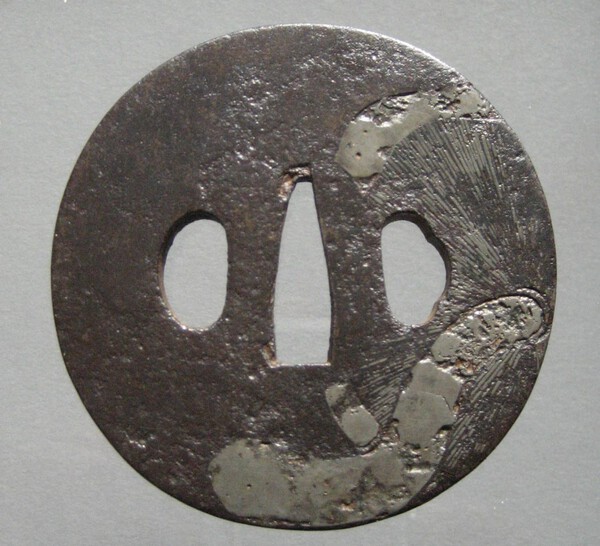
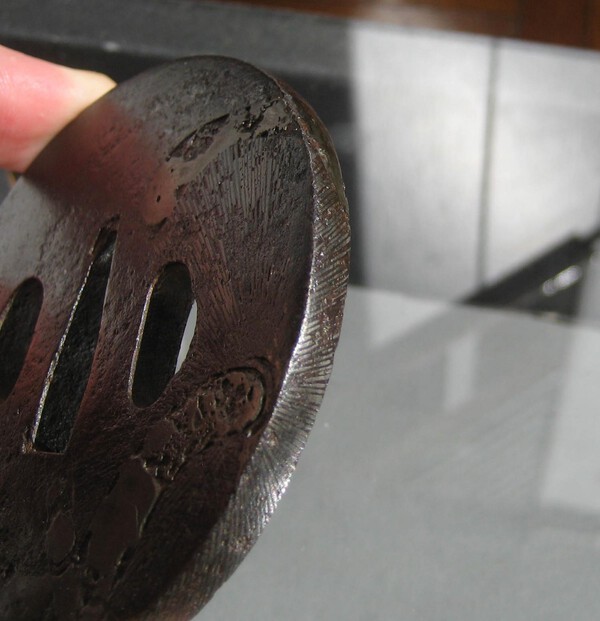
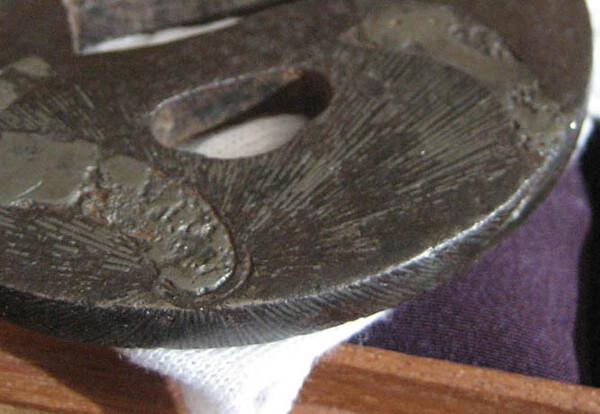
Hi Dirk, I am guessing you are referring to that Matsukawa Mushroom Hazama (Hozon)? The use of the diamond hard sahari inlay does originally come from korean pottery. More durable than the iron, some of the Hazama and Kunitomo tsuba with iron loss are quite dramatic. I guess I can throw that one up as an example. My favorite part of that was the mimi, with the design wrapping over the mimi onto the backside. Hefty tsuba too. You'll probably need to click on the images to get the wabi-sabi feel of the tsuba. Sahari inlay work had quite the distinct feel to it. I know modern makers claim they can do it, but it never has the warbled age marble craggy feel of the earlier pieces. ______________________________________________________________________________ I'd been thinking more of an Ono examples I have, that is sort of over the top Wabi-Sabi... I'm not sure if I have images of that one on this computer. Steve has a much better sense of Wabi-Sabi than I do.
- 152 replies
-
- 10
-

-
As others have, I wish you the best heart for facing the reality of the last goodbye. Be they two legged or four legged, the goodbyes are different each time- but there is never a way to 100% prepare. I've found friends laying in the field, and also been holding another friend's hand in the hospital for days as he refused to let go in what was certainly a losing fight. For me... I chose to try and focus on the fun stories remembered, whether it was the friend too lazy to shave that tried to Nair his beard off -or- Zenboia that little cat that took extreme pleasure in hiding in the bushes at college to dart out and lightly bite or brush women's ankles. Zenobia clearly enjoyed getting them to shriek, and would stalk the dining hall area for victims. Stories help. Tsuba #3: is very good. I could never figure out what it was from the photo- Two primary suspects were either highly skilled Echizen or one of the Hizen area carvers. Then again, it could just as easily be a rare unsigned piece by one of the Shonai or Akita area. This is all to admit I don't know who probably made it, but it is very well done. I wish it were signed. I hope someone else will buy it before I return from traveling. Curran
-
 Luca, It is a shame, because there is much to appreciate seeing a good iron Nishigaki, Jingo, and Hayashi side by side. A baseline tsuba on the table also helps frame it all. Part of it is the different approaches to the working of the iron by various artists. In each line, there are certain generations that I particularly enjoy. This doesn't mean they all have something to appreciate, as even highly regarded makers have off days and underwhelming examples.
 -
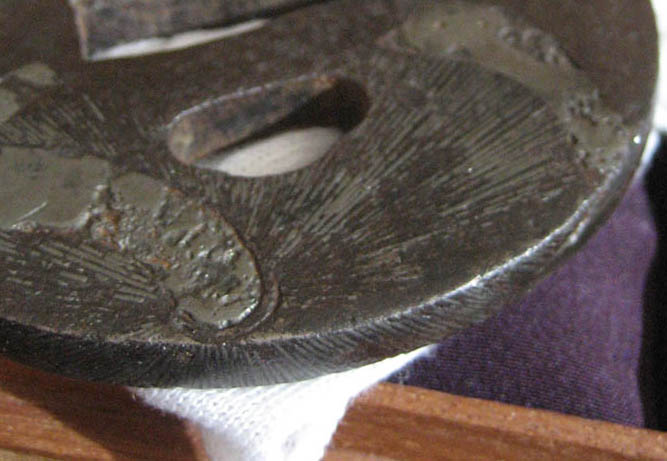
Hi Luca, Given the evenness of the patina over what appear to be blisters, former rust divots, etc., I openly wonder if the damage was not removed with some degree of strong force and then re-patinated? I wouldn't commit to any kantei opinion or say much about it, as I think it fairly altered from its original existence. Think of it as a restored car? The level and skill of restoration varies. There are things that could be observed from it, but dissecting and talking between its original form vs the altered current state is a bit of juggling knives. It would be easy to say one thing and have others grab the wrong conclusion from it. I've made my fair share of 'wrong observations' along the years, and wish I could go back and edit some of my own posts from 7, 8, 10, 11 years ago along the learning curve.
-
Given the rust, I thought iron. I think Marco needs help confirming the mei. I don't have access to Wakayama books for now.
-
Haynes Index. I don't have a copy with me at the moment. Perhaps someone else can open it and flip the pages of Vol 1 for you. It would be helpful if you can post the kanji.
-
Nbthk Papers Reissued, Realistically?
Curran replied to Curran's topic in General Nihonto Related Discussion
Ahha... That settles it rather definitively. Sorry that I had not seen that or known that before. I felt embarrassed asking the question. Now that TH is required for Juyo, I wish they'd ease down how much it costs for TH. Opinion: Even with a strong $USD, as a =<25% of the value it is too expensive for tsuba not worth $2500 or more. -
I'm looking at purchasing a tsuba now. I believe the signature is authentic. The seller is someone I trust in Japan and says the owner of the tsuba bought from Ginza Choshuya a number of years ago and lost the NBTHK papers. It is currently unclear if they were Hozon or TH. With tosogu [not swords, I still admit my journeyman need for papers there] I've reached that point where below Juyo level I don't much care about papers or no papers. Post 2014 shift in the fittings team, the papers are nice if they come with- but otherwise I trust my own opinion. That topic is a bit more touchy if the item is signed and a bigger name. In this case, papers for signed examples of bigger names becomes important IF I ever resell it. ***In this instance, it will influence the amount I am willing to pay the seller***. I have never faced this issue before. I've bought both mumei, only to have the previous owners find the papers and forward them. Most of the time he and I didn't know they existed. In more than one instance, I've forgotten I had papers on something I was offering out. For tosogu, papers are nice but usually not that necessary to me unless the item is something more desirable and more than 50% subject to forgery or fake signatures. This would be one of those instances. If I can find an image of the papers, or reference the number on the papers, does the NBTHK ever reissue for H or TH? I am guessing not. Surprisingly I couldn't find a prior thread on this that wasn't about the old white papers and green papers.
-
Katchushi
-
That old thread is worth reading. 7 years later: Pete's observations are the smarter than mine. I'd edit my old writings, if I could. From one picture, I'm going to say yours is relatively flat- not shaped surface? Partially for that reason, I am sticking with katchushi on yours. My opinion is Edo period. This isn't precise science, even at the paid level of the NBTHK. I was shown a tsuba over the weekend that had NBTHK Hozon papers to Ono. A few days later, I see a high nigh identical one with NBTHK Hozon papers to Haruta. They were both papered the same year, about 6 months apart. I have no idea why. The seller of the Haruta one writes, "This Tsuba has features of Owari Tradition, robust feeling, but has been attributed to the Haruta Tradition." I agree with the seller. Take our opinions as opinions. Unlike the NBTHK, we aren't paid.
-
Hi Patrick, Old paper or price label, aged by glue backing or other substance such as oil? Float it with alcohol, soap, water, and toothbrush or toothpick it apart and off. Katchushi is the best call. Bone or ivory in moderation, as patina at the seppa dai already looks thin- while further out towards the edges could use some rust removal.
-
In The Defense Of Shinsa & Papers
Curran replied to Jussi Ekholm's topic in General Nihonto Related Discussion
I agree with Steve and Peter. I do feel the NBTHK has declined significantly in the value of their Tosogu shinsa since about January 2014. Prior to that, they were the gold standard. If I didn't understand an attribution, I went and studied until I saw what the NBTHK was seeing. Often I learned something and mentally applauded. Since 2014, they are doing things like this: https://www.touken-matsumoto.jp/eng/product_details_e.php?prod_no=TSU-1568 -
Ian, -thank you.
-
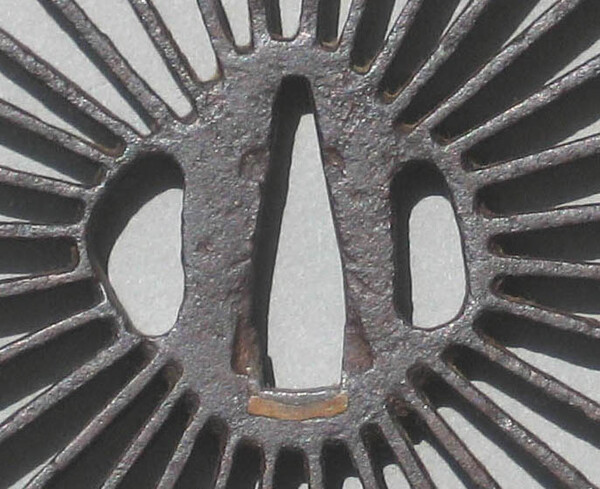
I was following this, as I had the same question as Pete. In my case, I was looking specifically for Saotome tsuba with earlier style kozuka and kogai ana like the attached one. Please let me know if there is anything similar.
-
Steve, Thanks for editing to the correct photo from Wakayama.
-
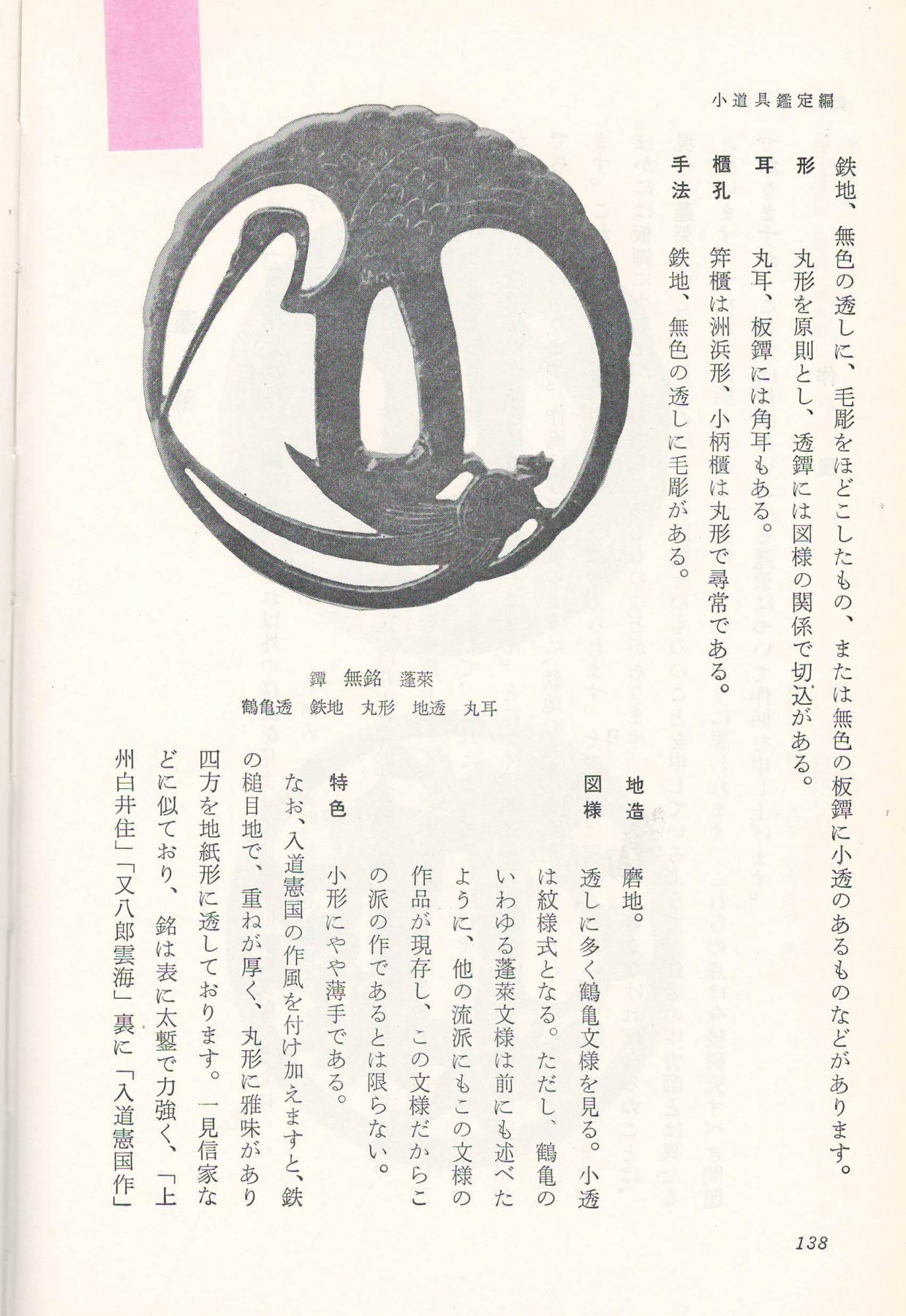
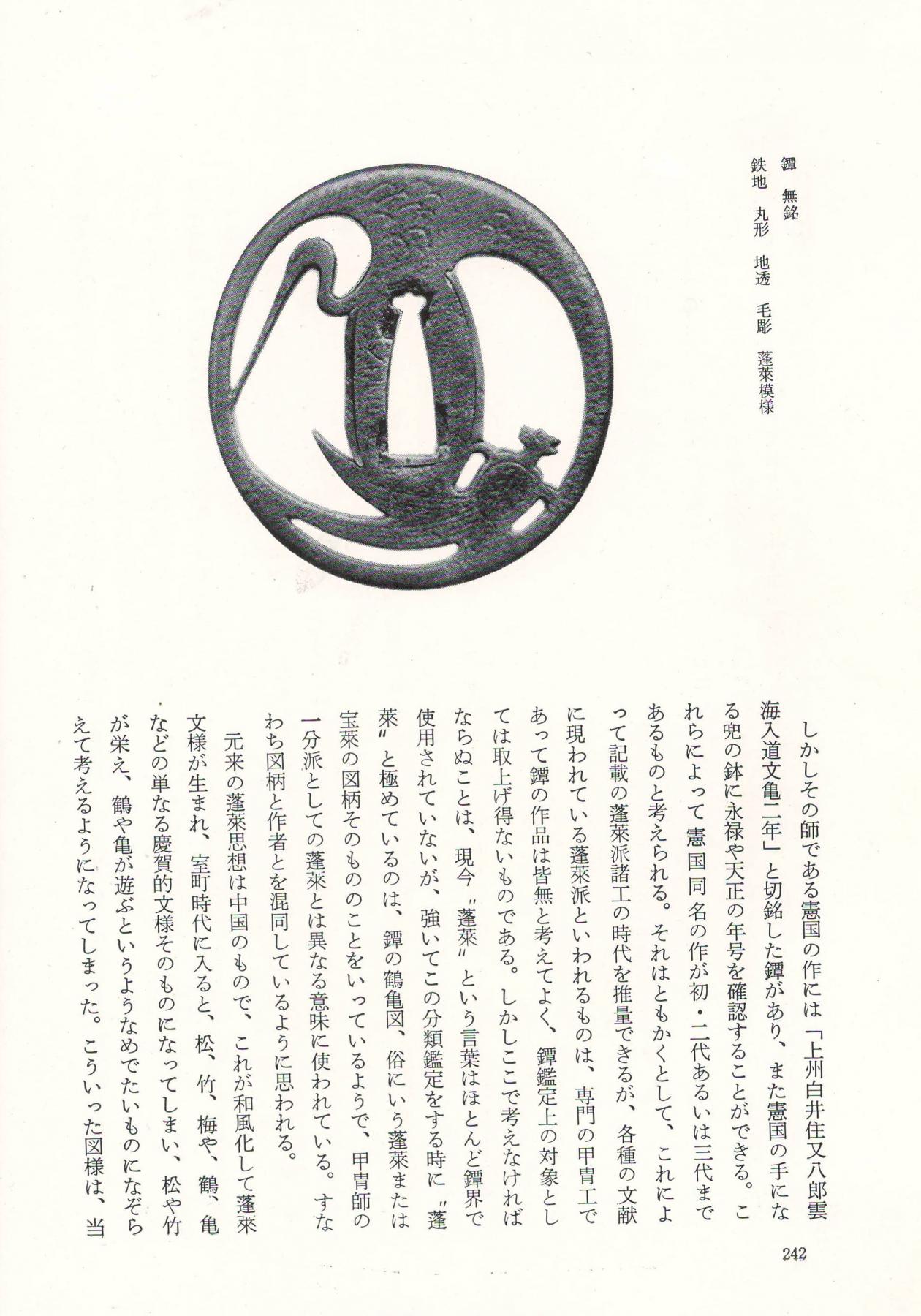
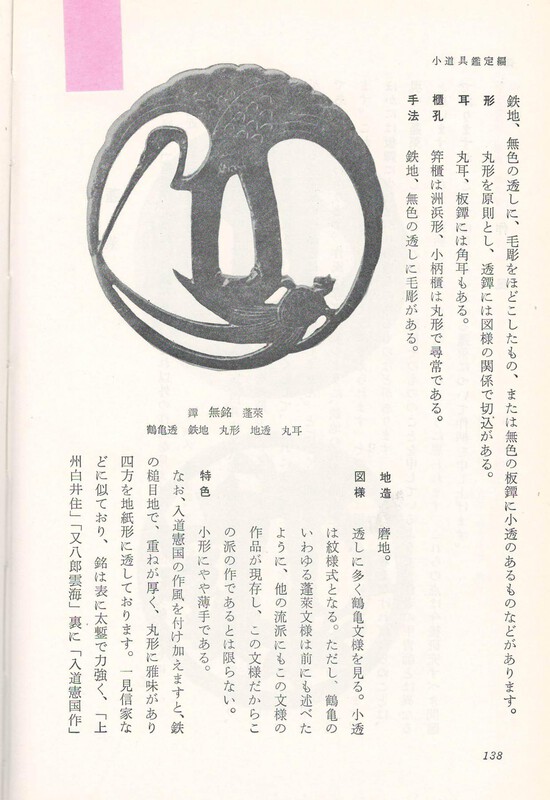
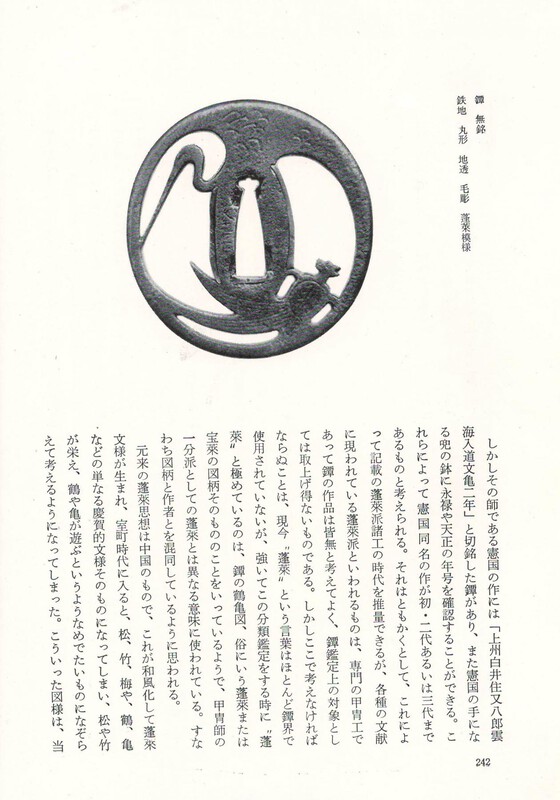
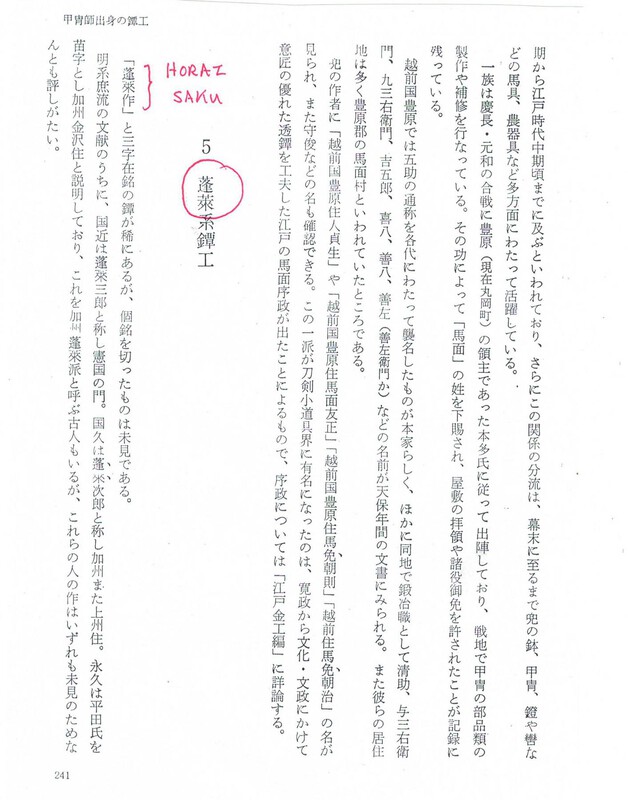
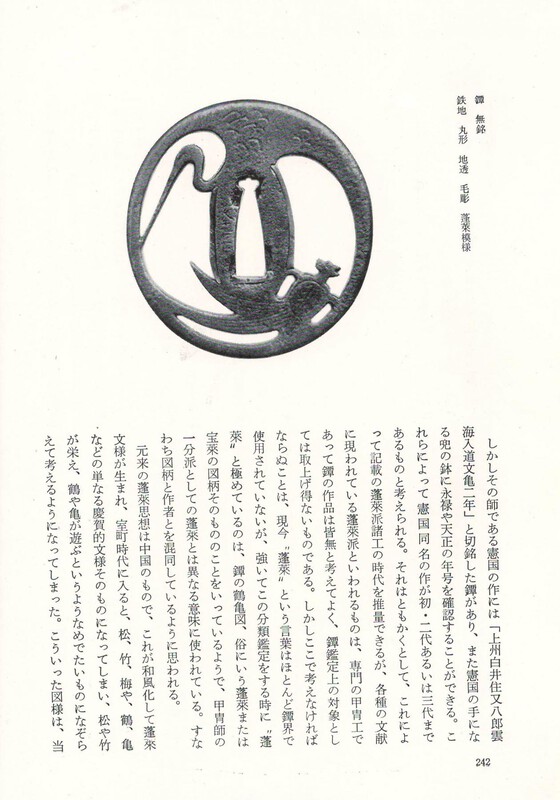
NBTHK and NTHK rely very HEAVILY on Wakayama. Personally, I think the NBTHK relies on them a bit too much. If you want to doubt, that is fine by me. I considered the NBTHK gold standard up til about Jan 2014. Now I think their tosogu shinsa results since Jan 2014 can be a bit squirrely or rather weak-sauce. You have to give them obvious stuff or stuff a dead match for Wakayama reference books. Study tsuba I used for this kantei <---> Wakayama Vol. 1 Horai example. (1) Going totally off what I could observe and had learned over the years up to 2018 , I came to Tosa Myochin. (2) While hitting the books for Jean, it was thrown at me by Dojokiri (person unknown) and another via PM that these are 'Horai'. I wondered, "What the heck is Horai?". It sounds a CDC term for a social disease Patient 0, or the plural form for those things Harry Potter went around destroying. (3) Back to the books..........oh, okay... Horai is some term used to attribute Myochin.... but somehow Kaga Myochin rather than Tosa Myochin. Myochin, Myochin, Myochin ["Marsha, Marsha, Marsha!"] {joking Brady Bunch TV show reference for any non US that might be confused} Anyway... it was a relatively good kantei until I had to be open minded and consider the opinion of older guys and the old books. Not that they are right. I just am deferring to them rather than my original opinion of Tosa Myochin. You say Myochin, I say Myochin, or Horai by another name. Ergo Edo period Myochin. So there ya go. I think I am going to take a break.
-
1- Horai 2- Kaga Myochin (?) According to Haynes n Long Website 3- Horai 4- Horai Or it is better to say 1, 3, and 4 would have been called Horai at the time #3 was papered. A friend loaned me one about identical to #3 with only tiny variations between the two. I cannot tell the date of the papers from the picture I have on file, but it had Hozon NBTHK papers were to Nishigaki. This could be an example of 1980s opinion vs early 2000s opinion.
-
The Horai school is akin to the Kaga_Myochin. If you clicked on the Bob Haynes link, you could read his statement " This example would seem to be the work of the Edo period Myochin school. The original Horai school was related to the Kaga Myochin group, and this example was probably made by a later master of that school." Both the tsuba below are 'Horai' according to the books.
-
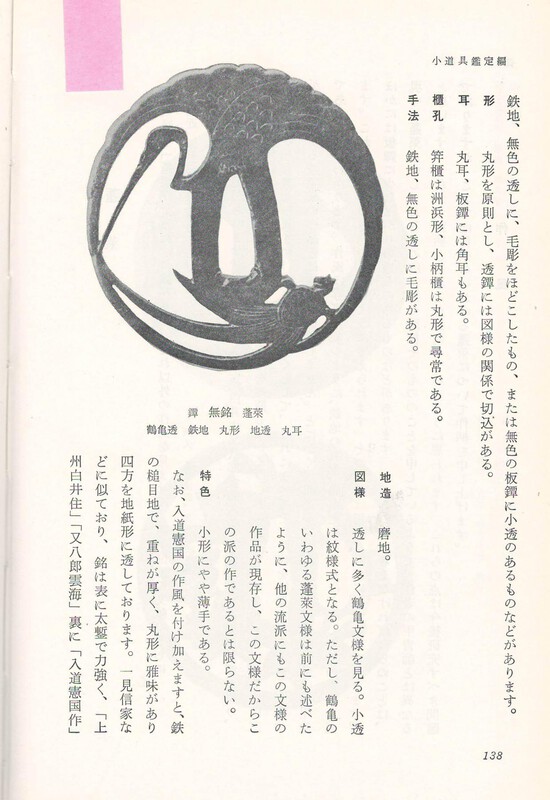
I posted the wrong picture earlier. It is now corrected. --Refer to the Wakayama Vol.1 picture. {the one without the hot pink tab at top}
-
Update Correction: As Dojikiri cryptically said and left the discussion, further study through about 30 books has popped up several confirms that the tsuba is indeed Horai as in closely associated with the _Kaga_ Myochin armor makers. These are from 40 and 50 year old texts and a modern shinsa team may not 100% support- but I understand these tsuba are traditionally of the Horai school. Indeed, the one listed in Wakayama's 8 volume set is very similar to mine. My Tosa Myochin call seems a near miss. I don't know much about Kaga Myochin. Link to Bob Haynes and Long website on the topic of Kaga Myochin: http://www.shibuiswords.com/haynesTsu3.htm Regarding my kantei tsuba, I revise my opinion slightly and think best attribution should be 'Horai Ippa' (Kaga Myochin linked) instead of Tosa Myochin.
-
George, In allusion to his journeys, the inscription, "The sea is full of propitious stars," is still written over the doors of boat cabins." Beautiful. I sincerely enjoyed reading that. I've seen this design many times, and never known it had such a meaning.
-
Mostly I agree with Steven here. In the past I've taken up this topic on the National Gardening Association Forums before, and got a variety of answers with some smarter gardeners arguing towards wasabi, or a type of it. It gets complicated, and further confused by differences in Kanji for several different things all condensed into fewer names in English. The scroll painting is an antique depiction of wasabi vs a more modern cultivated version. I felt there might be a better answer or different answer for J's question, as I've seen versions of these menuki pop up before. I was going to post an opinion next time I stumbled on the similar in a book or elsewhere. Either that, or he can post in the National Gardening Association Forums. Those people are strong in the knowledge base.