Bugyotsuji
-
Posts
15,159 -
Joined
-
Last visited
-
Days Won
325
Content Type
Profiles
Forums
Events
Store
Downloads
Gallery
Everything posted by Bugyotsuji
-
Accessories for the Tanegashima
Bugyotsuji replied to Bugyotsuji's topic in Tanegashima / Teppo / Hinawajū
Version A and Version B. There was a small random plug attached to the original flask string, and although nothing great to look at, it seemed that someone had thought it special enough to keep it attached. Possibly the original cap had split? I decided to use the old top eye-loop plug for Version B, fitting it into a ‘new’ section of dried bamboo. The old strings I kept too, although they are quite frayed and broken.

-
John, antler like yours, or bone, we will see nowadays more often since ivory has been largely legislated away. Just plain and smooth on the back? A sweet thing. These were designed for the width of an average obi, fitting or locking behind the obi, with the decoration facing outwards. Your comment about ‘swinging’ makes sense and may account for the relative shortness of time that these were in fashion. I have two or three examples, ranging from crude to fairly good, but I was blown away recently by a beautiful one for around $8,000 in a Kyoto antiques fair!
-
Edo Period Corner Part II
Bugyotsuji replied to estcrh's topic in General Nihonto Related Discussion
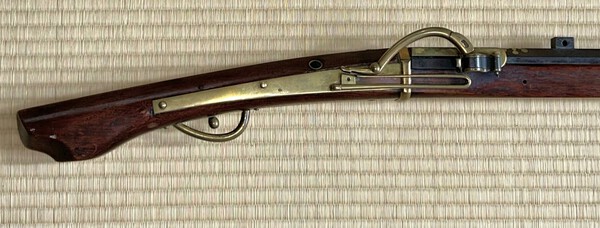
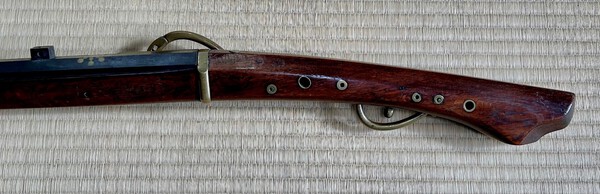
Here are some promised photos, and and
-
Somehow I have lost the registration card for a precious wakizashi. In order to get a new one issued there are some hoops through which one has to jump. 1. Contact the education board of the prefecture where the original was issued. Tokyo in my case. Pray you have a copy of the original. Pray you originally registered yourself as the new owner within 20 days of purchase as the law stipulates. They send you the forms to fill out, which you send back to them. 2. In theory they then contact the education board where you live and request a sai-hakkō be issued at the next sitting of their committee, whenever, wherever. 3. You bring the blade at the agreed place and time for inspection, which usually takes a full morning, pay your money for a new card. ¥6,000(?). In order to get past step 1 above, however, they have requested that I go to Police Headquarters and file an official ‘lost’ notice and collect a number code. So I went to the Police station and was advised over the phone by the authorities that if there is a possibility that it’s at home and I’ve misplaced it, in a sword bag or down the side of a drawer, then they cannot issue such paperwork. They would need to know that it got lost out and about, going to the Togishi for example, and I would have to state when I last saw it. I do not want to involve the Togishi in this as ultimately it’s my responsibility and not his. He told me does not have it and I believe him. Feeling stuck between two branches of government, I took the bull by the horns and went to Police HQ with all my paperwork and the forms from Tokyo, and begged them to help me out. Finally they have agreed to issue the vital number for me! Happy Christmas! This has taken a month so far since I first phoned the Tokyo Board of Education. Now I fill in all the paperwork and send it off to Tokyo for a new attempt at Step One above!
-
Accessories for the Tanegashima
Bugyotsuji replied to Bugyotsuji's topic in Tanegashima / Teppo / Hinawajū
Recently I came into possession of an odd assortment of flasks, of which two coarse powder flasks were ‘genuine’. One was missing its measuring cap, which should fit over the spout, with a little eye loop fixed above it. I spent three days making one and it’s now almost perfect, in material, color, shape and functionality. But then I had to go and discover a small section of bamboo which I had overlooked first time around, and this looks potentially even better. :sigh: Back to the drawing board! -
Edo Period Corner Part II
Bugyotsuji replied to estcrh's topic in General Nihonto Related Discussion
Here I was thinking that was the same photo! Snap! Well spotted re the ‘jewel’. I was wondering if anyone might comment on it, a sure sign of Inatomi Ryū school of gunnery. When you say ‘latest’, you mean that gun above, right? I’ll take some shots maybe tomorrow. Happy Christmas! -
Gunpowder flasks/primer flasks antique or vintage?
Bugyotsuji replied to arilar's topic in Tanegashima / Teppo / Hinawajū
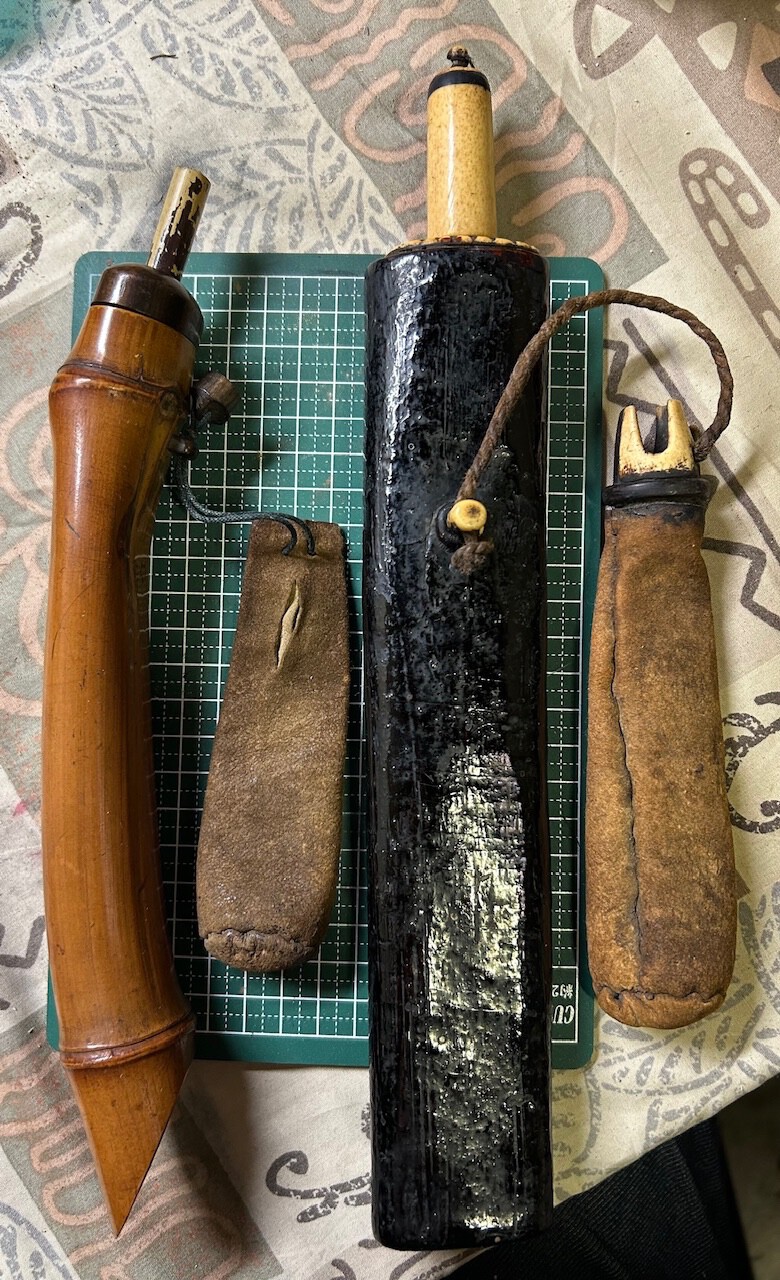
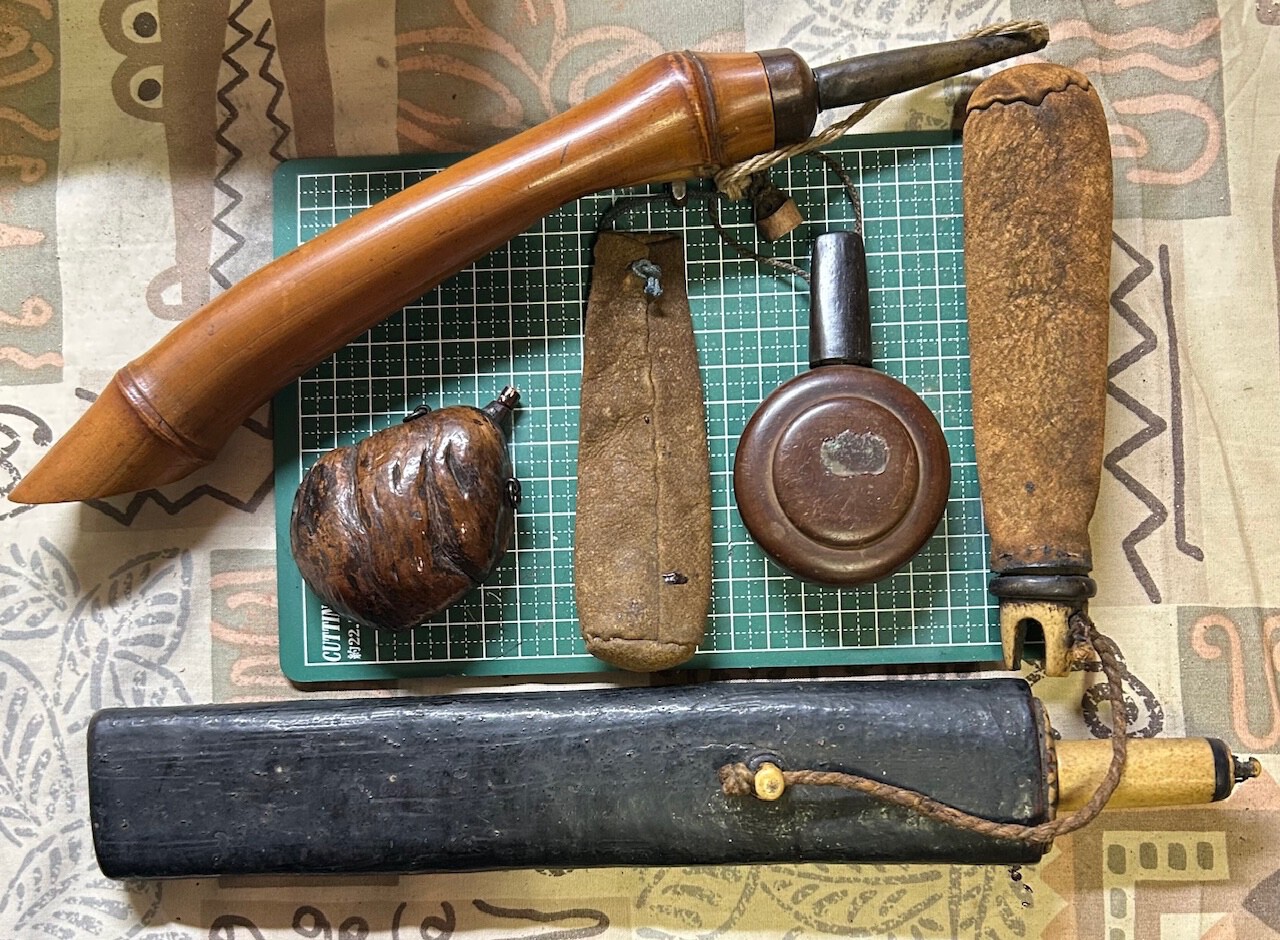
So, removing the botch jobs, three out, realistically we are down to these four. Two coarse powder flasks, a crow’s beak ball dispenser and a regular ball bag. The ‘ruffs’ on the black lacquer flask are quite roughly cut. Not Daimyo quality! Now I need to make a measuring cap for the bamboo flask.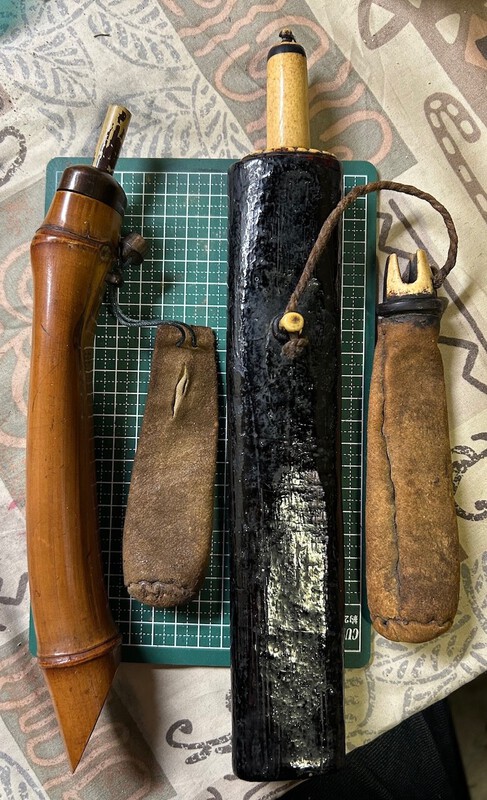
-
Edo Period Corner Part II
Bugyotsuji replied to estcrh's topic in General Nihonto Related Discussion
At an auction one guy was trying to sell a pair of ragged old bamboo cleaning rods for a teppō. There were no bidders, so he was trying to give them away. Still no takers. As I walked out of the door he shoved them into my hand, smiling. I left them in the hall at home and my wife moved them round to the trash corner. Today, a month later, I took a closer look and realized that the one with an old scrap of cleaning cloth stuck in the end is actually a very old bamboo karuka ramrod. So, that has now joined the viable replacement ramrod candidate pile; many guns that turn up either lack a ramrod, or have something unsuitable fitted. It’s quite long; here you can see it against my longest gun, from Sakai. Notice the hole for a cleaning rag. I wonder what kind of gun it originally came from.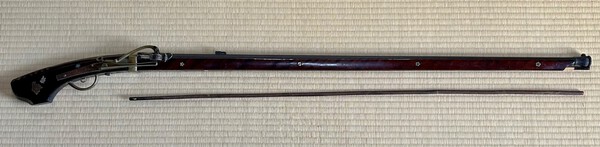
-
Gunpowder flasks/primer flasks antique or vintage?
Bugyotsuji replied to arilar's topic in Tanegashima / Teppo / Hinawajū
The guy selling had these in a box which he wouldn’t show anyone. I was the highest bidder, on a gamble. As you can see, only about 65-70% is OK. There was one more ‘powder flask’ in the box which I gave to someone. The long bamboo flask had a strange metallic cartridge cap, which I suddenly realized was the mouthpiece of a kiseru! That went straight into the scrap metals box.
-
If money is no object and a new Koshiraé does not trouble you, then you will be providing vital work and income for needy modern artisans. If you prefer to adapt an old Koshiraé for the antiques feel, this may work out if you are lucky, but reshaping internally and boring of new mekugi ana in the tsuka will probably be necessary, and fine adjustments with tsuba, seppa etc., may cause headaches for someone. This too would be best done by a trained artisan. You may also need to order a tsunagi or takemitsu to hold the empty Koshiraé (the one you are not using) together.
-
Why not!?!?! Oh, and it says 廣島 Hiroshima on the old registration card.
-
Great teamwork to extract the full name and background from one single unclear photo, Uwe!
-
Edo Period Corner Part II
Bugyotsuji replied to estcrh's topic in General Nihonto Related Discussion
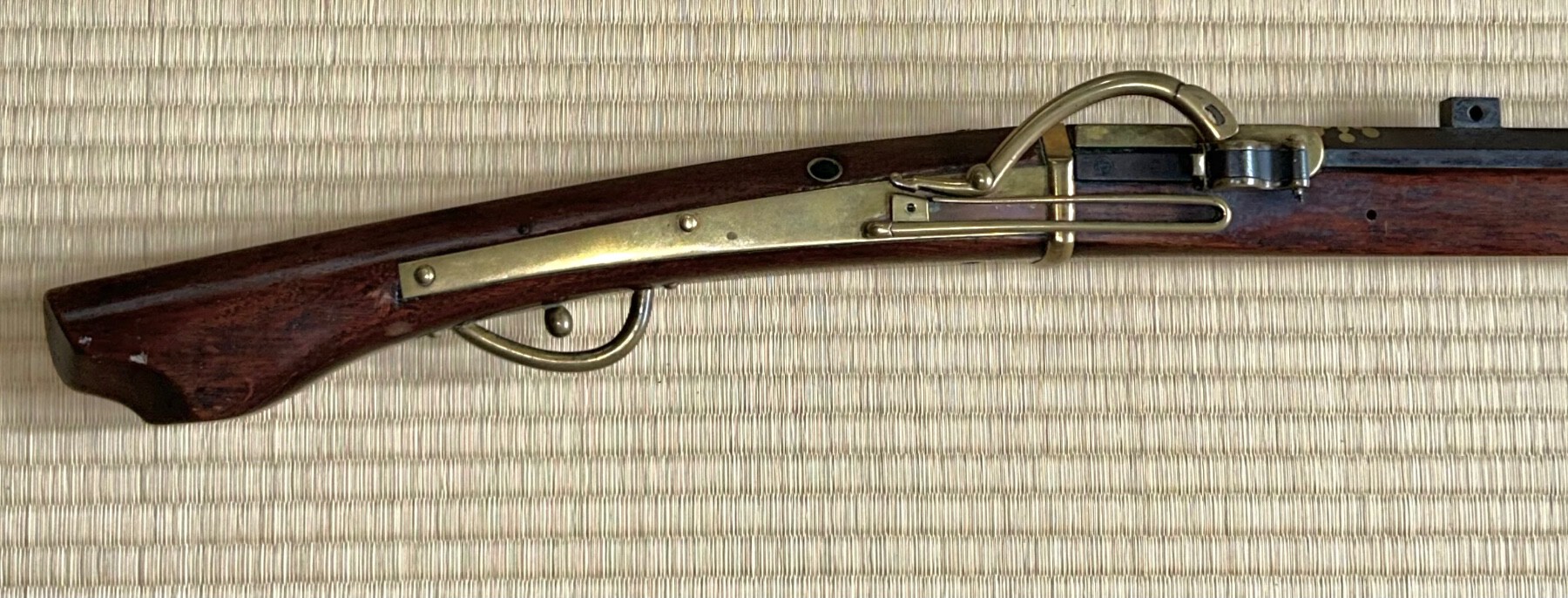
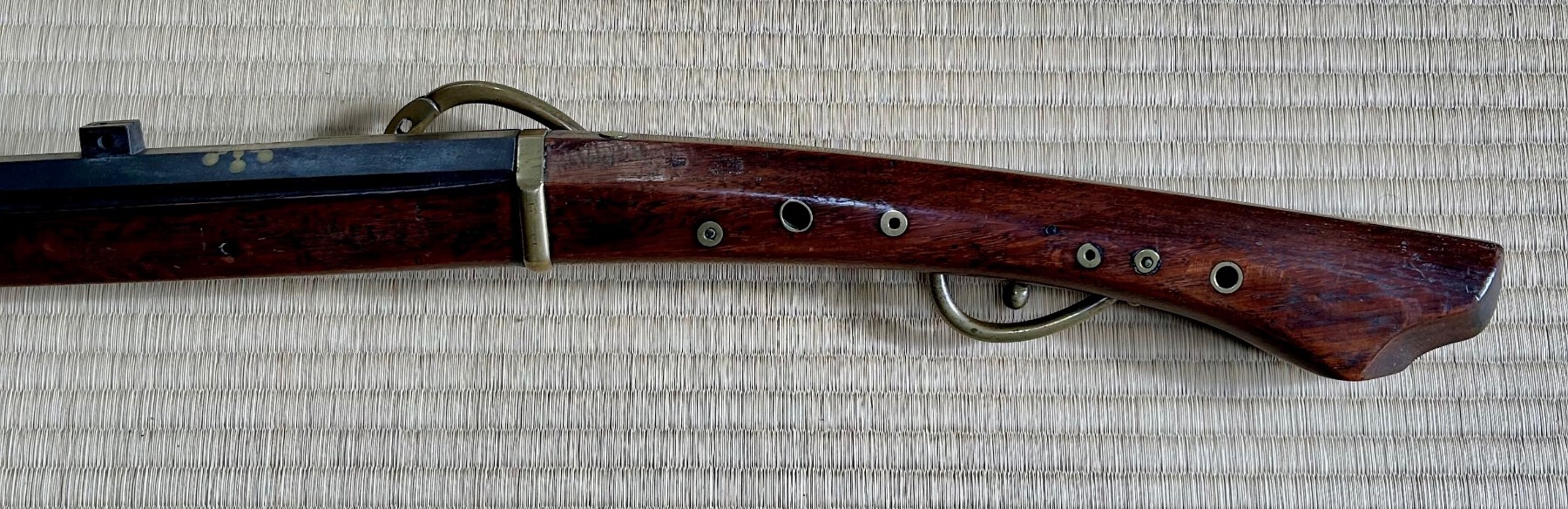
Looking back at the posts of mid-April this year (page 40 of this thread) where I was 'forced' to hand over an Inatomi-Ryu matchlock just acquired at auction. Slippery as eels, they are. Yesterday an almost identical situation arose, with an even better example, but this time I think I got the human relations angle right, and for the time being I am now the proud owner of an Inatomi school gun. Not only is the overall condition surprisingly good, but the Kamon on the barrel is beautifully done. Good for static displays, but could be fired anytime if necessary. Will need to give it a thorough check, and a new ramrod first. Back in November someone offered me payment for services rendered in the form of a matchlock, in lieu of cash. It's a good solid gun, but not in great condition. Subsequent TLC has improved it a little. That matchlock could now go into auction to help subsidize this latest Inatomi purchase. Photo of kamon
-
Enami, or the House of Enami, = Enamiya, were one of the largest and most prolific gunsmith organizations in Osaka. Great that there is a dated gun listed for this smith, giving us a working lifetime of what, somewhere around 1780 to 1820?
-
Hmmm… they could be persimmons, maybe, which slowly turn a dark rusty colour as they cure.
-
Gunpowder flasks/primer flasks antique or vintage?
Bugyotsuji replied to arilar's topic in Tanegashima / Teppo / Hinawajū
Today at auction I bought a box of powder flasks without having had a close look at them. Sadly there was little in there of any real age or value. I’ll clean them up, make some replacements for the missing parts and then (with the others I bought recently) probably pop most of them back into another auction. -
Good idea 👍 Uwe! You may well be correct.
-
Usually referred to as 七宝 Shippo in Japan, a word which covers the two concepts of a) that particular design or pattern, and/or b) cloisonné.
-
Usually one photo is not enough. It will need to be seen from two or three different light angles to pick out the contrasting shadows and details more clearly. It could be 'Sesshu Ju Setsuya Ihei Saku' 摂州住摂(津)屋伊兵衛作 If so, (and we will wait for confrmation from Uwe or one of our resident Japanese nationals), then this gun was made by Ihei of the House of Settsu-ya, living in Sesshu Province (present-day Osaka).
-
Usually a bisen will cause problems if it has not been touched for a century or two. No panic. Removing one is a fine art, but some bisen will not budge whatever you do, and you may do serious damage in the process. (To be cont.)
-
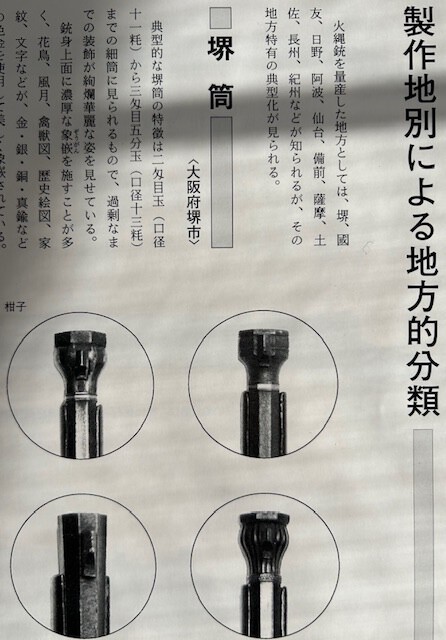
Yes, that is a very nice example of a Sakai muzzle surround with silver zogan inlay. See this photo of four examples from the region. The pan lid has 38 beautifully incised on it, suggesting that this may have been on a gun as part of a multiple order. The number is often repeated on other parts, so if you do not see it elsewhere this strengthens the possibility that it was drafted in as a replacement cover. The pin may also be a replacement as they were usually a hollow cylinder for insertion of a particular wire to support a small protective rain box. 三 八 (三八 Sanju hachi, thirty eight) From the Sakai (Osaka) section of Sawada Taira’s ‘Nihon no Furujū’ (Old guns of Japan)
-
Gunpowder flasks/primer flasks antique or vintage?
Bugyotsuji replied to arilar's topic in Tanegashima / Teppo / Hinawajū
Looking forward to seeing whatever you have, Lars. "Fer better or fer wusser" as my Scottish mother used to say. Thank you for your frankness and willingness to share and learn. Really refreshing! -
Thanks Rob! So just a small decorative mask.
-
Some thoughts on a Netsuke I bought a couple of days ago. In hyoutan (gourd) style, an example of a Netsuke with natural attachment, i.e. no himotoshi-no-ana holes. You can find them plain like this, with the cord tied around the 'waist', or sometimes with a metal (silver, brass, etc.) ring fitment there. (I already had some from before, a pinewood 'koma kara uma' example, an Edo glass one, plain, and an ivory gourd with a ring fitment and wooden stopper, for example.) The material looks to be horn, possibly cow or buffalo horn. Under certain angles you can see the lacquered remnants of 壽 kotobuki, and some flower designs. The central waist looks well rubbed, as though that section had been worn with a cord or string for some time. The price was not too bad, but I could not really decide on how old it might be. I have a suspicion that it is early to mid 20th century. Even so, after some humming and hawing, I decided to undo the purse strings and place my cash on the barrelhead. After all, I can use it to hang other things from.

-
Identify signature on okimono tahua nut horse
Bugyotsuji replied to Japanese Okimono Carving's topic in Other Japanese Arts
You are a dog? Hmmm... better than me, I guess. I'm a rat...