DirkO
-
Posts
1,126 -
Joined
-
Last visited
-
Days Won
5
Content Type
Profiles
Forums
Events
Store
Downloads
Gallery
Everything posted by DirkO
-
天明 - Tenmei -1781 ?
-
While looking for something else I came across this in Yamanaka's Newsletters - sorry for the bad picture quality:

-
I just recently acquired a menuki set with the same theme, so I recognised immediately
-
For those interested in the theme hyoutan-namazu: By the late Muromachi period, namazu had become firmly associated with unrest and upheaval, though not specifically with earthquakes. Around 1413, the shōgun, Ashikaga Yoshimochi, commissioned the artist Josetsu to produce a now famous painting loosely connected with the Zen Buddhist idea that one's mind cannot be grasped. A group of Zen priests close to the shōgun then added a series of poems to the painting. The result was *Hyōnenzu* 瓢鮎図, which means literally "Illustration of catching a namazu (鮎 in this case, not the usual 鯰) with a gourd." This complex painting features, in the foreground, a *ragged looking man* trying to catch or hold down a catfish with a smooth bottle gourd. The namazu has moved into relatively open water and is about to enter a wide area overgrown with weeds. Catching it or pinning it down with a gourd seems to be impossible, and, indeed, today the image of pinning down a catfish with a gourd is a well-establish metaphor for doing the impossible. At the time the painting was created, however, the range of possible meanings of its rich symbolism was quite wide, and interpreting this painting thoroughly requires a book-length study (and there is one: Shimao Arata 島尾新, Josetsu-hitsu hyōnenzu: hyōtan-namazu no ikonorojii 『如拙筆、瓢鮎図:ひょうたんなまずのイコノロジー』, [Tokyo]). Here is the key point to bear in mind for our purposes: Hyōnenzu is the earliest known example of the image of pinning down a catfish with a gourd or other object.
-
Hi Jean, Does he accept any other payment methodes than cheques? (transfers, VISA, Paypal,....) - coz I can't seem to find any?
-
It attributes the sword to Gassan Sadayoshi
-
I would agree with Paul, many of the Koto Gassan were simply signed 'Gassan' although there are signed pieces left as well. I think their attribution refers to that fact.
-
Kogatana is signed Tamba no Kami Yoshimichi, I think
-
I find this an interesting rationale. It's known that certain blades were rejected by shinsa, but after crushing the mei, they were attributed to the smiths who were in the signature in the first place. So likely they were rejected for the mei and not for the work itself. This is a self fulfilling way of working, because over time, all the varying mei will be assumed gimei, except those in the books. So it stands to reason that this way, certain valid shoshin ways of signing will disappear because they were deemed gimei, simply because they weren't recorded in the books.
-
Hi Thomas, Thanks for clarifying! Seeing it's a meito book I suspected a named sword, so it's good you me straight Now I can move forward with the rest of the index.
-
Thanks a lot Morita-sama! I actually had Ochi, but thought it was wrong :-) But I never would've found Haito without your help! Does this mean this is a mei-to, a sword with Gô "Haito"?
-
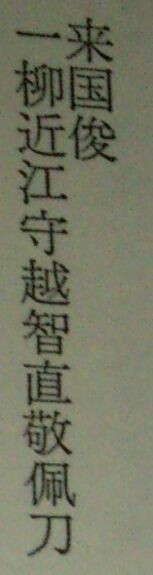
Hi, I'm currently making an index to Shinko Meito Zufu and this kiritsuke mei for a Rai Kunitoshi tachi has me stumped. I can find most of the kanji, but can't make anything from it Can someone help me out? ?IchiRyu? Omi (no) Kami X X Nao X Katana 一柳近江守越智直敬 ? 刀
-
 Years ago I also offered to pay him in advance for this book. But he refused. I can't remember the exact reason nor can I track down the mail (probably deleted). Maybe you should simply contact Harry and ask him?
 -
Best five or so books for beginning Nihonto
DirkO replied to Sam Elliott's topic in General Nihonto Related Discussion
http://www.nihontomessageboard.com/faq.html -
OK, how about our favourite shape-shifter - the tanuki?

-
Big congrats Ford! Thoroughly deserved
-
storage of urushi-coated koshirae
DirkO replied to Marius's topic in General Nihonto Related Discussion
Here's what the Bishop museum in Hawaii thinks (no idea where I got this .pdf): Urushiconserving.pdf -
Hi Martin, They use it merely as a selling point, but it's more nuanced probably. Seeing the blade belonged to someone important at that time, doesn't mean by definition that it's a good blade (although one can expect a somewhat higher standard - the Daimyo addage is made purely to this effect)
-
Isn't a Daimyo Toroku (sho) just a torokusho with a very early low number? They call it Daimyo because the first ones to have their swords registered this way were the nobility at that time. More info: http://www.nihontomessageboard.com/articles/sword_law.pdf
-
Very interesting! Thanks Morita-sama
-
Stunning, I absolutely love the contrasting textures You continue to amaze us, even though our expectations of you might have become unrealistically high!
-
@ Morita-Sama, Thanks a lot for the kao! Even the new book by Markus Sesko about the Hon'ami family doesn't have those
-
Hi Morita-sama, That explains why I couldn't find a match, my list of kao only goes up to Koson. Do you perhaps have a good scan example of his kao? (for future reference)
-
Here's another one which might be helpfull: scanning nihonto.pdf
-
Hi Robert, is there a stamp on the other side located at the same position as the kao? Would it be possible to post a larger picture of the origami? The 2 kanji just above the Kao seem to indicate Hon'a and it's dated the 3rd day which is also correct. I couldn't find any match for kao though.