Gabriel L
-
Posts
752 -
Joined
-
Last visited
-
Days Won
8
Content Type
Profiles
Forums
Events
Store
Downloads
Gallery
Everything posted by Gabriel L
-
How did they have tamahagane from the 1300s? How did they even know that was when it was produced? Very interesting.
-
Mei is quite obviously false. Ten minutes of checking against genuine examples should convince anyone of that. Strokes are pointing the wrong direction in places, even.
-
BTW the name of the liturgical language often written using the Devanagari or Siddham writing systems is Sanskrit, not "Sanscript."
-
Yeah, I forgot to check "synonymous" kanji. I was looking for 政. Thanks Klaus! :-)
-
Stephen, That seems to be exactly it. Masazane 政眞. Doesn't appear in Sesko… should have checked Stein's site before posting. :-) Thank you, —G.
-
Images here. I see —zane (_眞) but I cannot figure out the first character. Opinions welcome. Thanks, —G.
-
Signature: Tanba-No-Kami Yoshimichi
Gabriel L replied to rodrig4's topic in General Nihonto Related Discussion
Translation of original post: Looks gimei to me. -
Craig Harris
Gabriel L replied to Grey Doffin's topic in Sword Shows, Events, Community News and Legislation Issues
Very sorry to hear it. Like many here, I acquired a portion of my library from Craig. Rest in peace. -
Translation Assistance .....yoshi?
Gabriel L replied to Chefsmagic's topic in Translation Assistance
胤吉 -
Thanks Jean — I totally forgot this section existed.
-
Check out this beauty (no affiliation of course!): http://katananokura.jp/SHOP/1505-O01.html Seems like a good deal… relatively speaking. I think one of my favorite details is how he transformed the naginata-bi (distinctive short groove) into the trunk of the plum tree. Inspired! EDIT: Imgur gallery at (http://imgur.com/a/OrhVG) for convenience / posterity. (katananokura removes pages after they sell)
-
Veli-Pekka Viitanen Has Passed Away
Gabriel L replied to Jussi Ekholm's topic in General Nihonto Related Discussion
How terrible. RIP Veli. -
Why would someone try to make an ubu sword appear shortened? Is it opposite day? Easy enough for me to say so but it's obviously suriage.
-
They could never be used with the exact same techniques used for single-edged swords, but Westerners got along just fine killing each other with double-edged blades for many centuries… On a lighter note, amazing daisho Nick.
-
Even assuming (as I do) that the mei is gimei as-is… the blade still looks pretty dang nice IMHO.
-
Bonhams Arts of Samurai in NY
Gabriel L replied to BIG's topic in Sword Shows, Events, Community News and Legislation Issues
? That was the auction from October… it's come and gone (and not much sold). -
Translation help needed...Suke Tada (?) Daito
Gabriel L replied to Ed Hicks's topic in Translation Assistance
You've seen a couple of this signature specifically? If so that is good evidence for the smith being meikan more (not in the meikan), as opposed to gimei or something. -
Translation help needed...Suke Tada (?) Daito
Gabriel L replied to Ed Hicks's topic in Translation Assistance
Looks to me like: Awa no Kami Tomotada 阿波守朝忠 However it is not totally obvious whom that would refer to if correct. ------------ EDIT: so I googled "阿波守朝忠" and look what comes up… you asking the same question twice? :lol: -
Hello all, I was wondering something. Why is it that, when a smith has a title (Yamato no Daijō, Etchū no Kami, etc.) it is so frequently for a province other than where he principally worked—sometimes extremely far away? I get that the titles are often honorary at best, but wouldn't it make sense for a title to be granted by officials of the same province? How does this tie in to the administrative / feudal systems of the time, and why would one province or another be chosen at all? Any insight welcome. Cheers, —G.
-
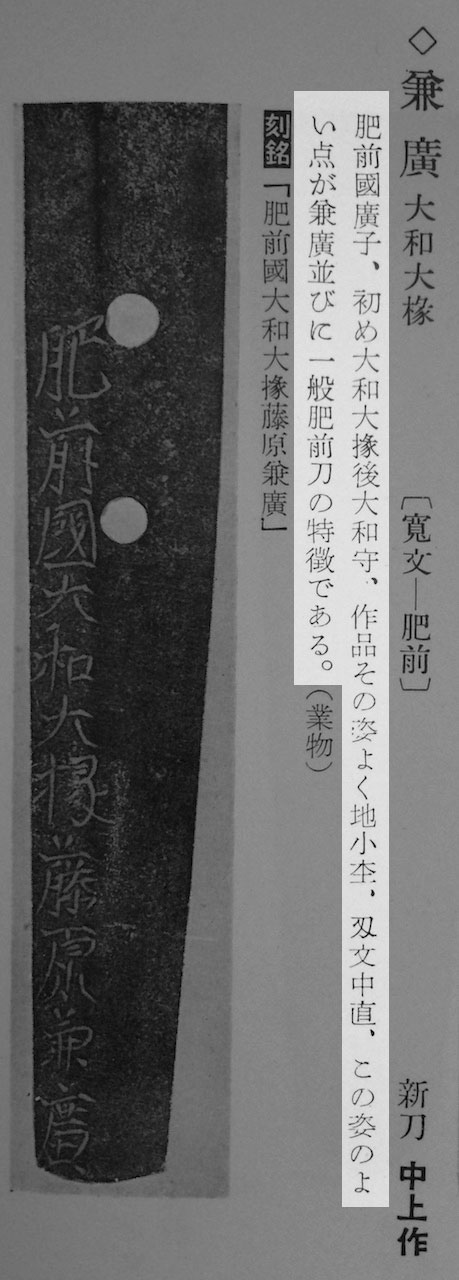
Hi everyone, Funnily enough my Shintō translation of Fujishiro seems to have accidentally omitted this smith (Yamato no Daijō Kanehiro). Can someone please translate the highlighted lines? The rest (mei, title, date, etc.) is easy enough, just the actual "paragraph" text is needed. Thank you, —G. ------------------------- EDIT: so I took some extra time to hunt down the characters I didn't know and transcribe it: Filling in the gaps with dictionaries (edit 2: now with a little outside help), I have zeroed in on the following translation: I would really appreciate it if someone who actually knows anything about Japanese grammar could give me a more accurate translation!

-
To clarify for future readers, Guido's last post (with the "real" HM) was sarcastic. Obvious enough if you actually read the text, but if you are scanning, it might be a source of confusion. Thanks for the article Guido, nice to get a straightforward, down-to-earth treatment of the subject.
-
I am actually with Jimi on this one. I can see at least half a dozen incidental small bumps and divots which correspond between the two — but are very subtle in one photo or the other due to the completely different lighting. Just for example, look at the small bump inside the loop of the cord. What at first appear to be discrepancies are all accountable via the light shift and glare/bleed in the overexposed regions. Be forewarned, not only can the lighting difference cause glare and artifacts, but also complex camera lens distortions can subtly shift proportions. Jimi, re-photograph your kozuka with on-axis light and it will be more obvious.
-
Honjo Masamune found!! (well almost... maybe)
Gabriel L replied to Adrian S's topic in General Nihonto Related Discussion
:lol: :lol: :lol: -
Honjo Masamune found!! (well almost... maybe)
Gabriel L replied to Adrian S's topic in General Nihonto Related Discussion
Yes, that suspicious Col. Victor Cadwell.* His statue in the NBTHK lobby, in recognition of his role in saving the Japanese sword, must have been a mistake. (/sarcasm) *not Caldwell -
Translation of Ito Bushu tsuba book by Markus Sesko
Gabriel L replied to Jesper's topic in Translation Assistance
That's what I would think… except history has proven that at least some owners feel quite differently. In any case I wholeheartedly agree and as I said I neither wanted to distract from the main topic nor discourage the project… it was more an interesting thought experiment / desire to see that no snags occur. Cheers, —G.