Gabriel L
-
Posts
752 -
Joined
-
Last visited
-
Days Won
8
Content Type
Profiles
Forums
Events
Store
Downloads
Gallery
Everything posted by Gabriel L
-
S F Show
Gabriel L replied to tetsugendo11's topic in Sword Shows, Events, Community News and Legislation Issues
That right there is brilliant design. -
There's something unusual going on in "waki 5.jpg". In the newspaper, that is.
-
Brian, I don't mind (in fact I'm flattered), but perhaps you can wait until I send you a slightly updated copy? I've noticed at least one typo and I hate the typography... :lol: Enough off topic from me, I'll PM you later.
-
Thanks Todd. PS, Ray, if you did a number of these you could probably derive truly average shapes for given time periods / schools (of course, we're talking about a LOT, haha!). I always thought that it could be neat to see a more quantitative approach to kantei.
-
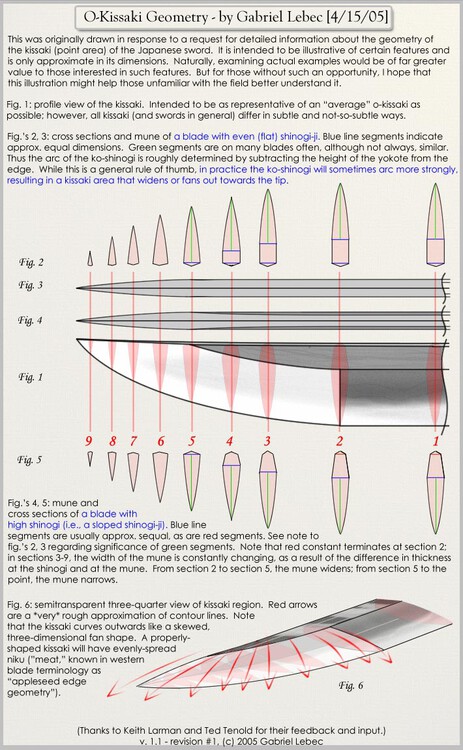
Hi Ray, looks like fun. I'm sure the dimensions you used are accurate, but what about the kissaki shape? Looks like there's something funky going on with the ko-shinogi. Other than that, I like it; you always look more carefully at a subject when you draw it (or build it in CAD or whatever). See attached for an old image of mine that focuses on the kissaki region.
-
Thank you for posting that Ron, it looks like a nice yanone as well. :-) I'd love to one day own some polished examples of complex karimata and yanagi-ba yanone, but those are uncommon and expen$ive as we all know. In the meantime my simple togari-ba example will do nicely.
-
With my admittedly western tastes, my favorite thing in soft metal tsuba is when materials are used to simulate real-world optical characteristics—e.g., iridescence in the case of dragonfly or fish eyes. Nice work, Ford.
-
Piers, ask and ye shall receive. Not a great shot (weird mix of tungsten and daylight colors reflecting) but good enough for dimensions. Thanks everyone for the comments!

-
Hello all, I just wanted to show off my recent acquisition (courtesy of NMB member Curran): a sashikomi-polished yanone. I was immediately drawn to the yanone not only for the scarcity of polished examples, but also because I am not sure I've ever seen one polished in sashikomi. It also had a decent size (2.5" point, 5.4" ubu nakago) and a very cool "flame" hamon, so I decided to try and photograph it. It ended up being remarkably difficult to photograph—my tripod is currently in another state, so handholding macro images at 1/8th of a second really pushed my skills! But I'm happy with the results, which also show some of the hada. Thanks very much to Curran for the cool item, and I hope you all enjoy!


-
It disturbs me how good the first one looks. Seems to me that there is zero possibility of a beginner being able to tell it's fake. Hell, iron tsuba may not be my strongest subject, but I can usually tell the difference—I would not have cried foul on that example, and even after being told its fake the most I can see is a harsh quality to the texture.
-
By the way Ben, it occurred to me you might not have noticed the board has a commercial links section: http://www.nihontomessageboard.com/ (look at the top menu) And Dr. Stein also has a very good commercial link list: http://home.earthlink.net/~steinrl/sites2.htm If you are looking for a good real nihonto at reasonable prices, start there. There are many dealers listed with varying items at varying prices, so you will still have to shop around, but at least this is a more dependable starting point than eBay, random classifieds on nonrelated fora, or general antiques dealers. But as someone else pointed out earlier in this thread, STUDYING is the number one way to actually figure out what is a good buy (and why!). Books should be purchase number 1; swords can follow down the road. No hurry, right?
-
Hi Ben, No problem, I like explaining the landscape to new collectors. It helps me forget how little I actually know compared to some of the other people on this forum. :lol: Don't take it personally when you get abrupt replies. Most students of nihonto get tired of writing the exact same things year after year to each new member. Typically I won't write as much as I did in this thread, but instead will take the easy way out of linking to some good sources for beginners: http://home.earthlink.net/~steinrl/nihonto.htm http://www.myarmoury.com/feature_books_nihonto.html http://www.jssus.org/nkp/fake_japanese_swords.html Etc. Anyway, welcome to the board. It really is the best English-language online forum on this topic, lots of the members are highly knowledgeable (again, more than me). With patience I am sure you'll find even the tersest posts to be useful. In fact, sometimes the best advice comes in the fewest words...
-
Ben, This is a skill that takes years of study and practice and seeing many many examples to become proficient in; it is not usually as simple as saying "X Y Z." But in general, there are several methods of gauging a mei. The first is to compare it against known true examples from the smith, which one does using either actual swords, or with photos / rubbings / scans in textual references (such as Fujishiro's Nihon Toko Jiten, or the Nihonto Koza, for example). The second is to assess the character of the chiseling—gimei often have "weaker" and less confident appearances, conceptually similar to signatures that have been traced vs confidently signed by the actual artist. But that approach is really just a weak corollary of the first. The last is to compare the quality of the sword and its artistry/workmanship to the known qualities of the smith. For instance, a convincing signature might be chiseled in the name of Masamune, but if the blade isn't swirling with activity of very particular types (large brilliant nie, plentiful chikei, etc.) but is instead a piece of crap, well, it's gimei no question—like finding a convincing Rembrandt signature on a finger painting.
-
Ben, let me break it down for you since you've had a mix of presentational styles so far. Most true nihonto (Japanese edged weapons) have been painstakingly cared for throughout their history, which includes EXPERT polishing maybe on the order of once a century or more. Japanese togishi (polishers) go through years of scholarship and apprenticeship to be able to work on antiques and adhere to the strictest and most traditional methods which have been going on for some time now. Because of such measures, we are able to enjoy even very very old swords (700+ years), some of which remain quite healthy (lots of material left). The swords you are looking at online are usually of this type, with near-uninterrupted fastidious care in the Japanese tradition. On the other hand, some blades in history have been over-polished or were "thin-skinned" to begin with. And much, MUCH more gravely, very many swords that "come out of the woodwork" in western cultures have been absolutely destroyed by GIs, etc. who "sharpen" or "polish" them with belt sanders, sandpaper, files, etc.—completely and irrevocably ruining them in most cases. A qualified professional may then attempt restoration and improve the situation, but the loss of material is, as you point out, likely to be extreme. In many cases the blade is simply a shadow of its former self or cannot be repaired period. However, sometimes the restoration can be successful, in which case the value increases dramatically. This is just the state of the art, so to speak. It is a completely different field from western curatorship where long-lost artifacts are preserved as-is; instead, it is more of a living tradition of heritage. Most old nihonto with original "old polish" from Japan will still easily have the hamon and even the hada and some other activity visible. They will be less brilliant and clear, but there nonetheless. The more subtle effects such as utsuri may be masked. It is swords which were appropriated by other nations and which since have been abused or neglected that are more difficult (but often not impossible) to inspect. With a strong light source and the right angle, a hamon is very often discernable, but the details may be obscure and it will be extremely difficult to assess the hada (grain) and impossible to detect more subtle activity. Some were oil-tempered and may have a hamon, but this isn't considered especially valuable. Most will not have a true hamon at all. A few WWII swords were forged by traditional smiths (e.g. Yasukuni smiths) and although will have their own wartime "look," will still have true hamon. ----------- With regard to the sword you first posted: it is very soft because someone has drastically over-buffed it in a non-traditional manner. This makes it extremely difficult to gauge whether it is a true nihonto or just a mass-manufactured wartime sword. My money is on militaria (not traditional) however. Just a feeling from over 10 years of study, take it or leave it. But you can have it looked over at a sword show or even better a local nihonto club to get a better opinion; photos can only say so much. It is definitely in true WWII mounts and the nakago (tang) is definitely from an authentic Japanese blade, but whether that blade is a low-quality mass-manufactured item or genuine nihonto is too tough for me at least to tell from the photos. ----------- As Jacques and Watson explained, in this field we consider authentic to refer more to whether or not the sword is actually from Japanese history (and not one of the countless, COUNTLESS fakes from China). Gimei refers to a false signature and is not considered to make the entire sword "fake," just its authorship so to speak. Collectors have different views on gimei. A sword can be high quality and valuable yet still be gimei, or it can be crap and be gimei; it can be mumei (no signature) and extremely high quality, or it can be mumei and low quality; it can have a genuine signature and be low quality, or a genuine signature and be a masterpiece. It's all contextual and approached on a case-by-case basis. In general, a confirmed signature by a given smith will bring in more money than a mumei blade attributed to the same smith. But even that is not always the case, with some smiths mumei is pretty much expected.
-
I'm going to take a different stance on the sword. My first impression was that the blade was actually very healthy looking despite the horrible surface treatment. But it also looks like a large percentage of the edge may have been "sharpened" away, which would raise serious warning flags. See the fourth and fifth photo links—somehow that doesn't look like ordinary fumbari to me. Perhaps it could be used as a practice blade by a (reputable) student polisher?
-
Samurai in New York
Gabriel L replied to Ted Tenold's topic in Sword Shows, Events, Community News and Legislation Issues
Thanks Ted, I might have missed this without your post. Cheers, —GLL -
Searching for best book?
Gabriel L replied to deanartinfo's topic in General Nihonto Related Discussion
THe only other one I know of (just remembered it) is John Slough's "Modern Japanese Swordsmiths 1868-1945," but I know nothing about this book, including whether its focus is on gunto or gendaito. Then there are also books on the Yasukuni shrine swords and the Kapp/Yoshihara modern Japanese swordsmith books, but those are less extensive/referential and have a more gendaito focus than "Imperial weapons" focus. So no, I can't really advise you, sorry! Good luck, —GLL -
Searching for best book?
Gabriel L replied to deanartinfo's topic in General Nihonto Related Discussion
For Imperial (i.e. 1868-1945) blades: Fuller & Gregory: Military Swords of Japan 1868-1945, and also Japanese Military and Civil Swords and Dirks. From Jim Dawson, Swords of Imperial Japan, 1868-1945. I only have the last one in that list so I cannot compare quality. I know the Fuller & Gregory works remain in demand for a reason. Military and Civil Swords and Dirks is the longest and has the most expensive used price, so perhaps that's the standard? I don't know, that period isn't really part of my own interest. Cheers, —GLL -
Another source: http://www.cci-icc.gc.ca/publications/c ... ment_ID=82
-
Alder wood? Poplar? Just use something low in acidity, I should think.
-
The Economics of Sword Collecting
Gabriel L replied to simonjbinks's topic in General Nihonto Related Discussion
If you can't justify it, don't buy it. I have been interested in arms & armour for over 12 years now and in that time I have bought with my own money (as opposed to gifts, raffle prizes, etc.) a grand total of SIX blades, three of which have since been sold, and the most expensive of which was $1,600. That is all I can reasonably (or arguably unreasonably) afford—there are much higher priorities than swords. You don't have to buy items to enjoy nihonto. Of course we all want to, but it is a fallacy to think that studying this subject and collecting antiques are synonymous. Right now, museum exhibits, sword shows, and sword clubs offer the chance to examine objects that 99% of us will never have the means to own. If you're trying to be more financially responsible, then swords are an obvious luxury to abstain from. I realize that may seem like anathema on this forum, where people would likely prefer to eat ramen noodles for a year if it meant they could afford a new sword , but it's a basic truth. -
The Manfrotto rail can change focus slightly on lockdown, or at least my old copy did. But if you don't consider the *exact* focus point critical—or you keep the lock partly screwed while adjusting focus, so the change is minimal—it's absolutely the best value focusing rail. Otherwise, I like my Novoflex Castel-L rail, especially since the rail bottom is dovetailed like an arca-swiss plate, so it doesn't need its own tripod plate. But the Novoflex is probably too expensive for what it is; ditto the Really Right Stuff rail (which I've never used). Neat photo, Darcy—for some reason I've never attempted macrophotography of swords, although they're an obvious subject.
-
Hi, New Here and would love some help
Gabriel L replied to lestweforget65's topic in Military Swords of Japan
Merci mille fois, Jean. Tom, such intriguing images! Such nice curves! How classic! ...Oh, and I suppose the sword is of interest too. :lol: The blurring of the shinogi (ridge) near the nakago strongly suggest someone once took a wire brush or other polishing device to it. Luckily it doesn't seem like the damage is irreparable, but that could only really be determined by a qualified professional looking at it in person. I think a polisher might elect to leave a substantial portion of that chip rather than lose so much material to eliminate it, but that's just my humble two cents. As to whether it's worth restoring (i.e. if the blade is of better than average quality under all that surface damage), well, there's no good way to tell any more about it from online photos. Possibly a "window" could be polished into it to reveal the quality of the forging. Otherwise getting it polished would be a very expensive gamble. You could always take it to a sword club to have knowledgeable people take a look at it—they might be able to tell you a little more about it. Otherwise there's just not much else we can do online, except maybe give more opinions on the authenticity of the mei (see here, here, etc.). Congrats on the find! Cheers, —GLL -
Hi, New Here and would love some help
Gabriel L replied to lestweforget65's topic in Military Swords of Japan
Cheater.