Rivkin
-
Posts
2,434 -
Joined
-
Last visited
-
Days Won
19
Content Type
Profiles
Forums
Events
Store
Downloads
Gallery
Everything posted by Rivkin
-
Sword's name I presume, Kirill R.
-
Well I never miss an opportunity to guess - both items are from 1800, the kozuka is Hamano Nara, the fk is harder to pinpoint, a very popular topic. With such extreme macro focus stacking is usually what I resort to. Kirill R.
-

Visiting Aoi Japan - First Nihonto Ever
Rivkin replied to radicalrad's topic in Auctions and Online Sales or Sellers
I can't offer much except for a very personal opinion: the notion that claim was made that specific collections are in large formed by purchases from Aoi Art is factually false. The discussion on green papers was similarly problematic because of the whole other set of factually false claims - that green paper Sadamune are always available on yahoo (no, they are very rare), that green paper swords are sold for nothing (no, they are expensive, except a steep discount on certain specific categories). Yes, maybe Aoi Art selling green papered swords is not to the liking of someone in America. Tough. Until I see any evidence that Aoi Art's blade was sold with such papers with a statement that the papers are to be trusted, but later failed to repaper - to me judging such sales has no more value than a niche personal preference. People buying green papered swords en masse for nothing in Japan and selling them with 10x markup - not aware of any such cases, its commercially very difficult to impossible. In the original discussion Andy Quirt was the one who had green papered sword for sale, and I really don't think depicting him buying up green papered swords in Japan and then swindling newbies is accurate at all. I personally can highly [!] recommend his shop, as probably most of the actual collectors. Coming back to Aoi Art, I found myself within the last year repeatedly in a difficult position. I was asked to comment about a dozen times on Juyo and above swords on sale by Tsuruta san with a caveat that it is "known" that the images were photoshopped and the item itself is highly problematic. In all cases it turned out to be an opinion coming from one and the same person. Obviously I could not just say - I vouch for the item. Because I did not see the blades myself. Neither did the dealer who did not like them. And why should I take the responsibility? At best I can only comment on the photographs presented, which in my case is not worth that much. In light of this, my position was always - take it with two grains of salt. Somebody who bought a sword, studied it extensively and then voiced what he saw as a problem may or may not have a point. I heard so many times "it will never be Juyo again because it is slightly suriage/hamachi moved/etc.", it seems as much an art of guessing as objective analysis. Had papered swords pronounced saiha by supposed experts. Maybe they are right! But compared to all of those case, Le Grande Opiniators - like me, commenting based on photographs or oshigata should be assigned lesser priority. Every matter reported by those without personal involvement - much lesser priority. I heard so many horrible stories in the past decades about "what really happened", I lost count. When I acted on this rumors I typically made mistakes myself. Just as with Aoi Art, I heard a worrisome tale about Fred Weissberg. Zero chance its real. I can't comment on Hitler, Mao and others, as my understanding of those subject is very slim. Kirill R. -
Worksheet for NTHK is a must. Besides the score it can contain comments that don't go on the paper (uncommon). Kirill R.
-
Visiting Aoi Japan - First Nihonto Ever
Rivkin replied to radicalrad's topic in Auctions and Online Sales or Sellers
Dmitry's showing items from Aoi Art and openly discussing this, is a public record on facebook. The case in point - almost everybody uses Aoi once in a while. He has a wide range of items, prices and clients. Is Tsuruta san the most honest, straightforward and worthy dealer? No. The problem is, I don't know any such person. He is better than quite a few, but I never worked with a dealer I did not have an issue with, at least once in a while. Never saw a dealer whose description was not proclaimed dishonest by someone else. Or someone commenting that the items "should not be sold", because they have demerits - mumei, or bad horimono. I heard stories about Fred Weissberg. Spending some time with him I instead formed an opinion he is a very honest and direct man. Does not mean agreeing with everything he says. There are horrible stories about myself. I am glad they are exotic. One thing I learned from that - not to take too seriously anything that does not come from a victim. If someone says - I was wronged in such a way, then at least something did happen. If the story is told by another dealer whose moral qualities demand fixing the world... Maybe I simply don't like people with high morals. I am but a simple unscrupulous man in the world of scholars and ancient nobility on the mother's side. Once I was selling a koshirae; I brought it to a very old and very respectable dealer. He looked at it, said I can take it, but the menuki are new. This can be hard to see for a newbie, but new gold has this distinctive look. He quoted the price reflecting that. I walked out. A few months later I decided I need the money and have to sell it. Brought it back; he looked at it - a really decent koshirae. And well, the price does reflect it having nice gold menuki from a respectable school. Kirill R. -
Yes, but are the theoretical numbers they provide real? I was trying to "experience-based" look at it, and to me it seems that the real range is between 68 and 83, i.e. I never saw a blade rated outside it, if Yushu shinsa is taken as a separate matter. In this range I am quite certain of the following: 68-69: problem swords. 70-72: average blades 75-76: good blades, which apparently can/could go Juyo with a slightly different attribution, but in general are not expected to do so. 81+ solid Juyo. Would this mean 78-79 sort of like blue papers NBTHK used to have? And there is I guess still a caveat that they give 78-79 to good shinto and shinshinto blades which however can be not a prime Juyo material (waki). I saw very few 77, 79 and 80, and suspect these are basically rare variations of 76 and 78 groups accordingly. Kirill R.
-
An advice or personal experience on NTHK NPO paper scores is appreciated, especially its upper portion. My take is that: Below 70 - major condition issues 70-72 - an average blade by chujosaku smith, or a more ambitious sword but with condition issues. 75-76 - TH analogue. This being said, I once had Juyo scoring 76 when submitted to check if there is an alternative name. So I guess this range includes a number of good blades, but with some detriment (mumei etc.). 77 - very rare, kind of 76 in nice condition. 78 - this is an island of sorts, as both 77 and 79 are rare. Good blades of average name smiths. 81 - more or less straightforward Juyo pieces. Signed ubu kamakura. Uncommon. I don't have any experience with their Yushu etc. so any information is appreciated. There are used to be posts that NTHK (NPO?) sort of grades each smith on its own curve, but I did not find it to be particularly holding in my experience. Kirill R.
-
Visiting Aoi Japan - First Nihonto Ever
Rivkin replied to radicalrad's topic in Auctions and Online Sales or Sellers
Everybody buys from Aoi. Suwaguchi, Dmitry, peasants, officers and ncos. I had couple of times issues like a minor fukure which was not disclosed in text and not clear on photographs. Tsuruta san seldom specifically comments on small-mid defects. Its something that a few others pointed out as well. Otherwise, above 250-450k yen it is well known as a shop where one can buy good things for less. High throughput, low margin. The one thing you will find lacking in this thread are the victims. Nobody says I bought a green papered sword from Aoi, which Tsuruta san said he trusts, had issues with repapering it and was sent off when complained. Or I bought papered sword, went to Tanobe for sayagaki and was told its saiha. I heard about a dozen of revelations about Tsuruta's real practices within the last year alone, none from the actual victims. All of them in fact went back to a single person who was kind enough to prevent collectors from being swindled by Tsuruta san. I guess, there are dealers who REALLY dislike Tsuruta. Otherwise if return guarantee is a big thing, then American dealers are the way to go. They also tend to have reasonable deals within this price range. nihonto.us, yakiba, nihontocraft come to mind a reliable shops that do have substantial wares in 1000-5000 usd range. Kirill R. -
Absolutely NO. Kirill R.
-
Modern. Kirill R.
-
Being an ignorant man, and with reactionary attitudes largely preventing Juyo submissions, I still _guess_ the actual passing is more challenging than 10%. Ubu, signed, Kamakura has probably 99% passing rate. Suriage but still long, Ichimonji - 80%. Katana Kiyomaro - 50%? So at each session after those things are auto-papered, then starts the real competition between still very good blades, but which are better in life than on paper. Fighting for the remaining spots. What kind of chance an absolutely stellar nidai Hizen Masahiro has? Kirill R.
-
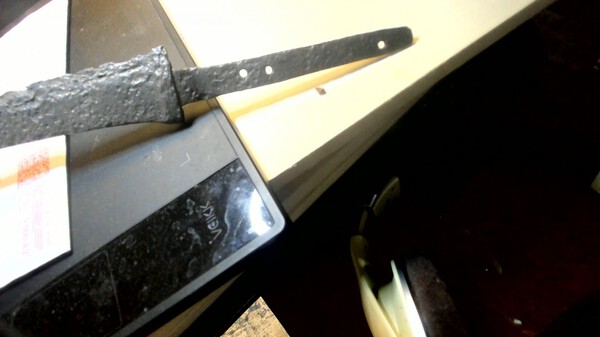
And while we are at it.... Continental chokuto do tend to have one ana and much later they go to two... But sometimes you get this uncommon suriage thing, and even though likely only one probably functional at any given time, it is kind of fun. Kirill R.
-
Yes its a bit weird, and it was I guess attributed thus as nagomaki naoshi. Regarding the red lacquer, very many people fear it, but I never saw anything disastrous with it. Its actually quite expensive to apply, and was quite often done to temple blades, usually yari and such. One has to guess that while today when publications talk about kogarasumaru they are talking about the one in Tenno collection. But by late Edo there were 16 kogarasumaru, and no less than 4 kusanagi all owned by major temples with supposed provenance all the way to the source. They had quite a lot of blades, especially some temples. Kirill R.
-
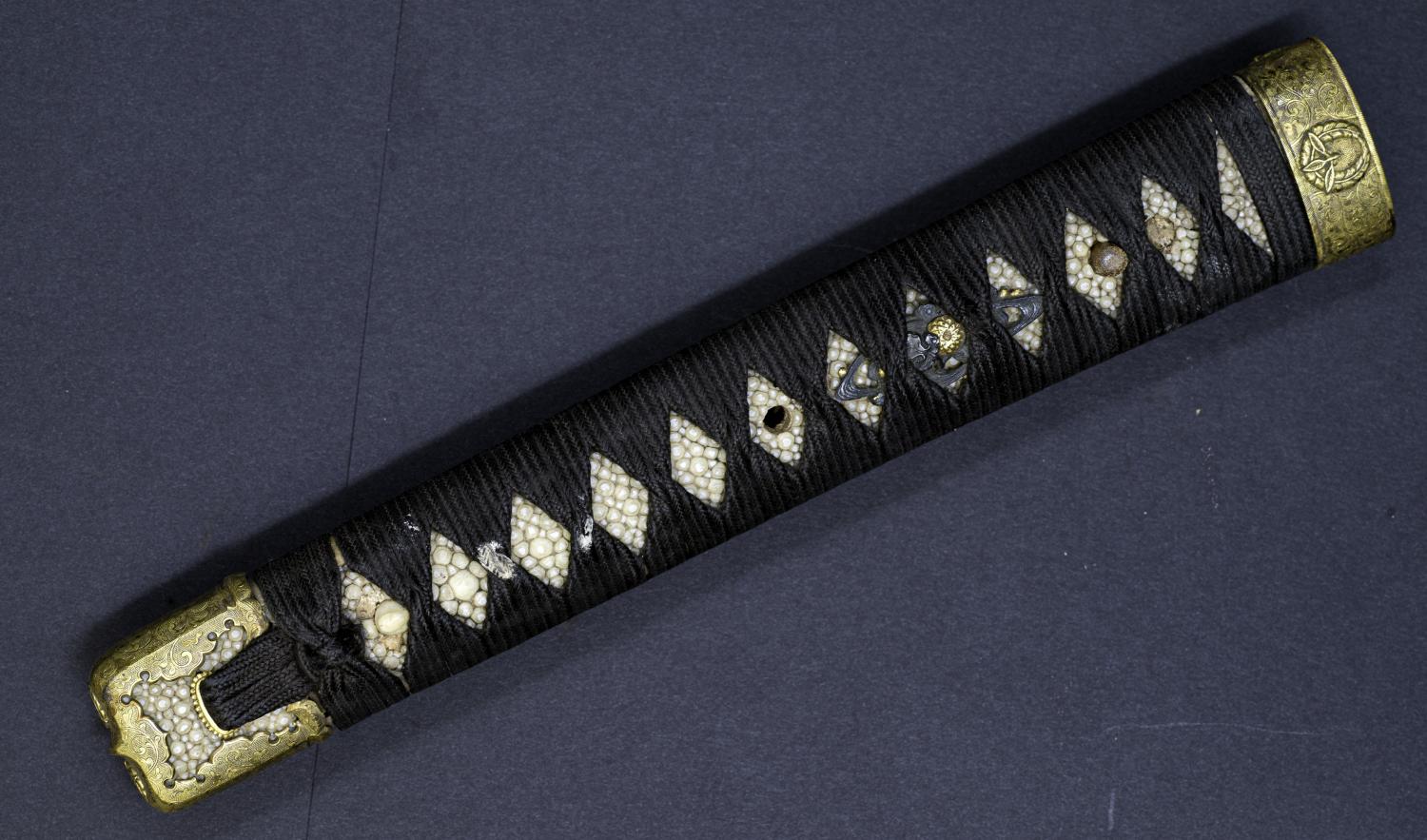
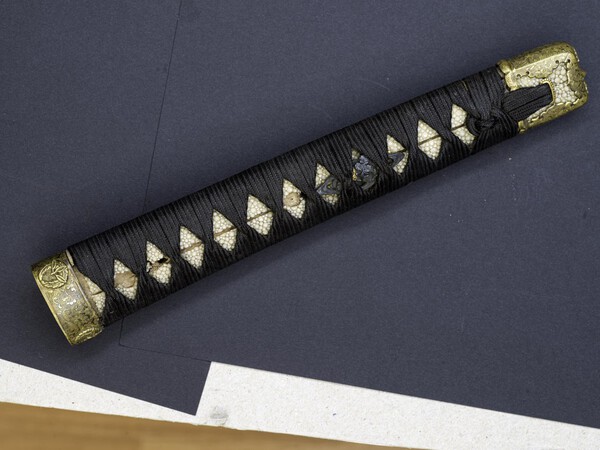
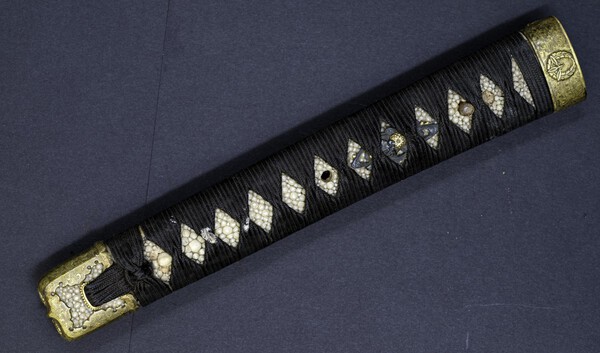
Yes, it is, but I've got only two mekugi coming with it. Kirill R.
-
There are two mekugi coming as a set. Could it be some weird reuse of a tsuka? I don't have the blade unfortunately, so no proof, but I don't think so. Kirill R.
-
Personal opinion: Tamahagane requirement applies to post-1935 or so swords, i.e. military patterns and post WWII production. For anything earlier, the historical-artistic value is assumed. You can get a registration for a European 19th century smallsword. You can get a registration for a 19th century Japanese sword where on nakago its written that its made from a Russian anchor. Or something made in 1914 from a steel of such and such Japanese company to commemorate something company-related. The boundary between "can get registered" vs. "illegal to own" is thus somewhat vague when we start dealing with swords made in 1920-1930s. You do see plenty of diplomatic smallswords sold with broken off blades, and then you see identical models with blades fully intact. On the artistic side, once you get to using steel which has very high thermal conductivity (extremely homogeneous and low grain size), including that between folding layers - the ability to form complex patterns in both ji and ha is impacted significantly. Its going to be a good sword, artistic it will never be. Kirill R.
-
Nice! My personal vote would be on Muromachi. Kirill R.
-
Sure, on Sunday. I will even boost the suspension - the ana are wide on one side and narrow on the other, and there are still two conical wood mekugi inserted in them. Kirill R.
-
No, that works in some countries with daggers. But continental chokuto had either iron or copper, not wood mekugi and went from one to two relatively early as well. Kirill R.
-
I own one (Momoyama) and owned a few. Kirill R.
-
No, its not a Kotetsu. Don't take my word on it, especially based on a photograph. But it is not a high quality sword. Jigane varies randomly, hamon is in nioi save for some sparkles of nie here and there. Kirill R.
-
Visiting other collectors
Rivkin replied to Peter Bleed's topic in General Nihonto Related Discussion
Will be honored to! Unfortunately the list is still ambitious. I am doing reasonably well with Muromachi and Edo, except for the following: Umetada, Horikawa, Kotetsu. Which are badly needed. Also, the photos of Inoue Shinkai, Sushinshi Masahide, Shodai Hizen Tadayoshi, Shodai Yasutsugu are not the best and if there is an opportunity to photograph other pieces it would be great. The biggest issue comes with pre-Muromachi, since the diversity of blades within apparently the same school or even maker is staggering. So even though I have quite a few examples of what is listed below, they do not really reflect the schools well enough. Katayama, Fukuoka, Yoshioka Ichimonji, Hatakeda, Ko Bizen are badly needed. The ones I have cover only about 20% of the wealth of expression that exists there. Also badly needed are Rai works not in suguha, and Awataguchi (I do have Shintogo though, but there is never enough Shintogo). Aoe is badly needed. Would benefit from better Enju, Echizen Rai, Ko Hoki, and Sadamune. Also my Chogi photographs are of not very representative blade (lots of tobiyaki). Would benefit from really good ko-Mihara. Overall anything good pre-Muromachi helps a LOT. There is a reasonable representation of Soshu as is, but if there are good blades they will always be included. In the publication its owner's choice regarding whether he wants the pictures identified as coming from his collection, or a more general acknowledgement in the introduction. Kirill R. -
Visiting other collectors
Rivkin replied to Peter Bleed's topic in General Nihonto Related Discussion
The goal maximum (which can prove to be unreachable) is to produce a photo essay of 200 blades covering the entire history of nihonto from chokuto to gendai. Of those 50-80 will be masterpieces, and the rest - typical period items. Some very average, some quite advanced. Right now I have about 300 photosets from which I can select 70-90 items for the publication. I figured with 600 good photosets will give me the desired 200. But that's very approximate, since I am still missing specific schools and names that need to be filled if the work is to be reasonably complete. About 30 items, mostly quite rare cases, but in the worst case I have lower quality photographs for about half of them. Some dislike my photographs, but I do believe in them and the technique is simplified to be reasonably quick... The only thing that remains is getting the actual items. Kirill R. -
Visiting other collectors
Rivkin replied to Peter Bleed's topic in General Nihonto Related Discussion
I am on a constant quest to collect photographs of J and TJ. For a good collection - will fly in, do the pictures, the owner gets the photographs, can shoot about 30-45 blades in 2 days. I need about 600 blades photographed to do good selection for a photo-album, have about 300 as of now. Kirill R. -
Well, I'll do a completely contratian and possibly ignorant opinion. Such metallic koshirae with Tokugawa's mon are considered in some circles to be Ainu type. There are Edo period examples which are quite expensive and very rare, there is one in TNM. Quite a few were made during Meiji and could be/are touristy... But they are not terribly common (i.e. you see one or two for sale per year) and do cost money. The scrimshaw koshirae is completely touristy and non-traditional (unlike this one), and yet you similarly see them maybe twice a year and they do cost money. There is a type of Ainu koshirae made of carved wood, which is made in Hokkaido even today and is very cheap. Kirill R.