


Higo-san
-
Posts
734 -
Joined
Content Type
Profiles
Forums
Events
Store
Downloads
Gallery
Everything posted by Higo-san
-
Hermann Historica Auction No 79 22nd May Online
Higo-san replied to Higo-san's topic in Auctions and Online Sales or Sellers
Dear Pietro this is a standard practice at many auction houses. It’s intention is to start a battle between bidders. On more than one occasion, I have witnessed items which would have been withdrawn without a single bid at the starting price, but after the auctioneer reduced the asking price, two bidders would jump in at the same time and the race began. It is all about human psychology . But it if the reserve price is not met during the auction, it is up to the owner to decide whether or not he/she wants to sell for the achieved hammer price. Best Chris -
Hermann Historica Auction No 79 22nd May Online
Higo-san replied to Higo-san's topic in Auctions and Online Sales or Sellers
Speaking as a tosogu collector, I think that the prices at yesterday’s Bonhams auction were rather moderate and not at all overpriced. Real problem seems to me that the number of high-class tosogu collectors is either decreasing (at least in Central Europe) or that more and more collectors tend to buy directly from Japan (not because of a lack of quality but rather because the amount of high-class pieces offered for sale in Japan is obviously much higher and you are free to choose a subject you are particularly fond of rather than to take what you get). IMHO you could have made some real bargains at that auction. -
Dear all for those who have not seen it yet: https://www.hermann-historica.de/en/auctions/detail/id/448 On the second day of the „Antique Arms & Armour, Hunting Antiques and Works of Art, Antiquities“ there are a couple of armor, swords etc offered starting at Lot 1895. Best Chris
-
Thank you for the additional pictures, Jason - I would place this tsuba (according to Sasano’s classification of sukashi tsuba schools) within the Kyo Shoami group, early Edo. Best, Chris
-
Then I do not see any traces of Akasaka work on Jason‘s tsuba. A kaku mimi with ko niku would - together with the rather thin ji-sukashi, the shape of the hitsu-ana/seppa-dai and the overall mokko shape - point towards a Kyo workshop.
-
Dear Jason could you take a picture of the mimi (rim) or describe its shape (rather square, round etc)? Judging from the pictures provided, I would lean towards Kyo Sukashi early Edo. Kind regards Chris
-
B&m Exhibition Munich
Higo-san replied to uwe's topic in Sword Shows, Events, Community News and Legislation Issues
It is actually an excellent exhibition - I am sure that Uwe‘s comment was meant as a joke. Best, Chris -
See above
-
See below
-
No. 8 reads Ishiguro Masatsune (石黒政常).
-
No. 1 is a tough one... my best guess: 後藤光?(花押) = Gotō Mitsu? (Kao) 十七?代 = 17th ? generation As the 17 seems to be a reference to some kind of genealogy, the Mei could read Gotō Mitsuhira. Best, Chris
-
Hi Dirk, thank you for the reply. A very interesting kantei and obviously the NBTHK shinsa‘s opinion is far more educated than mine. BTW, I did not say that the design on your tsuba was not a design invented by the Hayashi school but rather that Hayashi designs were copied by other (including later Higo) schools which is proven by the fact that this very design appears in the Kamiyoshi Ehon. Best, Chris
-
Dear Ford, a very nice video - however, I do not believe that this is a Hayashi Tohachi tsuba. The piece lacks the very typical koban-shaped seppa-dai which can be perfectly seen on the reference tsuba in Sasano‘s book. Secondly, the elongated hitsu-ana is very untypical for Hayashi tsuba and reminds me of Tosa Myochin or later Higo pieces (again, the reference piece in Sasano’s book shows more typical Tohachi hitsu-ana). Last but not least, I cannot see (or imagine) a typical Hayashi tsuchime on the piece in question. Your kantei seems to be based primarily on the design - however (and I am sure you are already well aware of this), the mere design can be misleading as Hayashi designs were copied by many other schools. This is not meant as criticism but as a contribution to kantei. Best, Chris
-
Thank you again, Piers! All the best, Chris
-
Thank you for the time, Piers!!! I have also come to the conlusion that we are actually looking for at least two Kanji. The last is indeed Hachi. All the best, Chris
-
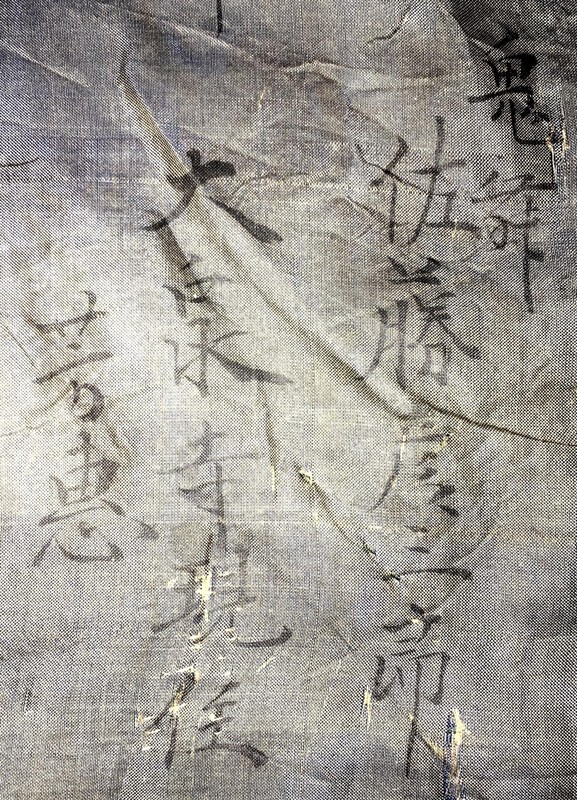
Inscription On A Late Edo Period Kesa
Higo-san replied to Higo-san's topic in Translation Assistance
Many thanks Steve and John for the information - that is very helpful! I thought the second line read 大和 which is an old spelling for Yamato. But I think you are right that this actually reads 大和寺現住 meaning „who lived at Daisen-ji“. -
Dear all, I would be very grateful for some translation assistance. I have already figured out some parts of the text: 十一月日 = A day in November 嘉永元歳 = First year of Kaei (=1848) 戌(Inu)申(Saru) = 1848 奇進人 = Kishinhito (perhaps a name?) The second picture is more tricky: 惠? 大和寺現住 = Yamato (a temple?) Ju 佐(藤原)三? = Son of ? ?作 = Made this Many thanks, Chris



-
Dear all, can someone read the single Kanji name on the left side? The right side reads „Bushu Ju“. Additional reference for this artist would also be appreciated. Best, Chris

-
Very interesting indeed! Thank you again, George!
-
Dear George, that was an amazing research work!!! Thank you so much for your assistance! I will also Google and try to find out more about this story. All the best, Chris
-
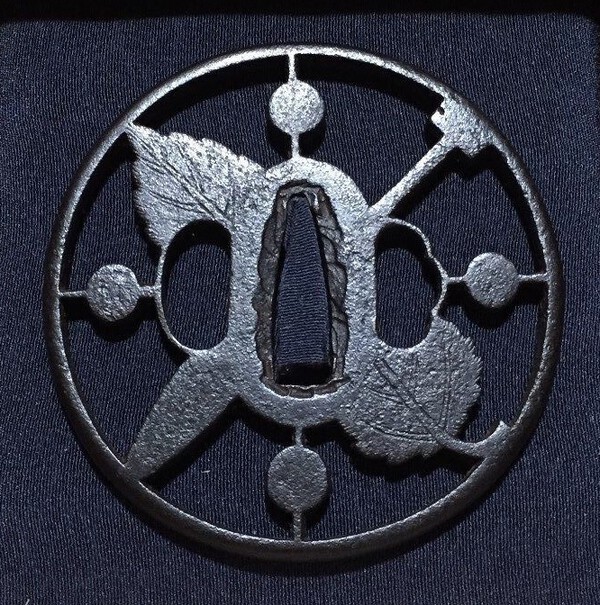
Thanks Arnold - I like your interpretation. A horizontal (falling leaves) and a vertical (moving paddle) movement make sense - like the movements of stars and planets as seen from earth. But I somehow believe this to be a very „Western“ interpretation of the subject. I was wondering whether or not there is a Japanese legend/saying/play which contains all elements seen on the tsuba. Best, Chris
-
Hi Arnold, you have to take several points into consideration: - the dimensions (I did not give away these in my first post because they are rather irrelevant for interpreting the subject) are 7.8 cm x 0.5 cm; you will find these dimensions on many Ko Shoami tsuba; - the rather elongated shape of the hitsu and in particular the shape of the kogai-ana; - the treatment of the surface (difficult to see on pictures); - the color and quality of the iron (even more difficult to see on pictures); - the shape of the rim: kaku mimi; - the piece is mumei; and last but not least: the design which brings us back to my original request ... Best, Chris
-
Dear all, I own a Muromachi/Momoyama-period Ko-Shoami tsuba with design of one paddle (kai), one oak leaf (shirakashi) and four stars/dots - does this ring a bell with someone? Would be interesting to hear an interpretation of this rather uncommon subject/combination of objects. Thanks and kind regards, Chris
-
SOLD




