Ford Hallam
-
Posts
3,091 -
Joined
-
Days Won
78
Content Type
Profiles
Forums
Events
Store
Downloads
Gallery
Everything posted by Ford Hallam
-
No problem Lorenzo, just trying to keep things clear. The peacock tsuba by Yoshioka Inabanosuke is, in my opinion, mainly kinkeshi zogan. The beak, feet and the wire outline of the seppa-dai are true inlay though. So that makes a good example of the technique. Also, with regard to the term Keshikomi zogan, I think the implied meaning of the kanji for "Komi" being to fill up or drive in etc, really adds to the understanding of the term. I would propose we use this term; kin keshikomi zogan to designate the use of mercury amalgam to fill engraved lines and dots and the more common gilding application to simply give a surface coating; kin-keshi
-
While it is possible to dissolve copper in mercury I very much doubt that it could be usefully applied in the same way that gold and silver is. I say this because in Japanese metalwork the copper would then be patinated and mercury based process lays down a layer of metal that is very porous and grainy. Silver and gold is burnished smooth or given a texture after it is applied. If you were to follow the same procedure with copper it would be practically impossible to create a perfectly smooth and oxide free surface (gold and silver don't form oxides as readily as copper and they aren't patinated either), which is a prerequisite for achieving a good solid colour. The example you mention (page 117, item 69 by Sano Naoteru), Lorenzo, is described as " red tinted copper and gold" but I didn't see any reference to kinkeshikomi nor red gold. In fact I've only ever, and then very rarely, seen red gold on late Meiji period work. From what I can see the description is accurate in saying it is flush inlay (Hira-zogan, or more correctly; hira sen-zogan) of 2 colours of gold (achieved by varying the purity of the alloys) and red patinated copper. For what it's worth, I also think the horse on the kashira that is shown from the front is a poorly drawn image...all the arguments about perspective, foreshortening and equine pedigree aside...a knock kneed pony is a dodgy ride :lol:
-
Hi Ted, yes, that's basically what I was getting at. The technique as used in the Americas by the pre-Columbian peoples is called depletion gilding. One of the more common gold alloys found naturally, particularly in those parts, was electrum. Essentially a 50/50 mix of silver and gold. Cementation...or depletion gilding would leach out the silver and thus leave the surface gold rich.
-
I described the basic technique a while ago here but here's the gist of it; I'll be adding the name you quoted, Rich, to my glossary...thanks :D I have serious doubts about etching the ground metal away the leave the gold in relief though. An etched surface is never very even and in addition the alloy would be selectively removed as the gold component would resist the action of the acid. Also, in order to patinate shakudo it's essential to polish the surface in such a thorough way so as to completely remove any oxides as they inhibit the development of the black colour that I can't see this suggestion of etching would be practical.
-

HI to every one from Smith Forge
Ford Hallam replied to Smith Forge's topic in General Nihonto Related Discussion
John, not to continue a pissing contest but I think the intent of some of the responses to your initial posts was misunderstood by yourself. You said you can defend yourself which implies that you felt yourself under attack...in fact many of us here felt this statement of yours; was, I think, the issue...and could be seen as an attempt to minimise the very significant differences in terms of absolute artistry in steel. I think it would be very misleading to try and see any sort of equivalence between Japanese art swords and Western style Japanese Blades. Ted's post sums up the matter very well. Perhaps some of us were a little harsh but to be honest if we're trying promoting an understanding of the highest standards of this art form we have to be constantly aware of uninformed opinion that may blur those standards. I understand that you are now not too well disposed to many of the people who have " welcomed" you aboard but to be honest I also think that your riposte will perhaps be something of an obstacle to learning anything of substance in this field. As with any art form, there is a wealth of very well informed, and hard won expert opinion that makes up the general body of knowledge and understanding. This is not always absolutely fixed and is under constant review and challenge. Those "opinions" that hold up to scrutiny remain while less well considered ideas are replaced by better explanations. There are certain "facts" to be had, of course, but they are less useful in isolation than when considered within the context of the whole subject....opinions and all :D Good luck, Ford -
HI to every one from Smith Forge
Ford Hallam replied to Smith Forge's topic in General Nihonto Related Discussion
nah...I'm not ...it's everyone else who's anal I'm just a pedant :D -
HI to every one from Smith Forge
Ford Hallam replied to Smith Forge's topic in General Nihonto Related Discussion
Hi John, and welcome to the forum . The term Nihonto is applied, very tightly, to all traditionally made Japanese swords...these criteria do not include the age of the blade, only he material and method of production. You['ll find most of our more experienced and seasoned members here to be less than tolerant of anything less than those standards...and for good reason . As you seem well aware, there is a world of difference between what we generally recognise as true Nihonto and blades inspired by that tradition. Personal appreciation of any particular blade in alternative "traditions" will have to remain a personal preference, like an appreciation of country music ...here, the standards of what constitute absolute quality in this field is not easily challenged So you'll not be surprised to discover that this statement will be considered irrelevant here....the opinion expressed has no qualification when considered against the greatest of Japanese Art Swords. It merely serves to demonstrate a profound lack of understanding of the "real thing". I almost want to apologise for this apparently harsh and abrupt "welcome" :? but after sensing Jacques immediate expression of concern I felt a need to support his sentiments...however he chose to express them so no apologies here Never the less, you may find us a fairly amiable bunch...most of the time :D regards, Ford -
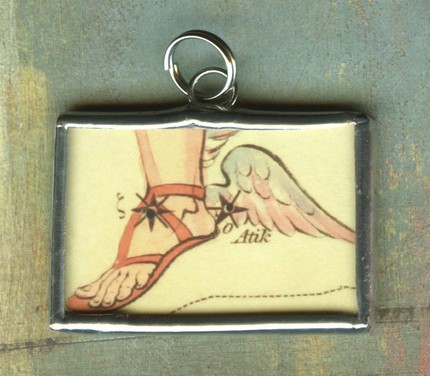
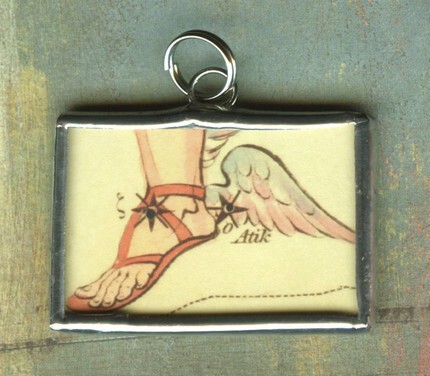
wings of de feet?
-
Why has no one bought this?
Ford Hallam replied to SwordGuyJoe's topic in Auctions and Online Sales or Sellers
Cheers Nariuszk, I didn't bother to study the description ... ...that simply won't do! ...We expect buffalo horn regards, Ford -
Why has no one bought this?
Ford Hallam replied to SwordGuyJoe's topic in Auctions and Online Sales or Sellers
Cheers, Henk yes, that the evidence I would cite...the only thing missing is the poorly shaped kissaki It's just too dodgy to risk money on based only on these images...just my opinion, and hoping to save certain cheque books regards, Ford -
Chicago show
Ford Hallam replied to Rich S's topic in Sword Shows, Events, Community News and Legislation Issues
Hi Barry, It sounds as though the Yamakichibei lecture would have been right up my street :D I'm sure many of us would love to read a write up or article on the subject...any chance you might persuade Mr Kirpatrick to get his theory published? regards, Ford -
It's a tricky one...that for sure :D I'm with Ian and Rich on this one. I also see no obvious clues that suggest casting. As John Stuart pointed out, I also think the rounder punch marks around the nakago ana are "after the fact". My guess would be quite recent, to allow fitting to a remounted sword. There appears to be some recent filing having been done in the nakago-ana that would support that idea. It may be completely subjective but I get a subtle sense of some sort of layering in the inner faces of the cut out areas. This has suffered some serious corrosion in the past but has been quite thoroughly cleaned of loose rust...I can see some patches of bare metal too, so I suspect some sort of chemical treatment was perhaps used. It actually makes me think of badly rusted steel that has been scrubbed with a wire brush. Still butt ugly though regards, Ford
-
Why has no one bought this?
Ford Hallam replied to SwordGuyJoe's topic in Auctions and Online Sales or Sellers
A couple of observations; the nakago has one of the worst fake patinas I've ever seen on a blade. It actually looks like it was painted on :D . The shirasaya doesn't convince me that it was made by a professional. The wood looks as though it has been sanded smooth. A big no no on shirasaya but if you don't have the skill to finish with a small Japanese hand plane what options do you have The wood doesn't look like magnolia either. The habaki has a very unusual colour...perhaps to make it look older than it really is. The kissaki of the blade is not very well shaped... The blade itself seems reasonably well made however I have a niggling suspicion it may be the work of an American smith...clever bugger that or an older genuine blade (although somewhat nondescript) that has had some "cosmetic" work done to make it appear more attractive. Whatever the truth of my suggestions the fact remains that the nakago has a fake patina on it.....so walk away quickly btw, I wasn't suggesting that if it is an new blade that's been messed with that the original maker did the messing...some other unscrupulous person has simply been a little creative shall we say? -
dang! that's an ugly baby
-
As someone trained both in the European jewellery tradition and classical Japanese methods I want to emphasise this point Reinhard makes; Jewellers shouldn't be allowed anywhere near tosogu
-
$120 for back issues of the NBTHK journals...crikey! I'm sitting on a fortune :D . If anyone's interested I can offer then at $100 each oops...just noticed that's for 12 issues I'd very strongly recommend this one though; http://cgi.ebay.com/Japanese-SWORD-COLO ... aultDomain I mentioned it yesterday on the thread about Onin/Heanjo tsuba. The range of tsuba shown is excellent, the quality of the images is very good and all in colour, and the actual examples are all superb. I can't remember what I paid for mine but that price might be considered a bit pricey...especially with such high shipping costs added. I'd imagine it's a lot cheaper in Japan, Y4000 seems about right to me.
-
For professional reasons I hesitated to comment on this thread earlier...I'd hate to think anyone would see it as me trying to drum up work The whole issue of restoration is quite a complex one, in my opinion. I don't believe there are any absolutes but I would very strongly agree with most of the views expressed here that things are best left alone. As Brian rightly points out though, active rust is something we would all agree is a matter to be dealt with so as to limit any further damage. There are though, in my experience, occasions where more intervention can be justified. I think we'd all shudder in horror at the thought of reapplying gold foil to the worn areas on a Momoyama period shakudo tsuba. Even though this could actually be done invisibly. We have come to appreciate the venerable look of age...because we're all quite refined people here, arn't we?:D ...not like the philistines who like everything all bling bling On the other hand, some years ago, I did a little job for a major auction house in London ( which will remain nameless, to protect me from being sued ) that required the creation and inlaying of a tiny gold spiral into a beautiful shakudo tsuba by quite a big name. I've seen it since and I can't even see which bit it was that I replaced. Before though, there was an awful pink, gaping scar where the original inlay had fallen out. I feel absolutely confidant that had the maker been available he'd have popped it back with no hesitation. I feel as though I was simply acting on his behalf . My point being, each piece can be considered on it's own merits and having done that the options available to you in terms of actual restoration can be considered. The biggest problem though, will be to find someone reliable enough to do the work...and honest enough to decline to task if they are not up to doing it perfectly. So on balance I come back to advising, as does everyone here, that things are generally best left alone.
-
cheers, Richard I really appreciate everyone's patience and consideration of many of the rather challenging points I've made. I absolutely agree with you here, Richard, but let it not be said by the next generation that we weren't up to the task of seriously and diligently evaluating what we believe. This forum makes possible a debate that would have been unimaginable 20 years ago...and as John ( Stuart) said earlier, this is NMB at it's best Regards, Ford
-
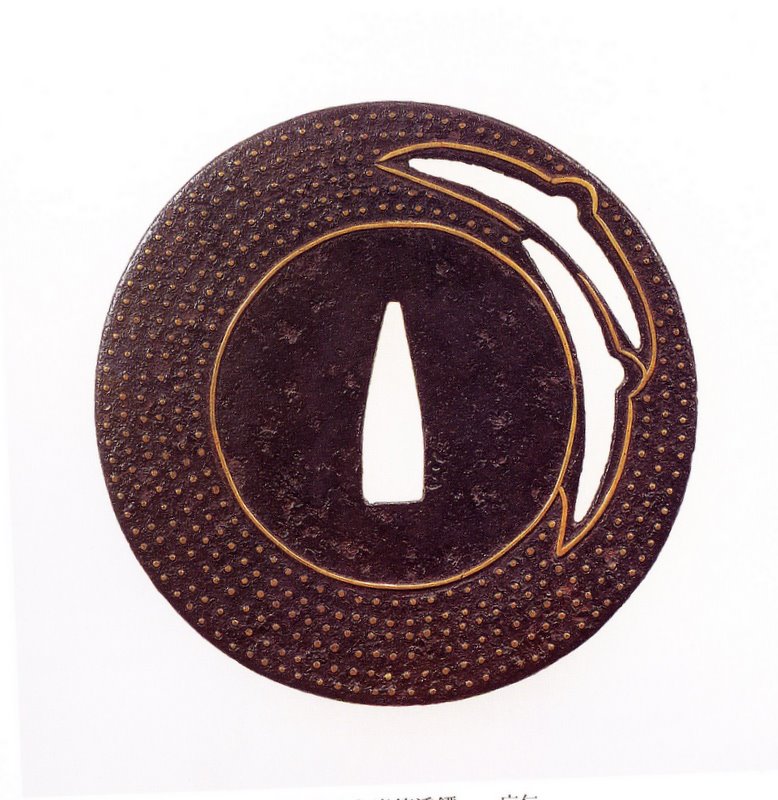
...and just to be mischievous here's a classic Ko-Tosho tsuba ( early Muromachi)from Tosogu no Kansho looks just like an Onin guard before it's decoration was applied. Could it be that the first Onin guards were just early tosho tsuba that got pimped in the period of the Onin wars? All this brass inlay was probably shiny when new too. :D But as some of you already know I have my doubts about he whole tosho / katchushi designation anyway. Looking at the early examples presented in either of the catalogues I've mentioned it seems pretty obvious to this metalworker that we are simply seeing a clear evolution of technique and style. The labels we use may be handy to distinguish particular early types but I think we need to keep in mind these are retro-fitted labels. I think tsuba makers have always been a dedicated group of artisans who met a huge demand for their wares. I simply don't buy the idea that swordsmiths and armour makers had time to moonlight on accessories. The technical "evidence" offered in the tsuba themselves ( ie, hammered rim or not, the look of the steel and the degree of piercing) is not at all convincing, it's only vaguely circumstantial and hardly constitutes any evidence at all. btw, it's a public holiday here in SA...that's why I've got time on my hands...he he, and the devil makes work for idle hands

-
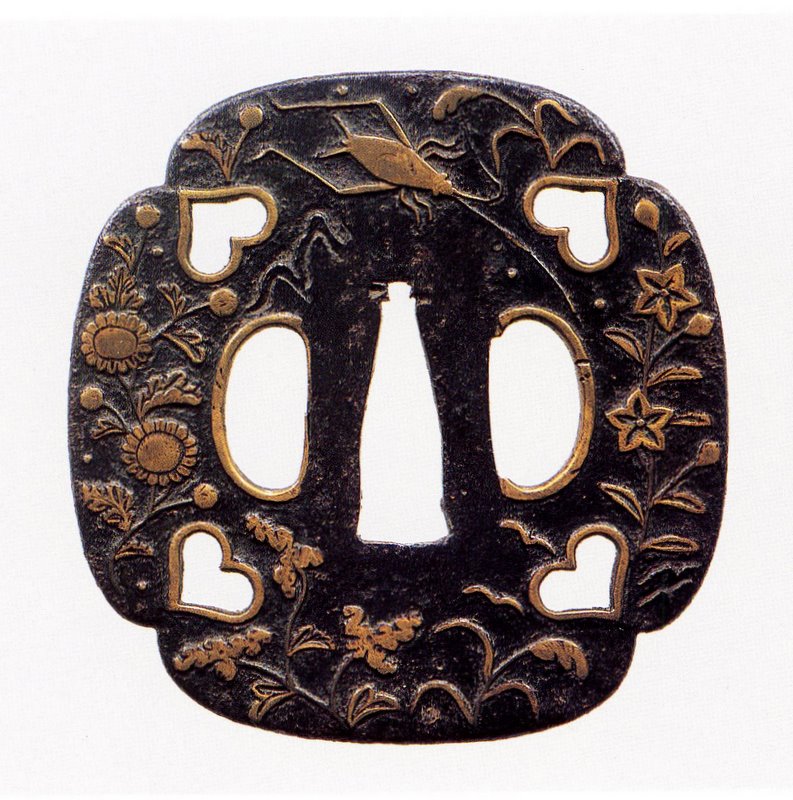
Hi John, thanks...and welcome to the heretic club :D To be honest I don't know that the apparent colour differences are that reliable at all. I made the suggestion almost in passing as a possible reason but as we can't actually be certain yet where the material come from, who made it or even why the composition changed...we can only guess. Specific analysis' of selected representative examples would help establish some parameters but even there there are bound to be variations. As regards the whole Onin / Heanjo classification I would suggest that the early dot and wire inlay work that characterises the classic Onin guard is well establish and pretty secure. The classic Heianjo tsuba with ducks, mon, leaves scrolls etc...and on a courser steel ground compared to the Onin steel plate is also quite distinguishable. It seem to me that there are some pieces that seem to be transitional works and the problem then arises when collectors need to put them in one or another category. I think attempts to find various esoteric minutiae by which we can distinguish them will always be flawed because we would be attempting to reverse engineer labels and categories where in fact none existed. Hi Bob, your suggestion that it might be possible to melt the alloy directly into a prepared cavity is, I think, quite possible. In effect it would be no different to brazing onto steel. The problem would arise when you need to keep the metal contained and tidy. This process you describe is actually very similar to the way sahari tsuba were created. It's a bit like champleve enamelling but in those cases the excess is simply filed away and the inlay is level with the ground, not raised. Also, the evidence does show that the actual inlay pieces are often made up of more than one piece so ruling out an in situ melt approach. Just to put some images up for those who may not be particularly familiar with these guards here are 2 fairly classic examples. Both assessed as being Muromachi period. The images come from an exhibition catalogue of sukashi tsuba dating from the Kofun period to the Edo period. This was held in 1999 at the Sano Art Museum and contained many National treasures, Important Cultural Property and Important Art Objects. Probably the finest exhibition of it's kind ever assembled. Onin Heanjo


-
Hi Richard, that's a perfect example of the sue-mon technique I was describing. I know the term you mention; Karakuri-dome . It's not incorrect at all, merely a alternative label. My point was merely to indicate that calling large, slightly raised areas of inlay suemon was a misunderstanding of that term. btw, I've been admiring and enjoying the newer images you have on you blog of tsuba, particularly the angled views from the side. Marcus, thanks for looking at the original Japanese text for us. I have long wondered how closely the translation follows the original text. In this case quite accurately it seems. For me this makes it easier to pin point the origin of this odd, and unsubstantiated theory re; cast inlay pieces. I think also that you're absolutely right when you point out the very real need for us to reassess received wisdom like this. Unlike many aspects of this study of ours this particular question can in fact be settled convincing and scientifically. When metal is cast is solidifies with a characteristic " as cast" grain structure. In the case of brass type alloys this is very distinct and actually quite visible to the naked eye. Chances are you've perhaps seen this effect. If you take a moment to examine cast brass door handles...particularly older ones on public buildings, (unless they've been polished bright ) you may see what appear to be flecks of crystals in the metal surface. These are often quite large, up to 4 or 5mm across.. This effect is called kesho in Japanese and is a defining trait of cast brass and sentoku in particular. The moment the cast metal is worked these grains begin to break down and in reducing a cast ingot of say 10mm thick by the time it's been hammered down to a 1 or 2 mm thick sheet all visible ( to the naked eye) crystal structure will have been obliterated. The different internal structures of these 2 phases of the alloy are very different and can quite easily be seen in microscopic images of the etched metal. I doubt that anyone will volunteer an Onin guard so we could remove some inlay and examine it in this way but never the less you'd expect to see at least some hint of "as cast" grain structure in these pieces of inlay in the same way you can see it on cast door handles....if they had been cast. Anyway, this is a lot of work to discredit a theory that has no basis for it's claim anyway :D I like to see some evidence for that claim....other than "it says so in the Bible"....I mean the aesthetic study"
-
Hi John, thank you for considering my comments ...let me add to my argument against the "cast inlay pieces" theory. When looking at these Onin guards I find no visual clues at all to indicate the inlay was pre-cast. I assume the author of that suggestion was the writer, or translator of "Tsuba, an aesthetic study." I quote; " The cast pieces have a smooth appearance on the surface" In fact anyone who has ever actually cast brass will tell you it tends to need a fair bit of work to render it smooth. As cast surfaces will also exhibit porosity...especially brass. The surface of these inlays has been smoothed with scrapers, as with any type of inlay, and then polished with nagura stones and charcoal. "There are no sharp edges as might be found on carved inlay, though occasionally a few chisel marks may be made on the pre-cast piece after insertion in the plate" As I already wrote, removing sharp edges from inlays in not difficult. Rather one has to take care not to round the edges of any carving one wants to keep crisp. He then goes on to claim that all the parts of the decoration, thin lines, roped borders and even dots are made from cast pieces. The last, the dot inlay ( ten-zogan) is particularly absurd as this would probably be the most awkward way of inlaying dots When casting pieces like small and thin bits of inlay you have 2 options available to you. Either making the shapes in wax first, encasing the wax models in clay or similar mould making material, melting out the wax and then pouring in the molten metal. The technical difficulties inherent in successfully casting thin sections of brass, even in modern workshops, would suggest that this option highly unlikely. The other option is to cast the metal into open moulds. Here we are faced with a similar problem though. Molten metal doesn't level out nice a thin and flat in a shallow mould. Surface tension ensure that the cast metal will tend to form useless blobs rather than obligingly filling the desired form. So I think this option is also a non-starter. But my main objection to this theory is that there is no need of it. It seems to to have been dreamed up by someone who had absolutely no practical knowledge of basic metalwork technique. It's the sort of comment I've heard from visitors to my own studio when they see how things are actually made. People simply assume metal is easily poured into moulds and there you have it...the finished piece. I wish! :D While I'm dealing with this section I want also to mention the use of the term suemon zogan. In the TES this is described as broad, raised areas of inlay. This is incorrect. Sue actually refers to a small post and mon in this case is the word we use to denote the piece to be inlaid. (Mon-gane) Suemon is correctly applied to appliqué type work and can't really be called true zogan ( inlay) Some early kozuka show this technique. You'll recognise it when you can see that the main decorative element is actually resting on top of the nanako ground and not set into the plate. It is held in place by means of the previous mentioned post. This passes through the plate and either glued in place or the post bent over. The technique was also common on Meiji period vases.
-
Hi John ( the good doctor ) I'm intrigued by the 2 points you cite with reference to differentiating between late Onin and early Heinjō-zōgan tsuba. Specifically the claim that the inlay on Onin guards was pre-cast and the difference in colour of shinchu allegedly indicating the place of origin; ie Chinese or local production. It think it speculative to try and use something like colour, which is so easily altered by any number of external factors and conditions, as a definitive kantei point. While it's true that the composition of an alloy has a major effect on the patina colour we must accept that with items as old as these sorts of tsuba the colours that may have developed may be very misleading. It may also be of interest to consider the following extract from the Wakan san-sai zue, an encyclopaedia published in 1716. It apparently drew heavily on a original Chinese text. "It seems that shinchu is made with do (copper). This method was not known in ancient times; it started recently ( mid Edo period?) and is still not very refined. For this reason imported Shinchu from China is used. Nowadays many fine things are made using it and it is always called shinchu. The recipe is one kin of copper, one third of that quantity of zinc and one third of that ( ie, the zinc ) quantity of lead. The vulgar name is Kara-shinchu. If you decrease the proportion of zinc the resulting metal is softer." This would seem to suggest that early Heinjō-zōgan tsuba-shi were quite possibly also using imported shinchu. I would suggest that the colour differences ( and these are often quite clear ) came about as a result of the need for the Heianjo makers to remelt their alloy to create a more malleable metal more suited for wire inlay. Remelting shinchu would result in an inevitable loss of zinc, and probably also lead. This could plausibly explain the colour change. I should also note that the actual composition given in that excerpt seems unlikely to me, the 33% zinc is commonly found in modern commercial brass but 16 or 17% lead doesn't feel right to me at all. I've had analysis' done of shinchu used by Yasuchika I and II...both yellowish coloured and warmer ochre coloured ones. None had more than 15% of zinc and the lead, if present, was less than 2 %. Incidentally, my own recreations of these alloys indicates that the small amount of lead is what turns the alloy from the yellowish tones and gives it a more ochre colour. Shinchu appears in print again in the Manpozenshu, another encyclopaedia, this one published in 1755. This time it's called Namban shinchu and it use described as " for metal decorations" A final thought regarding the casting of shinchu. Molten brass liberates a great deal of the zinc as it's highly volatile (and toxic) so recast metal would be a different composition from the imported material. Apart from the fact that I can't see any great advantage to pre-casting the decoration it would appear to somewhat problematic too. The whole notion that the decoration on Onin guards was cast really needs to be seriously reconsidered. Frankly, I find the idea quite improbable and unnecessary. ...and this is me being reserved with my opinion regards, Ford
-
:D trust you, Jacques, to find hole in my cunning attempt to undermine the whole tosho/katchushi classification...still, perhaps you have help me blur the distinction even more
-
Hi John...sorry to have ended the game too soon...I'll think up another I'm absolutely with you on the Musashi idea. It was in fact his brushwork that first got me thinking about his real spirit. It's very powerful yet quite unaffected...what I like to call uncontrived, something that for me is the mark of a sublime artist. How that may have translated into a sword made by him is an idea that is quite excite to ponder. After all, his version of the sea cucumber design tsuba is very distinctive and subtle in it's shaping... regards, ford