Ford Hallam
-
Posts
3,091 -
Joined
-
Days Won
78
Content Type
Profiles
Forums
Events
Store
Downloads
Gallery
Everything posted by Ford Hallam
-
Marc I hope you'll forgive me using your various comment and observations to illustrate more specifically the pitfalls I've described in my previous post. Your point about the extent of the preparatory ground crosshatching is incorrect, I'm afraid. Your apparent misunderstanding stems, I imagine, from your belief that wherever there is/was crosshatching then it would follow that originally there was gold attached there. You assert; "...it seems clear that what remains of the gilding is a very partial rendition of the craftsman's intent." This reveals your fundamental misunderstanding the process. In fact it would be common practice to cut an area somewhat bigger than the desired eventual gold application. Even the gold foil, when initially lightly applied (before the final fully securing) is a little bigger than the final outline. The rough shape is tacked in place and then carefully cut out with a scalpel-like tool (mawashi-kiri) and the excess peeled away, leaving only the precise shape as required. The foil is then properly secured and burnished smooth, obliterating the crosshatching seen in the un-worn gold, and the surrounding iron ground. In time, as the gold is worn away through handling, the underlying crosshatching becomes visible and the gilding takes on the appearance we easily recognise today. We appreciate, today, the suggestion of "wabi-sabi" this worn effect implies but the likelihood is that this isn't what it looked like when new. Sometimes, if you examine this sort of work under a microscope you can still see traces of the scalpel cuts. All this to say that the irregular gold edgings in the Bushu iron tsuba's leaves is deliberate and mostly exactly as the maker intended. Period illustrations of similar designs reveal exactly the same sorts of details, ie; those irregular edgings to the leaves, just as happens in nature, and in Japanese art illustrated to suggest the transience of the beautiful flower even as it blooms. As for the Shakudo tsuba and it's somewhat angular hard edged graphic gilding style , that too is simply yet another an artistic convention. One we see in many woodblock prints and period painting of certain schools.
-
One way to gain a little context with respect to what we might think an artist or craftsman of the past intended with their work is to study the paintings and drawing of the time and to read about the sorts of aesthetic considerations that were important to those people. The art of tosogu cannot be understood or appreciated in a vacuum. It's been suggested that the past is a foreign land...how much more so then when it's old Japan? The greatest error any of us can commit in the study of this subject is to approach it with our modern sensibilities and a mish-mash of Western misconception of what oriental art and philosophy might be. As for interpreting tool marks and the like as a way to try and understand technique I'm afraid that that aspect really is far too complex to be attempted from the comfort of an armchair. The problem here is that writers on tosogu have for far too many years been labouring under the illusion they they actually have a clue as to how these objects were made....consequently a bizarre 'theory' of Japanese metalwork technology has become something of a dogma is this field of study, but it simply doesn't stand up to any real studio, metallurgical or scientific examination.
-
I'd be very interested to learn how mercury amalgam is made to adhere to iron as this would seem to contradict some basic metallurgical principles.... And while it was common practice in Europe to fuse gold foil to highly polished steel (at blueing temperature) or iron the gold used was very thin (thin enough to allow oxygen to diffuse through it in fact), much thinner than we see on tsuba, there is no evidence that this practice was applied in Japan.
-
John, where fire gilding has been used on iron in the western tradition they copper coated prior to the fire gilding. Methods to flash plating with copper were in use long before electroplating was developed.
-
I'll just offer a few observations... Mercury amalgam gilding cannot be applied to iron or steel. This is because the mercury simply won't stick to the iron. This problem can be resolved by first copper plating the iron and then applying the mercury solution to that. As far as my experience goes I've never seen evidence that old tsuba-ko ever did that though. The mercury amalgam, when applied to non-ferrous metals or alloys isn't simply rubbed on the bare metal either. A special solution of mercury dissolved in acid and diluted with water is rubbed on the prepared the ground, a bit like applying a flux, this leaves a thin mercury layer that then readily absorbs the amalgam. A less well known or recognised way of gilding non-ferrous metals and alloys involves fusing, at relatively low temperatures (about 400 degrees C) , thin gold sheet. This is not to be confused with the contemporary Korean technique of Keum Boo. The technique, on tosogu can be recognised where the edge of the gilding really does have a defined edge that you can feel with you fingernail. To my knowledge this process, which appears to be quite common , hasn't properly been defined in tosogu literature nor is it practiced today. It is also distinct from uttori as far as I can detail. With nunome-zogan, as has been described, it can most readily be identified where traces of the chisel work crosshatching shows through the worn gold foil but it's important to realise that simply because you cant see the crosshatching doesn't mean it's not nunome-zogan. The finer work is cut such that by the time the iron is patinated the marks are invisible to the naked eye.
-
Chris, with only your drawing to go by I can't say for certain but it sounds to me what has happened with your example is that the inlay patch has simply become loose over the years and now easily falls out as the lip that held it secure perhaps corroded away.
-
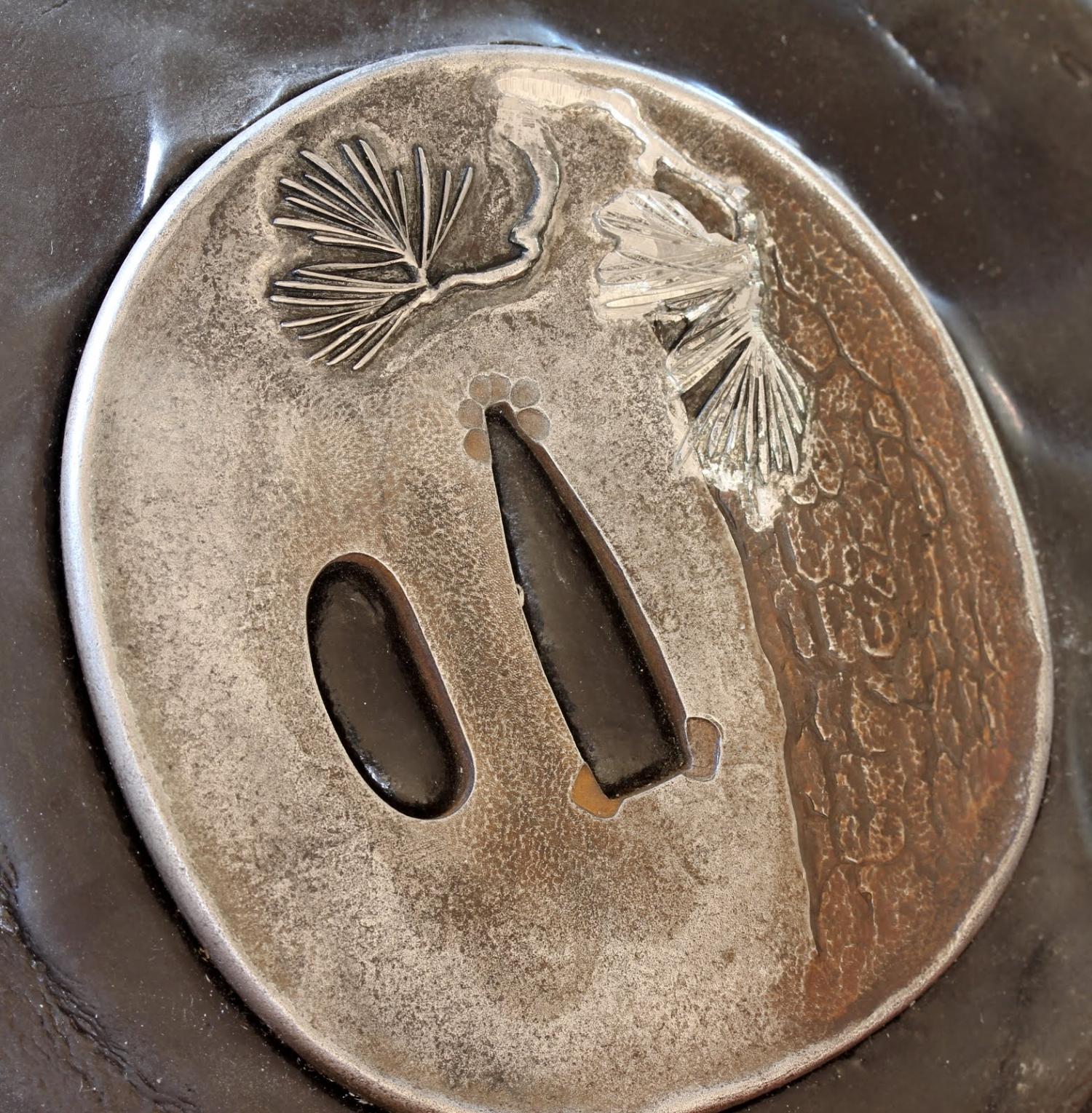
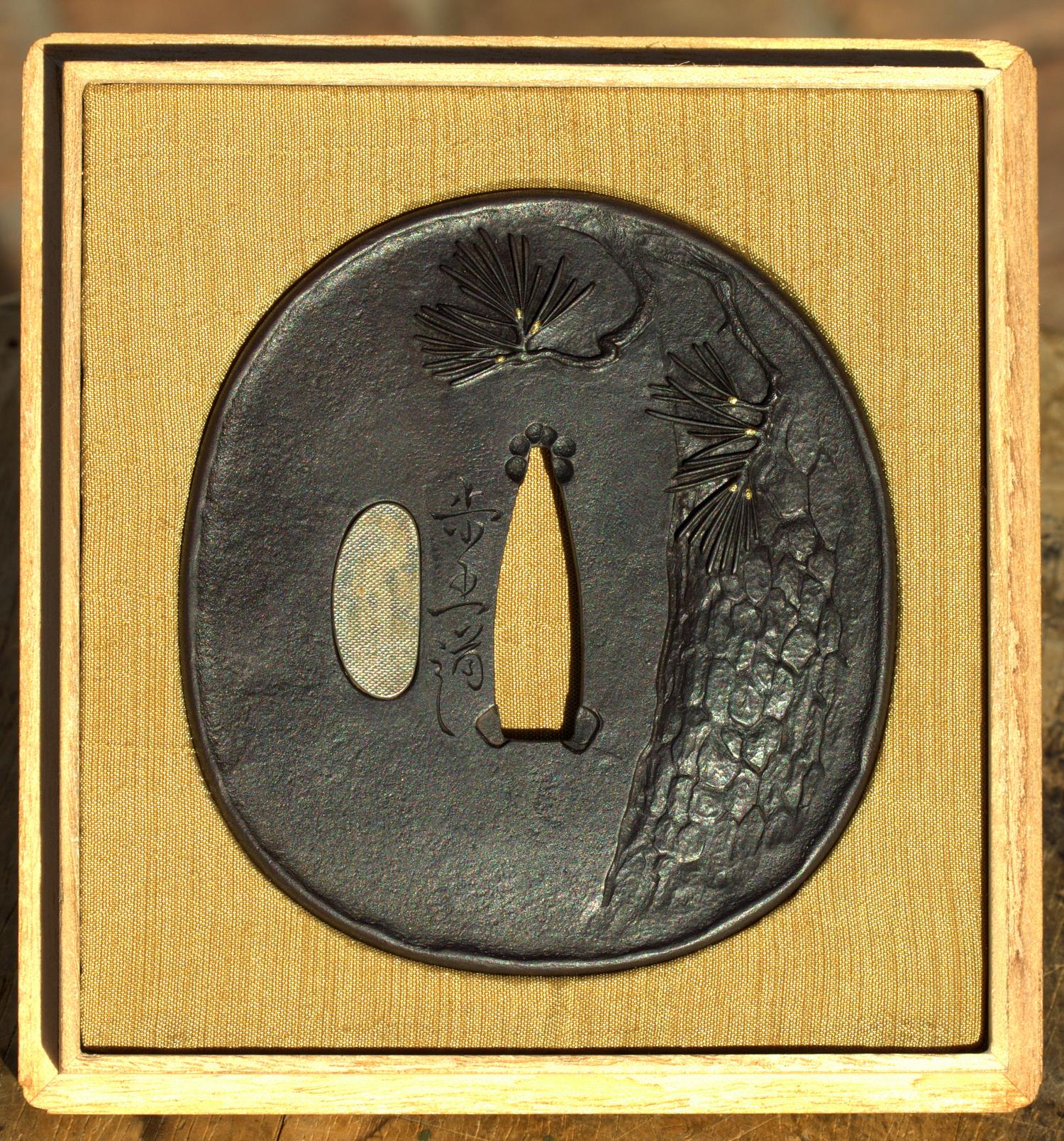
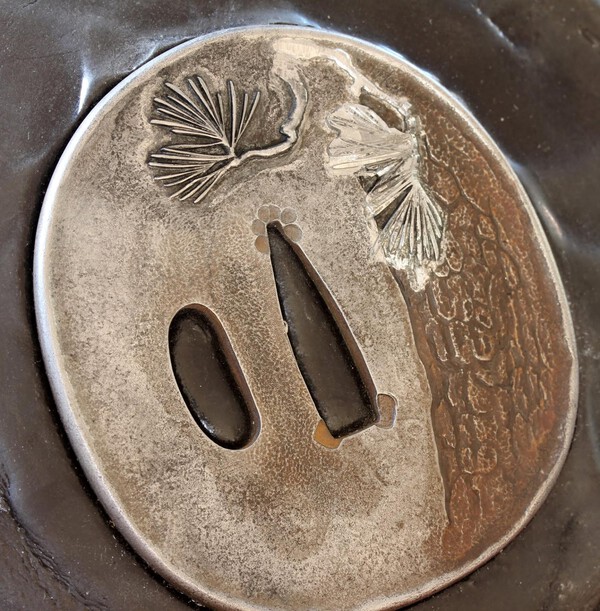
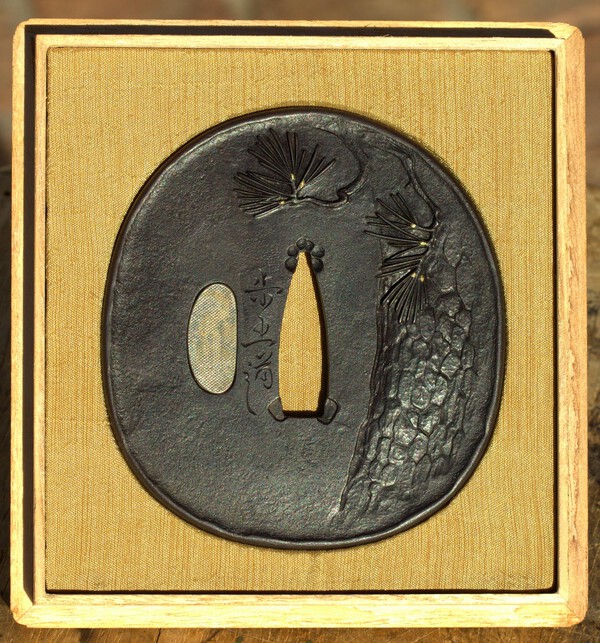
Sorry Gents, I do try to keep an eye on posts here, but as Brian suggested sometimes work gets in the way...or my hands are knackered and I cant be arsed to hit the keyboard The technical issue you're describing, Bruno, was pretty much the standard approach used by tsuba makers in the past to create extra height or volume in the ground metal. As has been already said iron isn't really all that hard when it comes to carving or pushing the metal around so that inlaying pieces of iron into an iron ground really is very simple. In fact I use the same approach quite a bit myself. Inlaying a piece a bit bigger than the final form needed is also very sensible because it means you can carve to exactly the shape you want and not be limited from the outset by a specific shape that has already been decided and cut out. In the image below you might be able to see where I inlaid two oversized iron pieces where I wanted the pine needles to be. The more completed group has a clear outline where you can see I've worked the join in to hide the seam. The other group is in this image is not so far in terms of defining the needles but you can see the larger patch I set in and how I've outlined the needles. The excess iron was then simply carved away to leave the fine cluster neatly separated and appearing to lie on the undisturbed iron ground. ...and what can't easily be seen in the photo is that the centre of the pine tree's trunk also has a section added in that it allowed me to create some volume and a feeling of roundness up beyond the level of the base plate of iron.
-
I please everyone enjoyed this little investigation and came away entertained and a little wiser What I find interesting is that this piece was evidently made specifically for the new year's festivities and as such would probably only have been worn on that day. It was probably not a cheap piece to commission so it was intended to make quite the status statement. It would then have been unlikely to have been worn after that day (until the next year perhaps) because that would have suggested that the wearer couldn't afford a more appropriately themed piece and made him look very unfashionable and inelegant.
-
Hi Piers, pretty good on all the lesser details but the main decorative objects seems to have been a little obscure. This from Wikipedia, Kubo Shunman 19th cent. Hama-yumi (the bow) and Buriburi-Gitcho, Boy's toys for the New year celebration.

-
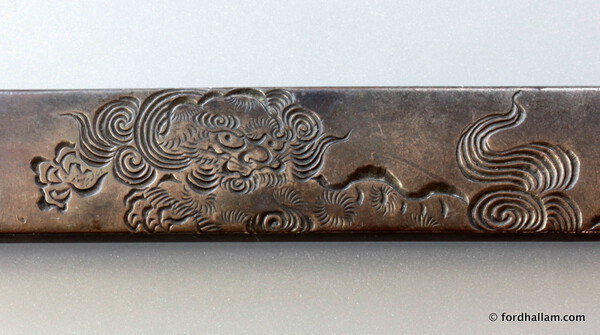
no other takers...? well the style/genre of carving is certainly that developed by the Yokoya school under Somin I ( 2nd Yokoya master), the actual painting style the katakiri work was based on was that of the artist Hanabusa Itcho, a close friend and teacher of Somin. But this piece is in fact the work of a Yokoya student, Furukawa Genchin. He studied under Somin and adopted his style, albeit with a touch of his own style in there. The Furukawa school that followed from him included his son, grandson and a number of of others. I suppose the lesson learned might be that while this classic style of kata-kiri derives from the Yokoya it's worth remembering that after Genchin there was at least on other school well versed in the style.
-
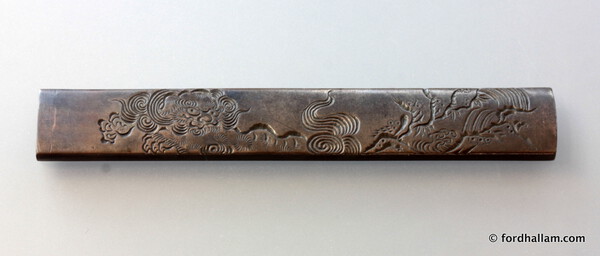
A little something to start the new year and perhaps dust out the festive cobwebs. The school association ought to be pretty obvious but who, exactly, did this chiselling? Double click to see larger images. I'll post the mei tomorrow.
-
The term solid gold is bandied about far too easily imo. By definition solid gold would suggest 24 ct. ie. pure gold. If there are any other alloying elements present, copper, silver or zinc, then the mass of metal isn't solid gold anymore. Further, Japanese metalsmiths were expert at manipulating the surface of gold alloys to enrich then so as to create a finish that might appear to be a purer alloy than it might actually be. So judging an alloy's composition from colour alone may not be all that reliable. The habaki is question could as easily be a 50% brass (1/3rd zinc) and gold alloy or a gold and 20% silver alloy. And Franco, a 22ct gold alloy contains 91.7% fine gold.
-
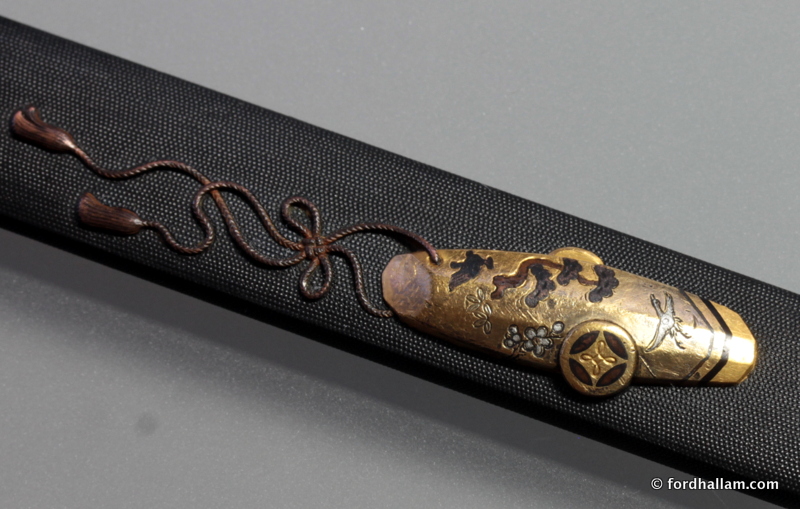
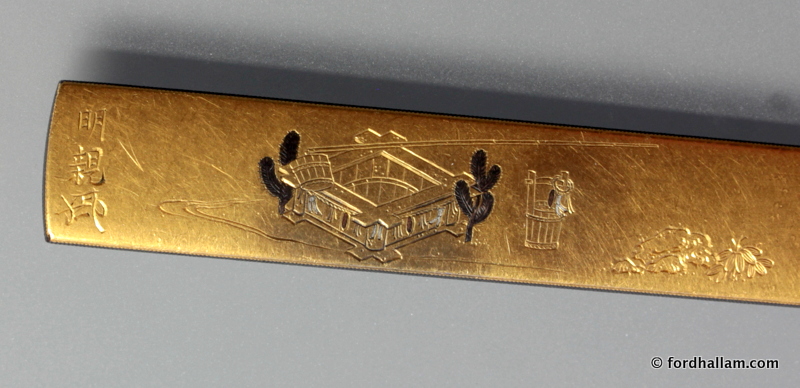
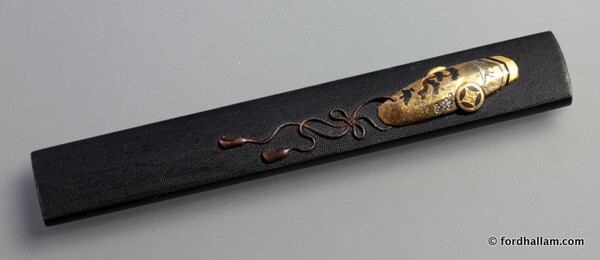
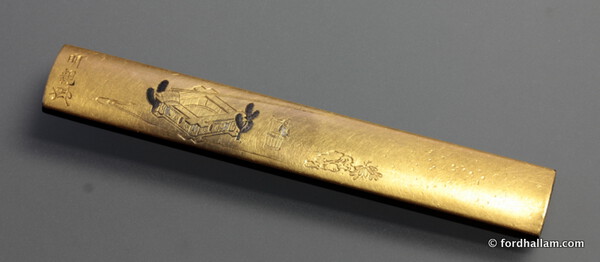
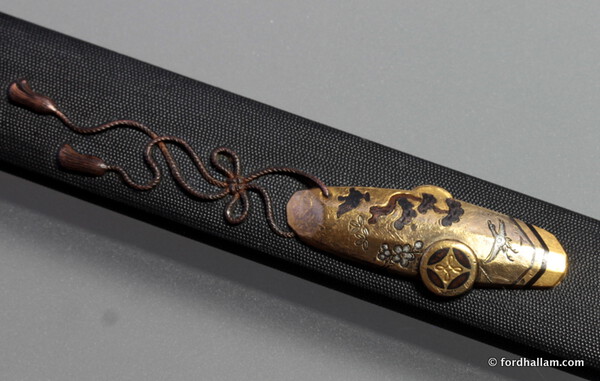
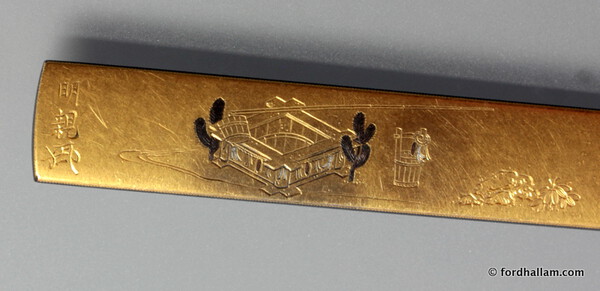
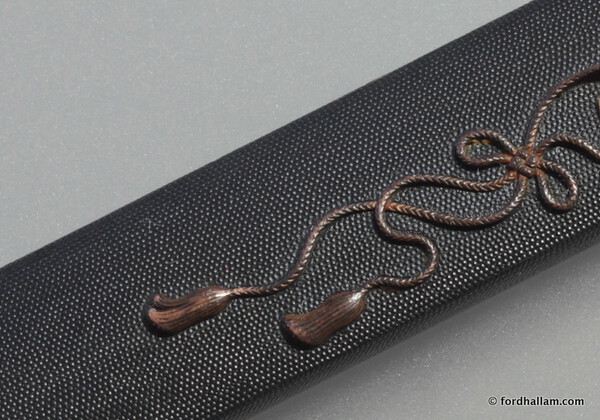
This is a Kono school kozuka that was evidently made to celebrate the New Year. The artist is Akichika, he was a direct student of the celebrated Kono Haruaki Hogen. This is pretty decent work so the question is can you identify all of the elements of the design that allude to the new Year celebration? Some are obvious, other perhaps less so. Double click the images to see larger versions. And a very happy new year to you all.
-
Hi Brian it's carved, but if you the look at the actual technical skill in evidence you might begin to notice many awkward spots and 'missteps'. The nakago-ana itself, is poorly shaped too. Overall it's a fair attempt at classical work using traditional tools. I see evident of the maker having used a hisage ( a scraper) to smooth the craved surface. In the stems and tendrils, in a few spots there are little ripples left, this tells me the maker wasn't completely proficient in the hisage's use. Used heavy-handedly it will leave chatter marks, those ripples I see.
-
Sorry to be the nay-sayer but to my eyes this looks like a fairly modern piece. It's clearly emulating one of the Choshu groups in style, as Curran pointed out, but it's not the work of a professional Edo period tsuba-ko in my opinion. The design itself is interesting for the fact that it isn't really typical for the Choshu group the actual technique is attempting to copy. The design feels more like something we see on certain types of Heian-jo brass inlay works.
-
Probably worth remembering that the first 4 generations of the Yasuchika school all used the same two kanji in their mei.
-
The only way a restored patina on shakudo can be detected is if the pre-clean/polish of the worn area is not carried out sensitively. The most common mistake I see in this respect is a too hard or shiny polish that is at odds with the soft and subtly aged old surface.
-
I reckon Henry is dead right. Pounding powdered clay with an apparatus like this is still fairly common in many pottery producing areas of Japan today. Although many are water wheel style driven.
-
very very soon. put it this way, i have other big projects for next spring
-
yaki- namashi means annealing...the lead removal thing is nonsense. the rest is too muddled to correct without writing a page or two...but you can all read everything soon.
-
Perhaps using google as ones first point of reference with respect to the esoterica of classical Japanese metalworking technology is not an entirely robust strategy But far from it for me to lecture anyone I merely asked for some clarification on an assertion I found to be at odds with the hard data of scientific analysis. I have little interest in opinions at this point only substantiated and verifiable data. regards and night night fh
-
In the wider art world any one who attempted to create a false comparisons between, say, the water colours of Turner and the use of oil paint by Rembrandt would be regarded as naive at best, and a Philistine at worst. Similarly evaluating van Gogh in reference to Constable makes no sense at all. I find it disappointing that in the world of tosogu appreciation this self evident observation is'nt appreciated with regard to the many different styles and genre of kinko and tanko work.
-
Sounds like it might be a Hizen (Hirado) work.
-
Hi Curran I'm intrigued to learn where this point comes from, Do you have a reference, please? thanks Ford
-
.