Geraint
-
Posts
3,128 -
Joined
-
Last visited
-
Days Won
10
Content Type
Profiles
Forums
Events
Store
Downloads
Gallery
Everything posted by Geraint
-
Dear Uwe. Yes, it's an education making a habaki isn't it? Just one suggestion, perhaps a little fuller toward the base of the habaki? Keep at it. All the best.
-
Dear Jason. So you have an ubu mumei katana with an extended kissaki. Tell us what you can see, the photographs don't do much good. What about any sign of yakidashi? What does the boshi do? What is the hamon and any activities you can see? How about the nakago, what can you see there? From your study what time periods would you expect to see a katana of that nagasa with an extended kissaki? Looking forward to seeing where this one goes. All the best.
-
Dear Rob. My suggestion above was based on the memory of a written account which recorded that on a very few occasions Japanese officers were asked to go through surrendered swords to pick out the better ones. It is hard to account for the well written kanji otherwise as this would not have been done on a sword when carried, I think. While some Japanese troops were employed by the allies after the end of hostilities to combat local insurgencies I would guess the newspaper, dated in English, would be a post war addition, possibly by the service man who had acquired the sword. It's a nice thing and interesting to surmise but we will never know. All the best.
-
Of course this is just conjecture but I wonder if this is the result of a Japanese officer being asked to sort through a pile of swords at the end of the war and identify those of interest? I have never come across this before and find it interesting. (Only one coffee into the day myself!) All the best.
-
Dear Grev, I agree with Sebastien, the photograph does the mei no favours, coupled with some corrosion. It looks as if the image has been cropped and enlarged a little too much. The overall images do not suggest a cast tsuba to me. All the best.
-
Sword auction in Paris
Geraint replied to PietroParis's topic in Auctions and Online Sales or Sellers
Well the prices realised are up and there are a few surprises. Lot 5 for example. I imagine both the vendors and the auctioneers are very satisfied! All the best. -
Dear Aliaksandr. This is an out and out fake. If you look at the mei you should be bale to see that it is not cut or chiselled in any way. Other indicators are the surface finish, the muddy feel of the faces and the piece of Shoki's hat that crosses the seppa dai. All the best.
-
Dear Chris. This photo is of the end of the tsuka that fits into the fuchi. The fuchi is the metal collar that fits around this. Nice sword by the way. All the best.
-
My understanding is that these are two different themes, the first well cover and the later abalone drying racks, as with so many designs a variety of interpretations would work. I have handled one example of the first design and it was quite thin, I think Satsuma would usually be a thicker plate. All the best.
-
Dear James. I think it's a sweetie! As you say it needs some sensitive restoration which is going to cost you however I really like the look of the blade and would go for it if it was within my reach. Let us know how it turns out. All the best.
-
Dear Dale. An interesting group, some of which I guess will have to end up as generic. However number 5 might be Kumagai, compare here, http://www.nihonto.us/HIGO JINGO 2 LD.htm You don't indicate thickness but if thin number 2 might be an early plate with later decorative additions. 16 Echizen Kinai? I am sure others will have ideas for you. All the best.
-
Dear Jeremy. This is not a Japanese sword, as Jean has suggested. No point trying to make kanji fit. All the best.
-
Dear Bob. Oh , how I wish that were true! That part just jumped out from the photograph. By the way another lovely tsuba. I love the positive/negative aspect of the design. All the best.
-
Dear Bob. Have I missed something? This one is also signed Echizen ju. No? All the best.
-
Dear Steve. As you say you have embarked on a lifelong journey of discovery and learning, this sword will give you plenty to work on. It's in polish so you will be able to see what the sword has to offer and as everyone else has said the koshirae is very nice. One observation is that with three seppa it is possible that at some time the tsuba has been swapped out, the present one looks like a sanmai tsuba, something to look into when it arrives. Enjoy the moment of opening the parcel! All the best.
-
Dear Bob. This set, https://tokka.biz/fittings/FK207.html The description would suggest that the phrase references the design rather than shape of the tsuba or artist. Love it by the way. (And I don't think I have ever seen a winged tiger either.) All the best.
-
Dear P. Some more information here. https://www.japaneseswordindex.com/tsuba/sanmai.htm All the best.
-
Dear Grev. I think in this context it means something like, "Take your hand away from your wallet, take it away quickly and no one gets hurt!" All the best.
-
Dear Johan. OK, I'll bite. The lack of response may be because you are seeking meaning where none exists. Dating a saya such as this is almost meaningless, the only useful guide is that good black lacquer takes on a deep brown tinge over time. Japanese lacquer at it's best is stunning. At the other end of the scale it is tawdry. The quality of the work on the example you post is not great, I do not think that can be accounted for by wear. The weed is quickly done and without great precision, the fish are delineated crudely and the octopus looks like it has been out of the water for rather too long. To summarise, the quality of the decoration is low. There is the possibility that this was a perfectly plain saya that has received the attentions of someone trying to tempt the Gaijin in the late 19th century or early 20th. This idea would be supported by the rather nice horn fittings. All the best.
-
Dear Jason. In this case trust your eyes. All the best.
-
Dear Dan. You are basically correct, tachi would be signed on the opposite side if not shortened. In effect this is a katana in tachi koshirae. The style of koshirae is not uncommon and is generally suggested to be for Imperial celebrations at the very end of the 19th century or the start of the 20th. The fittings are usually brass, engraved with floral designs and often silver plated. Here's another example. All the best.
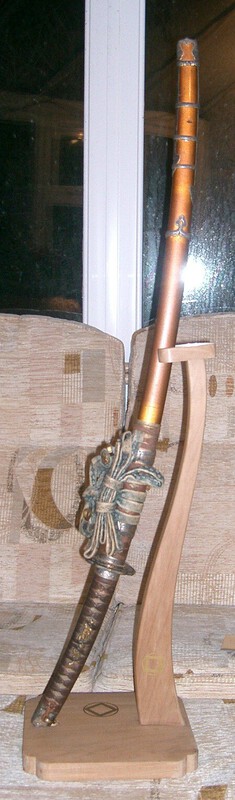
-
Dear Jayden. Your first to picture show the swordsmiths signature which is Tsuda Omi no kami Sukenao. The other side is the date which I can't quite make out. This is a big name and there is a probability that this signature will not be genuine. However don't do anything in the way of cleaning at all and take a few more pictures for others to asses. Whatever the consensus this is a genuine Japanese sword and deserves looking after. One to compare here, you can see why I suggested a fake signature, http://www.samuraisword.com/nihonto/Hozon/Sukenao/index.htm All the best.
-
Need help with identifying this sword
Geraint replied to John Barry's topic in Military Swords of Japan
Dear Barry. Nice kaigunto. Photographs of the entire nakago, both sides would help. All the best. -
Help identifying inherited sword
Geraint replied to MillstoneBoroVintage's topic in Translation Assistance
Dear Danielle. Your sword is signed, "Kazusa no Suke Fujiwara Kaneshige". This is a smith named Kaneshige who was working around 1660, there are two possible smiths. As with all art works the possibility of a forged signature exists but I don't think it likely in this case. It is in samurai mounts and although we can't see much detail they look attractive. You don't give a length, which is measured from the tip to the notch on the back edge where the habaki, (blade collar) sits, but I am guessing that it is katana length, i.e. 24" plus. It's a nice thing and should be cared for. It looks in quite good condition. Do not do anything to it, very important. Don't be tempted to clean the tang or anything else, it is just as it should be. Above all don't touch the blade with your bare hands. There may be a member of the NMB who is near you who can give you a hands on appraisal but most of us would like to see a shot of the bare blade without the fittings. All the best. -
Dear Dale. For what it is worth I see too many differences for these to be called a daisho, apart from the base material and the seppa dai design. e.g. detail of the tail at one o'clock, carving of the mimi, detail of the dragon head at 12 o'clock, sinuosity of the tail at 9 o'clock and so forth. I would suggest that the kinko version is a pale imitation of the quality of the iron example. Not all daisho koshirae have what we might call a true daisho pair of tsuba. I can recall a daisho where the smaller tsuba was a lacquered pair to the larger which clearly had been done when the daisho koshirae was produced. I think you are right when you suggest utsushi or what in other circles might be called school of. All the best.