paulb
-
Posts
3,046 -
Joined
-
Last visited
-
Days Won
73
Content Type
Profiles
Forums
Events
Store
Downloads
Gallery
Everything posted by paulb
-
I carry a pocket knife too. But there is little excuse for carrying a butcher's knife, machete or " night stealth death dagger" in a UK Town. All of which have been taken from teenage gang members at various times
-
Thank you Jussi for an interesting example. First and foremost your initial point that papers are an attribution is absolutely right and worth re-emphasising. An attribution, especially on a mumei blade is an opinion, albeit a very learned one but it is not a statement of fact. I took a very long time to take that on board when I started studying. Regarding the example you have illustrated (which I would love to see in hand) I have listed some thoughts below. 1. I believe that Enju work at its best is as good or better than much Yamashiro Rai work. I mentioned this in the recent post on the Norikuni blade. The jigane especially is beautiful and a very tight and consistent ko-itame which would rival Rai Kunimitsu and Rai Kunitoshi. 2. Awataguchi work is best known for an even tighter hada, nashiji which is a degree smaller, more nie covered and consistent than Rai or Enju. However a number of Awataguchi smiths including Kuniyasu and later Kuniyoshi also produced work which combined nashiji with a more open itame. 3. Kuniyoshi was one of the most prolific of the Awataguchi smiths. He was thought to be the son of Norikuni and Father or elder Brother of Yoshimitsu. My perception is that his work while still of a very high standard did not reach the same level as either his father or his son/brother. Kuniyoshi was also working at the same time as the earlier generations of the Enju school who were recreating Yamashiro work with smiths such as Kuniyasu, Kunitoki and Kunisuke all working in the first quarter of the 14th century. So here we have a mumei sword of undoubtedly high quality and Yamashiro influence dating from the last quarter of the Kamakura period. The initial assessment perhaps being a little conservative opted for Enju. On reflection when looking t it the second group either felt the quality was slightly better or that some of the features didn't fit the original attribution. For example the boshi in this blade is ko-maru where a major kantei point for Enju is that they were predominantly O-maru. This being the case they moved the attribution from being the best of Enju (my statement not theirs) to being the work of a lower tier (again my opinion not theirs) Awataguchi work. What this does illustrate I think is that what we should look at is the sword. Regardless of the period, school or tradition is it well made and of high quality. In this case the answer is yes the attribution and to some extent the level of papering is less important, although it will of course have a dramatic commercial implication. First and foremost it is a beautiful thing. Another example i remember but unfortunately have no mages of was a sword being sold by a Japanese dealer. In his description he stated that "the blade was originally attributed to Ichimonji but on resubmission it was reappraised as Edo Ishido, which is unfortunate" Again the sword hasn't changed but the change of attribution probably halved the coomercial value. Thanks Jussi food for thought in an area i spend a lot of time studying
-
Yes it was there Jussi. Interestingly it generated far less interest than some of the other blades there. I think the quiet conservative nature of the blade takes a lot of looking at to fully start to appreciate (it took me quite a while to get my eyes focused on what was there) but it was well worth the effort. Something touching 800 years old and in pretty much perfect condition and a quality level unsurpassed since. But yes I am very biased
-
Many thanks Koichi-san I have passed your answer on to the person who is investigating the sword.
-
Hi Steve, Many thanks for your help I will pass it on to the person who sent me the image. I am sorry I don't have any other images but I will see if I can obtain some I appreciate your help Best Regards Paul
-
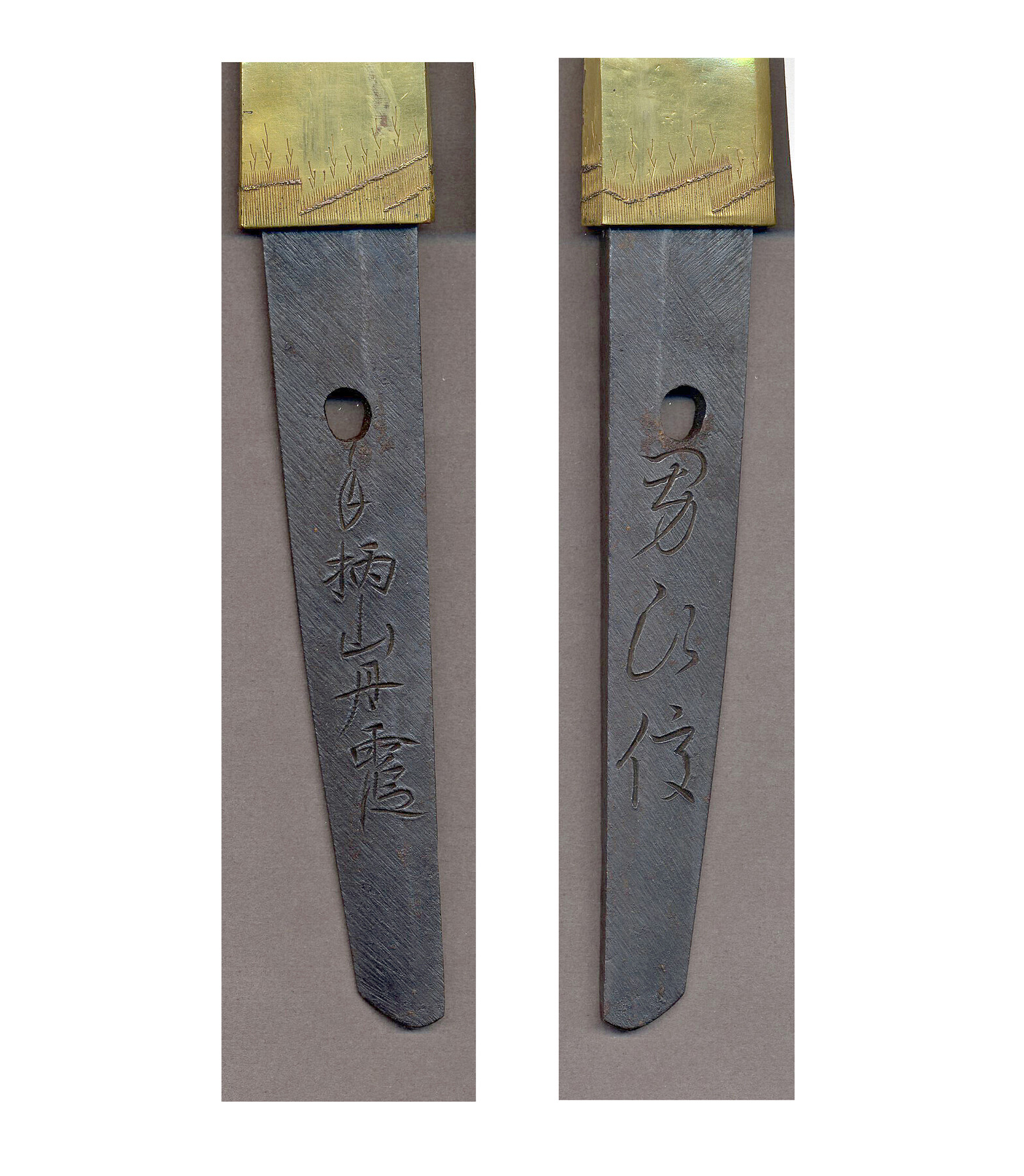
I am the first to admit that my translating abilities are poor at best but I think for this one I have reasonable excuse. Can anyone help decipher the image below please?

-
Once again thank you all for your input. The blade is attributed to Awataguchi Norikuni who is recorded as working between 1219 nd 1222. He was believed to be the son of Kunitomo and the Father or grandfather of perhaps the greatest maker of Tanto Yoshimitsu. He is also listed as one of the resident smiths of the Emperor Go-Toba. I think this points out how difficult it can be to assess a blade from images. Most misleading of all was the nakago which as John pointed out looks red n the image. Two things one it is O-suriage so it is possible the tang could look less black then the age might suggest because the patination has had less time to develop on the newly formed nakago. In this case it has more to do with the lighting for the photograph. In hand the nakago is a deep rich black. The shape is rather slender and if you try and imagine the ubu sugata it would have had a relatively strong koshi-sori and the overall shape slender and refined. it also has an ikubi kissaki. Almost everyone picked up on the very tight ko-itame hada as all the suggestions were for schools that created this in varying degrees .However Awataguchi smiths took this to a whole new level. The hada comprises of a minute ko-itame, known as Nashiji and covered in very fine and bright ji-nie. When I first saw the Enju blade illustrated I said the hada was so fine it might be considered Awataguchi. Then I saw the Norikuni and realised how wrong I was. Nashiji is a whole level finer than anything else. On occasion works by smiths such as Kunimitsu and Kuniyasu can also include a nagare element and o-itame, but it is this very fine nashiji that makes Awataguchi work unique (at least in my opinion) well done all who answered , all picked up on some elements which led to the strong Yamashiro association. Interestingly no-one got the date of manufacture which I think shows one of the issues is trying to date an O-suriage work.
- 25 replies
-
- 11
-

-

-
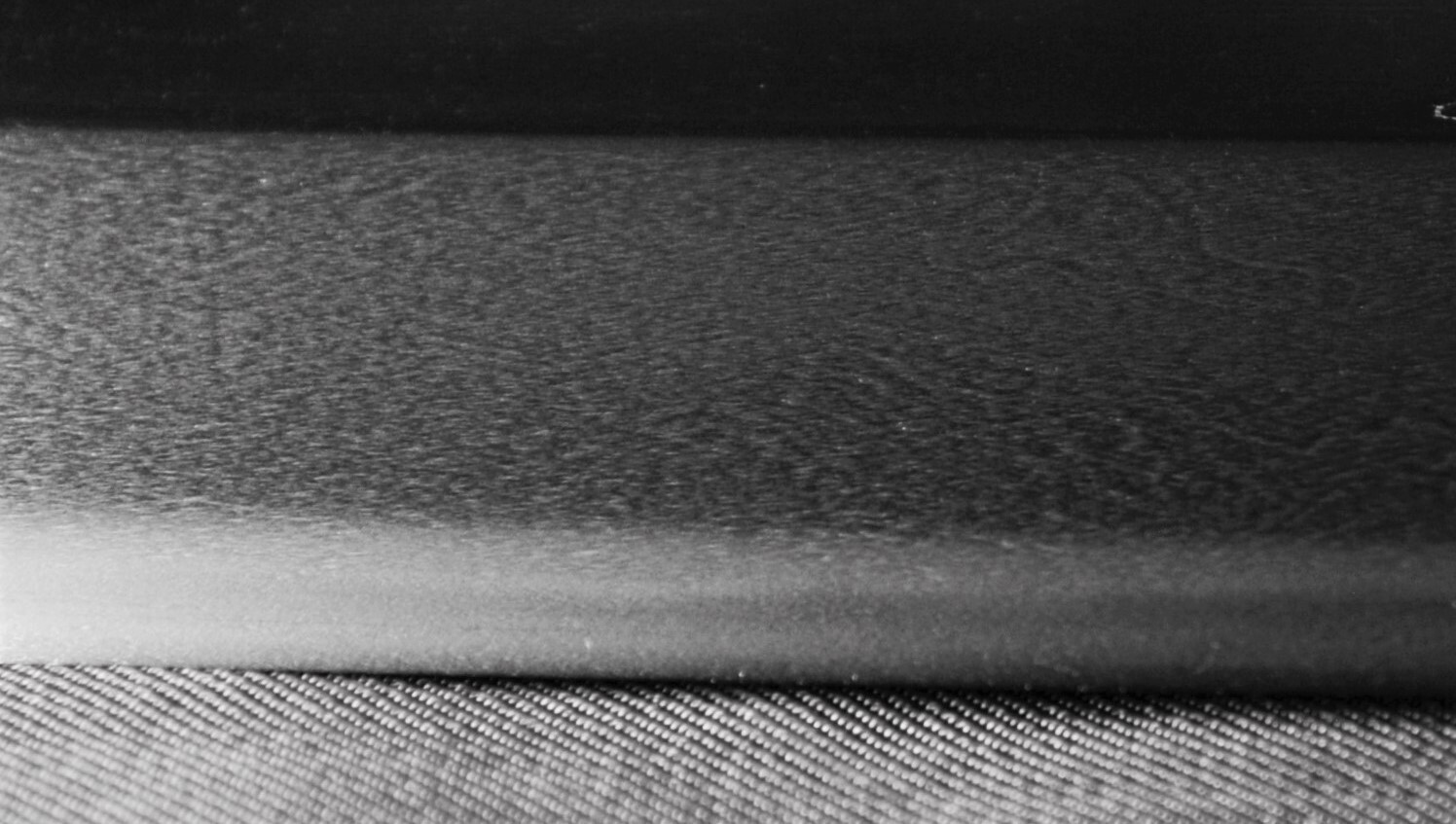
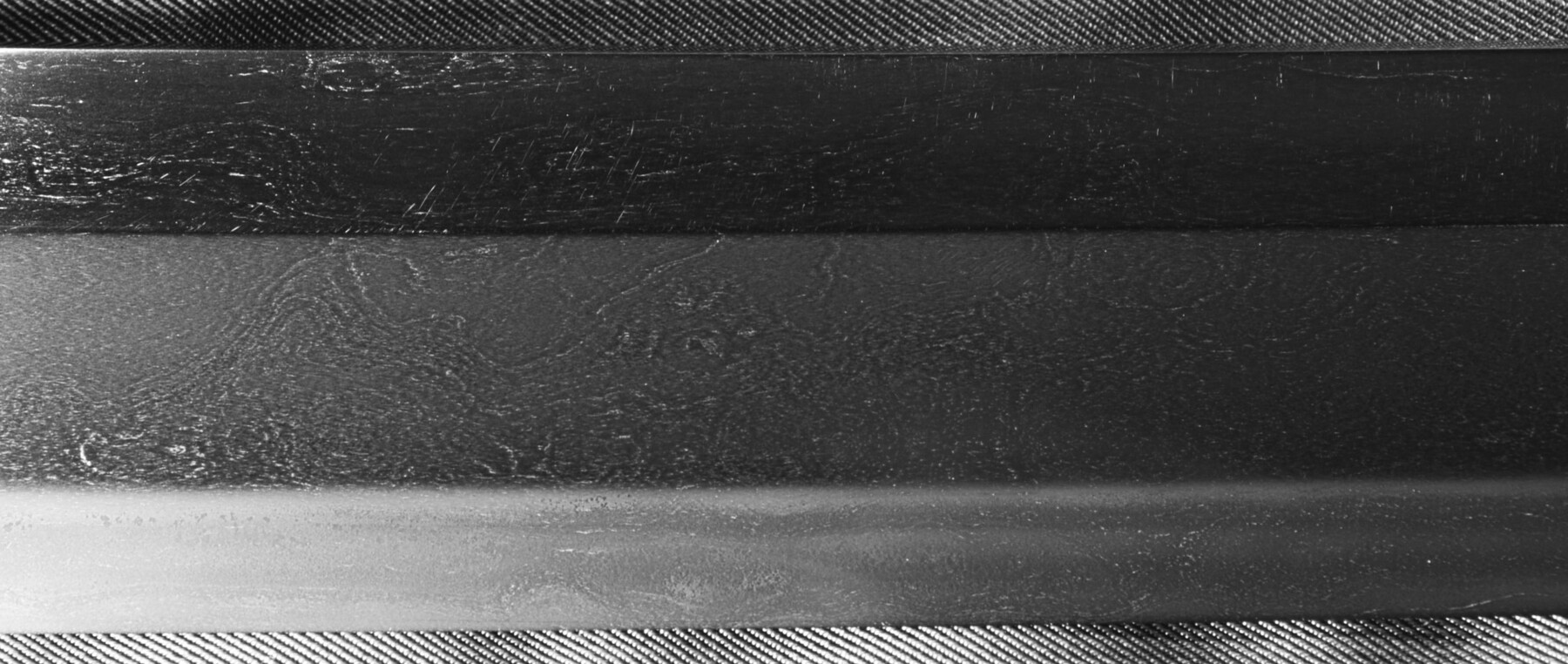
Thank you for taking the time to respond. The answers show a level of consistency i.e. Yamashiro or Yamashiro influenced (Rai Enju, Aoe and Hizen) Date-wise late Kamakura or Nambokucho seem favoured but I am not sure why. Dimensionally this blade lacks the grand sugata that would automatically lead you to Nambokucho. I will leave it for a bit longer but below I have added some examples of Rai/Enju, Aoe and Hizen hada for comparison. Rai/Enju Ko-itame hada Aoe Chirimen hada Hizen Konuka hada
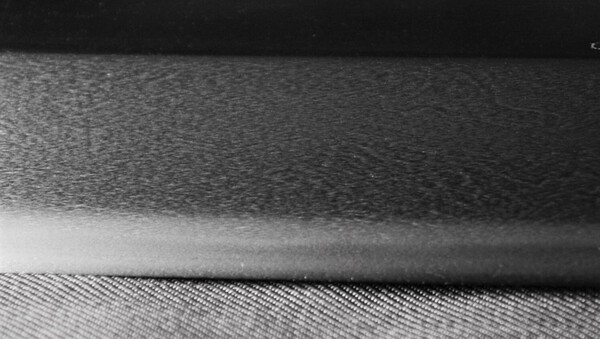

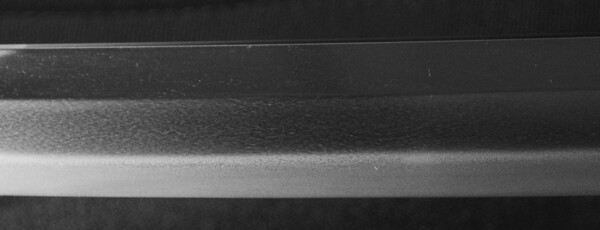
-
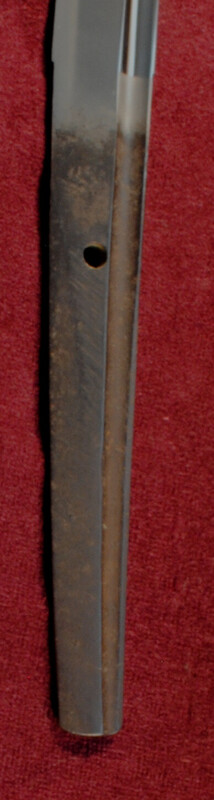
The inabilty to hold physical meetings over the past twelve months has meant it hasn't been possible to look at and study swords not previously seen. I was trawling through some images and cme across this one. Just for fun take a look and see if, based on what little you can see you can suggest a date for it and possible tradition/school. details: Sugata 68.5cm sori 1.8cm motohaba 2.5cm sakihaba 1.8cm kasane 0.5cm It is O-suriage.

.thumb.JPG.03e5ac611096c18f9701be9a517bcf18.JPG)
.thumb.JPG.56bc1a1dd75b158f6c4e6172509fec0a.JPG)
-
Don't worry JP this wasn't related to your post
-
Customs wait for antique arriving in UK
paulb replied to shanegt's topic in General Nihonto Related Discussion
I am a bit out of date so it may have changed but normally in the past customs pass the item to the carrier with the charges and the carrier asked for payment before scheduling delivery. -
Customs wait for antique arriving in UK
paulb replied to shanegt's topic in General Nihonto Related Discussion
from past experience Parcelforce don't update status until the parcel has left the customs hall and on site in their hub (usually Coventry) -
I think I am in the same camp as Guido and saiha a possibility and that might also explain the very "glassy" finish in the ji-hada. However that could also be the result of a poor polish. The lack of activity in either hada or hamon doesn't suggest it is early, at least to me. If it isn't re-tempered then I would go for an utushi no earlier than Momoyama, but that is a guess based mainly on the shape of the hamon
-
Fantastic piece of work Jussi I really admire your patience!! I have already been scanning it for swords I might have seen
-
if it wasn't thought to legitimate the paper would have been issued.
-
Do Shoshin and Gimei refer to the sword or mei
paulb replied to Freddie's topic in General Nihonto Related Discussion
It would be classed as gimei if the mei was removed it would then paper as a mumei blade by the original Smith. Seen a juyo example a blade signed kuniyasu (awataguchi) when mei was removed it papered to Awataguchi -
some work he did for me a while ago

-
I am not sure why this should have gained a negative reaction on FB (but then again so much does without real justification) But I am of much the same opinion as Brian. You have an authentic, traditionally made blade, dating I would guess from between 1450 and 1550. While not a national treasure it is competently made and appears to be in good condition without obvious flaws. I am no expert in Showa mounts but these appear to be good quality and condition. While I don't think you got a bargain I don't think you paid way over the odds for the sword. It looks to be an honest work and to be honest far better than 90%+ of the first purchases most of us have made in the past
-
Darcy's current tosogu listings
paulb replied to Brian's topic in Auctions and Online Sales or Sellers
Mark, They are best regarded as a piece of art. What distinguishes good fittings from the ordinary is a combination of materials, composition and level of skill. Some of the finest metal workers to exist, not only in Japan but world wide were making the fittings for swords. Take a look at some of the examples here and on websites such as Darcy's and you can see the incredible skill employed in their manufacture. It is much like visiting a gallery of fine paintings. -
Darcy's current tosogu listings
paulb replied to Brian's topic in Auctions and Online Sales or Sellers
I think if you look at some of the top end dealers in Japan you would be surprised at how reasonable Darcy's stuff is in comparison. Certainly with regard to swords, which I am much more comfortable assessing, I have seen Tokyo dealers typically running at 30-40% more than the equivalent on Yuhindo. -
Adam, This is a guide only there are always exceptions. I have seen Rai blades from the 14th century which were nearly 8mm thick. But as always in this type of assessment I tend to be guided by the "norm" the more exceptions to that you see the less likely it is to be what you might hope. For me the nakago, the way the shinogi distorts in it and the colour, combined with the thickness suggest the later date but as always this is only opinion not a statement of fact.
-
I would tend to shin-shinto. Look at the way the shinogi runs in to the nakago it wobbles and if this were an O-suriage Koto piece I think I would expect it to run as a smooth continuation of what's happening in the blade. The patination on the nakago also looks a little superficial and possibly created rather than the result of natural aging. Always difficult from images. One key dimension you need to look at is the thickness. If it is koto I would expect it to be fairly thin (6mm or so) Shin-Shinto more like 7-8mm
-
Forgive me I haven't read all the posts in detail but the basic premise at the start was the view that quality of workmanship decreased as one progressed through a school, i.e. 4th generation wasn't as good as 1st or whatever. In many cases this is true but it is by no means always the case. At the start I believe the original post mentioned nidai Hizen Masahiro, well in most of the texts I have read and the blades I have seen he was regarded as a better smith than his father. Shodai Masahiro was a great teacher but his son the better smith. Likewise second generation Kanesada more highly regarded than others, Sandai Tadayoshi, probably the best and so on. Its true that as manufacture progressed through the Muromachi demand meant quality suffered and therefore later smiths produced fewer great swords than their forefathers but this was due in part to available material and in part to time pressure. It doesn't necessarily mean the smiths were less skilled. Some extremely fine blades were produced by later generation smiths in many schools as always you need to judge the sword in front of you.
-
I think I need glasses for the early morning. The title had me trying to guess why anyone would want to remove a larger herbivore with a Teppo and from where (eyesight or senility not sure which)


.JPG.ba0dfd1dc7e49c71c9bada40b93fe950.JPG)
.JPG.dc28e3c530decf47b51eafa431bf3d9f.JPG)