runagmc
-
Posts
1,198 -
Joined
-
Last visited
Content Type
Profiles
Forums
Events
Store
Downloads
Gallery
Everything posted by runagmc
-
He's just excited... call it wishfull thinking... :lol:
-
Unless they mistakenly put the wrong translation on the e-sword sales page. Normally one would think Yasu when seeing 全, since that's the most common. Mabey they didn't verify the translation.
-
Granit, as I wrote on your other post, there is a Bishu Masamitsu that apparently signed this way, http://nihontoclub.com/smiths/MAS479
-
Thanks guys
-
According to http://www.sho-shin.com/kinju.htm, this horimono is suppose to be "The Four Pillars". What does this refer to? The best answer I could find is the four noble truths of Buddhism, but somehow I don't think that's right. Does anyone know exactly what this is, and can anyone show any more examples of this design?

-
Paper says Oshu/Bishu Masamitsu... or at least, I think that's the translation... I think it may be this smith, http://nihontoclub.com/smiths/MAS479
-
First purchases, Good blades and Bad flaws.
runagmc replied to willy wonka's topic in General Nihonto Related Discussion
If a person can learn something from a particular sword, then for them, it's a study sword. That being said, the higher the quality and level of importance, the more worthy a blade is of serious study by everyone, and therefore more worthy of the label 'study sword'. -
Chris, are you sure? Do you have a reference to a Sekishu Saneyuki? Here's a Sekishu Sadayuki from Oei period... http://nihontoclub.com/smiths/SAD890 If you have pictures of the sword, it may help if you posted them...
-
Google Hizen Tadahiro...
-
Your opinion? koto wakizashi signed and dated
runagmc replied to Drago's topic in Auctions and Online Sales or Sellers
Better term is profile taper. Do a forum search for funbari/fumbari for past discussions about this... -
Why don't you just google the name. You will probably find enough info to keep you busy for a while.
-
First purchases, Good blades and Bad flaws.
runagmc replied to willy wonka's topic in General Nihonto Related Discussion
My first blade was a mumei wakizashi that I paid almost nothing for. In my own assesment, I believe it was a Sue-seki kazuuchi mono. It was in a clear sashikomi polish which displayed proper shape and lines, lots of hataraki, and decent, but somewhat loose mokume/itame hada with masame shinogi. On the sashi ura there were two pretty bad kitae ware. None of the draw backs stopped me from learning alot about how to care for a sword, and what some of the characteristics of Nihonto look like in hand. I also believe that a person should try to step up in quality as they go. -
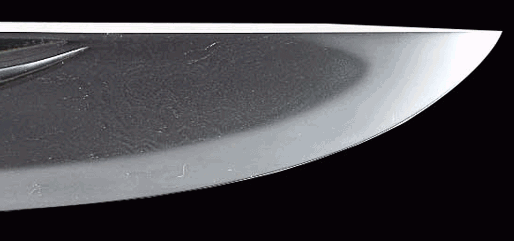
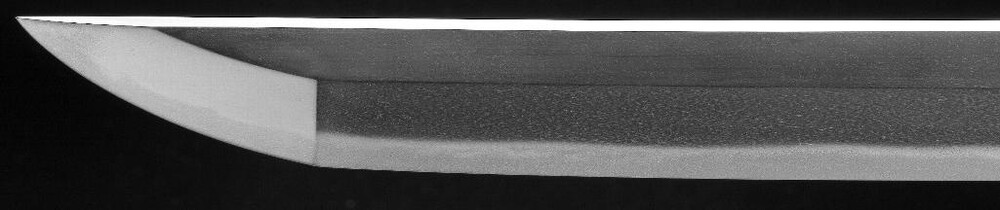
Nashiji hada is mainly identified with early Yamashiro, while konuka hada is mainly identified with Hizento. This blade is most likely a komokume/itame mix that hasn't been brought out very well. Also, the shaping of the kissaki doesn't look so good to me. It looks like the polisher wasn't agressive enough in getting the ko-shinogi right during shitaji (rough pollish). Anyway, all in all it's certainly a big improvement, but hopefully you won't hate me for pointing out some things I see that could've been better, in my opinion. I know it's not easy to post something and hear it criticised, but understand, it's not directed at you. Also, critique of the restoration aside, it is still a very nice inheritance that I'm sure you can appreciate much more now. Thanks a lot for sharing the experience. It has been an interesting post. Here's the best example I could come up with for nashiji hada. It's hard to understand from a picture because the chikei, which is a difining characteristic, is nearly impossible to photograph. Here is an example of konuka hada
-
This sword may be a good canidate for restoration, in my opinion, as long as there aren't any critical flaws visible... hopefully the rust isn't too deep...
-
The way I see it, all naginata naoshi were modified to be carried as either a katana or a wakizashi. The presence of a yokote wouldn't matter. The question is, was this blade originally a naginata that was modified to be a wakizashi (naginata naoshi), or just an uno kubi zukuri wakizashi? And according to what Jacques said, this would be the latter... although the nakago does look modified in the oshigata. Mabey utsushi?
-
Yeah, I use to go to Callaway Gardens a lot when I was a kid, but I havn't been in probably almost 20 years now. Also, my parent's back yard is FULL of pink and white azaleas, and I agree, they are pretty, blooming under the tall pines.
-
Yes, just don't mistake active rust for patina. This should be left to someone who knows what they're doing so it can be PROPERLY done, as Ron says.
-
No, as far as I've always heard there's no way to tell for sure. From what I've read, some smiths probably marketed foreign steels as special rare material, and so it made since for them to make note of it on the nakago. It's impossible to say how consistent they were about it though since, like I said, there's no way to tell just by looking.
-
Newbie Looking for First Katana
runagmc replied to Joeyg's topic in General Nihonto Related Discussion
Thanks for the correction. But an item still has to have Hozon papers before it can get Toku Hozon ones, right? It just doesn't have to have Toku Hozon before Juyo... and, to get to Tokubetsu Juyo it would have to pass Hozon and Juyo shinsa first. It still seems like it would make more sense to give an item the paper that coincided with it's importance of preservation upon the first submition... but mabey there's a good reason for the way they do it. -
Curran, could those be choji rather than daikon? Either way it's a really nice tsuba...Edit-I live in the mid western part of Georgia and sweet tea is a favorite here. Everytime I travel out of the south, I miss it.

-
Newbie Looking for First Katana
runagmc replied to Joeyg's topic in General Nihonto Related Discussion
I agree that you would be able to get a better quality item if you went with something papered to Hozon, for your budget. Just because a sword only has Hozon papers doesn't mean that's the best paper it can receive. Papers can't neccesarily be seen as the final word on a swords quality or collectability. With the NBTHK, you have to re-submit the same sword to get the next level of papers. So, for a sword to get Juyo papers, it has to go through Hozon and Tokubetsu Hozon shinsa first... which I've always thought was kinda ridiculous. I think they should give the sword the highest paper possible at the first submission, and just charge a price according to the level of paper... so the higher the paper the more it would cost. Then collectors would know that what ever paper an item has is the highest it can go at shinsa, and relative to the quality and collectability of the sword. Anyway... enough rambling. You've been given some good advice to get you started. Mainly, don't be in a rush. Patience will pay off in the long run. -
In the tsuba above, I would think the groove cut around the edge would make the inlaying difficult.
-
Help! Does anyone know this nakago signature?
runagmc replied to Romano's topic in Translation Assistance
I don't think this is one we can expect an inexperienced person to get... At first glance I thought Noshu, then I thought Bishu, but now I think it says Sesshu for Settsu province... and the last kanji looks like mabey Ju cut in half... -
Newbie Looking for First Katana
runagmc replied to Joeyg's topic in General Nihonto Related Discussion
There are several Tokubetsu Hozon katana in koshirae and polish in that price range on here. This was just the first site I looked at, so they are out there if you look. http://www.e-sword.jp/newlineup.htm -
need help with tang translation on both sides
runagmc replied to Petersan's topic in Translation Assistance
From what I can tell, it is possible this blade could be from 1791. We would need better pics to be sure...