


runagmc
-
Posts
1,198 -
Joined
-
Last visited
Content Type
Profiles
Forums
Events
Store
Downloads
Gallery
Everything posted by runagmc
-
Stating that you would feel more comfortable with an iron tauba is one thing... stating that tsuba that have never been mounted, or are made of soft metal, don't deserve to be called tsuba but "tsuba like" art is another entirely...
-
Chris, are you saying you think this tribute to Munechika is original to the blade? Like I said, I have seen similar as well, but not on the omote in this position.
-
Keith, what you say is exactly my point, which is why it makes no sense to say funbari can only be found up to the Kamakura era. Last time we had this discussion there were several people who argued that funbari is only seen on ubu Kamakura and older tachi, which doesn't make sense to me. Funbari is just a physical feature that can be made into any blade. I fully agree that it originated and is most common in early tachi, but to say nothing outside of that era can have funbari is wrong to me. Also, funbari is not something that just IS or IS NOT present. It's something that has a range, from none to alot. There can be no funbari, or a little funbari, all the way to very prominent funbari. And I'm talking about abrupt widening at the machi. Anyway, sorry to take the post off track.
-
My understanding is that all kaiken are aikuchi. Kaiken is a specific type of aiguchi mounting.
-
Funny how he mentions the funbari... Many people on this forum have argued that funbari can only be found on Heian and Kamakura tachi...
-
Ed, thanks for posting all these interesting pieces lately to give us something to look at. The tribute on the omote is something I can't remember ever seeing before. I have seen similar on kogatana, obviously, and katakiriha tanto, but always on the ura. I would think the tribute is non-original and done by someone other than the smith... mabey an owner. Most collectors would probably consider this a flaw... similar to a bad horimono. What does everyone else think? I think this blade has what is called a naginata-hi...
-
From what I've read, they kept the kaiken in a bag even when carrying them. If self defense was their purpose, I would think that you would want it to be more easily accessable. It sounds to me like kaiken were a status symbol for women of the samurai class, kind of like the daisho was for men. The reference on jigai was interesting. It sounds like mabey these were kept by women of the samurai class for this purpose as well.
-
Here's some info on kaiken if you haven't seen it, http://www.ksky.ne.jp./~sumie99/kaiken.html
-
Kim, unfortunately it's never that simple. Kanji can be written in different styles and with varying strokes. A good portion of the population in antiquity had minimal reading and writing skills, which is probably one reason you see so many variations. The only way to get good is practice.
-
I have to say, the argument that soft metal tsuba are non functional kinda doesn't make sense when you consider all the ones that WERE mounted, and therefore, must have been considered functional.
-
When you start putting limitations and restrictions on an art form that has nothing to do with raising the quality, it usually impedes the overall level of work. I think tradition is important to remember and follow to a point, but it shouldn't end up being something that stops foward progress. Why do something the "traditional" way if a "modern" way can produce better results? On the other hand, there are many jobs where the traditional way will produce the best results. Notice that either way, achieving the best QUALITY is the final goal. For me, the appreciation of these crafts has always been partly about romanticism, but more about the amazing level of craftsmanship and asthetic... and no nationality has a monopoly on either of those things. All that being said, I understand what Chris is saying, and I think it's going too far to call it rascism. I think people who have the view Chris is talking about may be allowing their interpretation of tradition to cause a slightly biased outlook... and I think they have the right to that outlook in this situation, whether others think it's completely fair or not.
-
Jean, do you have a reputable source for this definition... or are you going on your own personal opinion of what a yoroidoshi is. I basically agree with your definition from what I've seen... I'm just wondering if you have found references that define a yoroidoshi as needing to be hira zukuri and a minimum of 1cm, because I've never seen a reference where it was so strictly defined.
-
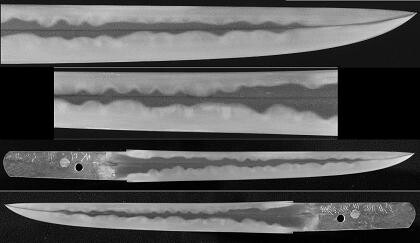
I have seen other blades of this size recently being sold as yoroidoshi, but as I said before, it's a marketing thing. Unfortunatly it causes some confusion. What do you guys think about a moroha zukuri tanto like this... could it be labeled as a yoroidoshi,
-
Ford, I feel your pain. I do portraits in pencil and charcoal, and everytime somebody sees one they get this look of disbelieve and ask me why I don't do it for a living. Simple... it's nearly impossible to make a living as any kind of artist... or traditional craftsman for that matter. With any art or craft traditionally linked to a place, era, or ethinicity, I mainly care about how it was made and the skill level of the artist, not what their background is. Some of the greatest artist in history didn't do a ten year apprenticeship or learn under a master. I'm not saying these things don't mean anything, but to me they aren't the final word on judging an artist's work. Also, I'm glad to hear all the open-minded answers...
-
Unusual nakago inscriptions...
runagmc replied to george trotter's topic in General Nihonto Related Discussion
Henk-Jan, here's a Shibata Ka from Darcy's site with a peom/song on the nakago. Very interesting blade and write up that everybody should look at, http://www.nihonto.ca/shibata-ka/ -
Here's my range of emotions on this post :? :x :D
-
6mm kasane is slightly above average, but at almost 30 cm I wouldn't consider it a yoroidoshi. They are often 1cm kasane or more, and shorter... but like alot of nihonto related terms, yoroidoshi is not strictly defined so it's open to interpretation. Also yoroidoshi, or armor piercer, seems to be commonly used as a sales pitch because it sounds cool. Anyway, it's a nice tanto, and I like the aiguchi koshirea. Edit: I just re-read your post and saw that the nagasa is actually only 19cm (my mistake), so mabey it's fair to call it an armor piercer after all, I don't know
-
From what I've read, a tanto is refered to as a yoroi-doshi when it was made with an unusually thick kasane for piercing armor. I would think this would be just a tanto. It's hard to say about age, but I think shinto is a good possiblity. Gonome patterns like this are seen often on Bungo and some Mino smiths. It's just a guess, but mabey a good jumping off point.
-
Whether you agree or not, I think you understood my point... and it had nothing to do with shopping by price opposed to quality. It had to do with encouraging beginners to get in way over their heads on their first purchase.
-
I have to disagree to some extant that lower end blades are harder to sell. If anything I would say it's often the other way around. Also, there's a difference between buying a lower end collectable sword for a fair or good price, and overpaying for a non-collectable piece of junk. What if a person could afford a $15,000 dollar sword for his first piece... would you encourage a person who had never owned a sword before to buy something like that? I definitely would not.
-
Buying a seriously flawed blade is one thing, and almost always a bad idea unless you can get it for almost nothing, and even then it's not recommendable. But learning everything you can from every sword you see, flawed or not, is another. When people say you can't learn from a flawed blade under any circumstance it makes it sound like a genuine Masamune with a hagire wouldn't even be worth looking at! Just because a blade has a flaw doesn't mean it can't also have some characteristics worth studying. Even severe flaws are worth studying, but as Keith said, they're not worth buying. So, to sum up fatally flawed blades: worth studying, not worth collecting
-
Never heard that one before... I'm guessing that means you don't think it's anything special, but he should do a little more research just in case... Edit: Now that I think about it, I do remember a saying like "don't throw out the baby with the bathwater". Anyway... moving on... :D
-
I would think this would be very late koto at the earliest. One thing that's interesting is the sugu hamon... from what I have seen, not very many naginata from the later periods where done with suguha. I would think that would help narrow down a school or smith for someone who really knows naginata.
-
I don't think Break-Free would be a good idea. It's not made for use on patina. It's an oil compound made to clean guns. I don't think this tsuba looks that rusted anyway...
-
In my own personal opinion, beginners who have never owned a collectable quality Nihonto before should start with a lower end one that's in good enough polish for the blade's characteristics to be viewable. You can get a good sue Muromachi wakizashi in good polish for a fraction of the price of higher end stuff. Something along the lines of a more mass prouced Bizen Sukesada wakizashi in good polish won't break your bank and will allow you to not only learn about Nihonto characteristics first hand, but also allow you to learn to do basic care and maintenance on a sword that's lower quality. This way if you make a beginner type mistake it won't be on an extremely expensive and important sword. That's my 2 cents...
