runagmc
-
Posts
1,198 -
Joined
-
Last visited
Content Type
Profiles
Forums
Events
Store
Downloads
Gallery
Everything posted by runagmc
-
I've never had the opportunity to use kanna. I was wondering how they compare to modern planes as far as making adjustments to cut depth and things like that. Why do you prefer them? Is it just because they're traditional? I looked into making some a while back, but it looked like more trouble than I thought it was worth. It looked like a fairly complicated process, to get it right. I would probably need one in hand to copy the construction.
-
Hey Jim, looks like your doing a good job. I'm also a woodworker... I use to make a living at it, but now it's just a hobby. Do you use traditional Japanese planes or modern ones. I use modern ones just because thats what I'm use to. Also, I was wondering if you made the tachi kake as well.
-
Yes, that was my reason for asking about this blade. The suriage doesn't have a normal purpose... The only reasons I can come up with are, if it was shortened to fit a set of mounts, or if the valley in the hamon reached the ha (which could be seen as fatal flaw), and somebody shortened the blade to move the ha machi to the point of the low spot in the hamon. Both of these seem like possible explanations, but not good explanations. I just wanted to see if anyone else had any other ideas. Thanks for all the replies everyone...
-
Yes, this kissaki is poorly shaped. And yes, the boshi is what you need to look at. Try to imagine how much metal would need be removed to make the kissaki shape correct, and see if that would allow the boshi to still exist without running off the blade at any point. If there is enough boshi, reshaping the kissaki can be easily done by a togishi.
-
You answered both questions with one pic... nice job Roy
-
That's another good point. I can't say that I've ever seen them displayed together on a kake either. Along those same lines, has anyone ever seen a matching set of mounts for tachi and tanto that were made as a pair?
-
Guys, I don't think any of us presume to be able to give any SOLID EVIDENCE of Masamunes existence or non-existence... at least I don't. That's my whole point. The stories are INCONSISTENT, and impossible to draw SOLID CONCLUSIONS from, as far as I can tell. More importantly, just because a book or a person says something is FACT does not make it FACT unless there is INDISPUTABLE EVIDENCE to back it up. And this goes for ALL history, not just Masamune.
-
Ok Jacques, I don't doubt that you know the process. It just seemed like there was some confusion about what we were talking about. I just mentioned yaki otoshi and saiha to cover all the bases. As you saw, I also wrote that those things didn't seem to be the case here. To be clear about one more thing, even though I know you already know this, some others may not, so... the rule about saiha and hozon papers, as far as I know says: If a blade is zaimei by a famous smith, and Nambokucho or earlier in age, saiha can be allowed for a blade that's important for reference, and if the condition of the nakago and jiha is well preserved. In this case the blade's state of saiha must be mentioned in the paper. And yes, I'm aware that your statement is still relevant for this blade, since it's Muromachi, not by an extremely important smith, and it is suriage. I just stated the rule for clarity for other readers. As far as it being a broken wakizashi, that doesn't seem possible since the original mekugiana and mei suggest the original length was around 32cm. Or at least that's how it looks to me. Thanks again for your input
-
Rikugun Jumei Tosho: Yasumoto Norimitsu
runagmc replied to SwordGuyJoe's topic in Military Swords of Japan
That would imply a lack of control by the smith during yaki ire, but... I was thinking, it could actually be beneficial to the toughnes of the sword. A harder ,but less flexible edge in the monouchi, and a softer more flexible edge toward the machi. Seems like it could make sense in theory. It would be giving the smith too much credit to say he was thinking that far ahead from one sword, but if that was a characteristic that was consistent in a smiths work, you might think it was made that way for a reason. I'm not suggesting that's the case here... I'm just thinking out loud -
Yeah Lance, in examples like this it probably came down to them using whatever they could get their hands on, or whatever was easiest. We would obviously never shorten a sword or carelessly drill holes in nakago to fit a set of mounts now, but back in those days most swords were viewed in a utilitarian way. The large number of o-suriage katana we have that were cut down from tachi to better fit the style of the times shows that they weren't so concerned about preserving the originality of their swords like we are. It seems kind of ironic that bushi were said to have viewed their swords as being holy in a way, but still they would punch mekugi ana through the mei and make other somewhat careless alterations. So in summary... swords were seen as holy, but utilitarian:? I guess it's fair to say that the place of Nihonto in Japanese history is nothing if not complex...
-
Rikugun Jumei Tosho: Yasumoto Norimitsu
runagmc replied to SwordGuyJoe's topic in Military Swords of Japan
Looks pretty good to me. Any full pictures of suguta? -
Ford, I hope you keep posting, cause like you pointed out, most of us need you to relieve us from our ignorance on metalworking. You should document more of your projects and post them here, to help educate us. And I will say this, at least your posts are never boring... :D
-
Keith, I was just pointing those things out to add something to the discussion, really. I know from reading your other posts that there was no reason to think you meant it too literally... plus I thought it was an interesting perspective that I had never considered.
-
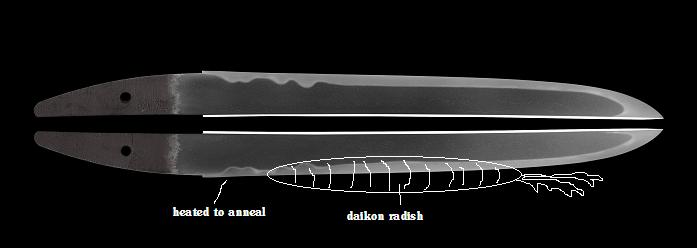
Then the blade is shortened like so,

-
Thomas and Jacques, I believe Chris is saying that many times when a blade is shortened, they anneal a small portion of the hamon, so when the nakago is reshaped by filing, it's easier to file down. He points out that sometimes the edge of the blade was cut into a diakon radish to keep the part of the hamon that they didn't want to anneal unaffected. Something like this, Hopefully this beautiful artwork :D will help explain. I think we're all in agreement that there is no retemper here.

-
Lance, an interesting note: the ubu tanto you posted has a nagasa around 26 cm, while the suriage one I posted is around 28 cm. Not that it neccesarily means anything, but the one I posted must have been a fair amount bigger, to still be bigger even after suriage. Edit: It looks like the suriage one lost about 4 cm, which would mean it was originally long for a tanto. Mabey it was cut down to fit some used mounts that where too small.
-
And no Thomas, I don't own it. Just a sale I ran across online. Thanks again
-
Chris makes a good point. Mabey that has something to do with it. It also could be just from a low spot in the hamon like I first assumed and like Lance suggested, or a mix of the two. But these things still leave me to wonder why it would've been shortened to begin with. That's why I suggested that mabey a low valley reaching the ha in that spot was the reason someone shortened it to that point. Mabey the owner saw it as a flaw and decided to cut it down to remove it. I guess it's impossible to say for sure. BTW nice pic to represent the idea Lance, Thanks to all
-
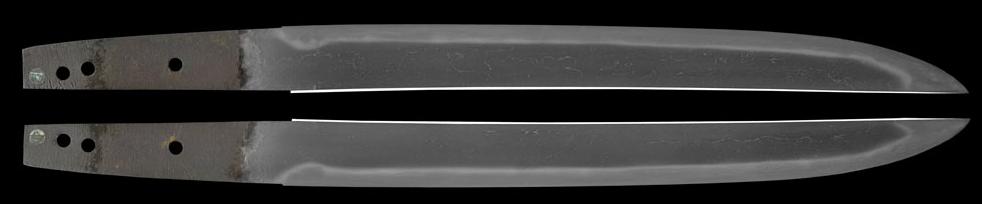
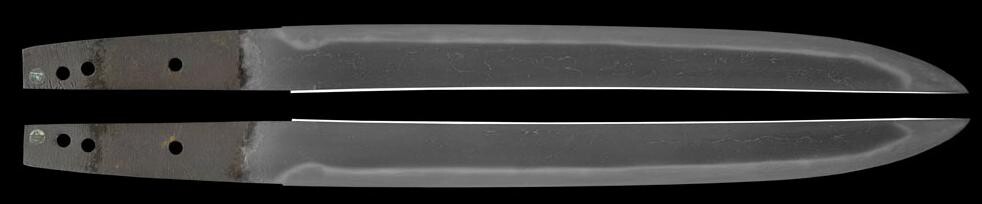
I wondered if somebody cut down this tanto because of the hamon. Yaki-otoshi doesn't seem possible since it's a tanto, and from the Muromachi period. Has anyone seen yaki-otoshi in tanto? Since it's a smith from the Muramasa mon, mabey the spot where the hamon goes off the blade was one of the low valleys this school is known for, and the person who decided to cut it down saw it as a flaw. To me it looks like the hamon was intentionally started at the point where the new machi was eventually made, rather than running into the nakago like it should, being suriage. The only other possible explanation I can think of is saiha, but that doesn't look likely to me. Any thoughts? Am I missing something? http://www.samuraishokai.jp/sword/10602.html
-
Eric, even the most elite historians can only have educated theories on some portions of history... and the earlier and less documented the history, the more difficult it is to narrow down the possible theories until something is universally excepted as fact. Much of writen history is contradictory, and other parts are not documented at all. While we should take the highly educated theories that people like Dr Honma come up with very seriously, we shouldn't automatically consider them to be the absolute unquestionable truth. Even elite historians can't always agree on things like Masamune. Nobody is above being questioned... EVER.
-
"We need to re-examine swords attributed to Masamune from now on and to sort out real Masamune from amongst them." Good luck with that... Researching these things is great as long as we don't loose sight of the reality that most of the truths from the early periods will never be solidly proven or disproven. It's like trying to put together a million piece puzzle to which most of the pieces are missing or broken. We can't force the pieces to fit or make up new pieces, and try to pass it off as history.
-
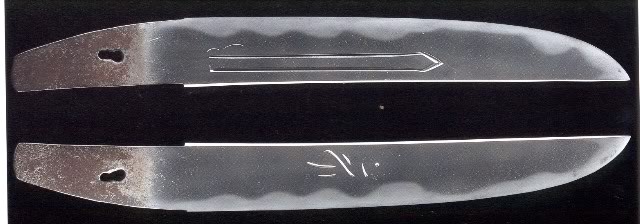
Here's the other 2 Hocho Masamune's... I wonder which one Nakahara was talking about... I would guess the one at the bottom
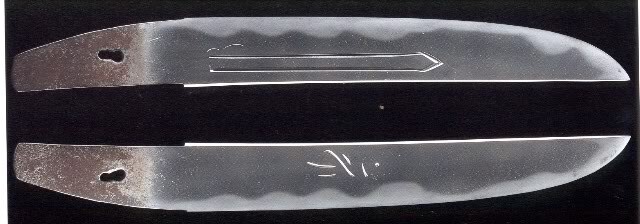
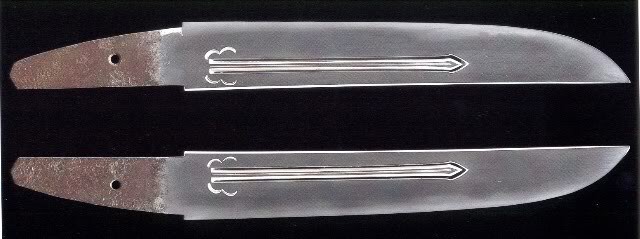
-
Interesting point about the torii, Keith... I never thought about it that way. It would only really apply with tachi, since the katana and wakizashi would be edge up. Which brings me to ask, what if you're displaying a tachi with a wakizashi... first, does anybody do this? I assume you would still follow the tachi edge down, wakizashi edge up rule. I guess the only way it could have the look of the torii is if you were displaying 2 tachi on one stand. Then you could have the shorter one on bottom and it would resemble the torii...
-
As you suspected, the hamon shows a lack of control in places rather than intentional activity.
-
Some help with translation of Mei and info on smith please
runagmc replied to markturner's topic in Nihonto
Hey Mark, Making a firm judgement on the market value of a Japanese sword is very difficult in general, and even more so when trying to do so by pictures. It's commonly said that a sword is worth what someone will pay for it. This is of no help to someone buying a sword, but that's just the way it is. Like Grey said, we don't know what you paid and we don't have the luxury of viewing the sword in hand. With your sword, it doesn't look like it's going to be possible for the forum to give a firm judgement on it's authenticity. In this case, I think you have to assume your sword is gimei until you have a shinsa panel confirm otherwise. That being said, it appears to be a well made Japanese sword that looks to me to be 2 to 4 hundred years old... and personally I would lean more towards the 1600's. The mounts look like good quality as well. I hesitate to even say this, but if I were buying this sword/koshirae, and I was considering it gimei (with the possibility of having the mei removed), I would look for a conservative price around $1500-$2500. That doesn't mean that's what it's worth, that just means that's what it would be worth to me... and I only put my head on the chopping block by saying this to try to relieve some of your frustration. Mabey others will be able to agree or disagree with that price range, and you can use those opinions to help you make a decision.