John A Stuart
-
Posts
8,372 -
Joined
-
Last visited
-
Days Won
20
Content Type
Profiles
Forums
Events
Store
Downloads
Gallery
Everything posted by John A Stuart
-
colours of tsuka-ito
John A Stuart replied to darkness2's topic in General Nihonto Related Discussion
That is the problem with JSTOR it is expensive. You need a friend who has access or an institution that has it. The most restrictive laws were instituted by Ienari, maybe start there. I shall go through my archives but be patient. John -
colours of tsuka-ito
John A Stuart replied to darkness2's topic in General Nihonto Related Discussion
Hi Jon, Try JSTOR, http://links.jstor.org/sici?sici=0073-0548(1964%2F1965)25%3C123%3ASRASIE%3E2.0.CO%3B2-2 http://mailman.lbo-talk.org/2002/2002-November/027850.html Or google 'Tokugawa Sumptuary Laws' You will find the above and plenty more. John -
Hmmmm, I see similarities. Thanks, I will forward. John
-
Information about a Katana. Bishu Osafune Sukemune. 1511.
John A Stuart replied to slavia631's topic in Nihonto
Sukemune was a commonly faked signature even at the time as well as after. John -
Ah ha, so those yamagane tsuba I've seen that look like they've been alloyed with lead are in fact the true examples of yamagane. This means that the tsuba that are attributed as such but look like suaka, with the nice nut brown patinas are wrongly stated such. Clears up a question. The 'All metals are gold...' statement was sort of tongue in cheek, although true for metal poor countries. Thanks guys. John
-
Right on Pete. The thing of it is yamagane and suaka seem to look very similar when a good patina established. I think some fittings may be mislabeled because of this. That kin or kane character is interesting as to how it is used. Kinzoku being metal uses it, but hagane (steel) and kogane (gold) seem to use the character for gold as a short form for metal. Kogane, yellow metal is the term for gold rather than just kane, gold. All metals are gold so to speak. John
-
Hi All, I thought I knew the difference once upon a time but am questioning myself now. Tell me if I'm right or not. The difference between yamagane and suaka is that yamagane is copper found in the raw metallic state and is used without smelting so that the natural impurities are part of its character, while suaka is copper smelted from ore. A funny aside, yamagane; is the kanji roots from mountain metal (gane) or mountain gold (kane) ? John
-
Hi All, On another forum someone has asked for info concerning a certificate issued by 'Token Kenkyuren Kyokai'. It seems I've seen this before but can not recall where or the group it comes from. Any info??? John

-
Books that you would recommend on collecting Tsuba's
John A Stuart replied to Dino's topic in Tosogu
Well, Being interested in blades before fittings I am partial to iron tsuba, but lately am really appreciating some suaka fittings I have acquired. I like kinko but the lustre is dimming. My best all round reference is Tsuba Kanshoki but when you focus on a specific type or group you never have enough. Of course any good index is the most go to reference and totally invaluable. I sometimes wonder if I am a collector of arms or a book collector. :lol: John -
Just a quick question... Is this even real?
John A Stuart replied to USMC-LCPL's topic in Translation Assistance
Hi Loren, I understand your frustration but after a tiome you will get more accustomed to the kanji connected with nihonto. Romanji would not make the language comprehensible since there are so many homophones that have completely different meanings. Even using kana you need to be aware of context to decipher the meanings. John -
Books that you would recommend on collecting Tsuba's
John A Stuart replied to Dino's topic in Tosogu
Great to see you on-board Michael. John -
Stephen, Yesterday I got an elders discount on my groceries. Scared the heck out of me. Old shoes are like good friends, comfortable and they do not rub you the wrong way. :lol: John
-
Yes, John. Generalisations can be misinformative, I think, sometimes. As well, I dislike statements that are premised with ' a great master, an expert, etc. says'. Too ambiguous. Better to name the person from whom the statement came. John
-
Hi All, Finally I have got my new up-link installed and may now join in again. My question for comment is a reprint of "TSUBA" by R.B. Caldwell in JSSUS newsletter, Dec 2007. In that article is 'A great master said, " If it doesn't have a seppadai it isn't a tsuba". Now, I know that some tsuba during the Meijijidai and onwards were without seppadai and have metalwork in that area that would preclude their use mounted on a sword, but, many tsuba previously show no defined seppadai and were made to be mounted. This statement seems, to me, to be fallacious or is there something I have missed? John
-
Piers, Do you think it is done to clear the barrel or is it one of those traditions that just hung on? John
-
Hi Todd, The most common method to remove debris is called chiburi, This is a quick sweep of the sword with a sudden stop to 'fling', as Brian says, the debris off the blade. Prior to noto, as well, one takes the washi that is within the fold of the front of kimono to wipe the blade. Most kata have this formalised as part of the technique. When you see the washi in most movies peeking out from the kimono that is it's purpose. John
-
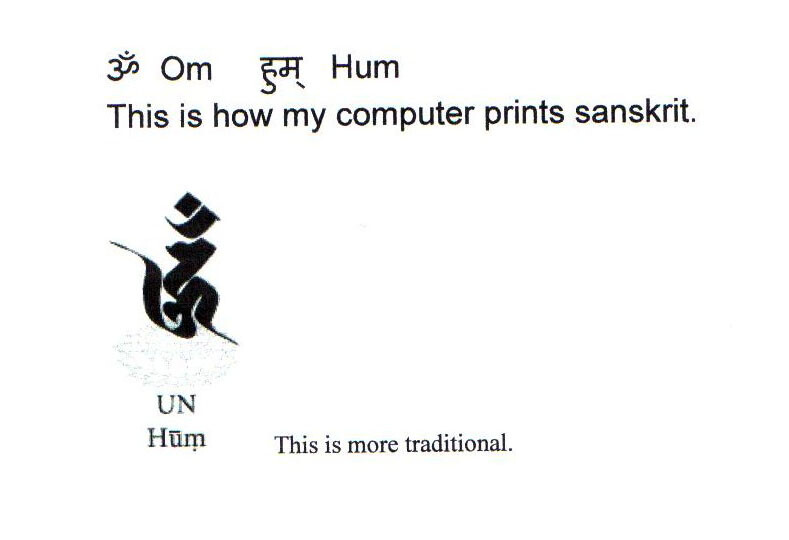
Hi, The mantra 'On akishubiya un' starts with the sound om or aum, and ends with hum sound. This is to Ashuka Nyorai. The sanskrit for 'hum' is what is on the tsuba. I can't put sanskrit in text, but here is a scan of a page I printed.
-
Hi Andreas, Again there is no hard fast rule. My tsuba for shoto consistently run under 7 cm along any axis. Those you picture seem awfully large, some dimensions over 8 cm, to be classified as not daito tsuba. Perhaps others can add their voices on this. John Oh, I forgot to add. The nakagoana of 2.87 cm would fit swords of daito size. J
-
Hi Andreas, You say no mimi which is a rim on the outside of the tsuba, ears. I guess you mean no hitsuana. Most small swords have an accompanying tousogu but no rule. I think this tsuba is totally unsuitable for a shoto, but it is your taste and up to you. It has to do with the aesthetic balance in daisho as well as effect. Most people who practice iaido find wearing daisho for the first time after practice with only the daito quite a change and can require adjustment of technique. I find the smaller the profile the shoto has the easier to adjust. Again, a matter of taste. John
-
Hey Pete, I saw that at the playboy mansion the last time Hef invited me over. :lol: John
-
Hi Jean, I have watched this sellers auctions for some time. He sells so so swords with a good one now and then. He seems to keep most happy. Most times papers are pictured. John
-
Ford brings up a good point in that this koshirae was made for display only, with the nakago being exposed like that. What does the other side look like? Does it have a shinogi there too? John If this was ever sankozuka mounted the nakago would cause difficulties, wouldn't it? Without that type of mounting, does it no longer become a shrine sword but a functional otanto or kowakizashi?
-
The fact that this sword has sori in the nakago does not bother me at all. There were many swords produced that had this feature although they were not ken but tachi. In this case it actually goes to prove tnat it was never a yari, as if that shape of nakago did not already illustrate that point. I am interested in the balance of it. That type of kissaki would pull the centre of balance forward giving more momentum to a slashing strike than another short sword of equal length. As to why there is so much difference in the two sides at the machi may have to do with function when in koshirae, but ????? John
-
Relationship between Daimyo and Katana-kaji, Takumi?
John A Stuart replied to Bugyotsuji's topic in Nihonto
Although I have heard no stories about specific daimyo forging their own swords, it is not beyond possibility. Gotoba forged his own swords, Goshoyaki, so why not? I shall look for more data, never thought about this before. John -
Thankyou, I'll have to check it out. The price is certainly reasonable. The Minoto Taikan cost me over $700. John